


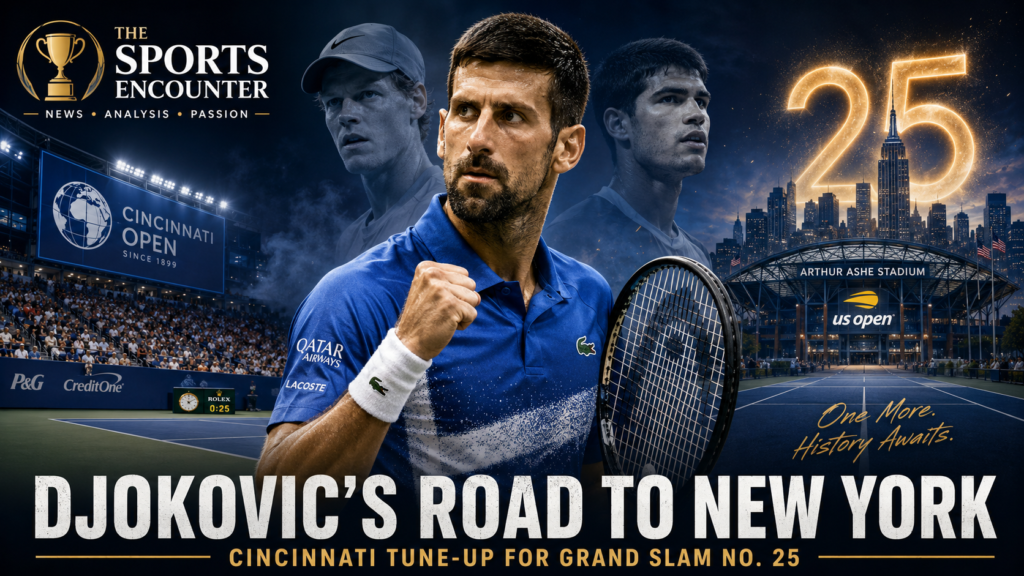
Novak Djokovic will return to the Cincinnati Open for the first time since his unforgettable 2023 title run. At 39, the tournament offers more than preparation for the US Open. It will test whether he can build enough match sharpness to challenge Jannik Sinner and Carlos Alcaraz without exhausting the body carrying his pursuit of a record 25th Grand Slam title.
Novak Djokovic knows exactly what Cincinnati can provide before the US Open.
Three years ago, he survived one of the most punishing ATP Masters 1000 finals ever played, defeating Carlos Alcaraz after three hours and 49 minutes in oppressive heat. Djokovic left Ohio with a trophy, a sharper competitive edge, and the confidence that his body could still withstand the sport’s most demanding young challenger.
He then traveled to New York and won the 2023 US Open.
Djokovic returns to Cincinnati in August 2026 carrying the same ultimate objective, but almost everything around him has changed. He is now 39. Jannik Sinner and Alcaraz have taken control of the men’s game. Physical recovery takes longer, tournament scheduling requires greater caution, and Djokovic has openly admitted that the difficult weeks of training and pain before major events have become harder to enjoy.
The Cincinnati Open will therefore serve as a carefully managed experiment.
Djokovic needs competitive matches before the US Open, which begins its singles main draw on August 30. He also needs to avoid the kind of physical burden that could leave him depleted during the second week in New York.
That balance may shape his final realistic attempt to move beyond Margaret Court and become the first singles player in tennis history to win 25 Grand Slam titles.
For continuing coverage of the men’s tour, Grand Slam races, and the biggest stories around the sport, readers can follow The Sports Encounter’s Tennis Hub.
Novak Djokovic’s US Open Preparation at a Glance
| Category | Detail |
|---|---|
| Player | Novak Djokovic |
| Age | 39 |
| Current major titles | 24 |
| US Open titles | Four |
| Cincinnati titles | Three |
| Last Cincinnati appearance | 2023 champion |
| 2026 Cincinnati Open dates | August 8-23, with the main ATP field beginning after qualifying |
| 2026 US Open dates | August 23-September 13, with the singles main draw beginning August 30 |
| 2026 Australian Open result | Finalist |
| 2026 Wimbledon result | Semifinalist |
| Wimbledon semifinal loss | Jannik Sinner won 6-4, 6-4, 6-4 |
| Main objective | Build match sharpness without compromising physical recovery |
Cincinnati Is About Finding the Right Amount of Tennis
Most players enter a Masters 1000 tournament trying to win every available match.
Djokovic’s priorities are more complicated.
A deep run would provide confidence, ranking points, and repeated exposure to the conditions he will face in New York. Hard courts demand explosive movement, reliable serving, disciplined return positioning, and the ability to absorb pace from younger opponents.
Too many long matches could create a different problem.
Djokovic no longer needs proof that he can win Cincinnati. He completed the career Golden Masters there in 2018, added another title in 2020, and defeated Alcaraz in the celebrated 2023 final. The value of his 2026 appearance will depend less on whether he lifts another trophy and more on how his body responds from one match to the next.
His ideal week may involve several competitive victories, at least one match against an elite opponent, and enough recovery time before traveling to New York.
A title would strengthen his belief that another major remains within reach. A physically expensive final could leave his team asking whether the price was too high.
Djokovic and his coaches must monitor more than the scoreboard. His movement after wide defensive runs, recovery between matches, serve speed, shoulder response, leg strength, and energy during extended rallies may provide the clearest evidence of his US Open readiness.
Why Djokovic Skipped Montreal Before Committing to Cincinnati
Djokovic withdrew from the 2026 National Bank Open in Montreal, giving himself a longer recovery period after Wimbledon.
That choice fits the selective scheduling strategy that has defined the later stage of his career. He no longer measures success through the number of tournaments played. His season revolves around arriving at Grand Slams healthy enough to survive seven best-of-five matches.
The Sports Encounter previously examined why Djokovic and Sinner skipped Montreal before the US Open. Their decisions reflected a wider tension across modern tennis. Masters 1000 events carry prestige and major ranking points, yet players who repeatedly reach the second week of Grand Slams need longer periods for recovery.
Djokovic’s calculation differs from Sinner’s because of age.
Sinner is 24 and operating at the physical peak of his career. Djokovic has accumulated more than two decades of professional mileage, thousands of competitive sets, and the repeated strain of playing deep into the sport’s most important tournaments.
Skipping Montreal gave Djokovic additional time to recover from Wimbledon, rebuild his conditioning, and prepare for the North American hard-court environment.
Choosing Cincinnati suggests he and his team believe at least one competitive tournament remains necessary before New York.
The Lesson From Djokovic’s 2026 Grand Slam Campaigns
Djokovic has already shown in 2026 that he can challenge for major titles without playing a warm-up tournament.
He entered the Australian Open without a competitive preparation event and reached the final. He followed a similarly limited schedule before Wimbledon and advanced to the semifinals.
Those results would represent an outstanding season for almost any player. Djokovic judges himself against a different standard.
He said after Wimbledon that reaching the later rounds was good, but not good enough. His career has conditioned him to measure success through trophies rather than respectable finishes.
That statement explains why Cincinnati matters.
Djokovic has proved that he can navigate early Grand Slam rounds through experience, serving quality, return intelligence, and superior match management. The problem emerges when he meets Sinner or Alcaraz late in the tournament.
Those matches demand immediate physical intensity. Djokovic cannot spend several sets discovering his timing or adapting to the speed of the court. The younger champions attack from the opening games and apply pressure through pace, movement, and sustained depth.
Cincinnati can help Djokovic reach that level before the US Open begins.
Sinner’s Wimbledon Victory Exposed the Margin Djokovic Must Recover
Jannik Sinner defeated Djokovic 6-4, 6-4, 6-4 in the 2026 Wimbledon semifinals.
The score told a clear story. Djokovic remained competitive, but Sinner controlled the moments that determined each set. The Italian protected his serve, attacked Djokovic’s second delivery, and prevented the match from becoming emotionally or tactically complicated.
The Sports Encounter’s review of Sinner’s complete Wimbledon 2026 title defense showed how effectively the world No. 1 handled Djokovic before defeating Alexander Zverev in the final.
Djokovic could not consistently move Sinner away from his preferred baseline positions. His changes of direction created some openings, but the younger player recovered quickly and kept the Serbian under pressure.
That matchup revealed the current challenge.
Djokovic still possesses the tactical knowledge to understand what Sinner is doing. Executing the necessary response for three, four, or five sets has become far harder.
Cincinnati can help him measure whether his hard-court movement and ball speed have improved since Wimbledon. The quicker surface should make his return game and redirected backhand more influential. It should also reward a stronger first serve and allow him to shorten rallies more effectively than he could on slower courts.
Djokovic Needs More Free Points on Serve
The serve may become the most important shot in Djokovic’s US Open preparation.
He built much of his career around returning better than anyone in the sport, extending rallies, and forcing opponents to play an extra ball. At 39, conserving energy has become equally important.
A high first-serve percentage would reduce the physical cost of his service games. More aces and unreturned serves would help him avoid repeated neutral rallies against players who can match his baseline quality.
Location matters as much as speed.
Djokovic needs to use the wide serve to open the court, attack the body to restrict return swings, and find the center line when opponents begin leaning toward the outside corners.
His second serve will face even greater scrutiny. Sinner and Alcaraz step inside the baseline, take the ball early, and turn moderate second serves into immediate attacking opportunities.
If Djokovic protects that delivery in Cincinnati, his chances of staying close to the younger leaders will improve. Repeated pressure behind the second serve would remain a warning sign before New York.
The Return of Serve Can Still Change the Balance
Djokovic’s return remains the area where age has taken the least away from his game.
His anticipation, balance, racket control, and ability to read serving patterns continue to produce opportunities that most players cannot create. He blocks powerful first serves deep, attacks weaker second deliveries, and forces opponents to hit uncomfortable first shots after serving.
Cincinnati’s fast hard courts will test whether his reactions remain sharp enough against the tour’s biggest servers.
Strong returning could also shorten matches. Early breaks allow Djokovic to control sets without spending excessive energy in tiebreaks or extended service battles.
The best version of his US Open preparation would include matches in which he establishes pressure immediately, converts break points efficiently, and avoids unnecessary physical drama.
The 2023 Cincinnati final demonstrated his ability to survive an epic contest. The 2026 version of Djokovic may benefit more from avoiding one.
The Alcaraz Question Still Shapes Djokovic’s Record Chase
Carlos Alcaraz and Sinner have shared 10 of the last 11 Grand Slam titles entering the 2026 US Open period.
Their control of the majors has forced Djokovic into an unfamiliar position. For most of his career, younger challengers had to break through the established dominance of Djokovic, Roger Federer, and Rafael Nadal.
Djokovic now stands as the veteran trying to interrupt a rivalry that has become the sport’s new center of power.
Alcaraz presents a different problem from Sinner.
Sinner applies sustained pressure through clean, repeatable pace. Alcaraz changes the geometry of the court. He uses drop shots, explosive forehands, sudden net attacks, defensive speed, and emotional momentum to prevent opponents from settling into predictable patterns.
Djokovic’s 2023 Cincinnati victory over Alcaraz remains relevant because it showed how he can solve those variations. He absorbed the early pressure, managed the heat, changed his return position, and gradually turned the match into a physical and psychological struggle.
Three years later, repeating that formula over nearly four hours would carry greater physical risk.
Djokovic needs a more economical path. A stronger serve, shorter return games, and earlier aggression may offer a better chance than attempting to outlast Alcaraz through prolonged exchanges.
What Djokovic’s 2023 Cincinnati Run Can Still Teach Him
The 2023 Cincinnati title carries emotional importance, but Djokovic cannot simply recreate the same approach.
That victory showed several qualities that remain essential:
- He refused to panic after falling behind.
- He adjusted his return position as the match developed.
- He used his backhand to redirect Alcaraz’s forehand pace.
- He remained emotionally engaged despite severe physical discomfort.
- He found his best serving when the match reached its most important stages.
The deeper lesson concerns competitive exposure.
Djokovic left Cincinnati knowing that he could handle the intensity of the leading young player. That confidence traveled with him to New York, where he won his fourth US Open title.
His 2026 preparation requires a similar form of evidence. He needs to feel his timing hold under pressure and see his body recover normally after difficult matches.
A competitive meeting with Sinner, Alcaraz, Alexander Zverev, Taylor Fritz, or another leading hard-court player could tell him more than several comfortable early-round victories.
How Cincinnati’s Expanded Format Changes the Risk
The Cincinnati Open now occupies a larger space in the calendar than the traditional one-week Masters event Djokovic won in 2023.
The expanded structure gives players more recovery time between some rounds, but it also extends the overall tournament window. A finalist may spend close to two weeks inside the event environment before traveling to New York.
That format creates advantages and risks for Djokovic.
Rest days can help him recover between matches. The longer stay also provides access to training courts, treatment, and repeated practice under competitive conditions.
However, tournament life remains physically and mentally demanding even on days without matches. Players train, complete recovery sessions, attend media obligations, and remain inside a structured routine.
Djokovic’s team must decide how much practice he needs between rounds. Extra hitting can improve rhythm, but it also adds load to his shoulder, back, hips, knees, and legs.
Every session must serve a purpose.
Five Areas Djokovic Must Test in Cincinnati
| Area | What Djokovic Needs to See | Why It Matters in New York |
|---|---|---|
| First serve | High percentage and consistent placement | Creates shorter games and protects energy |
| Second serve | Enough depth and variation to avoid immediate attacks | Sinner and Alcaraz punish weak second deliveries |
| Movement | Explosive first step and stable recovery after wide balls | Hard-court defense places heavy strain on the legs |
| Return game | Early pressure and efficient break-point conversion | Allows Djokovic to control sets without long tiebreak battles |
| Recovery | No major drop in energy or movement after difficult matches | The US Open requires seven rounds across two weeks |
The Physical Preparation May Matter More Than the Result
Djokovic has spoken honestly about the pain involved in preparing for elite competition.
That admission should not be mistaken for a lack of motivation. He continues to enter majors because the competitive thrill still matters to him. The difficult part lies in the weeks of training, treatment, recovery, and physical stress required to give himself a chance.
The Cincinnati Open will show whether that work has produced a body capable of handling New York.
Djokovic’s movement should be assessed late in matches rather than during the opening games. Many experienced players can begin with sharp footwork. Fatigue exposes the real condition of the legs.
His recovery after serving also deserves attention. A slower first step after landing can leave the next shot exposed. Reduced rotation may affect both serve speed and backhand stability.
The ability to slide safely on hard courts will remain another key measure. Djokovic has used controlled sliding throughout his career to defend wide positions and recover toward the center. The technique saves time but places considerable stress on the lower body.
New York May Offer Better Conditions Than Wimbledon
Djokovic’s Wimbledon semifinal defeat raised questions about whether he can still survive the physical demands of seven major rounds.
The US Open presents a different tactical environment.
Hard courts reward his return, backhand direction changes, and ability to redirect pace. The surface also produces a more predictable bounce than grass, giving Djokovic greater confidence when taking the ball early.
Arthur Ashe Stadium has provided some of his greatest triumphs and most painful defeats. He has reached 10 US Open finals and won four titles, including the 2023 championship that tied Court’s record of 24 majors.
The official US Open player profile for Novak Djokovic lists him among the tournament’s leading former champions and confirms his place in the 2026 field.
New York’s heat and humidity create their own dangers. Long daytime matches can drain energy, while night sessions may finish deep into the early morning.
Djokovic’s seeding will also influence the path. A lower position could place him against Sinner or Alcaraz before the final, reducing the possibility that the younger stars eliminate each other.
Does Djokovic Still Have a Realistic Path to Major No. 25?
Yes, although the path has narrowed.
Djokovic reached the Australian Open final and Wimbledon semifinals in 2026. Those results confirm that he remains one of the few players capable of navigating the early and middle stages of a major with consistency.
The Sports Encounter asked whether Djokovic could win another historic title during his pursuit of an eighth Wimbledon crown. The conclusion from London still applies to New York: his tennis remains strong enough, while his physical durability against the best younger players creates the larger doubt.
A favorable draw would help. Djokovic would prefer to avoid repeated five-set matches during the opening week and reach the quarterfinals with minimal physical damage.
Conditions will matter as well. Cooler sessions, predictable scheduling, and efficient victories could preserve his legs for the final weekend.
He may also need one of Sinner or Alcaraz to leave the tournament before meeting him. Defeating both across consecutive rounds would demand an extraordinary physical performance.
That does not make the record impossible. Djokovic has spent his career solving challenges that appeared too large.
Why the 25th Major Carries So Much Weight
Djokovic currently shares the all-time singles record of 24 major titles with Margaret Court.
Winning another would give him sole possession of one of tennis’s most visible historical records. It would also strengthen his argument as the most accomplished singles player the sport has produced.
The number has followed him since his 2023 US Open victory.
Every major now becomes a referendum on whether the record will arrive. Each loss creates questions about age, motivation, and the narrowing window available to him.
Djokovic has learned to live with that pressure, but the body does not respond to history. It responds to training load, recovery, movement, sleep, and accumulated fatigue.
Cincinnati represents the practical side of the record chase. The trophy in New York may be the dream, but the work in Ohio will determine whether the dream has a physical foundation.
The Draw Could Change Djokovic’s Cincinnati Strategy
Djokovic’s approach may depend heavily on his path through the Cincinnati field.
Early matches against powerful servers could provide useful return practice without requiring endless baseline exchanges. Opponents who defend well and extend rallies would offer a stronger physical test.
A meeting with Sinner or Alcaraz would provide the clearest competitive measure, although reaching such a match would also increase the workload before the US Open.
Djokovic may face a difficult decision if he reaches the later rounds after several long contests. Continuing to chase the title would support his competitive instincts. Protecting his body could better serve the major objective.
He has rarely entered a tournament without wanting to win it. Managing ambition may become as important as managing pain.
Cincinnati Will Reveal Whether Djokovic Can Change Gears Quickly
Grand Slam champions need several levels of tennis.
They require a stable level for early rounds, a stronger version for dangerous seeded opponents, and an elite level for the final weekend.
Djokovic once moved between those gears almost automatically. He could survive difficult openings, adjust during matches, and peak when the trophy came within reach.
At this stage of his career, moving into the highest gear carries a greater physical cost.
Cincinnati will show whether he can still raise his intensity for the decisive points without losing movement and energy afterward. A strong tiebreak, a difficult service hold, or a late break against a top opponent may reveal more than the final tournament result.
What Would Count as a Successful Cincinnati Open?
Success does not require Djokovic to win the title.
A productive tournament would include three or four competitive matches, reliable serving, strong returning, and no physical setback. Reaching the quarterfinals or semifinals while feeling healthy could provide the preparation he needs.
A title would create momentum and reinforce the memory of 2023. It would also increase expectations and potentially add several demanding matches before New York.
An early defeat would not automatically end his US Open hopes. Poor movement, reduced serving power, or visible physical discomfort would create greater concern than the loss itself.
The result must be judged alongside the quality and physical cost of his tennis.
Final Verdict: Cincinnati Is Djokovic’s Most Important Test Before New York
Novak Djokovic’s return to Cincinnati is a calculated attempt to solve the central problem of his 2026 season.
He remains good enough to reach the final stages of Grand Slams. The difficulty lies in arriving there with enough physical strength to defeat Sinner, Alcaraz, or both.
Skipping Montreal protected his recovery after Wimbledon. Playing Cincinnati should restore the match rhythm he lacked when entering earlier majors without a warm-up event.
The decision makes sense, but the margins are narrow.
Djokovic needs enough tennis to sharpen his serve, return, movement, and competitive reactions. He cannot afford a tournament that leaves his body struggling when the US Open begins.
His 2023 Cincinnati title showed that an exhausting triumph could become the foundation for victory in New York. At 39, the wiser preparation may involve gaining the same confidence through fewer hours on court.
Sinner and Alcaraz now control the major landscape. Djokovic’s pursuit of title No. 25 depends on finding one more stretch of tennis in which experience, precision, and belief overcome the physical advantage of youth.
Cincinnati will provide the first serious answer.
Frequently Asked Questions
Is Novak Djokovic playing at the 2026 Cincinnati Open?
Yes. Djokovic has confirmed his return to the Cincinnati Open for the first time since winning the tournament in 2023.
Why is Djokovic playing Cincinnati before the US Open?
Djokovic wants competitive hard-court matches before the US Open. Cincinnati will help him test his serve, return, movement, fitness, and recovery against a strong Masters 1000 field.
When does the 2026 Cincinnati Open take place?
The full Cincinnati Open runs from August 8 to August 23, 2026, including community events, qualifying, and the expanded main tournament schedule.
When does the 2026 US Open begin?
The wider US Open schedule begins on August 23, while the singles main draw starts on August 30 and runs through September 13.
How many times has Djokovic won the Cincinnati Open?
Djokovic has won Cincinnati three times, taking the title in 2018, 2020, and 2023.
What happened in the 2023 Cincinnati final?
Djokovic defeated Carlos Alcaraz in a three-set final lasting three hours and 49 minutes. He later carried that momentum into New York and won the 2023 US Open.
How many US Open titles has Djokovic won?
Djokovic has won four US Open men’s singles titles.
How did Djokovic perform at the 2026 Australian Open and Wimbledon?
He reached the Australian Open final and the Wimbledon semifinals. Jannik Sinner defeated him 6-4, 6-4, 6-4 at Wimbledon.
What record is Djokovic chasing?
Djokovic is pursuing his 25th Grand Slam singles title. A victory would move him beyond Margaret Court and give him sole possession of the all-time singles record.
Who are Djokovic’s biggest US Open rivals?
Jannik Sinner and Carlos Alcaraz remain the leading obstacles. The pair have shared 10 of the last 11 men’s Grand Slam titles entering the 2026 US Open period.
Does Djokovic need to win Cincinnati to contend at the US Open?
No. His main objective is to gain match sharpness while remaining healthy. Several competitive matches without a physical setback could represent better preparation than a draining title run.