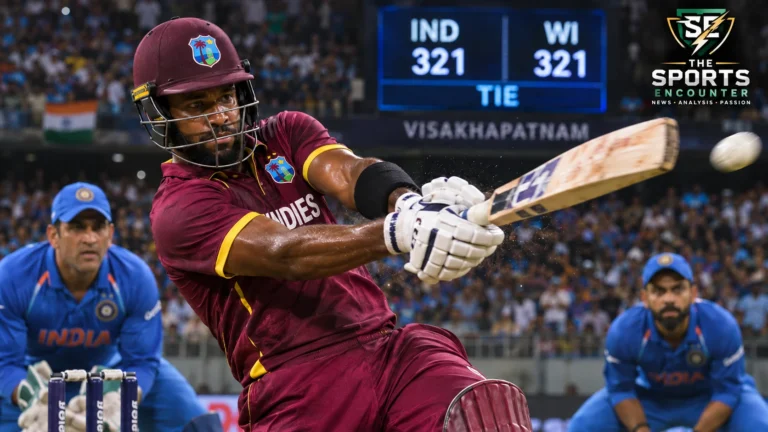
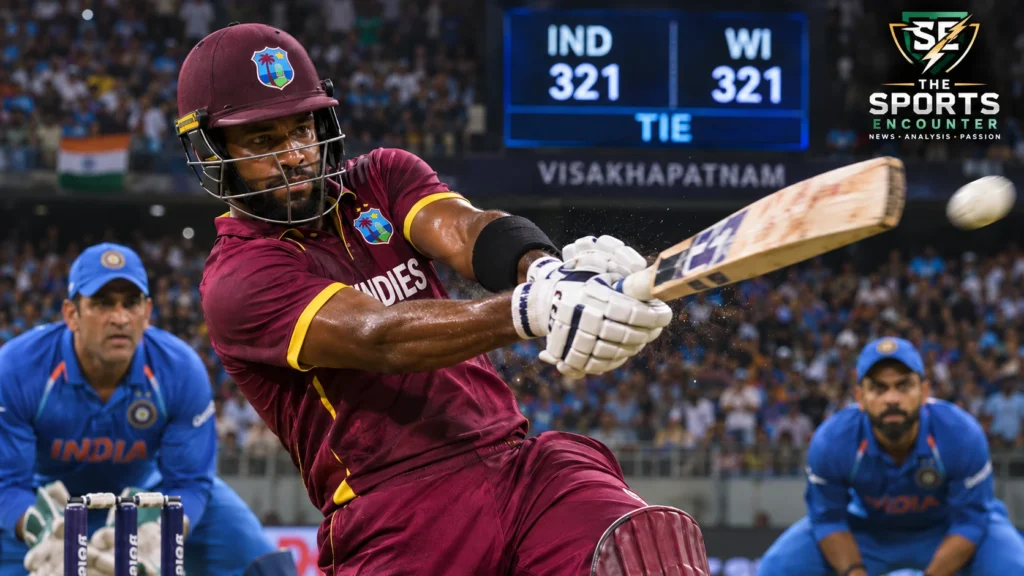
VISAKHAPATNAM, India, October 24, 2018: Virat Kohli had reached 10,000 ODI runs faster than anyone in cricket history, scored an unbeaten 157 and guided India to 321/6. With one delivery remaining in West Indies’ chase, the hosts were still five runs ahead. Umesh Yadav had the ball, and India stood one successful delivery away from celebrating a victory worthy of Kohli’s extraordinary milestone.
Shai Hope had other plans. The West Indies wicketkeeper-batter drove the final delivery toward the off-side boundary, collecting four runs to level the scores at 321. India had not lost, but its remarkable captain had been denied the victory that appeared certain only moments earlier. Hope finished unbeaten on 123 from 134 balls, completing one of the most memorable last-ball escapes in ODI cricket.
Key Takeaways
- Virat Kohli had reached 10,000 ODI runs faster than anyone in cricket history, scored an unbeaten 157 and guided India to 321/6.
- Kohli entered the match needing 81 runs to reach 10,000 in One-Day Internationals.
- West Indies’ most effective bowler was off-spinner Ashley Nurse.
- India reached 222/4 in the 41st over when McCoy bowled MS Dhoni for 20.
The encounter earns Match 79 status in The Sports Encounter’s A Celebration of 5000 ODIs, a collection revisiting 100 extraordinary men’s One-Day Internationals.
Story at a glance
India vs West Indies 2018: Match Summary and Result
India entered the second ODI after winning the opening fixture at Guwahati by eight wickets.
Virat Kohli’s 157* Turns a Personal Milestone Into a Match-Winning Total
Kohli entered the match needing 81 runs to reach 10,000 in One-Day Internationals.
Ambati Rayudu’s 73 Provides the Partnership India Needed
Ambati Rayudu played an essential supporting role after India’s early setbacks.
Ashley Nurse’s 2/46 Prevents India From Taking Complete Control
West Indies’ most effective bowler was off-spinner Ashley Nurse.
India’s Final Ten Overs Turn a Competitive Score Into 321/6
India reached 222/4 in the 41st over when McCoy bowled MS Dhoni for 20.
Three performances made this match exceptional. Kohli achieved a historic batting milestone, Shimron Hetmyer produced a devastating counterattack of 94 from 64 balls, and Hope ensured West Indies matched India’s total despite losing seven wickets.
The most revealing feature of the contest was how each team appeared to have secured the advantage, only to watch it disappear.
India vs West Indies 2018: Match Summary and Result
| Match detail | Information |
|---|---|
| Fixture | India vs West Indies, second ODI |
| Date | October 24, 2018 |
| Venue | Dr. Y.S. Rajasekhara Reddy ACA-VDCA Cricket Stadium, Visakhapatnam |
| Series | West Indies tour of India, 2018 |
| Toss | India won and elected to bat |
| India | 321/6 in 50 overs |
| West Indies | 321/7 in 50 overs |
| Result | Match tied |
| Player of the Match | Virat Kohli |
| India’s leading batter | Virat Kohli, 157* |
| West Indies’ leading batter | Shai Hope, 123* |
| Other standout batter | Shimron Hetmyer, 94 |
| Best India bowling | Kuldeep Yadav, 3/67 |
| Best West Indies bowling | Ashley Nurse, 2/46 |
| Series position | India led 1-0 |
India entered the second ODI after winning the opening fixture at Guwahati by eight wickets.
West Indies had scored 322/8 in that match, but Kohli’s 140 and Rohit Sharma’s unbeaten 152 enabled India to reach the target with 47 balls remaining.
Visakhapatnam presented another demanding batting contest.
Yet the second ODI produced a very different result.
This time, West Indies possessed enough discipline and late-order resilience to prevent India from completing another successful defense or chase.
Virat Kohli’s 157* Turns a Personal Milestone Into a Match-Winning Total
Kohli entered the match needing 81 runs to reach 10,000 in One-Day Internationals.
The India captain had been scoring with extraordinary consistency, making the milestone appear increasingly inevitable.
India won the toss and chose to bat.
However, West Indies made a positive start.
Kemar Roach removed Rohit Sharma for four when Shimron Hetmyer completed a catch at point.
India were 15/1.
Shikhar Dhawan scored 29 from 30 deliveries before Ashley Nurse trapped him lbw.
The score was 40/2 after 8.4 overs.
Kohli now faced the task of rebuilding the innings while approaching an important career landmark.
He responded with another commanding display of ODI batting.
The right-hander combined disciplined placement with controlled aggression, building his innings around partnerships rather than attacking indiscriminately.
He eventually finished unbeaten on 157 from 129 deliveries, striking 13 fours and four sixes.
His strike rate of 121.71 helped India accelerate despite losing wickets through the middle and late overs.
More importantly, Kohli remained at the crease throughout the period when India moved from a vulnerable early position to a substantial final total.
Kohli Becomes the Fastest Batter to 10,000 ODI Runs
When Kohli reached 81, he became the fastest batter to score 10,000 runs in men’s ODI cricket.
He achieved the milestone in his 205th innings.
Sachin Tendulkar had previously held the record, reaching the landmark in 259 innings.
Kohli therefore completed the achievement 54 innings faster.
The significance extended beyond the raw run total.
Ten thousand ODI runs had historically represented sustained excellence across many years.
Kohli reached the landmark through a combination of remarkable consistency, rapid scoring and the ability to produce substantial innings under pressure.
His unbeaten 157 also represented his 37th ODI century.
That performance would ordinarily have dominated the match’s entire narrative.
Instead, West Indies produced a response that ensured the contest would be remembered for two exceptional centuries.
Ambati Rayudu’s 73 Provides the Partnership India Needed
Ambati Rayudu played an essential supporting role after India’s early setbacks.
He scored 73 from 80 deliveries, striking eight boundaries.
Rayudu joined Kohli with India at 40/2.
The pair added 139 runs for the third wicket, taking India to 179/3.
Their partnership was particularly important because West Indies had removed both openers relatively early.
Rather than attempting an immediate counterattack, Rayudu concentrated on building a substantial innings while Kohli controlled the scoring.
The partnership also prevented West Indies from exposing India’s middle order during the first half of the innings.
Nurse eventually bowled Rayudu in the 33rd over.
India were 179/3 after 32.2 overs.
The dismissal ended India’s largest partnership, but the platform for a competitive total had been established.
Rayudu’s innings deserves recognition because it gave Kohli the freedom to accelerate later.
Without that stability, India might have been forced to prioritize survival over scoring.
Ashley Nurse’s 2/46 Prevents India From Taking Complete Control
West Indies’ most effective bowler was off-spinner Ashley Nurse.
He claimed 2/46 from ten overs, maintaining an economy rate of 4.60.
His wickets were Dhawan and Rayudu.
Both dismissals interrupted important phases of India’s innings.
Dhawan’s wicket reduced India to 40/2.
Rayudu’s dismissal ended the 139-run third-wicket partnership.
Nurse was also among the few West Indies bowlers to maintain control when Kohli was established.
Devendra Bishoo supported him with an economical spell of 0/48 from ten overs.
Together, the two spinners conceded 94 runs from 20 overs.
That represented an important contrast with the seam attack.
Roach conceded 67 runs, debutant Obed McCoy went for 71, and captain Jason Holder conceded 50 from six overs.
West Indies had created early opportunities, but it struggled to restrict India’s acceleration during the final ten overs.
Kohli’s unbeaten innings ultimately lifted the hosts to 321/6.
The visitors needed 322 to win.
India’s Final Ten Overs Turn a Competitive Score Into 321/6
India reached 222/4 in the 41st over when McCoy bowled MS Dhoni for 20.
At that stage, India had a useful total but still needed a strong finish.
Kohli supplied it.
He attacked with increasing freedom, taking advantage of gaps in the field and punishing deliveries that missed their intended length.
Rishabh Pant contributed 17 from 13 balls.
Ravindra Jadeja added 13 from 14.
Neither innings was substantial, but both players helped Kohli maintain momentum.
India added 99 runs after Dhoni’s dismissal, finishing at 321/6.
The final total appeared formidable, particularly given the experience of India’s bowling attack.
Kuldeep Yadav, Yuzvendra Chahal and Jadeja offered different spin options, while Mohammed Shami and Umesh Yadav provided seam bowling.
India had reasons to believe the total would be enough.
West Indies, however, had already demonstrated its ability to score more than 300 in the opening ODI.
That made the chase a genuine contest rather than an improbable ambition.
Shai Hope’s 123* Anchors West Indies’ Chase
West Indies began its reply with attacking intent.
Kieran Powell scored 18 from 20 balls before Shami dismissed him.
Chandrapaul Hemraj contributed 32 from 24 deliveries, striking six boundaries.
Kuldeep bowled Hemraj with the score at 64.
Marlon Samuels then made 13 from ten balls before Kuldeep removed him.
West Indies were 78/3 after 12 overs.
The required target was still substantial, but the visitors had maintained an aggressive scoring rate.
Hope now needed a partnership.
He found the ideal collaborator in Shimron Hetmyer.
While Hetmyer attacked the bowling, Hope concentrated on building an innings capable of lasting through the chase.
His approach was measured without becoming excessively defensive.
He rotated the strike, collected boundaries when opportunities appeared and managed the changing requirements as wickets fell.
The wicketkeeper-batter eventually finished unbeaten on 123 from 134 deliveries.
His innings contained ten fours and three sixes.
The strike rate of 91.79 was lower than those of Kohli and Hetmyer, but the circumstances required a different approach.
Hope had to preserve wickets while ensuring West Indies remained close enough to challenge during the final overs.
His contribution ultimately proved decisive.
Shimron Hetmyer’s 94 From 64 Balls Changes the Match
Hetmyer produced the most aggressive major innings of the contest.
He scored 94 from 64 deliveries, striking four fours and seven sixes.
His strike rate of 146.88 transformed the chase after West Indies had lost three wickets.
The left-hander attacked India’s spinners, particularly Chahal.
During the 26th over, he struck Chahal for 16 runs across three deliveries.
His willingness to target the boundary allowed West Indies to stay ahead of the required scoring rate.
Hope and Hetmyer added 143 runs for the fourth wicket.
The partnership took West Indies from 78/3 to 221/4.
It was the decisive acceleration of the chase.
At that stage, West Indies needed 101 runs with six wickets remaining and more than 18 overs available.
Victory was firmly within reach.
Hetmyer then made the mistake that changed the contest.
Chahal delivered a ball that offered a scoring opportunity.
Hetmyer attempted another powerful shot toward the leg side, but Kohli completed the catch near the deep midwicket boundary.
The dismissal left Hetmyer six runs short of a century.
It also removed the batter most capable of finishing the chase quickly.
Why the Hope-Hetmyer Partnership Mattered
| Measure | Performance |
|---|---|
| Partnership | 143 runs |
| Starting score | 78/3 |
| Ending score | 221/4 |
| Hetmyer’s contribution | 94 from 64 balls |
| Hope’s final contribution | 123* from 134 balls |
| Target | 322 |
| Runs required after Hetmyer’s dismissal | 101 |
The partnership demonstrated how differently the two players approached the same challenge.
Hetmyer supplied the scoring acceleration.
Hope provided continuity.
Their contrasting methods briefly placed West Indies in control.
However, the loss of Hetmyer altered the balance.
India’s bowlers could now concentrate on restricting the established Hope while attacking the remaining middle-order batters.
Kuldeep Yadav’s 3/67 Keeps India in the Contest
Kuldeep Yadav was India’s leading wicket-taker.
He claimed 3/67 from ten overs.
His first wicket came when he bowled Hemraj for 32.
He then removed Samuels for 13, reducing West Indies to 78/3.
Both wickets helped India interrupt a rapid start.
Kuldeep later dismissed Rovman Powell for 18, preventing another partnership from developing.
However, his economy rate of 6.70 reflected the difficulty India’s spinners faced against Hetmyer’s aggressive approach.
The wrist-spinner continued attacking despite being targeted.
His wickets were important, but they did not completely stop the chase.
Chahal finished with 1/63 from ten overs.
His dismissal of Hetmyer was arguably India’s most significant breakthrough.
Jadeja conceded 49 from ten overs without taking a wicket.
Together, India’s three spinners produced four wickets, but the established West Indies batters still found enough scoring opportunities to remain competitive.
Jason Holder’s Run Out Reopens the Contest
After Hetmyer’s dismissal, West Indies lost momentum.
Rovman Powell departed for 18 with the score at 253/5.
Captain Jason Holder then joined Hope.
Holder scored 12 from 23 deliveries.
His main responsibility was to support the established batter and prevent another collapse.
The pair added 47 runs for the sixth wicket.
However, West Indies’ scoring rate declined.
With three overs remaining, the visitors needed 22 runs.
Chahal delivered an economical 48th over, conceding only two runs.
The over also contained Holder’s run out.
West Indies slipped to 300/6.
The target was now 22 runs away, and only 12 deliveries remained.
Hope was still at the crease, but the equation had become much more difficult.
Mohammed Shami’s Penultimate Over Puts India Within Touching Distance
Shami delivered the 49th over.
The fast bowler varied his pace and length effectively, preventing Hope and Ashley Nurse from accessing the boundaries they needed.
The over yielded only six runs.
West Indies reached 308/6 after 49 overs.
Fourteen runs were required from the final six balls.
India now appeared to hold the advantage.
Its captain had scored an unbeaten 157.
Its bowlers had recovered from the pressure created by Hetmyer.
The visitors had lost several wickets while the required rate increased.
Kohli entrusted the final over to Umesh Yadav.
The stage was set for another important Indian victory.
The Final Over: How Shai Hope Denied India Victory
West Indies needed 14 runs from six deliveries.
Hope and Nurse were at the crease.
Umesh began with a yorker that allowed Hope to take one run.
Nurse then attempted to attack the second delivery.
The ball went toward his pads and produced four leg-byes, reducing the required runs.
The next ball brought another wicket.
Nurse attempted a ramp shot but was caught by Rayudu.
Crucially, the batters had crossed, bringing Hope back onto strike.
West Indies now needed seven runs from two deliveries.
Hope responded by taking two runs from the fifth ball.
The equation was five from one.
India needed only to prevent a boundary.
Umesh delivered full and wide outside off stump.
Hope drove the ball toward the off side.
It passed the fielder and reached the boundary.
West Indies finished at 321/7.
The match was tied.
Neither team could claim victory, but the visitors had produced an extraordinary escape after falling behind during the closing overs.
Final-Over Score Progression
| Delivery | Event | Runs remaining |
|---|---|---|
| Before 50th over | West Indies 308/6 | 14 |
| 49.1 | Hope takes a single | 13 |
| 49.2 | Four leg-byes | 9 |
| 49.3 | Nurse dismissed; one run completed | 8 |
| 49.4 | Hope scores one | 7 |
| 49.5 | Hope takes two | 5 |
| 49.6 | Hope hits four | Scores tied |
The sequence demonstrates how quickly the pressure changed.
India began the over defending 14.
After Nurse’s dismissal, the hosts appeared even closer to victory.
Yet Hope remained composed enough to collect the final runs.
His boundary did not produce a win, but it denied India one.
Continue A Celebration of 5000 ODIs
 A Celebration of 5000 ODIsA Celebration of 5000 ODIs Match 78: Dwayne Bravo’s Slower Ball Breaks India’s 17-Match Chasing Streak
 A Celebration of 5000 ODIsA Celebration of 5000 ODIs Match 77: Zimbabwe vs New Zealand 2011, Malcolm Waller’s Unbeaten 99 Completes a Record Chase
 A Celebration of 5000 ODIsA Celebration of 5000 ODIs – Match 76: When Abdul Razzaq’s Century Stunned South Africans
Why Virat Kohli Was Player of the Match
Virat Kohli received the official Player of the Match award.
His unbeaten 157 was the highest individual score of the contest.
He also reached 10,000 ODI runs in his 205th innings, establishing a new men’s record for the fastest progression to that landmark at the time.
Kohli contributed 48.9% of India’s total.
His innings combined rebuilding after early wickets with aggressive acceleration during the closing overs.
The award was therefore justified.
However, Hope’s unbeaten 123 deserves comparable recognition for its influence on the match.
Without his contribution, West Indies would almost certainly have failed to match India’s total.
Hetmyer’s 94 was equally significant in creating the conditions for the late comeback.
The three innings produced a fascinating contrast.
Kohli dominated the first half of the match.
Hetmyer supplied the most explosive counterattack.
Hope survived long enough to decide the final result.
Five Turning Points That Produced the Visakhapatnam Tie
1. India Recover From 40/2
Rohit and Dhawan departed early, but Kohli and Rayudu added 139 runs.
The partnership created the platform for India’s 321/6.
2. Kohli Reaches 10,000 ODI Runs
The India captain became the fastest player to reach the milestone and finished unbeaten on 157.
His performance appeared to have secured a winning total.
3. Hetmyer’s 94 Puts West Indies Ahead
The left-hander attacked India’s bowling and added 143 with Hope.
His dismissal at 221/4 removed the visitors’ most aggressive batter.
4. India’s Bowlers Control Overs 48 and 49
Chahal conceded two runs in the 48th over, while Shami allowed six in the 49th.
West Indies were left needing 14 from the final six balls.
5. Hope Hits the Last Ball for Four
With five runs required, Hope found the boundary.
The teams finished level at 321, producing one of the most remarkable ties in ODI history.
Why Match 79 Belongs in A Celebration of 5000 ODIs
This encounter satisfies several of the criteria established for the series.
The first is historical significance.
Kohli’s 10,000-run milestone represented an exceptional batting achievement.
The second is individual brilliance.
Three batters delivered performances that substantially altered the match.
The third is competitive uncertainty.
India and West Indies each appeared positioned to win at different stages.
The fourth is the finish.
A last-ball boundary changed the result from an Indian victory into a tie.
The match also provides a useful comparison with Match 78, when Dwayne Bravo’s slower ball secured a one-run victory for West Indies against India in Kingston.
In 2006, one delivery ended India’s chase when victory appeared almost certain.
In Visakhapatnam, one delivery prevented India from winning when West Indies appeared defeated.
Both encounters demonstrated how a match could change dramatically on its final meaningful ball.
Another useful comparison is Match 56, when Kohli’s 183 powered India to a remarkable chase against Pakistan in the 2012 Asia Cup.
Both innings demonstrated Kohli’s extraordinary ability to dominate ODI contests.
Yet the outcomes differed.
Against Pakistan, his batting helped India complete a substantial chase.
Against West Indies in 2018, even an unbeaten 157 could not secure victory.
The difference reflects an enduring truth about ODI cricket.
Exceptional individual performances can shape a contest without determining its final result.
Complete Match Scorecard: India vs West Indies, October 24, 2018
India Innings: 321/6 in 50 Overs
| Batter | Dismissal | R | B | 4s | 6s | SR |
|---|---|---|---|---|---|---|
| Rohit Sharma | c Hetmyer b Roach | 4 | 8 | 1 | 0 | 50.00 |
| Shikhar Dhawan | lbw b Nurse | 29 | 30 | 4 | 1 | 96.67 |
| Virat Kohli (c) | Not out | 157 | 129 | 13 | 4 | 121.71 |
| Ambati Rayudu | b Nurse | 73 | 80 | 8 | 0 | 91.25 |
| MS Dhoni (wk) | b McCoy | 20 | 25 | 0 | 1 | 80.00 |
| Rishabh Pant | lbw b Samuels | 17 | 13 | 2 | 0 | 130.77 |
| Ravindra Jadeja | c Kieran Powell b McCoy | 13 | 14 | 0 | 0 | 92.86 |
| Mohammed Shami | Not out | 0 | 1 | 0 | 0 | 0.00 |
| Umesh Yadav | Did not bat | |||||
| Kuldeep Yadav | Did not bat | |||||
| Yuzvendra Chahal | Did not bat | |||||
| Extras | 3 leg-byes, 5 wides | 8 | ||||
| Total | 6 wickets, 50 overs | 321 |
Fall of wickets: 15/1 (Rohit, 3.1), 40/2 (Dhawan, 8.4), 179/3 (Rayudu, 32.2), 222/4 (Dhoni, 40.2), 248/5 (Pant, 43.3), 307/6 (Jadeja, 48.5).
West Indies Bowling
| Bowler | Overs | Maidens | Runs | Wickets | Economy |
|---|---|---|---|---|---|
| Jason Holder | 6 | 0 | 50 | 0 | 8.33 |
| Kemar Roach | 10 | 0 | 67 | 1 | 6.70 |
| Ashley Nurse | 10 | 0 | 46 | 2 | 4.60 |
| Devendra Bishoo | 10 | 0 | 48 | 0 | 4.80 |
| Obed McCoy | 9 | 0 | 71 | 2 | 7.89 |
| Marlon Samuels | 5 | 0 | 36 | 1 | 7.20 |
West Indies Innings: 321/7 in 50 Overs
| Batter | Dismissal | R | B | 4s | 6s | SR |
|---|---|---|---|---|---|---|
| Kieran Powell | c Pant b Shami | 18 | 20 | 3 | 0 | 90.00 |
| Chandrapaul Hemraj | b Kuldeep Yadav | 32 | 24 | 6 | 0 | 133.33 |
| Shai Hope (wk) | Not out | 123 | 134 | 10 | 3 | 91.79 |
| Marlon Samuels | b Kuldeep Yadav | 13 | 10 | 3 | 0 | 130.00 |
| Shimron Hetmyer | c Kohli b Chahal | 94 | 64 | 4 | 7 | 146.88 |
| Rovman Powell | c Rohit b Kuldeep Yadav | 18 | 18 | 1 | 1 | 100.00 |
| Jason Holder (c) | run out (Rayudu/Chahal) | 12 | 23 | 0 | 0 | 52.17 |
| Ashley Nurse | c Rayudu b Umesh Yadav | 5 | 7 | 0 | 0 | 71.43 |
| Kemar Roach | Not out | 0 | 0 | 0 | 0 | 0.00 |
| Devendra Bishoo | Did not bat | |||||
| Obed McCoy | Did not bat | |||||
| Extras | 1 bye, 4 leg-byes, 1 wide | 6 | ||||
| Total | 7 wickets, 50 overs | 321 |
Fall of wickets: 36/1 (Kieran Powell, 6.1), 64/2 (Hemraj, 9.3), 78/3 (Samuels, 11.6), 221/4 (Hetmyer, 31.5), 253/5 (Rovman Powell, 37.3), 300/6 (Holder, 47.2), 315/7 (Nurse, 49.4).
India Bowling
| Bowler | Overs | Maidens | Runs | Wickets | Economy |
|---|---|---|---|---|---|
| Mohammed Shami | 10 | 0 | 59 | 1 | 5.90 |
| Umesh Yadav | 10 | 0 | 78 | 1 | 7.80 |
| Kuldeep Yadav | 10 | 0 | 67 | 3 | 6.70 |
| Ravindra Jadeja | 10 | 0 | 49 | 0 | 4.90 |
| Yuzvendra Chahal | 10 | 0 | 63 | 1 | 6.30 |
Result: Match tied.
Player of the Match: Virat Kohli, 157 not out from 129 deliveries.
Series position after Match 2: India led 1-0.
Shai Hope’s Final Boundary Ensures the Match Is Remembered for Both Teams
Kohli’s 157 established a remarkable individual record and placed India in a commanding position.
Hetmyer’s 94 changed the momentum of the chase.
Kuldeep’s wickets and India’s disciplined late overs appeared to restore control.
But Hope survived every reversal.
His innings required patience, attacking judgment and the ability to remain composed with the match approaching its final delivery.
The last-ball boundary completed a remarkable contest.
It also ensured that Kohli’s personal milestone would share the historical spotlight with West Indies’ determination.
The Visakhapatnam tie remains one of the defining encounters in A Celebration of 5000 ODIs because it illustrates the rare occasion when two batting performances of exceptional quality produce neither a winner nor a loser.
For Shai Hope, the unbeaten 123 became an enduring example of composure under pressure.
For Kohli, his unbeaten 157 secured another extraordinary career achievement, even though India could not complete the victory.
After 642 runs and 100 overs, neither team could claim the final advantage.
A Celebration of 5000 ODIs
- A Celebration of 5000 ODIs Match 79: Shai Hope’s Last-Ball Four Denies Virat Kohli Victory After Historic 10,000-Run Milestone
- A Celebration of 5000 ODIs Match 78: Dwayne Bravo’s Slower Ball Breaks India’s 17-Match Chasing Streak
- A Celebration of 5000 ODIs Match 77: Zimbabwe vs New Zealand 2011, Malcolm Waller’s Unbeaten 99 Completes a Record Chase
- A Celebration of 5000 ODIs – Match 76: When Abdul Razzaq’s Century Stunned South Africans
- A Celebration of 5000 ODIs Match 75: Australia vs Sri Lanka 2010, Mathews and Malinga Rescue an Impossible Chase