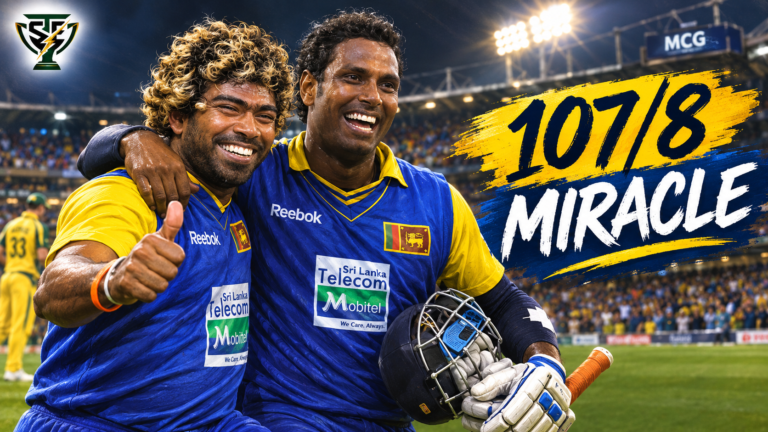
MELBOURNE, Australia, November 3, 2010: Australia needed just two wickets to defend 239 against Sri Lanka at the Melbourne Cricket Ground. The visitors were 107/8 after 25.2 overs, with Kumar Sangakkara, Mahela Jayawardene, Tillakaratne Dilshan and most of the batting lineup already dismissed. Debutant Xavier Doherty had taken four wickets, and Sri Lanka still required 133 runs. Then Angelo Mathews and Lasith Malinga produced one of the most astonishing partnerships in ODI history, adding 132 for the ninth wicket before Muttiah Muralitharan struck the winning boundary to complete a one-wicket victory.
The contest delivered an extraordinary reversal after Sri Lanka’s bowlers had initially controlled Australia’s innings. Thisara Perera claimed 5/46, limiting the hosts to 239/8 despite Michael Hussey’s unbeaten 71. Doherty then dismantled Sri Lanka’s middle order, but Mathews’ unbeaten 77 from 84 balls and Malinga’s fearless 56 from 48 transformed the chase. Malinga was run out with the scores level, giving Australia one last opportunity to escape, but Muralitharan finished the match at 243/9 in 44.2 overs. Mathews received the Player of the Match award for an innings that turned an almost certain defeat into an unforgettable victory.
Key Takeaways
- Australia needed just two wickets to defend 239 against Sri Lanka at the Melbourne Cricket Ground.
- The contest delivered an extraordinary reversal after Sri Lanka’s bowlers had initially controlled Australia’s innings.
- Australia entered the contest with a batting lineup containing Shane Watson, Brad Haddin, Michael Clarke, Michael Hussey and several capable lower-order contributors.
- Sri Lanka possessed an experienced international attack led by Malinga and Muralitharan, supported by Perera and the off-spin of Suraj Randiv.
The encounter is Match 75 in The Sports Encounter’s A Celebration of 5000 ODIs, our collection of 100 extraordinary men’s One-Day Internationals.
Story at a glance
Australia vs Sri Lanka 2010: Match Summary
Australia entered the contest with a batting lineup containing Shane Watson, Brad Haddin, Michael Clarke, Michael Hussey and several capable lower-order contributors.
Thisara Perera’s 5/46 Prevents Australia From Building a Bigger Total
Thisara Perera produced Sri Lanka’s outstanding bowling performance.
Michael Hussey’s Unbeaten 71 Rescues Australia’s Innings
Michael Hussey produced Australia’s most important batting performance.
Brad Haddin’s 49 Provides Australia’s Best Top-Order Contribution
Brad Haddin scored 49 from 55 deliveries, striking eight fours.
Sri Lanka’s Bowling Keeps Australia to 239/8
Perera supplied the wickets, but Sri Lanka’s other bowlers helped restrict Australia’s scoring.
Its inclusion reflects the scale of Sri Lanka’s recovery, an exceptional ninth-wicket partnership, two outstanding bowling performances and the unusual spectacle of a team losing its ninth wicket with the scores tied before still finding a way to win.
Australia vs Sri Lanka 2010: Match Summary
| Match detail | Information |
|---|---|
| Tournament | Sri Lanka tour of Australia, 2010-11 |
| Match | First ODI |
| Date | November 3, 2010 |
| Venue | Melbourne Cricket Ground |
| Toss | Australia won and elected to bat |
| Australia | 239/8 in 50 overs |
| Sri Lanka | 243/9 in 44.2 overs |
| Result | Sri Lanka won by 1 wicket |
| Balls remaining | 34 |
| Player of the Match | Angelo Mathews |
| Australia’s highest scorer | Michael Hussey, 71* |
| Sri Lanka’s highest scorer | Angelo Mathews, 77* |
| Best bowling, Sri Lanka | Thisara Perera, 5/46 |
| Best bowling, Australia | Xavier Doherty, 4/46 |
| Decisive partnership | Mathews and Malinga, 132 |
| Series consequence | Sri Lanka took a 1-0 lead |
Australia entered the contest with a batting lineup containing Shane Watson, Brad Haddin, Michael Clarke, Michael Hussey and several capable lower-order contributors.
Sri Lanka possessed an experienced international attack led by Malinga and Muralitharan, supported by Perera and the off-spin of Suraj Randiv.
The visitors first established an opportunity through their bowling.
Then they almost surrendered it through their batting.
Thisara Perera’s 5/46 Prevents Australia From Building a Bigger Total
Thisara Perera produced Sri Lanka’s outstanding bowling performance.
He claimed five wickets for 46 runs from eight overs, dismissing Brad Haddin, Michael Clarke, Cameron White, Steven Smith and John Hastings.
His spell repeatedly interrupted Australia’s attempts to build partnerships.
Shane Watson fell early to Malinga for ten, leaving Australia 30/1.
Haddin and Clarke then added 55 runs for the second wicket, bringing some stability to the innings.
Clarke scored 27 from 31 deliveries before Perera dismissed him, caught behind by Sangakkara.
Australia were 85/2.
Perera then removed Haddin for 49 and bowled White for a first-ball duck.
Australia slipped to 88/4 after 19 overs.
The two wickets in the same over significantly weakened the hosts’ position.
Perera later returned to dismiss Smith for 12 before removing Hastings for 16 in the final over.
His fifth wicket completed a memorable spell.
Thisara Perera’s Five-Wicket Performance
| Statistic | Performance |
|---|---|
| Overs | 8 |
| Maidens | 0 |
| Runs conceded | 46 |
| Wickets | 5 |
| Economy rate | 5.75 |
| Share of Australia’s dismissals | 62.5% |
| Australia total | 239/8 |
Perera accounted for five of Australia’s eight wickets.
Although he conceded runs at a higher rate than Malinga, Randiv and Muralitharan, his ability to break partnerships was instrumental in preventing Australia from developing a substantially larger innings.
His contribution deserves recognition alongside the famous batting recovery that followed.
Michael Hussey’s Unbeaten 71 Rescues Australia’s Innings
Michael Hussey produced Australia’s most important batting performance.
He remained unbeaten on 71 from 91 deliveries, striking one boundary.
His innings was unusual because of how much responsibility he carried after Australia’s top order repeatedly lost wickets.
Hussey arrived during a difficult period and initially rebuilt alongside Shaun Marsh.
The pair added 67 runs for the fifth wicket, taking Australia from 88/4 to 155/5.
Marsh contributed 31 from 53 deliveries before Randiv dismissed him.
Hussey then continued working with the lower order.
Smith scored 12, Mitchell Johnson made ten, and Hastings contributed 16.
Although those innings were individually modest, they allowed Hussey to keep Australia moving toward a competitive total.
Hussey ultimately batted through the innings, taking Australia to 239/8.
His performance illustrated the value of patience on a surface where scoring had not been straightforward.
Without his resistance, Australia’s total might have been considerably smaller.
Brad Haddin’s 49 Provides Australia’s Best Top-Order Contribution
Brad Haddin scored 49 from 55 deliveries, striking eight fours.
He was Australia’s most productive batter during the opening 20 overs.
Haddin initially supported Watson before establishing the second-wicket partnership with Clarke.
The pair helped Australia recover from 30/1 to 85/2.
However, Haddin fell one run short of a half-century when Perera dismissed him, caught by Dilshan.
His departure was particularly damaging because White followed immediately.
Australia were reduced to 88/4.
The innings had shifted back in Sri Lanka’s favor.
Haddin’s 49 nevertheless provided an important foundation for the eventual total.
The combined contributions from Haddin and Hussey accounted for 120 of Australia’s 239 runs, or 50.21%.
Sri Lanka’s Bowling Keeps Australia to 239/8
Perera supplied the wickets, but Sri Lanka’s other bowlers helped restrict Australia’s scoring.
Malinga conceded only 39 runs from ten overs and dismissed Watson.
Randiv took 1/35 from nine overs, removing Marsh.
Muralitharan conceded just 36 runs from nine overs without taking a wicket.
Dilshan contributed four overs for 17.
Together, Malinga, Muralitharan and Randiv conceded 110 runs from 28 overs.
That combined economy rate of 3.93 restricted Australia through long periods of the innings.
Kulasekara had a more difficult afternoon, conceding 60 runs from ten overs, although he dismissed Johnson.
Sri Lanka’s Bowling Performance
| Bowler | Overs | Maidens | Runs | Wickets | Economy |
|---|---|---|---|---|---|
| Lasith Malinga | 10 | 0 | 39 | 1 | 3.90 |
| Nuwan Kulasekara | 10 | 0 | 60 | 1 | 6.00 |
| Thisara Perera | 8 | 0 | 46 | 5 | 5.75 |
| Muttiah Muralitharan | 9 | 0 | 36 | 0 | 4.00 |
| Suraj Randiv | 9 | 0 | 35 | 1 | 3.89 |
| Tillakaratne Dilshan | 4 | 0 | 17 | 0 | 4.25 |
Australia required Sri Lanka to score at 4.80 runs per over to win.
That was a manageable rate for a team containing several established international batters.
However, the chase developed very differently from what the target suggested.
Kumar Sangakkara’s 49 Cannot Prevent Sri Lanka’s Early Collapse
Sri Lanka began the chase disastrously.
Dilshan scored seven before Peter Siddle dismissed him.
Tharanga managed only three and was run out.
Sri Lanka were 19/2 after 5.1 overs.
Captain Kumar Sangakkara and Mahela Jayawardene attempted to rebuild.
Sangakkara attacked positively, scoring 49 from 46 deliveries with six fours.
Jayawardene contributed 19 from 27 balls.
Their 54-run third-wicket partnership briefly restored order.
Sri Lanka reached 73/3 before Doherty trapped Jayawardene lbw.
Chamara Silva then made only four.
Sangakkara followed for 49, bowled by Doherty.
Sri Lanka slipped to 84/5.
Johnson dismissed Perera for a duck.
The score became 86/6.
Sangakkara had provided the most substantial top-order contribution, but his dismissal left Sri Lanka’s inexperienced lower order facing an increasingly difficult task.
The required scoring rate remained modest.
The problem was the number of wickets Sri Lanka had lost.
Xavier Doherty’s 4/46 Turns His ODI Debut Into a Near Match-Winning Performance
Xavier Doherty made an immediate impression on his ODI debut.
The left-arm spinner claimed 4/46 from ten overs, including one maiden.
He dismissed Jayawardene, Silva, Sangakkara and Kulasekara.
Three of those wickets removed established members of Sri Lanka’s batting lineup.
His dismissal of Jayawardene broke the third-wicket partnership.
Removing Sangakkara shortly afterward deprived Sri Lanka of its most experienced remaining batter.
Doherty then trapped Kulasekara lbw for a duck, reducing Sri Lanka to 107/8 after 25.2 overs.
Australia appeared to have effectively won the match.
Sri Lanka still needed 133 runs, and only two wickets remained.
Xavier Doherty’s ODI Debut
| Statistic | Performance |
|---|---|
| Overs | 10 |
| Maidens | 1 |
| Runs conceded | 46 |
| Wickets | 4 |
| Economy rate | 4.60 |
| Main victims | Jayawardene, Silva, Sangakkara, Kulasekara |
| Sri Lanka after eighth wicket | 107/8 |
| Runs Sri Lanka still needed | 133 |
Doherty’s figures would have been a compelling Player of the Match performance in many circumstances.
His wickets had exposed Sri Lanka’s final three batters before the innings reached its halfway point.
However, Mathews and Malinga refused to accept the apparent inevitability of defeat.
Angelo Mathews’ Unbeaten 77 Turns Sri Lanka’s Collapse Into a Historic Recovery
Angelo Mathews delivered the defining innings of the match.
He scored an unbeaten 77 from 84 deliveries, striking eight fours and one six.
His performance combined intelligent strike rotation with controlled aggression as the chase entered its most dangerous phase.
When Sri Lanka reached 107/8, Mathews had already survived the collapse around him.
The visitors needed another 133 runs.
He now had Malinga at the other end, a specialist fast bowler whose batting was not expected to carry a chase of this magnitude.
Mathews initially concentrated on rebuilding.
He managed the scoring rate while ensuring that Sri Lanka did not lose another wicket.
His approach became increasingly positive as the partnership developed.
Rather than simply protecting Malinga, Mathews allowed his partner to contribute actively.
That decision was important.
A partnership built entirely around one batter attempting to score while the other defended would have allowed Australia to apply more predictable pressure.
Instead, both batters began finding boundaries.
Mathews reached his half-century from 61 deliveries.
The partnership subsequently passed 100.
Australia’s bowlers were unable to produce the dismissal required to finish the contest.
Angelo Mathews’ Match-Winning Innings
| Statistic | Performance |
|---|---|
| Runs | 77 not out |
| Balls faced | 84 |
| Fours | 8 |
| Sixes | 1 |
| Strike rate | 91.67 |
| Partnership with Malinga | 132 |
| Sri Lanka when eighth wicket fell | 107/8 |
| Sri Lanka’s final total | 243/9 |
| Official award | Player of the Match |
Mathews’ unbeaten innings represented 31.69% of Sri Lanka’s final score.
More importantly, he remained at the crease after the entire recognized batting lineup had been dismissed.
His composure provided the foundation for Malinga’s extraordinary contribution.
Lasith Malinga’s 56 From 48 Balls Changes the Match
Lasith Malinga is best remembered as one of ODI cricket’s most dangerous fast bowlers.
At Melbourne, he produced an innings that demonstrated another dimension of his cricketing ability.
He scored 56 from 48 deliveries, hitting six fours and two sixes.
His strike rate of 116.67 was higher than that of every other Sri Lankan batter who faced more than ten deliveries.
Malinga joined Mathews when Sri Lanka were 107/8.
The required 133 runs appeared overwhelming for a ninth-wicket partnership.
However, Malinga attacked Australia’s bowling with confidence.
He struck boundaries against the seamers and refused to allow the required scoring rate to become unmanageable.
His aggression also changed Australia’s field settings.
The hosts could no longer treat him as a specialist bowler who needed only to be contained before another wicket fell.
He became a genuine batting threat.
Malinga reached his half-century from 42 deliveries.
His innings was the only ODI half-century of his international career.
He eventually fell for 56, but only after helping Sri Lanka draw level with Australia’s score.
The innings remains one of the most important lower-order batting contributions in Sri Lankan ODI history.
Mathews and Malinga Add 132 Runs: The Partnership That Australia Could Not Break
The ninth-wicket partnership began at 107/8.
It ended at 239/9.
Mathews and Malinga had added 132 runs.
The stand lasted 110 deliveries, producing a scoring rate of 7.20 runs per over.
That was extraordinary because Sri Lanka had needed to score at only 4.80 runs per over at the beginning of the innings.
By attacking rather than simply surviving, the pair recovered the lost momentum while maintaining control of the chase.
The partnership was a world record for the ninth wicket in ODIs at the time.
It also represented 54.32% of Sri Lanka’s final score.
The Record Ninth-Wicket Partnership
| Measure | Figure |
|---|---|
| Sri Lanka when partnership began | 107/8 |
| Runs required | 133 |
| Partnership | 132 |
| Deliveries | 110 |
| Scoring rate | 7.20 per over |
| Mathews’ final score | 77* |
| Malinga’s final score | 56 |
| Sri Lanka when Malinga fell | 239/9 |
| Runs required to win at that point | 1 |
The partnership fundamentally changed the contest.
Australia had been two wickets away from victory while defending a manageable total.
After the stand, the hosts needed one wicket to prevent Sri Lanka from scoring just one more run.
That was the last opportunity Australia would receive.
Malinga’s Run-Out Gives Australia One Final Chance
The partnership ended through a dramatic run-out.
Sri Lanka reached 239/9 when Steven Smith’s fielding resulted in Malinga’s dismissal for 56.
The scores were level.
Australia had finally broken the partnership that had almost single-handedly won the match for Sri Lanka.
The situation created an extraordinary final test.
Muttiah Muralitharan, primarily selected for his bowling, was the last batter.
Mathews remained unbeaten at the other end.
Sri Lanka needed one run to win.
Australia needed one wicket to force a tie.
Muralitharan responded by striking a boundary off Shane Watson.
Sri Lanka finished on 243/9 after 44.2 overs.
The visitors had won by one wicket with 34 balls remaining.
The final margin hardly reflected the scale of the recovery.
At 107/8, Sri Lanka had appeared certain to lose.
By the end, their last two batters had completed one of ODI cricket’s most remarkable escapes.
Five Turning Points That Defined the Melbourne Thriller
1. Perera Reduces Australia to 88/4
Australia had established a promising second-wicket partnership, but Perera’s wickets removed Clarke, Haddin and White in rapid succession.
The collapse prevented the hosts from building a more commanding total.
2. Hussey Carries Australia to 239/8
Hussey’s unbeaten 71 rescued the innings and gave the hosts a competitive total to defend.
3. Doherty Destroys Sri Lanka’s Middle Order
The debutant dismissed Jayawardene, Silva, Sangakkara and Kulasekara.
Sri Lanka collapsed to 107/8.
4. Mathews and Malinga Add 132 Runs
The pair produced a then-world-record ninth-wicket partnership, transforming an apparent defeat into a winning opportunity.
5. Malinga Falls With the Scores Level
His run-out left Sri Lanka 239/9.
Muralitharan then struck the winning boundary, completing the one-wicket victory.
Continue A Celebration of 5000 ODIs
 A Celebration of 5000 ODIsA Celebration of 5000 ODIs Match 74: India vs Australia 2009, Tendulkar’s 175 Ends in a Three-Run Heartbreak
 A Celebration of 5000 ODIsA Celebration of 5000 ODIs Match 73: New Zealand vs Australia 2007, McCullum Completes Stunning 350 Chase After Hayden’s 181
 A Celebration of 5000 ODIsA Celebration of 5000 ODIs Match 72: New Zealand vs Australia 2005, McCullum and Vettori Complete Record 332 Chase
Australia vs Sri Lanka 2010: Complete Match Scorecard
Australia Innings: 239/8 in 50 Overs
| Batter | Dismissal | R | B | 4s | 6s | SR |
|---|---|---|---|---|---|---|
| Shane Watson | c Perera b Malinga | 10 | 20 | 0 | 0 | 50.00 |
| Brad Haddin (wk) | c Dilshan b Perera | 49 | 55 | 8 | 0 | 89.09 |
| Michael Clarke (c) | c Sangakkara b Perera | 27 | 31 | 3 | 0 | 87.10 |
| Michael Hussey | Not out | 71 | 91 | 1 | 0 | 78.02 |
| Cameron White | b Perera | 0 | 1 | 0 | 0 | 0.00 |
| Shaun Marsh | c Sangakkara b Randiv | 31 | 53 | 0 | 0 | 58.49 |
| Steven Smith | c Sangakkara b Perera | 12 | 15 | 1 | 0 | 80.00 |
| Mitchell Johnson | b Kulasekara | 10 | 17 | 0 | 0 | 58.82 |
| John Hastings | b Perera | 16 | 15 | 1 | 0 | 106.67 |
| Xavier Doherty | Not out | 3 | 2 | 0 | 0 | 150.00 |
| Peter Siddle | Did not bat | |||||
| Extras | 1 bye, 5 leg-byes, 4 wides | 10 | ||||
| Total | 8 wickets, 50 overs | 239 |
Fall of wickets: 1-30 (Watson, 6.2), 2-85 (Clarke, 16.5), 3-88 (Haddin, 18.5), 4-88 (White, 18.6), 5-155 (Marsh, 35.2), 6-178 (Smith, 40.2), 7-204 (Johnson, 45.2), 8-235 (Hastings, 49.3).
Sri Lanka Bowling
| Bowler | Overs | Maidens | Runs | Wickets | Economy |
|---|---|---|---|---|---|
| Lasith Malinga | 10 | 0 | 39 | 1 | 3.90 |
| Nuwan Kulasekara | 10 | 0 | 60 | 1 | 6.00 |
| Thisara Perera | 8 | 0 | 46 | 5 | 5.75 |
| Muttiah Muralitharan | 9 | 0 | 36 | 0 | 4.00 |
| Suraj Randiv | 9 | 0 | 35 | 1 | 3.89 |
| Tillakaratne Dilshan | 4 | 0 | 17 | 0 | 4.25 |
Sri Lanka Innings: 243/9 in 44.2 Overs
| Batter | Dismissal | R | B | 4s | 6s | SR |
|---|---|---|---|---|---|---|
| Upul Tharanga | run out (Doherty) | 3 | 18 | 0 | 0 | 16.67 |
| Tillakaratne Dilshan | c Hussey b Siddle | 7 | 6 | 1 | 0 | 116.67 |
| Kumar Sangakkara (c, wk) | b Doherty | 49 | 46 | 6 | 0 | 106.52 |
| Mahela Jayawardene | lbw b Doherty | 19 | 27 | 2 | 0 | 70.37 |
| Chamara Silva | c Watson b Doherty | 4 | 8 | 0 | 0 | 50.00 |
| Angelo Mathews | Not out | 77 | 84 | 8 | 1 | 91.67 |
| Thisara Perera | b Johnson | 0 | 4 | 0 | 0 | 0.00 |
| Suraj Randiv | run out | 10 | 21 | 0 | 0 | 47.62 |
| Nuwan Kulasekara | lbw b Doherty | 0 | 2 | 0 | 0 | 0.00 |
| Lasith Malinga | run out (Smith) | 56 | 48 | 6 | 2 | 116.67 |
| Muttiah Muralitharan | Not out | 4 | 2 | 1 | 0 | 200.00 |
| Extras | 2 byes, 12 wides | 14 | ||||
| Total | 9 wickets, 44.2 overs | 243 |
Fall of wickets: 1-10 (Dilshan, 3.3), 2-19 (Tharanga, 5.1), 3-73 (Jayawardene, 15.2), 4-84 (Silva, 17.2), 5-84 (Sangakkara, 17.3), 6-86 (Perera, 18.3), 7-107 (Randiv, 24.6), 8-107 (Kulasekara, 25.2), 9-239 (Malinga, 43.4).
Australia Bowling
| Bowler | Overs | Maidens | Runs | Wickets | Economy |
|---|---|---|---|---|---|
| Mitchell Johnson | 10 | 1 | 68 | 1 | 6.80 |
| Peter Siddle | 8 | 0 | 51 | 1 | 6.38 |
| Shane Watson | 6.2 | 0 | 39 | 0 | 6.16 |
| John Hastings | 6 | 0 | 27 | 0 | 4.50 |
| Xavier Doherty | 10 | 1 | 46 | 4 | 4.60 |
| Steven Smith | 3 | 0 | 8 | 0 | 2.67 |
| Michael Clarke | 1 | 0 | 2 | 0 | 2.00 |
Result: Sri Lanka won by one wicket with 34 balls remaining.
Player of the Match: Angelo Mathews, 77 not out from 84 deliveries.
Series position: Sri Lanka led 1-0.
Why Mathews Was Player of the Match Instead of Perera or Doherty
The official award went to Mathews for his unbeaten 77.
Perera’s five wickets were essential to restricting Australia’s total.
Doherty’s four wickets almost secured victory for the hosts.
Malinga’s 56 was one of the most remarkable lower-order contributions of the match.
However, Mathews remained at the crease throughout Sri Lanka’s extraordinary recovery.
He managed the partnership while protecting the final two wickets.
His innings required patience during the rebuilding phase and aggression once Sri Lanka regained confidence.
Most importantly, he remained unbeaten when the winning runs were scored.
The award therefore recognized the batter who had sustained Sri Lanka’s chase through its most difficult phase.
Malinga’s contribution deserves equal attention in understanding how the victory became possible.
Without his 56 from 48 balls, Mathews would almost certainly have been left with an overwhelming target.
Why Match 75 Belongs in A Celebration of 5000 ODIs
The Melbourne encounter ranks among cricket’s greatest lower-order recoveries because of the position from which Sri Lanka won.
The visitors were 107/8.
They needed another 133 runs.
Australia had taken eight wickets in little more than half the innings.
The lower-order batters faced a task that even established specialists would have found difficult.
Mathews and Malinga responded with a 132-run partnership.
Their stand was exceptional both in size and in scoring rate.
They attacked Australia’s bowling rather than allowing the required runs to become increasingly difficult to obtain.
The partnership also demonstrated the importance of batting depth in ODI cricket.
Malinga was primarily a fast bowler, yet his attacking half-century became essential to the result.
Mathews displayed the composure expected of an experienced specialist batter despite being only 23 years old.
The match offers an intriguing historical comparison with another extraordinary lower-order rescue in this series.
In Match 72, Brendon McCullum and Daniel Vettori rescued New Zealand against Australia in Christchurch, adding an unbeaten 74 runs for the ninth wicket.
That partnership completed a record chase.
In Melbourne five years later, Mathews and Malinga nearly doubled that partnership while rescuing Sri Lanka from an even more precarious position.
Both contests demonstrated the extraordinary possibilities that arise when lower-order batters refuse to accept an apparently inevitable defeat.
What Happened After Sri Lanka’s Melbourne Victory?
Sri Lanka’s win gave the visitors a 1-0 lead in the three-match ODI series.
They subsequently won the second ODI at Sydney, securing their first bilateral ODI series victory in Australia.
Australia won the final match at Brisbane, leaving Sri Lanka with a 2-1 series triumph.
The Melbourne encounter therefore became the opening chapter of an important achievement for Sri Lankan cricket.
It also arrived during the final months of preparation for the 2011 ICC Cricket World Cup.
Sri Lanka would go on to reach that tournament’s final before losing to India in Mumbai.
Mathews continued developing into one of Sri Lanka’s most important all-rounders, while Malinga remained a central figure in the national bowling attack.
Their partnership at Melbourne remains one of the defining performances of that era.
The One-Wicket Victory That Should Never Have Happened
The extraordinary feature of the match was the number of opportunities Australia had to finish the contest.
Doherty’s four wickets had reduced Sri Lanka to 107/8.
The hosts needed only two more dismissals.
Mathews and Malinga then produced a partnership that changed the match completely.
Even after Malinga’s run-out at 239/9, Australia had another opportunity to prevent defeat.
The scores were level, and Muralitharan was Sri Lanka’s last batter.
However, the final wicket never arrived.
Muralitharan struck the winning boundary, leaving Mathews unbeaten and Australia defeated.
The contest delivered outstanding performances from both sides.
Perera took five wickets.
Hussey carried Australia’s batting.
Doherty claimed four wickets on debut.
Mathews and Malinga produced a then-world-record ninth-wicket partnership.
Australia vs Sri Lanka 2010 belongs in A Celebration of 5000 ODIs because it proved that even eight wickets down, 133 runs behind and facing a world-class attack, a team can still find an extraordinary route to victory.
A Celebration of 5000 ODIs
- A Celebration of 5000 ODIs Match 75: Australia vs Sri Lanka 2010, Mathews and Malinga Rescue an Impossible Chase
- A Celebration of 5000 ODIs Match 74: India vs Australia 2009, Tendulkar’s 175 Ends in a Three-Run Heartbreak
- A Celebration of 5000 ODIs Match 73: New Zealand vs Australia 2007, McCullum Completes Stunning 350 Chase After Hayden’s 181
- A Celebration of 5000 ODIs Match 72: New Zealand vs Australia 2005, McCullum and Vettori Complete Record 332 Chase
- A Celebration of 5000 ODIs Match 71: South Africa vs Australia 2006, The 438 Chase That Changed Cricket