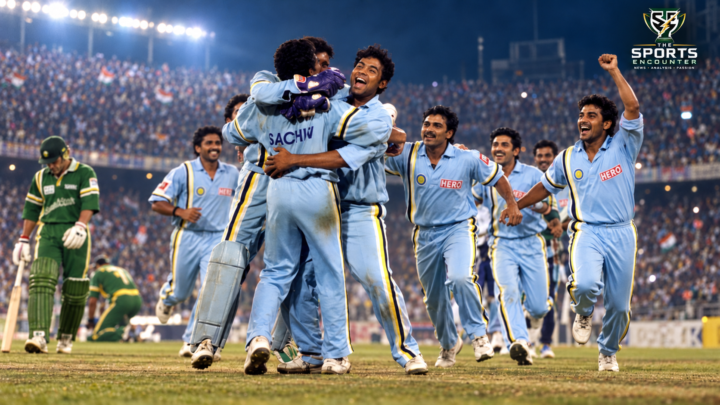
HYDERABAD, India, November 5, 2009: Sachin Tendulkar had dragged India to within 19 runs of an extraordinary victory over Australia. Chasing 351, he had already scored 175 from 141 deliveries, struck 19 fours and four sixes, and carried the hopes of thousands of spectators at Rajiv Gandhi International Cricket Stadium. India were 332/6 in the 48th over, with 19 runs needed from 17 balls. Then Tendulkar attempted an improvised shot against Clint McKay, Nathan Hauritz completed the catch, and a seemingly certain Indian victory slipped away. Australia dismissed India for 347 in 49.4 overs, winning by three runs in one of the most dramatic ODIs of the decade.
The defeat was especially painful because India had recovered from 162/4 through a magnificent 137-run partnership between Tendulkar and Suresh Raina. Australia’s 350/4, built around Shaun Marsh’s 112, Shane Watson’s 93 and Cameron White’s explosive 57, had looked formidable. Tendulkar’s brilliance nearly made it irrelevant. However, McKay’s three wickets, Watson’s 3/47 and Australia’s composure during the final overs turned the contest. Tendulkar received the Player of the Match award despite finishing on the losing side, while Australia moved 3-2 ahead in the seven-match series.
Key Takeaways
- Sachin Tendulkar had dragged India to within 19 runs of an extraordinary victory over Australia.
- The defeat was especially painful because India had recovered from 162/4 through a magnificent 137-run partnership between Tendulkar and Suresh Raina.
- The decisive collapse began when Raina fell with India at 299/5.
- The official Player of the Match award went to Tendulkar.
The match is No. 74 in The Sports Encounter’s A Celebration of 5000 ODIs, a historical series examining 100 One-Day Internationals that deserve to be remembered for their drama, performances and lasting significance.
Story at a glance

India vs Australia 2009: Hyderabad Match Summary
The series had been tied at two victories apiece before the Hyderabad encounter.
Shaun Marsh’s 112 Gives Australia the Foundation for 350
Shaun Marsh produced his maiden ODI century at a crucial moment.
Shane Watson’s 93 Sets the Tempo
Shane Watson was Australia’s most influential batter during the opening half of the innings.
Cameron White’s 57 From 33 Balls Changes the Final Target
Australia’s final acceleration was devastating.
India’s Bowlers Struggle Despite Harbhajan Singh’s Control
India’s bowling performance was uneven.
Its inclusion reflects the extraordinary contradiction at the heart of the contest. Tendulkar produced an innings that seemed sufficient to win almost any match, but Australia found a way to take the last six wickets before India could score the remaining 52 runs.
India vs Australia 2009: Hyderabad Match Summary
| Match detail | Information |
|---|---|
| Tournament | Australia tour of India, 2009-10 |
| Match | Fifth ODI |
| Date | November 5, 2009 |
| Venue | Rajiv Gandhi International Cricket Stadium, Uppal, Hyderabad |
| Toss | Australia won and elected to bat |
| Australia | 350/4, 50 overs |
| India | 347 all out, 49.4 overs |
| Result | Australia won by 3 runs |
| Player of the Match | Sachin Tendulkar |
| India’s highest scorer | Sachin Tendulkar, 175 |
| Australia’s highest scorer | Shaun Marsh, 112 |
| Leading Australian bowlers | Shane Watson and Clint McKay, 3 wickets each |
| India’s leading bowler | Praveen Kumar, 2/68 |
| Decisive partnership | Tendulkar and Raina, 137 |
| Series position | Australia led 3-2 |
The series had been tied at two victories apiece before the Hyderabad encounter.
A win would give either side an important advantage heading into the final two matches.
Australia’s attacking batting established the target, but their ability to defend it after conceding almost 350 runs ultimately decided the evening.
Shaun Marsh’s 112 Gives Australia the Foundation for 350
Shaun Marsh produced his maiden ODI century at a crucial moment.
He scored 112 from 112 deliveries, striking eight fours and two sixes.
Marsh opened alongside Shane Watson, and the pair immediately placed India’s bowlers under pressure.
The Australian openers combined patience with aggressive scoring, adding 145 runs before Harbhajan Singh dismissed Watson in the 26th over.
Marsh continued batting after losing his opening partner.
He added another 91 runs with captain Ricky Ponting, who contributed 45 from 45 deliveries.
Australia were 236/2 when Praveen Kumar bowled Ponting.
Marsh eventually fell to Ashish Nehra for 112, with Gautam Gambhir taking the catch.
Australia had reached 270/3.
The opener had occupied the crease through the first 43 overs, creating an excellent platform for a substantial finish.
His century was particularly important because Australia did not need a risky rebuilding phase during the innings.
The partnerships involving Watson and Ponting allowed the visitors to maintain scoring momentum while preserving wickets for the final overs.
Shaun Marsh’s Century
| Statistic | Performance |
|---|---|
| Runs | 112 |
| Balls faced | 112 |
| Fours | 8 |
| Sixes | 2 |
| Strike rate | 100.00 |
| Opening partnership | 145 |
| Partnership with Ponting | 91 |
| Australia when dismissed | 270/3 |
Marsh’s performance provided the stability that allowed Australia’s middle order to attack during the closing overs.
Shane Watson’s 93 Sets the Tempo
Shane Watson was Australia’s most influential batter during the opening half of the innings.
He scored 93 from 89 deliveries, hitting nine fours and three sixes.
His strike rate of 104.49 ensured Australia maintained pressure without needing excessive risks.
Watson attacked India’s bowlers whenever they missed their lengths.
His partnership with Marsh gave Australia an excellent start and forced MS Dhoni to search for breakthroughs rather than concentrate on controlling the scoring rate.
Watson eventually fell to Harbhajan Singh, caught by Ravindra Jadeja, with Australia at 145/1.
He had already done substantial damage.
The opening partnership lasted more than 25 overs and established the platform from which Australia could eventually reach 350.
Watson would later make an equally important contribution with the ball, claiming three wickets during India’s chase.
His all-round performance was one of the most significant factors in Australia’s victory.
Cameron White’s 57 From 33 Balls Changes the Final Target
Australia’s final acceleration was devastating.
Cameron White scored 57 from just 33 deliveries, striking two fours and five sixes.
His strike rate of 172.73 transformed Australia’s scoring rate during the final overs.
Michael Hussey contributed an unbeaten 31 from 22 balls, including two sixes.
The pair added 80 runs for the fourth wicket before White fell from the final ball of the innings.
Australia scored 105 runs during the last ten overs.
That late acceleration proved crucial.
India eventually fell three runs short.
Although the final margin cannot be attributed to one partnership alone, the additional runs scored through White and Hussey substantially increased India’s challenge.
Australia’s Batting Acceleration
| Phase | Score or contribution |
|---|---|
| Opening partnership | 145 |
| Australia after 40 overs | 245/2 |
| Runs from final 10 overs | 105 |
| White’s contribution | 57 from 33 |
| Hussey’s contribution | 31* from 22 |
| Final total | 350/4 |
The contrast between Australia’s measured opening partnerships and explosive finish illustrates why their innings proved so difficult to chase.
India’s Bowlers Struggle Despite Harbhajan Singh’s Control
India’s bowling performance was uneven.
Praveen Kumar claimed two wickets but conceded 68 runs from nine overs.
Nehra took 1/79 from ten.
Munaf Patel conceded 73 from nine, while Ravindra Jadeja went for 44 from five overs.
Harbhajan Singh was India’s most economical frontline bowler.
He conceded only 44 runs from ten overs and removed Watson for 93.
Yuvraj Singh also provided useful control, conceding 36 runs from seven overs.
However, Australia’s ability to score rapidly against the remaining bowlers undermined those economical spells.
A total of 350 placed immense responsibility on India’s batting lineup.
For much of the chase, Tendulkar appeared capable of meeting that challenge.
Sachin Tendulkar’s 175: One of ODI Cricket’s Greatest Losing Innings
Sachin Tendulkar produced an innings of astonishing quality.
He scored 175 from 141 deliveries, striking 19 fours and four sixes.
His strike rate was 124.11.
The innings was exceptional for its combination of endurance, attacking strokeplay and sustained control during a demanding chase.
India needed 351 runs to win.
Tendulkar understood that the required scoring rate would remain challenging throughout the innings.
He began positively alongside Virender Sehwag, who scored 38 from 30 balls.
Their opening partnership added 66 runs.
Sehwag’s dismissal did not interrupt Tendulkar’s momentum.
Gautam Gambhir fell for eight, Yuvraj Singh contributed nine, and captain MS Dhoni scored six.
India slipped to 162/4 in the 24th over.
Tendulkar had already established himself, but the chase now depended heavily on his ability to remain at the crease.
Suresh Raina joined him.
Together, they changed the match.
Sachin Tendulkar’s Historic Performance
| Statistic | Figure |
|---|---|
| Runs | 175 |
| Balls faced | 141 |
| Fours | 19 |
| Sixes | 4 |
| Strike rate | 124.11 |
| Partnership with Raina | 137 |
| Share of India’s total | 50.43% |
| India’s score when dismissed | 332/7 |
| Runs required at dismissal | 19 |
| Player of the Match | Sachin Tendulkar |
Tendulkar contributed more than half of India’s runs.
His 175 also carried him past 17,000 ODI career runs, another extraordinary milestone in his international career.
The innings remains one of the strongest examples of an individual performance dominating a match without securing victory.
Suresh Raina’s 59 Takes India to the Brink of Victory
Suresh Raina made one of the match’s most important contributions.
He scored 59 from 59 deliveries, including three fours and three sixes.
Raina arrived with India 162/4.
The required target remained substantial, and Australia had removed several leading batters.
Raina responded with intelligent aggression.
He supported Tendulkar while taking scoring opportunities against Australia’s bowlers.
The pair added 137 runs for the fifth wicket.
India advanced to 299/5.
By then, the chase had become increasingly manageable.
The partnership had reduced the required runs while preserving enough overs for India to complete the task.
However, Raina fell to Shane Watson in the 43rd over, caught by wicketkeeper Graham Manou.
His dismissal left Tendulkar responsible for guiding the lower order through the remaining 52 runs.
It was a pivotal moment.
Raina’s innings deserved considerable recognition because his partnership with Tendulkar was the period during which India transformed a difficult chase into a realistic opportunity to win.
Why the Tendulkar-Raina Partnership Mattered
| Match situation | India score | Runs needed |
|---|---|---|
| Dhoni dismissed | 162/4 | 189 |
| Raina dismissed | 299/5 | 52 |
| Harbhajan dismissed | 300/6 | 51 |
| Tendulkar dismissed | 332/7 | 19 |
| India all out | 347 | Australia won by 3 runs |
The partnership represented 39.48% of India’s final total.
More importantly, it stabilized the chase after four wickets had fallen.
Without Raina’s contribution, Tendulkar might have been forced to take significantly greater risks much earlier.
Clint McKay’s Three Wickets Turn the Match Against India
Clint McKay produced a defining bowling performance on his ODI debut.
He finished with 3/59 from ten overs.
His wickets were Gambhir, Dhoni and Tendulkar.
The dismissal of Tendulkar was unquestionably the most important.
India required 19 runs from 17 deliveries when the Indian batting legend attempted an improvised paddle shot.
McKay deceived him sufficiently for the ball to travel toward short fine leg, where Nathan Hauritz completed the catch.
Tendulkar departed for 175.
The stadium’s excitement turned into disbelief.
India still had three wickets remaining and enough deliveries to score the required runs.
However, Tendulkar’s dismissal removed the batter who had controlled the chase for almost the entire innings.
Australia immediately gained confidence.
McKay’s performance was particularly impressive because he was making his international debut under considerable pressure.
He conceded runs, as most bowlers did on the batting-friendly surface, but claimed wickets at stages that materially changed the match.
Shane Watson’s 3/47 Completes a Match-Winning All-Round Performance
Shane Watson contributed decisively in both innings.
His 93 helped Australia establish 350.
He then claimed 3/47 from 8.4 overs during India’s chase.
Watson dismissed Yuvraj Singh, Suresh Raina and Harbhajan Singh.
His dismissal of Raina was particularly important because it ended the 137-run fifth-wicket partnership.
Watson then removed Harbhajan for a duck.
India fell from 299/4 to 300/6 in the space of three deliveries.
That sudden double setback exposed the lower order while Tendulkar was still attempting to complete the chase.
Watson’s final contribution came during the closing over, when India needed to keep scoring without losing wickets.
His combined batting and bowling performance was central to Australia’s ability to recover after conceding almost 350 runs.
Ravindra Jadeja’s 23 and Praveen Kumar’s Late Six Nearly Save India
After Raina’s dismissal, India continued fighting.
Ravindra Jadeja contributed 23 from 17 deliveries, including three fours.
His strike rate of 135.29 helped India maintain the required scoring rate.
However, Jadeja was run out with the score at 333/8, shortly after Tendulkar’s dismissal.
The loss of two batters for one run severely damaged India’s chances.
Ashish Nehra then fell for one, leaving India 335/9.
Praveen Kumar and Munaf Patel became India’s last pair.
They added 12 runs, with Praveen striking a crucial six that briefly revived hopes of completing the chase.
The partnership ended when Praveen was run out for nine.
India were all out for 347 in 49.4 overs.
Australia had won by three runs.
The final dismissal underlined the cruelty of India’s position.
They had been within sight of victory with Tendulkar still batting.
Yet the lower order could not secure the final runs.
Six Wickets for 48 Runs: How Australia Stole the Hyderabad ODI
The decisive collapse began when Raina fell with India at 299/5.
Harbhajan departed without scoring, leaving India 300/6.
Tendulkar then carried the chase to 332 before falling.
Jadeja, Nehra and Praveen also departed before India could reach the target.
The last six wickets fell while India added 48 runs.
That sequence transformed a chase that had appeared under control into an Australian victory.
India’s Late Collapse
| Wicket | India score | Batter dismissed | Runs required |
|---|---|---|---|
| Fifth | 299/5 | Suresh Raina | 52 |
| Sixth | 300/6 | Harbhajan Singh | 51 |
| Seventh | 332/7 | Sachin Tendulkar | 19 |
| Eighth | 333/8 | Ravindra Jadeja | 18 |
| Ninth | 335/9 | Ashish Nehra | 16 |
| Tenth | 347 all out | Praveen Kumar | Australia won by 3 runs |
Australia’s bowlers deserve credit for maintaining pressure despite the difficult conditions.
Their fielding was also important.
The catch that removed Tendulkar and the run-outs of Jadeja and Praveen directly influenced the final result.
India’s weakness lay in the inability of the lower order to finish a chase that the top and middle order had almost completed.
Five Turning Points That Defined the Hyderabad Thriller
1. Marsh and Watson Add 145 Runs
Australia’s openers gave the visitors a commanding platform, with Watson scoring 93 and Marsh eventually completing his maiden ODI century.
2. Australia Score 105 in the Final Ten Overs
White’s 57 and Hussey’s unbeaten 31 transformed a competitive total into an imposing 350/4.
3. Tendulkar and Raina Add 137 Runs
India recovered from 162/4 to 299/5, putting the target within reach.
4. Raina and Harbhajan Fall for One Additional Run
Australia removed two batters in quick succession, leaving Tendulkar exposed alongside the lower order.
Continue A Celebration of 5000 ODIs
 A Celebration of 5000 ODIsA Celebration of 5000 ODIs Match 69: Praveen Kumar’s Four Wickets, Tendulkar’s 91 Break Australia in Brisbane Thriller
 A Celebration of 5000 ODIsA Celebration of 5000 ODIs Match 73: New Zealand vs Australia 2007, McCullum Completes Stunning 350 Chase After Hayden’s 181
 A Celebration of 5000 ODIsA Celebration of 5000 ODIs Match 72: New Zealand vs Australia 2005, McCullum and Vettori Complete Record 332 Chase
5. Tendulkar Falls With 19 Runs Required
McKay’s dismissal of Tendulkar triggered the final collapse.
Australia eventually secured a three-run victory.
India vs Australia 2009: Complete Match Scorecard
Australia Innings: 350/4 in 50 Overs
| Batter | Dismissal | R | B | 4s | 6s | SR |
|---|---|---|---|---|---|---|
| Shane Watson | c Jadeja b Harbhajan Singh | 93 | 89 | 9 | 3 | 104.49 |
| Shaun Marsh | c Gambhir b Nehra | 112 | 112 | 8 | 2 | 100.00 |
| Ricky Ponting (c) | b Praveen Kumar | 45 | 45 | 3 | 1 | 100.00 |
| Cameron White | c Tendulkar b Praveen Kumar | 57 | 33 | 2 | 5 | 172.73 |
| Michael Hussey | Not out | 31 | 22 | 1 | 2 | 140.91 |
| Adam Voges | Did not bat | |||||
| Graham Manou (wk) | Did not bat | |||||
| Nathan Hauritz | Did not bat | |||||
| Doug Bollinger | Did not bat | |||||
| Ben Hilfenhaus | Did not bat | |||||
| Clint McKay | Did not bat | |||||
| Extras | 6 leg-byes, 5 wides, 1 no-ball | 12 | ||||
| Total | 4 wickets, 50 overs | 350 |
Fall of wickets: 1-145 (Watson, 25.2), 2-236 (Ponting, 38.5), 3-270 (Marsh, 42.5), 4-350 (White, 49.6).
India Bowling
| Bowler | Overs | Maidens | Runs | Wickets | Economy |
|---|---|---|---|---|---|
| Praveen Kumar | 9 | 0 | 68 | 2 | 7.56 |
| Ashish Nehra | 10 | 0 | 79 | 1 | 7.90 |
| Munaf Patel | 9 | 0 | 73 | 0 | 8.11 |
| Ravindra Jadeja | 5 | 0 | 44 | 0 | 8.80 |
| Harbhajan Singh | 10 | 0 | 44 | 1 | 4.40 |
| Yuvraj Singh | 7 | 0 | 36 | 0 | 5.14 |
India Innings: 347 All Out in 49.4 Overs
| Batter | Dismissal | R | B | 4s | 6s | SR |
|---|---|---|---|---|---|---|
| Virender Sehwag | c Bollinger b Hilfenhaus | 38 | 30 | 5 | 1 | 126.67 |
| Sachin Tendulkar | c Hauritz b McKay | 175 | 141 | 19 | 4 | 124.11 |
| Gautam Gambhir | c Hilfenhaus b McKay | 8 | 13 | 1 | 0 | 61.54 |
| Yuvraj Singh | c & b Watson | 9 | 10 | 1 | 0 | 90.00 |
| MS Dhoni (c, wk) | c Voges b McKay | 6 | 15 | 0 | 0 | 40.00 |
| Suresh Raina | c Manou b Watson | 59 | 59 | 3 | 3 | 100.00 |
| Harbhajan Singh | c Manou b Watson | 0 | 2 | 0 | 0 | 0.00 |
| Ravindra Jadeja | run out (White/McKay) | 23 | 17 | 3 | 0 | 135.29 |
| Praveen Kumar | run out (Hauritz/Manou) | 9 | 9 | 0 | 1 | 100.00 |
| Ashish Nehra | c Hussey b Bollinger | 1 | 2 | 0 | 0 | 50.00 |
| Munaf Patel | Not out | 2 | 3 | 0 | 0 | 66.67 |
| Extras | 1 bye, 5 leg-byes, 8 wides, 3 no-balls | 17 | ||||
| Total | All out, 49.4 overs | 347 |
Fall of wickets: 1-66 (Sehwag, 8.5), 2-92 (Gambhir, 13.3), 3-126 (Yuvraj Singh, 18.3), 4-162 (Dhoni, 23.3), 5-299 (Raina, 42.3), 6-300 (Harbhajan, 42.6), 7-332 (Tendulkar, 47.1), 8-333 (Jadeja, 47.4), 9-335 (Nehra, 48.1), 10-347 (Praveen Kumar, 49.4).
Australia Bowling
| Bowler | Overs | Maidens | Runs | Wickets | Economy |
|---|---|---|---|---|---|
| Ben Hilfenhaus | 10 | 0 | 72 | 1 | 7.20 |
| Doug Bollinger | 10 | 0 | 75 | 1 | 7.50 |
| Clint McKay | 10 | 0 | 59 | 3 | 5.90 |
| Shane Watson | 8.4 | 0 | 47 | 3 | 5.42 |
| Nathan Hauritz | 5 | 0 | 43 | 0 | 8.60 |
| Adam Voges | 3 | 0 | 19 | 0 | 6.33 |
| Michael Hussey | 3 | 0 | 26 | 0 | 8.67 |
Result: Australia won by three runs.
Player of the Match: Sachin Tendulkar, 175 from 141 balls.
Series position: Australia led the seven-match series 3-2.
ODI debut: Clint McKay, Australia.
Why Sachin Tendulkar Was Player of the Match Despite India’s Defeat
The official Player of the Match award went to Tendulkar.
The decision reflected the scale of his innings.
He scored 175 against a substantial Australian bowling attack, maintained a strike rate above 124 and nearly completed a chase of 351.
His innings included 23 boundaries, producing 100 runs through fours and sixes alone.
He also reached the historic milestone of 17,000 ODI runs.
Australia’s Marsh scored 112, Watson contributed 93 and claimed three wickets, and McKay delivered three important dismissals.
Those performances were central to the victory.
However, Tendulkar’s 175 remained the most extraordinary individual achievement.
The award recognized a performance that deserved admiration regardless of the final result.
What Happened After Australia’s Three-Run Victory?
Australia’s victory gave them a 3-2 lead in the seven-match series.
The teams subsequently met in Guwahati, where Australia dismissed India for 170 and completed a six-wicket victory.
That result secured the series 4-2, with the final scheduled match at Mumbai abandoned without a ball bowled.
Australia’s success was particularly notable because the visitors had experienced several injury and availability challenges during the tour.
The victory also demonstrated their ability to win under pressure even when opposition batters produced extraordinary individual performances.
For India, the Hyderabad defeat highlighted an important weakness.
Tendulkar had almost single-handedly carried the chase, supported significantly by Raina.
Yet the remaining batters could not complete the task.
The match reinforced the importance of collective batting contributions, particularly when a chase extends into the final overs.
Why Match 74 Belongs in A Celebration of 5000 ODIs
The Hyderabad encounter deserves its inclusion because of the contrast between individual brilliance and collective performance.
Australia’s 350/4 was built through several substantial contributions.
Marsh scored a century.
Watson made 93.
Ponting contributed 45.
White and Hussey provided late acceleration.
India’s chase depended much more heavily on Tendulkar.
Sehwag offered a positive start.
Raina supplied the essential middle-order partnership.
Jadeja helped maintain the required scoring rate.
However, Tendulkar remained the dominant figure throughout the innings.
When he departed, the chase rapidly unraveled.
The contest also provides an intriguing comparison with another Tendulkar performance covered in this series.
In the 2008 Commonwealth Bank Series final at Brisbane, Tendulkar scored 91 and India defended 258 to win by nine runs.
In Hyderabad, he scored almost twice as many runs, but India lost by three.
The difference reveals an enduring truth about ODI cricket.
An individual innings can define the spectacle, but the result depends on partnerships, bowling control, fielding and lower-order execution.
Tendulkar’s 175 remains one of the greatest ODI innings played in a losing cause.
His performance gave India an opportunity that seemed almost impossible when Australia posted 350.
Australia’s final wickets then transformed the ending.
India vs Australia 2009 belongs in A Celebration of 5000 ODIs because it combined a magnificent individual innings, a record-setting personal milestone, 697 match runs and a three-run finish in which victory changed hands during the closing overs.
A Celebration of 5000 ODIs
- A Celebration of 5000 ODIs Match 74: India vs Australia 2009, Tendulkar’s 175 Ends in a Three-Run Heartbreak
- A Celebration of 5000 ODIs Match 73: New Zealand vs Australia 2007, McCullum Completes Stunning 350 Chase After Hayden’s 181
- A Celebration of 5000 ODIs Match 72: New Zealand vs Australia 2005, McCullum and Vettori Complete Record 332 Chase
- A Celebration of 5000 ODIs Match 71: South Africa vs Australia 2006, The 438 Chase That Changed Cricket
- A Celebration of 5000 ODIs Match 70: Pakistan vs Sri Lanka 2017, Sarfaraz and Amir Rescue a Lost Champions Trophy Chase