

What If You Could Get Two Wickets on One Ball? Cricket’s Catch-and-Run-Out Rule Explained
A brilliant fielding moment appeared to dismiss both batters from one delivery. The laws of cricket, however, allow only one wicket, with the caught striker required to leave.

A fielder takes a clean catch, turns toward the stumps, and runs out the other batter before anyone has time to process what just happened.
For a split second, it looks like cricket has produced the perfect double play: two batters defeated by the same fielder from a single delivery.
The scorecard, however, records only one wicket.
The striker who was caught must leave the field. The apparent run-out of the non-striker does not count because the delivery effectively ended when the catch was completed.
The sequence captured in the video below offers a brilliant example of how cricket’s dismissal laws operate when two possible wickets appear to occur from the same ball.
Can Two Batters Be Dismissed From One Ball?
Under normal cricket laws, a team cannot lose two wickets from one legal delivery.
A single ball can create several valid-looking dismissal opportunities. The striker might edge the ball, a fielder might complete a catch, and the non-striker may also be standing outside the crease when the wicket is broken.
Only one dismissal is entered in the scorebook.
In the incident shown above, the striker hit the ball in the air. The fielder completed the catch and then immediately used the same ball to break the stumps at the non-striker’s end.
Both actions were impressive. Only the first one had legal force.
Why the Caught Batter Has to Leave
The decisive rule comes from Law 33 of the MCC Laws of Cricket.
Law 33.5 establishes that a caught dismissal takes precedence when the conditions for a fair catch have been satisfied. That remains the case even when another method of dismissal could also appear justified during the same passage of play.
Once the fielder gained complete control of the ball and of their own movement, the catch was completed. At that moment, the striker was out caught.
The striker therefore became the dismissed batter and had to leave the field.
Key Rule
When a fair catch is completed, the striker is out caught. A second dismissal cannot then be added from the same delivery.
Why the Run-Out Does Not Count
The answer lies in the dead-ball law.
Under MCC Law 20.1.1.3, the ball becomes dead when a batter is dismissed. It is treated as dead from the instant of the incident that caused the dismissal.
Here, that incident was the completion of the catch.
Anything that happened afterward formed part of the visual sequence, but it could not create a second wicket because the ball was already dead in law.
The fielder could still throw the ball, remove the bails, or celebrate the apparent double dismissal. None of those actions could change the legal outcome.
The Sequence in Simple Terms
- The striker hits the ball in the air.
- The fielder completes a fair catch.
- The striker is dismissed caught.
- The ball becomes dead at the instant the catch is completed.
- The fielder then breaks the stumps at the other end.
- The non-striker cannot be run out because the ball is no longer in play.
What Does “Caught Takes Precedence” Mean?
Cricket deliveries can become complicated because more than one form of dismissal may seem possible.
A batter could edge the ball onto the pad, offer a catch, collide with the stumps, or leave the crease during the same fast-moving passage. Umpires need a clear hierarchy to determine which dismissal should be recorded.
The caught law supplies that hierarchy in this situation.
If the catch is fair and the striker has not already been bowled, the striker is out caught. The law gives that dismissal priority over another possible decision involving either batter.
That wording matters because it prevents one delivery from removing two batters through overlapping events.
Was the Fielder’s Run-Out Attempt Pointless?
From a legal perspective, yes. From a sporting perspective, it was still a remarkable display of awareness.
The fielder completed the catch, recognized that the non-striker was away from the crease, and reacted immediately. That combination of control, speed, and presence of mind explains why the clip feels so unusual.
Fielders are trained to finish every play. They may not always know whether a catch was completed cleanly, whether a no-ball has been called, or whether the umpire has recognized the dismissal. Breaking the stumps can protect the fielding side if the first dismissal is later ruled invalid.
Suppose the catch had been dropped or judged incomplete. The ball would have remained live, and the run-out might then have become the valid dismissal.
That possibility gives the fielder a practical reason to continue the play.
What If the Catch Had Not Been Completed?
The outcome could have changed completely.
A catch is only completed when the fielder has full control of the ball and their movement. Brief contact with the ball is insufficient. The fielder must secure it without grounding the ball or losing control during the completion process.
If the fielder had failed to complete the catch but recovered quickly enough to break the wicket, the non-striker could have been run out, provided that batter was outside the crease and the ball remained live.
In that version of events:
- The striker would remain not out because the catch was incomplete.
- The non-striker could be dismissed run out.
- Only the run-out would appear on the scorecard.
The same movement could therefore produce a different dismissed batter depending on whether the catch was legally completed.
What If It Was a No-Ball?
A no-ball introduces another layer.
A striker generally cannot be dismissed caught from a no-ball. A batter can, however, still be run out in certain circumstances.
If the delivery in the video had been called a no-ball, the catch would not dismiss the striker. The ball would remain live, and the subsequent run-out could potentially count if all conditions under Law 38 on run-outs were met.
That would leave the non-striker as the dismissed batter instead of the striker.
This is one reason fielders are taught to continue until the umpire makes the situation clear.
Can a Bowler Take Two Wickets With One Delivery?
No. A bowler can create two dismissal opportunities, but the batting side can lose only one wicket from that ball.
The scorecard records the dismissal that legally occurred first or the one given priority under the Laws.
A bowler might hit the stumps while the batter also offers a catch. In that case, bowled usually settles the matter before the catch becomes relevant because the striker has already been dismissed when the wicket is put down by the delivery.
Similarly, a catch followed by a run-out still produces one wicket because the catch completes the dismissal and kills the ball.
Could Two Wickets Ever Fall Without Another Ball Being Bowled?
Yes, but they would not both come from the same delivery.
For example, a new batter could be timed out after the previous batter was dismissed. The two wickets might occur close together on the scorecard, even though only one resulted from the delivery.
A batter may also retire out between deliveries under specific circumstances. Again, that would create another wicket without a fresh ball, but it would remain a separate dismissal event.
The distinction is important. Two wickets can fall between consecutive deliveries, but one live delivery does not remove two batters.
Why the Rule Makes Sense
Allowing two wickets from one ball would create major problems for scoring, strike rotation, appeals, and the order in which batters are dismissed.
Cricket therefore treats each delivery as capable of producing one completed dismissal.
The rule also creates a clean stopping point. Once a batter is out, the ball becomes dead, the dismissal is recorded, and the game prepares for the next batter or the next delivery.
Without that certainty, umpires would need to decide whether fielders could continue attempting dismissals after the first wicket had already fallen. A catch near the boundary could be followed by throws at both ends, turning one delivery into a chain of possible wickets.
The dead-ball rule prevents that confusion.
Why the Clip Is So Satisfying to Watch
The moment works because the fielder’s actions resemble a double play from baseball.
The catch removes the striker. The instant attack on the stumps appears to remove the non-striker. Visually, both batters have been beaten by the same piece of fielding.
Cricket’s scorebook tells a more restrained story.
The fielder earned one dismissal, while the second action became an impressive but legally irrelevant finish.
It is also a useful reminder that the most memorable moments in cricket do not always come from sixes, yorkers, or dramatic final-ball victories. Sometimes a five-second fielding sequence can open an entire discussion about how the game works.
The Hundred has regularly produced such fast, unusual moments. Its compressed format leaves fielders little time to reset and encourages the kind of urgent decision-making seen in this clip. Recent matches have also delivered a record-breaking batting assault at Headingley, a historic low-score defense by Southern Brave, and a controlled Welsh Fire chase against Southern Brave.
One Delivery, One Dismissal
The fielder in the video did almost everything required to dismiss two batters.
The catch was completed. The non-striker was short of the crease. The stumps were broken while the fielder still held the ball.
The order of events decided the outcome.
The catch came first, so the striker was out. That dismissal made the ball dead, which meant the apparent run-out could not remove the non-striker.
The official result was one wicket from one ball, even though the fielder’s brilliance made it look like two.
Fans looking for more tactical analysis and match coverage can also read how Nicholas Pooran transformed MI London’s opening chase, how Phil Salt adapted on a difficult Southampton pitch, and how Liam Livingstone nearly overturned Manchester Super Giants at Lord’s.
Frequently Asked Questions
Can two wickets fall from one ball in cricket?
No. One delivery can create more than one possible dismissal, but only one batter can be recorded as out from that delivery.
Why did the run-out not count after the catch?
The ball became dead when the catch was completed and the striker was dismissed. The later breaking of the stumps therefore could not produce another wicket.
Which batter is out when there is a catch and a run-out?
The striker who was caught is out because a valid caught dismissal takes precedence over the later run-out attempt.
Could the run-out count if the catch was dropped?
Yes. If the catch was incomplete, the ball would remain live and the non-striker could be run out while outside the crease.
Could the run-out count from a no-ball?
Potentially, yes. A striker cannot normally be dismissed caught from a no-ball, but a run-out may still be valid.
Does the bowler receive credit for the wicket?
The bowler receives credit when the striker is dismissed caught. A bowler does not receive credit for a run-out.

Breaking News
Sunil Narine Strangles Patriots as TKR Open CPL 2026 Defense With 19-Run DLS Win
Sunil Narine delivered a superb 3 for 7 as defending champions Trinbago Knight Riders restricted St Kitts and Nevis Patriots to 109 for nine before securing a 19-run DLS victory in their CPL 2026 opener.

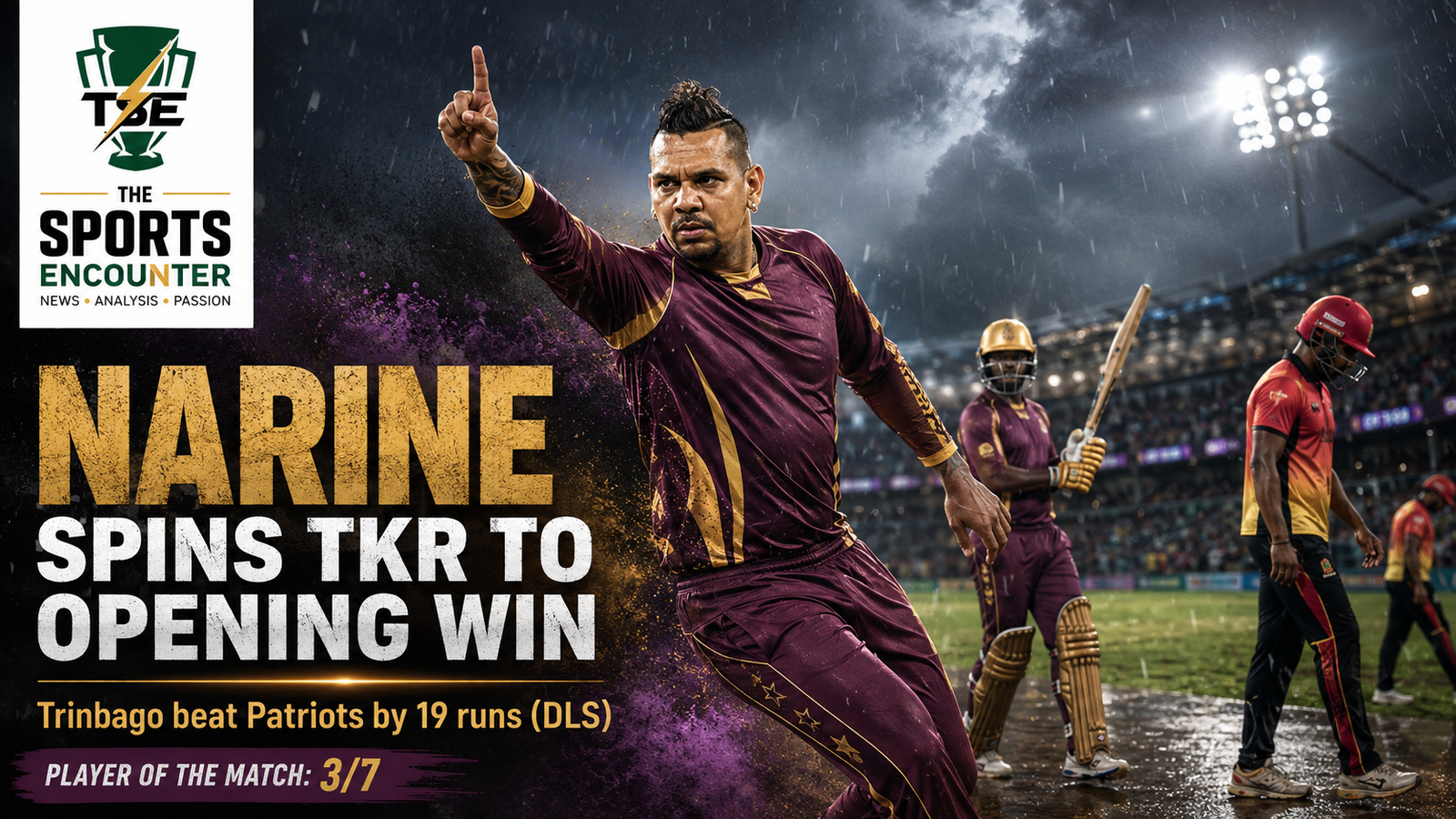
Trinbago Knight Riders began the defense of their Caribbean Premier League title with a controlled 19-run DLS victory over St Kitts and Nevis Patriots after Sunil Narine produced a remarkable 3 for 7 at Arnos Vale Ground in Kingstown.
The rain eventually ended the contest, but it did not decide which team deserved to win.
Trinbago had already dismantled the Patriots’ top order, restricted them to 109 for nine from 20 overs and moved comfortably ahead of the Duckworth-Lewis-Stern requirement before heavy rain returned during the chase on Saturday night.
The revised target had been set at 76 from 15 overs after earlier weather interruptions. TKR reached 94 for two at the end of the 15th over, with Matthew Breetzke unbeaten on 35 from 35 balls and Jyd Goolie on two. Joshua Da Silva had retired hurt after making 18.
With conditions worsening and no realistic prospect of further play, Trinbago were confirmed as 19-run winners under the DLS method.
That gave the defending champions their first two points of CPL 2026 and immediately showed why their bowling attack could again become one of the hardest units to survive in the tournament.
CPL 2026 Match 2: Key Information
| Match Detail | Information |
|---|---|
| Competition | Caribbean Premier League 2026 |
| Match | St Kitts and Nevis Patriots vs Trinbago Knight Riders, Match 2 |
| Date | August 8, 2026 |
| Venue | Arnos Vale Ground, Kingstown, St Vincent |
| Toss | Trinbago Knight Riders elected to field |
| St Kitts and Nevis Patriots | 109/9 in 20 overs |
| Trinbago Knight Riders | 94/2 in 15 overs |
| Revised target | 76 from 15 overs |
| Result | Trinbago Knight Riders won by 19 runs, DLS method |
| Player of the Match | Sunil Narine, 3/7 |
| Top scorer | Kevin Wickham, 38 from 44 balls |
| Best TKR batter | Matthew Breetzke, 35 not out from 35 balls |
| Points | TKR 2, Patriots 0 |
TL;DR
- Trinbago Knight Riders defeated St Kitts and Nevis Patriots by 19 runs under the DLS method in CPL 2026 Match 2.
- The Patriots managed only 109 for nine after collapsing to 16 for three and later 47 for six.
- Sunil Narine delivered an outstanding spell of 3 for 7 from four overs, including 21 dot balls.
- Terrance Hinds also claimed three wickets, while Dominic Drakes took two.
- Kevin Wickham top-scored for the Patriots with 38 from 44 deliveries.
- TKR were set a revised target of 76 from 15 overs and reached 94 for two before rain ended the match.
- Matthew Breetzke finished unbeaten on 35, while Colin Munro made 17 and Joshua Da Silva retired hurt on 18.
- The victory gave defending champions TKR two points from their opening match.
Narine Needed 24 Balls to Put the Patriots in Trouble
St Kitts and Nevis Patriots did not lose this game when the rain returned.
The damage began during Sunil Narine’s first spell.
Andre Fletcher had already shown his intent by striking a six, but Narine removed him for six with the score on seven. Kyle Mayers then fell leg before without scoring from the final ball of the same over.
The Patriots were 8 for two.
Alick Athanaze survived only a little longer. Narine removed him for a duck in the fourth over, leaving St Kitts and Nevis 16 for three and forcing the middle order into recovery mode before the powerplay had finished.
Narine’s final figures were extraordinary even by his standards: four overs, one maiden, seven runs and three wickets.
He delivered 21 dot balls from 24 legitimate deliveries.
That meant the Patriots scored from only three balls across his entire spell.
In a T20 competition built around boundary hitting, that level of control changes an innings before the wickets are even added to the calculation.
The Patriots could neither attack Narine nor rotate the strike consistently enough to escape him. Every quiet over increased the responsibility placed on whoever was batting at the other end.
For a defending champion beginning a new campaign, it was close to the ideal opening spell.
Patriots’ Powerplay Put the Entire Innings Under Pressure
The early collapse meant St Kitts and Nevis spent almost the entire innings rebuilding rather than setting up a finish.
They reached only 24 for three from the six-over powerplay.
Johnson Charles and Kevin Wickham attempted to stabilize the innings, but neither could significantly change the scoring rate. Charles made 21 from 25 balls before Jyd Goolie removed him at 40 for four in the tenth over.
The position then deteriorated quickly.
Jason Holder scored three before Terrance Hinds removed him. Navin Bidaisee fell to Hinds from the next delivery without scoring.
St Kitts and Nevis were suddenly 47 for six after 10.6 overs.
At that stage, reaching 120 would have represented a strong recovery.
Even 110 required work.
Kevin Wickham Provides the Only Real Resistance
Wickham became the central figure in the Patriots’ recovery because he did something their top order had failed to do: stay long enough to give the innings some structure.
His 38 came from 44 deliveries and included two fours and a six.
The strike rate of 86.36 was modest, but the scorecard around him explains why acceleration became difficult.
Fletcher, Mayers and Athanaze combined for six runs.
Holder and Bidaisee added only three between them.
By the time Wickham had a partner capable of staying with him, the Patriots were already trying to rebuild a damaged innings.
Ashmead Nedd finally offered useful support with 18 from 19 balls. Their partnership dragged the total from 47 for six toward something that could at least be defended if the pitch became difficult or the weather complicated the chase.
Dominic Drakes ended Wickham’s resistance at 79, with Akeal Hosein completing the catch.
Netravalkar then fell to Drakes without scoring from the final ball of the same over.
The Patriots were 79 for eight.
McCoy and Nedd Drag the Total Beyond 100
The lower order prevented complete collapse.
Nedd struck a six during his 18, while Obed McCoy provided the fastest meaningful innings of the night for St Kitts and Nevis.
McCoy made an unbeaten 13 from ten deliveries, hitting a four and a six. His late contribution helped the Patriots move beyond 100 before Hinds dismissed Nedd in the final over.
St Kitts and Nevis finished on 109 for nine at 5.45 runs per over.
It was substantially below the kind of total normally associated with safety in T20 cricket, even accounting for a surface that had offered enough grip and variation to keep the batters uncomfortable.
The broader pattern was more damaging than the final number.
Only three Patriots batters reached double figures.
Five members of the lineup scored three runs or fewer.
Three batters were dismissed without scoring.
Those numbers left the bowling attack with almost no margin for error.
TKR’s Bowling Depth Was as Important as Narine’s Brilliance
Narine produced the standout performance, but Trinbago did not rely on one bowler.
Terrance Hinds finished with 3 for 33, removing Holder, Bidaisee and Nedd.
Dominic Drakes claimed 2 for 20 and broke the Wickham-Nedd recovery before dismissing Netravalkar three deliveries later.
Goolie contributed the wicket of Charles.
Akeal Hosein went wicketless but conceded only 23 from his four overs while delivering 15 dot balls.
Across 20 overs, Trinbago’s attack rarely allowed the Patriots to build consecutive productive overs.
That is an important distinction.
Teams can sometimes recover from early wickets if the middle overs produce enough singles, twos and occasional boundaries to rebuild momentum. TKR denied that route.
Their bowlers kept asking the Patriots to restart.
By the time one partnership became established, another wicket broke it.
It resembled the pressure-driven victories seen throughout recent franchise cricket, including Guyana Amazon Warriors’ extraordinary defense of 85 in the Global Super League final. Low-scoring T20 cricket increasingly rewards attacks capable of sustaining pressure across several bowling styles rather than waiting for one strike bowler to rescue the innings.
Hales and Munro Give TKR a Functional Start
Rain had already affected the match before Trinbago began their chase, eventually producing a revised requirement of 76 from 15 overs.
The target changed the batting equation.
There was no need for Colin Munro and Alex Hales to chase the game aggressively from the first over.
Instead, TKR needed to stay ahead of the DLS calculation while protecting wickets in case another interruption arrived.
Hales made nine from 11 before Jason Holder dismissed him with the final delivery of the fourth over.
Munro followed for 17 from 17 when Waqar Salamkheil bowled him in the sixth.
The scoreboard showed 34 for two after 5.3 overs.
The Patriots had created an opening, but the required rate remained comfortably manageable.
Munro’s involvement also carried wider T20 significance for a TKR side packed with experienced short-format players. The modern franchise circuit has pushed career run records into remarkable territory, a trend examined in The Sports Encounter’s analysis of the race to become T20 cricket’s highest run-scorer.
Breetzke and Da Silva Remove the Risk
Matthew Breetzke and Joshua Da Silva then produced exactly the partnership the situation required.
There was little need for spectacular batting.
They needed to keep the chase stable, remain comfortably ahead of the DLS par score and deny St Kitts and Nevis the cluster of wickets that might change the calculation.
TKR reached 50 in eight overs.
At the ten-over strategic timeout, they were 63 for two.
The revised target was 76.
Control had shifted decisively toward Trinbago.
The third-wicket partnership eventually added 50 from 41 balls. Breetzke supplied 30 of those runs, Da Silva 12 and extras accounted for eight.
Da Silva retired hurt after reaching 18 from 22 balls with the total on 88 for two.
By then the contest was effectively under TKR’s control.
Breetzke remained unbeaten on 35 from 35 deliveries, hitting one four and one six. His innings was measured rather than explosive, but that suited the situation perfectly.
Rain Stops TKR From Finishing the Chase
Heavy rain returned with Trinbago on 94 for two after 15 overs.
The umpires removed the bails and the covers were rushed onto the field.
The interruption was frustrating for TKR because they appeared capable of completing the chase comfortably and may have preferred the opportunity to finish quickly enough to strengthen their net run rate.
Instead, the DLS calculation settled the contest.
The revised target after 15 overs had been 76.
Trinbago were on 94.
The official winning margin was therefore 19 runs under the DLS method.
The rain prevented the visual finish of a conventional chase. It did not create the underlying advantage.
Why TKR Deserved the DLS Victory
A rain-affected result can sometimes leave the losing side feeling that weather removed a genuine opportunity.
This one offered little basis for that argument.
TKR controlled all three major phases of the match.
1. Narine destroyed the top order
The Patriots lost Fletcher, Mayers and Athanaze for only 16 runs. Narine conceded seven from four overs and forced the entire middle order into repair work.
2. TKR never allowed a full recovery
Charles and Wickham stabilized the innings, but Goolie’s dismissal of Charles reopened the pressure. Hinds and Drakes then ensured that St Kitts and Nevis could never convert survival into acceleration.
3. The chase stayed comfortably ahead of the requirement
Hales and Munro fell, but TKR still reached 38 for two after the powerplay and 63 for two after ten. Breetzke and Da Silva kept wickets intact while the revised target continued to shrink.
By the time the final rain interruption arrived, Trinbago had eight wickets available and were already 18 runs beyond the target required after 15 overs.
Sunil Narine’s 21 Dot Balls Defined the Match
The raw figures already look exceptional.
4-1-7-3.
The dot-ball count gives the spell even greater context.
Narine bowled 21 deliveries without conceding a run.
That is 87.5% of his legitimate deliveries.
In effect, St Kitts and Nevis had three scoring balls available across an entire four-over quota.
The spell attacked both sides of T20 batting pressure.
Wickets removed established options.
Dot balls removed time.
Fletcher fell early. Mayers disappeared immediately afterward. Athanaze followed before the fourth over had been completed.
Every batter arriving afterward inherited a worse scoreboard and fewer overs in which to repair it.
That cumulative effect is why Narine was the obvious Player of the Match.
Akeal Hosein Starts His Captaincy With the Right Template
TKR entered the season carrying the responsibility that accompanies a championship defense.
The franchise won its fifth CPL title in 2025 and begins 2026 trying to preserve its position as the competition’s most successful team.
Akeal Hosein’s first match of the new campaign offered an encouraging blueprint.
His bowlers attacked early, controlled the middle and avoided giving St Kitts and Nevis a sustained release phase.
Hosein himself conceded only 23 runs from four overs.
The captain then watched his batting lineup avoid unnecessary risk during a rain-sensitive chase.
There will be nights when TKR’s hitters are required to chase 190.
This was a night that demanded reading the conditions and understanding the scoreboard.
They did both.
Patriots Have a Top-Order Problem to Address Quickly
St Kitts and Nevis can take some encouragement from Wickham, Nedd and McCoy getting the innings beyond 100.
The more urgent issue sits above them.
A top three featuring Fletcher, Mayers and Athanaze produced six runs between them.
Charles made 21 but needed 25 deliveries.
That left Wickham trying to rebuild while also being expected to create a competitive total.
No T20 lineup can rely consistently on its seventh, eighth and tenth batters to supply the acceleration missing from the top six.
Jason Holder’s side needs greater resistance against spin and a clearer method for rotating strike when boundaries become difficult.
The recent history against TKR adds to the concern. Trinbago won both meetings between the teams in 2025, including a 12-run victory in Tarouba, and entered this season with a strong recent record in the matchup.
The Patriots have enough bowling quality through Holder, Waqar Salamkheil, Obed McCoy, Netravalkar and Ashmead Nedd to make modest targets uncomfortable.
They first need the batting unit to give those bowlers something worth defending.
CPL 2026 Already Has Two Very Different Matches
The tournament has opened with contrasting examples of T20 cricket.
Antigua and Barbuda Falcons beat Jamaica Kingsmen from the final ball in Match 1, surviving a remarkable late collapse after Tajinder Singh appeared to have settled the chase.
Match 2 was built around control.
There was no 167-run target, no final-ball sprint and no frantic death-over turnaround.
Instead, Narine and the TKR attack slowly removed the Patriots’ options until the chase became an exercise in game management.
That contrast is valuable for a tournament entering its 14th season with an expanded seven-team field.
Fans can follow every developing storyline through The Sports Encounter’s cricket coverage and the dedicated CPL 2026 hub.
Official fixtures, competition information and tournament updates are available through the Caribbean Premier League’s official website.
What Comes Next?
TKR leave their opening match with two points and the confidence that their championship-winning formula still travels.
The batting lineup was never required to show its full power.
The bowling attack already has.
For St Kitts and Nevis, the defeat should create urgency rather than panic. The tournament has only begun, but a 109-run total exposed how quickly their innings can become dependent on recovery if the top order fails.
The next test will reveal whether this was one difficult night against an elite attack or an early warning about their batting structure.
Trinbago face a different question.
They won the 2025 title and have started 2026 with another victory built on bowling discipline, depth and experience.
Narine’s 3 for 7 supplied the headline.
The more important message for the rest of the CPL may be how little TKR needed from everyone else to control the game.
Frequently Asked Questions
Who won St Kitts and Nevis Patriots vs Trinbago Knight Riders in CPL 2026?
Trinbago Knight Riders defeated St Kitts and Nevis Patriots by 19 runs under the DLS method in Match 2 of the 2026 Caribbean Premier League.
What was the score in Patriots vs TKR?
St Kitts and Nevis Patriots scored 109 for nine from 20 overs. Trinbago Knight Riders reached 94 for two after 15 overs before rain ended the match.
Why did TKR win by 19 runs under DLS?
Weather reduced Trinbago’s chase to a target of 76 from 15 overs. TKR reached 94 for two after 15 overs, putting them 19 runs ahead of the applicable DLS target when further play became impossible.
Who was Player of the Match?
Sunil Narine was named Player of the Match after taking three wickets for only seven runs from four overs.
How many dot balls did Sunil Narine bowl?
Narine delivered 21 dot balls in his four-over spell. He conceded only seven runs and took three wickets.
Who scored the most runs for St Kitts and Nevis Patriots?
Kevin Wickham top-scored with 38 runs from 44 deliveries, including two fours and one six.
Who was TKR’s leading scorer?
Matthew Breetzke made an unbeaten 35 from 35 balls, including one four and one six.
How many wickets did Terrance Hinds take?
Terrance Hinds took three wickets for 33 runs from four overs, dismissing Jason Holder, Navin Bidaisee and Ashmead Nedd.
Who captains Trinbago Knight Riders in CPL 2026?
Akeal Hosein captains Trinbago Knight Riders in the 2026 Caribbean Premier League.
Are Trinbago Knight Riders the defending CPL champions?
Yes. Trinbago Knight Riders won the 2025 Caribbean Premier League title and entered the 2026 season as defending champions.
How many points did TKR receive for the win?
Trinbago Knight Riders collected two points from the victory, while St Kitts and Nevis Patriots received none.
Cricket
Is Babar Azam the Solution The Hundred Needs? His BBL|15 Impact Makes the Case
Babar Azam’s BBL|15 numbers were modest, but his wider impact was huge. Sydney Sixers gained followers, stronger crowds, sold-out fan zones and millions of social views. That makes his Big Bash season a compelling blueprint for what The Hundred needs next.


Babar Azam scored only 202 runs during his first Big Bash League season. He averaged 22.44. His strike rate was 103.06. By modern T20 standards, BBL|15 should have been an forgettable tournament for one of Pakistan cricket’s biggest names.
It was anything but forgettable.
Sydney Sixers gained around 35,000 followers around the announcement of his signing.
A dedicated Babar-themed supporter section at the Sydney Cricket Ground sold out.
The Sixers’ average home attendance increased by 9.3% from the previous season.
Ordinary league fixtures began clearing 25,000 spectators more frequently.
Babar-related social media clips generated millions of views.
Pakistani and South Asian supporters who previously had little reason to feel emotionally connected to an Australian domestic franchise suddenly had one.
Babar Azam did something that franchise cricket occasionally values even more than runs.
He made people care.
That is why his BBL|15 experience deserves another look now.
Thousands of miles away, The Hundred is experiencing an uncomfortable 2026 season in England. The cricket has improved, higher-profile players have arrived and broadcast engagement has remained encouraging, yet early men’s attendance fell 18.4% compared with equivalent opening fixtures in 2025.
The Sports Encounter has already examined whether The Hundred is losing its oomph among English cricket fans and why empty seats at Trent Bridge have become part of the 2026 conversation.
The BBL may already have demonstrated one possible solution.
The Hundred needs the Babar Azam effect.
The Babar Azam BBL|15 Paradox
| Measure | Babar Azam in BBL|15 |
|---|---|
| Runs | 202 |
| Average | 22.44 |
| Strike rate | 103.06 |
| Half-centuries | 2 |
| Highest score | 58* |
| Sixers follower increase around signing | Approximately 35,000 |
| Increase in Sixers average home attendance | 9.3% |
| First Sixers home attendance | 20,110 |
| Melbourne Stars home attendance | 25,589 |
| Hobart Hurricanes home attendance | 30,090 |
| Major Babar-related Instagram clip | 15.5 million views |
| Related X clip | 1.9 million views |
The contradiction is the entire story.
If Babar had scored 600 runs at a strike rate of 160, increased attendance could easily have been dismissed as the natural response to a player dominating the tournament.
He did not dominate it.
His statistical season was disappointing.
Yet the audience continued to follow him.
That means Babar’s commercial and cultural impact cannot be explained simply by batting performance.
The product people were buying was Babar himself.
Thirty-Five Thousand Followers Before the Experiment Had Even Begun
Cricket Australia understood Babar’s potential before he faced his first delivery.
When Sydney Sixers announced his signing in June 2025, Cricket Australia highlighted the extraordinary response to a teaser video released by the franchise.
The Sixers had gained around 35,000 new followers.
That happened around the signing announcement.
No innings was required.
No six was required.
No BBL century was required.
Cricket Australia also noted the size of Babar’s existing global social following and his enormous popularity among Australia’s Pakistani diaspora.
The official announcement described him as an addition whose value extended beyond Sydney Sixers to the Big Bash League itself.
That proved remarkably accurate.
For a franchise league, 35,000 new followers are not simply a vanity metric.
They represent 35,000 new opportunities to sell tickets, merchandise, subscriptions, sponsor exposure and future interest.
More importantly, they represent people who have made an active decision to connect with a franchise.
That is difficult to manufacture through advertising alone.
Babaristan Turned a Player Into a Match-Day Culture
Sydney Sixers then made one of the smartest decisions of the entire BBL season.
They did not simply put Babar in a Sixers shirt and hope people arrived.
They created Babaristan.
The dedicated supporter area at the SCG was built around Babar and the South Asian audience accompanying him into the competition.
The concept included culturally relevant entertainment, food, merchandise, fan experiences and a visible place inside the ground where supporters could identify themselves with Babar.
The first Babaristan allocation sold out before the Sixers’ opening home fixture.
Think about what Sydney achieved.
They converted:
- a player into an identity;
- an identity into a community;
- a community into ticket demand;
- ticket demand into atmosphere;
- and atmosphere into a stronger franchise product.
That chain is exactly what The Hundred needs to study.
The Sixers’ Crowd Numbers Make the Case Harder to Ignore
Wisden’s analysis of the season found Sydney Sixers’ average home attendance increased by 9.3% after Babar’s arrival.
The opening home match against Adelaide Strikers attracted 20,110 spectators, the Sixers’ best crowd for their first home game in four years.
Then the numbers grew.
A home fixture against Melbourne Stars drew 25,589.
The Hobart Hurricanes game attracted 30,090 despite the threat of rain.
Those numbers deserve context.
During the previous three seasons, only one Sixers league fixture outside playoffs and the Sydney derby against the Thunder had exceeded 25,000 spectators. That exception involved Steve Smith returning and scoring a century.
With Babar, exceeding 25,000 became less exceptional.
Again, we cannot mathematically assign every additional spectator to one player.
Winning form, scheduling, opponents, weather, other stars and wider BBL momentum all influence attendance.
But the combination of increased crowds, Babaristan demand and the immediate follower surge provides unusually strong circumstantial evidence of his pull.
BBL|15 Was Booming, and Babar Was One of Its Audience Engines
Babar’s arrival also coincided with an excellent season for the wider competition.
Cricket Australia reported that BBL|15 generated a total attendance of 1,089,043, up 12% year over year and the league’s biggest aggregate crowd since BBL|09 despite featuring 17 fewer matches.
The average attendance reached 24,751, the best per-match figure since BBL|07.
Television numbers strengthened too.
BBL|15 averaged 808,000 national viewers per game, a 5% increase, while 13 matches averaged more than one million viewers.
No responsible analysis should claim Babar caused the entire BBL resurgence.
He clearly did not.
The league also featured other Pakistani stars, leading Australian players, competitive cricket and favorable broader momentum.
But Babar became one of the season’s clearest international audience-acquisition assets.
His contribution belonged to the business of the Big Bash as much as to the cricket.
The Batting Numbers Actually Strengthen the Babar Argument
This is where the debate becomes fascinating.
Babar’s cricket numbers were poor for a modern T20 opener.
He scored 202 runs from 11 matches.
His average fell to 22.44.
His strike rate was only 103.06.
Wisden found that among BBL seasons in which a batter had accumulated at least 200 runs, Babar’s scoring rate ranked at the very bottom historically.
There is no point hiding that.
The Hundred would have legitimate sporting questions to ask about whether such a tempo fits a 100-ball competition.
Yet this is precisely why BBL|15 provides such a compelling commercial case study.
Babar failed to produce elite T20 numbers and still produced elite attention.
If he had been the tournament’s dominant batter, performance and popularity would be impossible to separate.
BBL|15 separated them for us.
Fans did not disappear when the hundreds failed to arrive.
The conversation around him continued.
The stands continued filling.
His supporters continued engaging.
Even Babar’s Controversies Became BBL Content
The strangest evidence of Babar’s reach arrived during one of his more frustrating moments.
Steve Smith declined a possible single while batting with Babar so he could retain strike for the next over.
Smith then hammered a BBL-record 32 runs from that over.
Babar later showed visible frustration when dismissed.
The incident exploded across social media.
Wisden reported that an Instagram clip around his reaction reached approximately 15.5 million views.
The corresponding post on X generated around 1.9 million.
Those numbers were far beyond ordinary BBL social reach.
Even commentary questioning Babar’s place in the Sixers side generated hundreds of thousands of views.
That is star gravity.
A sports competition needs moments people want to discuss after the broadcast ends.
Babar generated those moments even when the story was not flattering.
And This Is Where The Hundred Should Be Paying Attention
The Hundred’s 2026 problem has become increasingly difficult to explain through cricket quality.
The competition has better overseas players.
Salaries have increased.
International-standard attacks have improved the level of the men’s competition.
High-profile franchise investors have arrived.
Broadcast and social engagement have shown encouraging signs.
Yet the early attendance numbers moved in the opposite direction.
The first six men’s opening fixtures in 2026 attracted a combined 89,413 spectators, compared with 109,519 at the equivalent venues in 2025.
That represented an 18.4% decline.
Five of the first six venues were down year over year.
England and Trent Rockets batter Ben Duckett publicly admitted he was surprised by the weaker crowds because he believed the standard of cricket had improved.
That question matters.
If better cricket does not automatically bring more spectators, perhaps cricket quality is only part of the problem.
The Hundred Has Better Players. It Needs Players Who Bring People With Them
Franchise cricket often treats player acquisition primarily as a sporting exercise.
How many runs?
What strike rate?
How many wickets?
What matchup?
Those questions remain essential.
But modern sports businesses must ask another question.
How many people will care because this player is here?
Babar provides an unusually clear answer.
He brings a pre-existing audience.
That audience does not need to be taught who he is.
It does not need a six-week marketing campaign explaining why he matters.
It already has an emotional relationship with him.
The challenge for a franchise is simply converting that attachment into attachment to the team.
Sydney Sixers showed how.
The Hundred’s Identity Problem Makes Babar Even More Valuable
The 2026 Hundred has undergone the biggest transformation since its creation.
Private investment brought new owners into the eight franchises following transactions that valued stakes across the competition at hundreds of millions of pounds.
Several teams changed identities, colors or branding.
Oval Invincibles became MI London.
Northern Superchargers became SunRisers Leeds.
Manchester’s franchise adopted the Super Giants identity.
Those moves imported established global franchise brands.
They also disrupted some of the familiarity developed during The Hundred’s first five seasons.
Reporting during the current campaign has linked part of the attendance difficulty to rebranding, ticketing changes and the challenge of integrating new ownership models with established county cricket cultures.
This is where a player such as Babar becomes especially useful.
New brands require emotional shortcuts.
Babar is one.
Babar Could Give a Hundred Franchise Something Money Cannot Immediately Buy
You can buy advertising.
You can buy a new kit.
You can buy digital impressions.
You can buy elite players.
You cannot immediately buy emotional loyalty.
That usually takes years.
A superstar with a committed community can compress that process.
When Babar joined Sydney Sixers, tens of thousands of followers did not suddenly develop a lifelong fascination with Sydney cricket.
They followed Babar.
Then they encountered the Sixers.
That distinction matters.
The player became the gateway to the franchise.
The Hundred needs more gateways.
England May Be an Even Better Environment for the Babar Effect
The potential audience in Britain makes the argument particularly compelling.
England and Wales have a large and deeply established South Asian population. Census 2021 recorded 5.5 million people identifying within the Asian, Asian British or Asian Welsh high-level ethnic group.
Cricket already occupies a powerful cultural position within many British Pakistani and wider South Asian communities.
So The Hundred would not be asking Babar to create cricket interest from nothing.
It would be trying to redirect existing cricket passion toward a particular franchise and competition.
That is a much easier marketing task.
Imagine the Babar Effect at Headingley
One venue immediately illustrates the possibility.
Headingley has struggled for consistent Hundred crowds this season despite featuring high-profile players including Harry Brook, Jofra Archer and Adil Rashid.
The Sports Encounter reported an attendance of only 9,438 when SunRisers Leeds produced a spectacular record chase against Manchester Super Giants.
You can read the full match analysis in our report on Mitchell Marsh and Harry Brook’s record Hundred chase.
Yorkshire also sits beside one of Britain’s most significant Pakistani population centers.
Bradford’s 2021 Census population was 32.1% Asian, Asian British or Asian Welsh.
That does not mean every British Pakistani cricket fan would automatically buy a Hundred ticket because Babar appeared.
But the marketing opportunity is obvious.
A Babar-led franchise at Headingley could reach supporters across Leeds, Bradford and the wider Yorkshire region with a player they already know intimately.
The Hundred Should Study Babaristan, Not Simply Sign Babar
Recruiting him would only be step one.
The Sixers lesson was successful because the club built activation around the player.
The Hundred should recreate the mechanism rather than copy the name.
A franchise could build:
- dedicated Babar supporter sections;
- Urdu-English digital campaigns;
- British Pakistani creator partnerships;
- South Asian food experiences;
- music and entertainment reflecting local communities;
- community-club ticket initiatives;
- school and academy appearances;
- family ticket packages;
- limited-edition Babar merchandise;
- fan meet-and-greet competitions;
- Pakistan-themed rivalry nights;
- digital content designed specifically for audiences in Pakistan.
Then Babar stops being an overseas player occupying one roster slot.
He becomes a customer-acquisition strategy.
That Changes How His Salary Should Be Evaluated
Suppose a franchise looks only at his BBL strike rate.
At 103.06, the answer might be straightforward.
There are more explosive openers available.
But that calculation values only cricket output.
A more complete franchise equation should include:
| Sporting Value | Audience Value |
|---|---|
| Runs | Ticket demand |
| Strike rate | Social reach |
| Matchups | International audience |
| Fielding | Merchandise demand |
| Availability | Sponsor visibility |
| Role balance | Community engagement |
| Match-winning ability | Franchise follower acquisition |
Viewed through both columns, Babar’s value looks very different.
Babar’s Impact Creates a Commercial Multiplier
A true marquee signing can influence several revenue streams simultaneously.
More interest can mean more tickets.
More spectators can mean greater concession sales.
More emotionally invested fans can create merchandise demand.
Greater digital engagement increases sponsor exposure.
International attention strengthens the franchise’s value outside Britain.
Larger social communities create first-party audiences franchises can continue marketing to after the player leaves.
No public dataset allows us to calculate an exact pound value for the Babar effect.
We should not pretend otherwise.
But BBL|15 gives enough measurable evidence to establish that his commercial footprint exceeded what his 202 runs would suggest.
The Hundred Already Knows Babar Has Appeal
There is also an irony here.
Babar and The Hundred have circled each other for years.
The competition’s own official website described him as a global short-form star when he initially registered ahead of the league’s launch.
He was again listed among major overseas names available in subsequent drafts.
Yet the competition has never truly captured the Babar audience in the way Sydney Sixers eventually did.
That now looks like a missed opportunity.
Babar Does Not Have to Be the Best Hundred Batter to Be One of Its Most Valuable Players
This distinction is critical.
Nicholas Pooran may score faster.
Finn Allen may clear more boundaries.
Jos Buttler may offer a more naturally destructive 100-ball profile.
Harry Brook may produce greater tactical value to his team.
Franchise sport can accommodate more than one definition of value.
Babar could be worth more to The Hundred commercially while another player produces more runs per ball.
BBL|15 proved those concepts can coexist.
The Hundred’s Empty Seats Make Audience Value More Urgent
The Sports Encounter has watched this problem evolve throughout the season.
When Trent Rockets played Birmingham Phoenix at Trent Bridge, the official crowd was 11,988.
That represented a respectable five-figure attendance.
But wide television shots repeatedly revealed large unused sections of the stadium.
That contrast became the basis for our deeper examination of The Hundred’s empty-seat problem.
Other matches have demonstrated that demand remains available.
London Spirit attracted 23,847 for its opening men’s game at Lord’s.
Cardiff recorded a tournament-best home crowd during the early stages of the competition.
The Hundred therefore does not face complete audience rejection.
Its problem is inconsistency.
Babar is exactly the type of player who can make an otherwise ordinary Wednesday evening feel less ordinary.
The Hundred Does Not Need Another Rebrand as Badly as It Needs Reasons to Attend
The new ownership era has introduced fresh names, colors, investors and commercial ambition.
None of those automatically gives somebody a reason to leave home.
Fans respond to stories.
They respond to identity.
They respond to rivalries.
They respond to people.
Babar creates all four.
A Babar appearance against Shaheen Shah Afridi could become an event.
A Babar-Ben Duckett matchup could be marketed differently.
A Babar fixture at Lord’s immediately carries global digital potential.
A Babar appearance at Headingley could activate Yorkshire’s Pakistani cricket audience.
One player creates multiple storylines before a ball is bowled.
The Big Bash Discovered the Difference Between a Star and an Audience Magnet
Every franchise league has stars.
Very few athletes bring a ready-made community into the competition.
Babar is one of them.
The Big Bash learned this almost accidentally.
Sydney signed an elite international batter.
What it received was:
- a social-media acquisition engine;
- a diaspora connection;
- a ticketing story;
- a match-day activation platform;
- a sponsorship asset;
- and an international conversation generator.
The fact that his batting underperformed makes those outcomes harder to dismiss.
But Babar Alone Cannot Fix Everything
The Hundred’s structural problems still require structural solutions.
Babar cannot fix confusing franchise identities.
He cannot solve every ticket-pricing issue.
He cannot repair poorly timed fixtures.
He cannot eliminate tension between new investors and traditional county structures.
He cannot guarantee every stadium sells out.
And he cannot single-handedly turn every casual cricket supporter into a Hundred loyalist.
That is why the right description is not miracle cure.
Babar is a catalyst.
The Hundred still has to convert the attention he creates into lasting loyalty.
The Hundred’s Own History Proves New Fans Can Be Reached
The competition should not lose sight of what it has already achieved.
Its official figures show more than 2.5 million spectators attended across the competition’s first five years.
More than 200,000 people bought tickets to their first cricket match through The Hundred.
Families have formed a substantial portion of the audience, while the women’s competition has repeatedly established new attendance benchmarks.
The underlying concept can attract people.
The current challenge is maintaining and deepening that connection as the league changes.
Babar offers a shortcut into one of British cricket’s most passionate existing communities.
The Timing Could Hardly Be Better
Babar is also entering an interesting stage of his career.
He remains one of Pakistan cricket’s defining modern players and one of the sport’s most recognizable international personalities.
The Sports Encounter recently examined his wider career in our extensive assessment of Babar Azam’s place in Pakistan cricket history.
The BBL experiment added another dimension to his profile.
It showed leagues what happens when the Babar brand is activated properly.
A Babar Signing Should Be Built Around More Than Eight Matches
If The Hundred pursues Babar in a future season, his value should start months before opening night.
Announcement day should matter.
Preseason content should matter.
Community outreach should matter.
Merchandise should matter.
Pakistan-specific broadcasting and digital partnerships should matter.
Fixtures involving other Pakistani stars should be deliberately promoted.
Match-night culture should matter.
The Sixers demonstrated the mistake would be signing Babar and treating him like every other overseas player.
BBL|15 Redefined What a Successful Overseas Signing Can Mean
If we evaluate Babar’s Australian season purely through cricket, it was disappointing.
If we evaluate it through franchise economics, audience acquisition and cultural relevance, it becomes something very different.
That distinction matters because sports leagues increasingly compete for attention rather than merely against other cricket leagues.
The Hundred competes with football.
Streaming platforms.
Summer travel.
Concerts.
Social media.
Other forms of cricket.
And simple consumer fatigue.
To win that competition, it needs attractions capable of breaking through.
Babar has already proved he can.
How Badly Does The Hundred Need the Babar Effect?
Badly enough that the BBL evidence should be studied at franchise-board level.
The question should no longer be whether Babar’s strike rate makes him the perfect Hundred opener.
That is only one part of the decision.
The more important strategic question is whether The Hundred can afford to ignore somebody who has already demonstrated an ability to bring a huge cricket community with him.
The Hundred’s investors have spent enormous sums acquiring franchises.
Now they need people to care about those franchises.
BBL|15 supplied a case study in how that can happen.
The Babar Azam Effect in One Table
| BBL|15 Evidence | Potential Lesson for The Hundred |
|---|---|
| Approximately 35,000 Sixers followers gained around signing announcement | A marquee player can accelerate franchise audience acquisition immediately |
| Babaristan sold out | Player identity can become match-day community |
| Sixers average home attendance rose 9.3% | Star power can support physical attendance, not merely online engagement |
| 25,000-plus crowds became more common | Routine fixtures can become events |
| 15.5 million views on one Babar-related Instagram clip | A global star extends relevance beyond match broadcast windows |
| Strong Pakistani diaspora engagement | The Hundred can activate Britain’s established South Asian cricket audience |
| Only 202 runs at a 103.06 strike rate | Audience value can exist independently of elite statistical performance |
The Verdict: The Hundred Needs Babar Azam
Babar Azam’s first Big Bash season produced one of franchise cricket’s most useful recent lessons.
A player can have an ordinary tournament statistically and an extraordinary tournament commercially.
Two hundred and two runs did not define Babar’s BBL|15.
Thirty-five thousand new followers mattered.
Babaristan mattered.
The attendance increase mattered.
The 25,000 and 30,000-strong SCG crowds mattered.
The millions of social-media views mattered.
The Pakistani supporters who suddenly cared about Sydney Sixers mattered.
Those are exactly the kinds of outcomes The Hundred needs more urgently than another cosmetic identity change.
The competition already has talented cricketers.
It already has wealthy owners.
It already has broadcasters.
It already has famous grounds.
What it needs is deeper emotional attachment.
Babar carries that attachment with him.
The Big Bash did not need him to score 500 runs to discover his value.
The Hundred should not need another season of empty seats to understand it.
Babar Azam is not valuable to The Hundred simply because he can open the batting.
He is valuable because he can make people care who is opening the batting.
BBL|15 already proved the difference.
Frequently Asked Questions
How did Babar Azam perform in BBL 2025-26?
Babar scored 202 runs from 11 matches for Sydney Sixers, averaging 22.44 with a strike rate of 103.06. He made two half-centuries and recorded a highest score of 58 not out.
Was Babar Azam successful in the Big Bash?
His batting performance was below expectations, but his wider impact was significant. Sydney Sixers experienced stronger attendance, substantial social-media engagement and increased international interest surrounding his participation.
How many followers did Sydney Sixers gain after signing Babar Azam?
Cricket Australia reported that Sydney Sixers gained approximately 35,000 followers around a teaser campaign preceding Babar’s signing announcement.
What was Babaristan?
Babaristan was a dedicated Sydney Sixers supporter section at the SCG created around Babar Azam and South Asian cricket culture. The first allocation sold out before the Sixers’ opening home match.
Did Babar Azam increase Sydney Sixers attendance?
Wisden calculated that the Sixers’ average home attendance increased by 9.3% during Babar’s season. Multiple factors influence crowds, so the entire increase cannot be attributed solely to him, but the rise coincided with strong Babar-specific ticket and fan engagement.
How successful was BBL|15 overall?
Cricket Australia reported total attendance of 1,089,043, up 12% year over year, with average attendance reaching 24,751. National television audiences averaged 808,000 per match.
Are The Hundred crowds down in 2026?
Yes. Early 2026 data showed the first six men’s opening fixtures drawing 89,413 spectators compared with 109,519 at the equivalent venues in 2025, an 18.4% decline.
Why could Babar Azam help The Hundred?
Babar brings an established international audience, particularly among Pakistani and South Asian cricket fans. His BBL experience demonstrated that his presence can influence follower growth, ticket demand, social engagement and match-day culture even when his individual batting performance is modest.
Would Babar Azam’s strike rate be a concern in The Hundred?
Yes. His BBL|15 strike rate of 103.06 was low for modern short-form cricket. Any franchise considering him would need to evaluate his tactical batting role alongside his much broader commercial and audience value.
Has Babar Azam been available for The Hundred before?
Yes. Babar has previously registered for The Hundred player selection process, including being listed among overseas players by the competition itself.
Could Babar Azam revive The Hundred?
No individual player can solve every structural challenge facing a sports competition. However, Babar’s BBL|15 experience provides strong evidence that he could act as a major audience catalyst for The Hundred, particularly through British Pakistani and wider South Asian cricket communities.
What should The Hundred learn from Sydney Sixers?
The principal lesson is to activate the community around a marquee player rather than simply sign him. Sydney Sixers used Babaristan, targeted fan engagement and culturally relevant experiences to turn Babar’s individual popularity into franchise engagement.
Breaking News
Paul Walter, Tim Seifert Power Manchester Super Giants Amid Disappointing Weekend Hundred Attendance
Paul Walter and Tim Seifert shared a 119-run opening stand as Manchester Super Giants beat Southern Brave by 10 runs in Match 26 of The Hundred 2026. Tristan Stubbs fought back with an unbeaten 53, but Brave fell short as questions over disappointing weekend crowds continued.

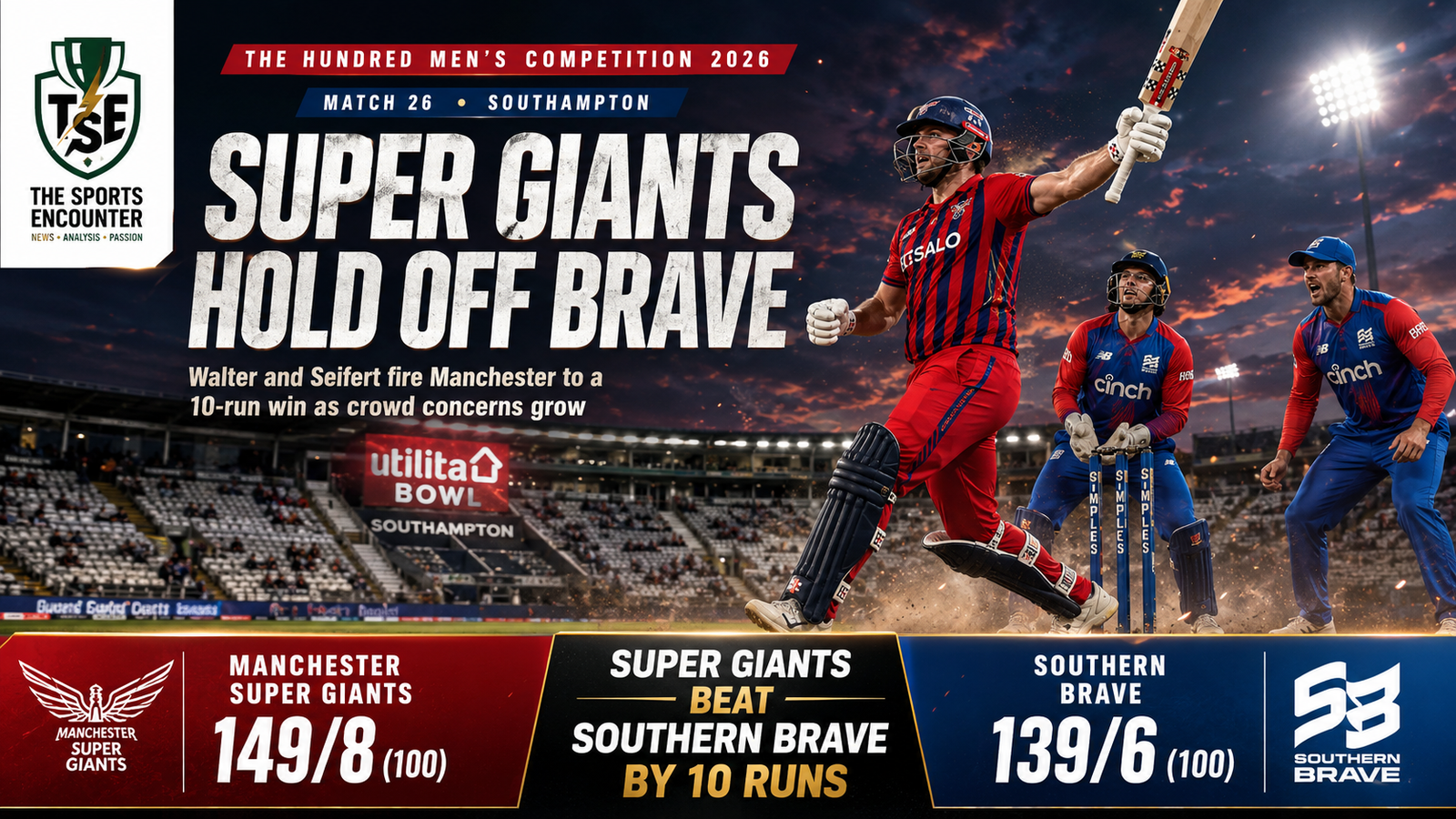
Manchester Super Giants defeated Southern Brave by 10 runs at the Utilita Bowl on Saturday, August 8, after Paul Walter and Tim Seifert built a spectacular opening partnership before their bowlers survived Tristan Stubbs’ late resistance.
The result of Match 26 of The Hundred Men’s Competition 2026 mattered considerably to Manchester’s qualification hopes. The atmosphere surrounding it may ultimately matter almost as much to the tournament itself.
Walter smashed 64 from 32 balls and Seifert made 55 from 34 as Manchester reached 149 for eight from their 100 balls. Southern Brave responded with 139 for six despite Stubbs carrying his bat for an unbeaten 53 from 38 deliveries.
Manchester therefore collected four important points and moved to 16 after seven matches, while Southern Brave remained stranded on eight points after suffering their fifth defeat in seven games.
The quality of the contest deserved attention. The apparent lack of a compelling weekend atmosphere at Southampton raised another question about whether The Hundred is losing some of its pull with English cricket supporters.
Southern Brave vs Manchester Super Giants: Match 26 Scorecard
| Competition | The Hundred Men’s Competition 2026 |
| Match | Match 26 |
| Date | August 8, 2026 |
| Venue | Utilita Bowl, Southampton |
| Toss | Manchester Super Giants elected to bat |
| Manchester Super Giants | 149/8 from 100 balls |
| Southern Brave | 139/6 from 100 balls |
| Result | Manchester Super Giants won by 10 runs |
| Manchester top scorer | Paul Walter, 64 from 32 balls |
| Southern Brave top scorer | Tristan Stubbs, 53* from 38 balls |
| Best Manchester bowling | Gus Atkinson 2/19, Liam Dawson 2/24 |
| Best Southern Brave bowling | Adil Rashid 2/17 |
| Points | Manchester Super Giants 4, Southern Brave 0 |
Walter and Seifert Build Manchester’s Innings Almost by Themselves
Manchester’s final total of 149 for eight disguises how unusual their innings became.
For 63 balls, Southern Brave could not dismiss either opener.
Walter and Seifert put together 119 runs, accounting for almost 80 percent of Manchester’s eventual total before the first wicket fell. Walter provided the greater acceleration, hitting six fours and four sixes during a 32-ball 64 at a strike rate of exactly 200.
Seifert complemented him brilliantly. His 55 came from 34 deliveries, with four fours and two sixes, giving Manchester both stability and scoring pressure from the other end.
It continued an excellent tournament for Seifert, who had already played a decisive role when Manchester demolished Welsh Fire in only 69 balls.
Southern Brave had a dangerous bowling attack containing Jofra Archer, Adil Rashid, Chris Jordan, Luke Wood and Moeen Ali. Walter and Seifert simply refused to allow that reputation to control the opening phase.
Then the entire innings changed.
From 119 Without Loss to 149 for Eight
The first breakthrough arrived when Walter was caught by Chris Jordan off Nikhil Chaudhary on ball 63.
What followed was one of the stranger collapses of The Hundred season.
Jos Buttler made only one from four balls before Jordan removed him. Seifert was run out for 55. Heinrich Klaasen faced four deliveries without scoring and fell to Rashid.
Leus du Plooy was then run out for one.
Manchester had gone from 119 without loss to 125 for five in only 13 deliveries.
The collapse carried additional significance because Buttler entered the contest shortly after becoming the highest run-scorer in men’s T20 cricket history. This time, Southern Brave prevented him from building another destructive innings.
Adil Rashid was particularly impressive. His 20 balls cost only 17 runs while producing the wickets of Klaasen and Michael Bracewell.
Jordan conceded nine from 10 balls and removed Buttler, while Chaudhary took Walter’s valuable wicket for figures of one for 14.
Those spells dragged Manchester back from the possibility of a much bigger total.
Tom Moores added 16 from 12 balls and Gus Atkinson finished unbeaten on six as Manchester scraped their way to 149.
Given what had happened after the opening partnership, Southern Brave would have considered the chase manageable.
Gus Atkinson Gives Manchester the Perfect Start
Southern Brave needed 150.
Three balls later, they were already in trouble.
Michael Pepper was bowled by Atkinson without scoring, giving Manchester exactly the type of start required when defending a competitive rather than overwhelming total.
Jamie Smith and Stubbs then attempted to rebuild.
The pair added 54 for the second wicket, but the partnership required 49 deliveries. That pace gradually pushed the required rate upward.
Smith scored 26 from 25 balls before Liam Dawson removed him.
Three deliveries later, Dawson struck again.
Moeen Ali departed without scoring.
Southern Brave had gone from 54 for one to 54 for three.
Stubbs Gives Southern Brave a Route Back Into the Match
Stubbs understood that simply surviving would no longer be enough.
Marcus Stoinis joined him and immediately changed the tempo, making 21 from 12 balls with two fours and a six.
The pair moved Southern Brave to 94 before Josh Tongue dismissed Stoinis after 76 balls.
The problem remained the number of deliveries already consumed.
Southern Brave reached 100 only after 80 balls. That left them needing 50 from the final 20.
Stubbs continued fighting.
The South African reached his half-century from 37 balls, with three sixes providing most of the acceleration. His unbeaten 53 eventually came from 38.
David Miller could not provide the finishing surge Brave needed. Michael Bracewell removed him for seven from eight balls.
Chaudhary briefly created another opening, striking four boundaries during a 10-ball 19.
Atkinson ended that threat on ball 99.
Chris Jordan hit the final delivery for four, but the outcome had already been decided.
Southern Brave finished 10 runs short.
Atkinson and Dawson Win the Middle Battle
Manchester’s bowling numbers explain why Stubbs could never completely unlock the chase.
Atkinson produced 11 dot balls among his 20 deliveries and finished with two wickets for 19 runs.
Dawson took two for 24, dismissing Smith and Moeen at precisely the stage when Brave needed to increase the pace.
Bracewell conceded only 12 from 10 deliveries and dismissed Miller.
Noor Ahmad went wicketless but allowed only 25 from his full allocation.
Tongue was more expensive at 36 from 20 balls, although Stoinis’ wicket justified his contribution in a critical phase.
Manchester effectively made Stubbs bat around a required rate that kept climbing.
The Hidden Turning Point: Southern Brave Never Recovered From Their First 55 Balls
The scorecard points toward Walter and Seifert as the headline performers, but Southern Brave probably lost the chase earlier than the final 20 balls suggest.
Their mandatory 25-ball powerplay produced only 26 runs and the wicket of Pepper.
They needed 48 deliveries to reach 50.
Smith and Stubbs produced a valuable rebuilding partnership after the early wicket, yet Manchester were comfortable allowing singles while the equation became steadily harder.
By the time Brave reached 54, more than half their innings had disappeared.
Then Dawson removed Smith and Moeen within three deliveries.
That sequence forced Stoinis, Miller, Chaudhary and Stubbs to chase an accelerating required rate against a bowling attack able to vary pace and matchups.
Stubbs’ innings kept the scoreboard respectable. Manchester had already created the conditions that made the chase increasingly improbable.
Manchester Super Giants Join the Qualification Fight on 16 Points
The victory carried major table consequences.
Manchester entered the fixture with 12 points from six games following three victories and three defeats. Their four points at Southampton lifted them to 16 from seven.
That puts them directly into a crowded qualification battle with several teams around the upper section of the standings.
The turnaround has been important because Manchester had looked vulnerable following their 45-run defeat against MI London.
The response since then has been impressive.
They crushed Welsh Fire by nine wickets before beating Southern Brave away from home.
Manchester now have a genuine pathway toward the knockout stage.
Southern Brave face the opposite reality.
They remain on eight points after seven games, having won only twice. Their problems are becoming particularly difficult to explain because the squad contains Archer, Rashid, Stoinis, Stubbs, Miller, Moeen and Jordan.
They have repeatedly produced competitive passages without controlling complete matches.
The pattern was visible earlier when Welsh Fire defeated Southern Brave despite another promising bowling effort.
The latest loss leaves their qualification prospects hanging by a thread.
A Saturday Evening at The Hundred Should Look and Feel Bigger Than This
There was another story around the cricket at Southampton.
The Hundred was playing a Saturday double-header during the English summer, at a major international venue, with some of the most recognizable names in world cricket involved.
But the broader attendance discussion surrounding the 2026 competition refuses to disappear.
No reliable official attendance number for this specific men’s match had been publicly established at the time of writing, so it would be misleading to attach an unverified figure to the contest.
The trend around the competition, however, is already documented.
Early reporting showed attendance across the opening six men’s matches of The Hundred 2026 falling by more than 18 percent compared with the corresponding fixtures in 2025. The Utilita Bowl was among the venues where crowd levels had also attracted attention.
The Sports Encounter has already examined the issue after noticeable empty seats appeared during a competitive Trent Rockets match at Trent Bridge.
That fixture officially attracted 11,988 spectators, yet significant gaps remained visible around the stadium.
The Southampton concern deserves attention because Saturday fixtures should represent one of The Hundred’s strongest opportunities to attract families and casual sports fans.
This season also has bigger salaries, increased overseas-player allowances and substantially greater private investment. The playing standard has generally risen.
The commercial challenge is turning that investment into stronger emotional attachment among local supporters.
The tournament can point toward broadcasting figures, digital engagement and the quality of its cricket. Those are valid measurements.
Fuller grounds remain one of the clearest public measures of whether people feel compelled to attend.
The Cricket Has Improved. The Event Still Needs More Oomph
That contradiction is becoming one of the defining themes of The Hundred 2026.
On the field, supporters are seeing extraordinary performances.
Sunrisers Leeds have produced record totals. Trent Rockets have become one of the tournament’s strongest teams. Manchester have Buttler, Seifert and Klaasen. MI London have assembled an intimidating group of international stars.
Only hours before this Southampton contest, Mitchell Santner powered Trent Rockets past MI London at The Oval to strengthen their position near the top of the competition.
The talent level provides plenty to sell.
The crowd conversation suggests the product still has work to do when converting sporting quality into urgency, attachment and matchday demand.
That becomes especially noticeable when a weekend fixture involving Buttler, Archer, Rashid, Klaasen, Stoinis, Miller, Stubbs and Dawson fails to generate the type of visual atmosphere such a collection of players should command.
What This Result Means for Manchester Super Giants
Manchester suddenly look dangerous again.
They have batting firepower throughout the order, while Atkinson, Dawson, Noor, Tongue and Bracewell give them several different bowling options.
Walter’s innings also matters structurally.
Manchester cannot expect Buttler and Seifert to carry every chase or powerplay. Walter scoring 64 from 32 gives the lineup another aggressive option and makes their batting less predictable.
The concern will be the collapse from 119 without loss to 149 for eight.
Against a stronger chase, that could easily have cost them the game.
What Went Wrong for Southern Brave?
Brave once again found themselves chasing the match rather than controlling it.
The bowlers recovered impressively after Walter and Seifert’s opening assault. Restricting Manchester to 149 after they had reached 119 without losing a wicket was an outstanding comeback.
The batting failed to capitalize.
A target of 150 required an average of 1.5 runs per ball.
Southern Brave scored only 26 from their first 25 and 50 from their first 48.
That forced their middle and lower order into increasingly high-risk cricket.
Stubbs played the situation intelligently and remained unbeaten, but an innings can become stranded when too much catching up is required at the other end.
Southern Brave now need more than improved individual performances. Their season also depends heavily on the wider qualification picture.
Key Takeaways From Southern Brave vs Manchester Super Giants
- Manchester Super Giants defeated Southern Brave by 10 runs.
- Manchester scored 149 for eight from their 100 balls.
- Paul Walter struck 64 from 32 balls with six fours and four sixes.
- Tim Seifert made 55 from 34 balls.
- Walter and Seifert shared a 119-run opening partnership.
- Manchester then collapsed from 119/0 to 149/8.
- Adil Rashid took two wickets for only 17 runs from 20 balls.
- Southern Brave finished on 139 for six.
- Tristan Stubbs remained unbeaten on 53 from 38 deliveries.
- Gus Atkinson took 2/19 and delivered 11 dot balls.
- Liam Dawson claimed 2/24.
- Manchester moved to 16 points from seven matches.
- Southern Brave remained on eight points after their fifth loss.
- The match also continued the wider conversation around The Hundred’s declining 2026 attendances.
Final Verdict
Manchester Super Giants won because they controlled the most important sections of the contest.
Walter and Seifert created the scoreboard advantage. Atkinson struck immediately. Dawson interrupted Southern Brave’s recovery. Manchester then kept enough pressure on Stubbs to ensure his half-century never became a winning one.
For Southern Brave, the frustrating part is that their bowlers gave them a genuine opportunity after Manchester’s dramatic collapse.
Their batting tempo gave that opportunity away.
The larger concern belongs to The Hundred.
Saturday evening cricket involving a collection of international stars should feel like a major sporting event. As the competition approaches its decisive stage, English cricket has to pay attention to whether the tournament is generating enough demand inside the grounds to match the investment, talent and spectacle being built around it.
The cricket at Southampton was competitive.
The race for qualification became more interesting.
The conversation about The Hundred’s ability to fill grounds will continue.
For official fixtures, results and competition information, visit The Hundred’s official website.
Frequently Asked Questions
Who won Southern Brave vs Manchester Super Giants in The Hundred 2026?
Manchester Super Giants defeated Southern Brave by 10 runs at the Utilita Bowl in Southampton on August 8, 2026.
What was the score in Southern Brave vs Manchester Super Giants?
Manchester Super Giants scored 149 for eight from 100 balls. Southern Brave finished on 139 for six from their 100 deliveries.
How many runs did Paul Walter score?
Paul Walter scored 64 from 32 balls, hitting six fours and four sixes at a strike rate of 200.
How many runs did Tim Seifert score?
Tim Seifert made 55 from 34 balls, including four fours and two sixes.
How big was Walter and Seifert’s opening partnership?
Walter and Seifert added 119 runs for Manchester’s first wicket before Walter was dismissed on ball 63.
How many runs did Tristan Stubbs score?
Tristan Stubbs finished unbeaten on 53 from 38 balls. He hit one four and three sixes.
Who were Manchester Super Giants’ best bowlers?
Gus Atkinson took two wickets for 19 runs from 20 balls, while Liam Dawson claimed two for 24.
How many points do Manchester Super Giants have after Match 26?
Manchester moved to 16 points from seven matches following their fourth victory of the 2026 competition.
Can Southern Brave still qualify for The Hundred playoffs?
Southern Brave remained on eight points after seven matches and have only one group-stage fixture remaining. Their position makes qualification extremely difficult and dependent on other results as well as their own final performance.
What was the attendance for Southern Brave vs Manchester Super Giants?
A reliable official attendance figure for the August 8 men’s match had not been established in the available sources at the time of publication. The game took place against the backdrop of a documented fall in The Hundred’s 2026 crowds.


FIFA Says Infantino Is Being Undermined as Leadership Crisis Turns Into a Battle Over Legitimacy
FIFA has escalated its defense of Gianni Infantino, warning of a concerted effort to undermine its president as the fallout...


When Will Lionel Messi Retire? Argentina President Says Only Messi Has the Answer
Lionel Messi’s retirement remains an open question after his eight-goal 2026 World Cup. Argentina president Claudio Tapia says only Messi...


English FA Turns Its Back on Gianni Infantino, Withdraws Support for Re-Election
The English FA has formally withdrawn its support for Gianni Infantino’s bid for another term as FIFA president, adding major...


FIFA President Apologizes to Member Nations After FIFA World Cup Selloff Plan Fails to Inspire
FIFA has apologized to its member associations after abandoning a controversial plan to sell a 20% stake in a new...


Infantino in Survival Mode After World Cup Stake Sale Idea Results in Global Revolt
Gianni Infantino’s abandoned World Cup commercial rights proposal has triggered an internal FIFA revolt, lost European support, and drawn a...


Crisis Plagues FIFA as Wenger, Grafstrom and Federations Break Ranks
Gianni Infantino’s grip on FIFA is under growing pressure after senior officials, European federations and former allies distanced themselves from...


Infantino Looks to Smaller Nations After UEFA, CONCACAF Snub
Gianni Infantino’s FIFA future may depend on smaller and emerging nations after UEFA and CONCACAF lost confidence in his leadership....


FIFA’s World Cup Stake Plan Failed in Three Days. The Damage to Gianni Infantino May Last Much Longer
FIFA’s attempt to sell a 20% stake in a new World Cup commercial entity collapsed within days after a global...


Cristiano Ronaldo’s World Cup Career: Goals, Records and Final Farewell
Cristiano Ronaldo became the first man to score in six FIFA World Cups, but football’s greatest tournament never gave him...


The Golden Generation Saying Goodbye After the FIFA World Cup 2026
The 2026 World Cup did more than crown a champion. It marked the emotional farewell of a generation that shaped...


Neymar’s World Cup Career: Skill, Pain, and the Rainbow Flick Legacy
Neymar carried Brazil’s World Cup hopes across four tournaments, producing unforgettable goals while enduring injuries, criticism and elimination heartbreak. His...


Is the FIFA World Cup 2030 Not for Sale Anymore?
FIFA’s proposal to sell a minority stake in a $20 billion World Cup commercial company appears to have collapsed after...


FIFA Explores 64-Nation World Cup for 2030: Is Another Expansion Worth It?
FIFA is examining whether the 2030 World Cup should expand from 48 to 64 teams. The proposal could increase global...


FIFA Revolt Moves Inside Infantino’s Office as Cordeiro Quits and Kevin Lamour Condemns World Cup Selloff
FIFA’s World Cup stake crisis has moved inside the organization. Carlos Cordeiro has resigned in protest, while chief operating officer...


Infantino’s World Cup Selloff Crisis Deepens as Adviser Quits and UEFA Backs FIFA Boycott
Gianni Infantino’s plan to bring private investors into a $20 billion FIFA commercial company has triggered a global soccer revolt....


CONCACAF Rejects FIFA’s World Cup Stake Plan as Infantino Faces a Global Governance Revolt
CONCACAF has unanimously rejected FIFA’s proposal to bring private investors into a new company controlling the commercial business of the...


Could UEFA Create Its Own World Cup? Kaveh Solhekol’s Warning Shows How Far the FIFA Crisis Could Go
UEFA’s threat to boycott FIFA competitions has opened a much bigger question for world soccer: if Europe walks away from...


UEFA Votes 55-0 for FIFA Boycott as Infantino’s World Cup Plan Sparks Open Revolt
UEFA’s 55 member associations have unanimously threatened to withdraw their national teams from FIFA competitions unless Gianni Infantino abandons plans...


Why FIFA Selling Stakes in the World Cup Isn’t a Good Idea
FIFA plans to raise up to $4.2 billion by selling minority stakes in a new commercial company valued at $20...


FIFA and UEFA at Loggerheads: Could the $20 Billion World Cup Plan Trigger a Global Soccer Revolt?
UEFA has opened a direct confrontation with FIFA over its proposed $20 billion World Cup company. The decisive battle will...


Pavithran Delivers Under Pressure as Malaysia End the Philippines’ Semifinal Dream
Pavithran Gunalan’s decisive header earned Malaysia a tense 1-0 victory over the Philippines, secured second place in Group B and...


Thailand Hold Their Nerve, End Myanmar’s Run and March Into the Semifinals
Worachit Kanitsribumphen and Jehhanafee Mamah converted penalties as Thailand beat Myanmar 2-0, won Group B with a perfect record and...


Ilhan Fandi Delivers the Point That Sends Singapore Through
Ilhan Fandi rescued Singapore with a decisive second-half equalizer against Indonesia, earning the Lions the point they needed to reach...


Barcelona Captain Heads to Liverpool in Surprise Loan Move
Liverpool have moved for Barcelona captain Ronald Araújo on a surprise season-long loan, giving Andoni Iraola an experienced center back...


Gerónimo Rulli Returns to Manchester City After a Decade
Gerónimo Rulli is set to return to Manchester City a decade after his first spell, with James Trafford’s £40 million...


Premier League 2026–27 Curtain Raiser: Fixtures, Teams, Title Contenders, Transfers and Season Predictions
The 2026–27 Premier League season begins with Arsenal hosting Coventry City on August 21. Explore the full opening weekend schedule,...


Vinicius Jr Signs Real Madrid Deal Until 2032 as Arsenal Transfer Hopes End
Real Madrid have secured Vinicius Jr on a long-term contract through June 2032, ending months of uncertainty and closing the...


Arsenal Secure Emirates Shirt and Stadium Sponsorship Deal Until 2033
Arsenal and Emirates have extended their landmark partnership until 2033, keeping the airline as the club’s front-of-shirt, training kit, and...


Anze Kopitar Becomes Immortal in Los Angeles as Kings Retire No. 11 and Build His Statue
The Los Angeles Kings will retire Anze Kopitar’s No. 11 and unveil a bronze statue outside Crypto.com Arena, cementing the...


Ville Koivunen’s Eight-Year, $32M Penguins Deal Is a Bet on Pittsburgh’s Next Era
The Pittsburgh Penguins have committed to their future by signing 23-year-old forward Ville Koivunen to an eight-year, $32 million contract...


Tommy Novak’s $13.95M Penguins Extension Reveals Pittsburgh’s Plan Beyond the Crosby Era
The Pittsburgh Penguins have secured versatile forward Tommy Novak on a three-year, $13.95 million extension. After recording 42 points in...


10 Highest-Paid NHL Players in History After Macklin Celebrini Takes Top Spot?
Macklin Celebrini’s record $18.8 million annual cap hit has changed the NHL salary hierarchy. We rank the 10 highest-paid NHL...


Ron Duguay Hospitalized After Collapse as Cancer Battle Takes a Dangerous Turn
Former New York Rangers star Ron Duguay remains hospitalized after collapsing at home, losing several teeth and suffering internal bleeding...


Is Babar Azam the Solution The Hundred Needs? His BBL|15 Impact Makes the Case
Babar Azam’s BBL|15 numbers were modest, but his wider impact was huge. Sydney Sixers gained followers, stronger crowds, sold-out fan...

Paul Walter, Tim Seifert Power Manchester Super Giants Amid Disappointing Weekend Hundred Attendance
Paul Walter and Tim Seifert shared a 119-run opening stand as Manchester Super Giants beat Southern Brave by 10 runs...


Mitchell Santner Blasts Trent Rockets Into The Hundred Top Three With Six-Wicket Win Over MI London
Mitchell Santner blasted an unbeaten 52 from 23 balls and Tim David added 32* as Trent Rockets chased 148 in...


Rickelton and Carse Crush Birmingham Phoenix as SunRisers Leeds Surge to Second in The Hundred
Ryan Rickelton’s 65 set up SunRisers Leeds before Brydon Carse and Matthew Potts tore through Birmingham Phoenix, sealing a 45-run...

Raza’s Late Power Carries MI London Through Lord’s Chase
Sikandar Raza supplied the late power after Nicholas Pooran and Sam Curran rebuilt the chase, carrying MI London past London...


Wimbledon 2026 Withstands FIFA World Cup Clash, Breaks Attendance Record
Wimbledon attracted a record 550,151 spectators and generated 4.8 billion social media impressions in 2026. Dry weather, Arthur Fery’s semifinal...


Wimbledon Men’s Singles Champions: How Triumph on Grass Changed Their Careers
From Spencer Gore and William Renshaw to Roger Federer, Novak Djokovic, Carlos Alcaraz, and Jannik Sinner, discover how every Wimbledon...


Guo Hanyu and Kristina Mladenovic Turn Trust Into Wimbledon 2026 Glory
Guo Hanyu and Kristina Mladenovic turned a new partnership into Wimbledon glory, defeating Gabriela Dabrowski and Luisa Stefani in a...


Jannik Sinner’s Wimbledon Defense Against Novak Djokovic and Alexander Zverev
Jannik Sinner’s Wimbledon 2026 defense began with a five-set escape and ended with victories over Novak Djokovic and Alexander Zverev....


Muchova, Noskova Turn Wimbledon Women’s Singles Final Into an All-Czech Affair
Karolina Muchova saved match point to beat Coco Gauff in a Centre Court thriller, while Linda Noskova handled Marta Kostyuk...


When Paris Welcomed Two New French Open Champions
Paris, France – June 9, 2026: There are days at Roland Garros when tennis feels like a sport. Then there...


French Open 2026: Mirra Andreeva Becomes a Grand Slam Reality
Mirra Andreeva relived the memories of Monica Seles on Super Sunday at Roland Garros to lift her maiden French Open...


Alexander Zverev Beats Flavio Cobolli, Agony to Lift Maiden French Open Title
Paris, France – June 7, 2026: While some titles are won in two weeks, Alexander Zverev took years of frustration,...


Galle Gallants Are LPL 2026 Champions After 5-Wicket Revenge Win Over Jaffna Kings
Galle Gallants are the 2026 Lanka Premier League champions after defeating Jaffna Kings by five wickets, chasing 124 in 15.5...


LPL 2026 Final Preview: Galle Seek Revenge as Jaffna Chase a Fifth Crown
Galle Gallants and Jaffna Kings meet in the Lanka Premier League 2026 final after three dramatic clashes this season, with...


Harper and Asalanka Punish Colombo’s Chaos as Galle Reach LPL Final
Sam Harper’s commanding 77 and Charith Asalanka’s composed 59 carried Galle Gallants past Colombo Kaps and into the LPL 2026...

McDermott and Neesham Set the Trap Before Sahan Ends Kandy’s LPL Run
Colombo Kaps eliminated Kandy Royals by 68 runs after McDermott and Neesham powered them past 200 before Sahan and Dahani...


Mishara’s Unbeaten 108 Sends Jaffna Kings Into LPL Final After 470-Run Assault
Kamil Mishara’s unbeaten century carried Jaffna Kings into the LPL 2026 final after Galle Gallants fell 14 runs short in...


Guyana Amazon Warriors Defend 85 to Break San Francisco Hearts and Retain Global Super League Title
Guyana Amazon Warriors recovered from 29 for eight, defended a total of 85, and defeated San Francisco Unicorns by six...


Tim Robinson Explodes as Unicorns Thump Vipers to Enter the Global Super League Final
Tim Robinson struck an unbeaten 68 as San Francisco Unicorns defeated Desert Vipers by eight wickets in the Global Super...

Perth Find Their Missing Finish as Spin Silences Guyana
Brody Couch rescued Perth Scorchers XI with 43 before five spin options dismantled Guyana Amazon Warriors for 121 in a...


Akeal Hosein Nearly Steals It, but Desert Vipers Escape in Final Over
Rilee Rossouw mastered a difficult Providence pitch before Desert Vipers survived Akeal Hosein’s four-wicket fightback to beat Perth Scorchers XI...


Shadab Khan and Zachary Carter Rescue Desert Vipers’ GSL Campaign
Shadab Khan dismantled San Francisco’s middle order before 19-year-old Zachary Carter launched a fearless chase, helping Desert Vipers secure their...


LeBron James Says No to LA 2028, but Team USA Is Reportedly Saving Him a Seat
LeBron James says he plans to watch the 2028 Los Angeles Olympics, but USA Basketball is reportedly prepared to give...


A Documentary on LeBron James in the Making?
ESPN is reportedly close to securing unprecedented access to LeBron James’ final NBA chapter, combining his Philadelphia title chase with...


Do the 76ers Have the NBA’s Best Starting Five After Adding LeBron James?
Philadelphia’s projected starting five now carries 36 All-Star selections, five MVP awards, elite scoring, defensive power, and a rookie wild...


How LeBron James Turns Philadelphia 76ers Into the NBA’s Must-Watch Team
LeBron James has not played a minute for the 76ers yet, but his arrival has already transformed Philadelphia into one...


Philadelphia 76ers Officially Announce LeBron James Signing, Assign 23 Jersey
LeBron James will wear No. 23 for the Philadelphia 76ers after officially joining the franchise for what he called his...


Pro Football Hall of Fame Class of 2026: Brees Headlines a Canton Night of Greatness and Hard Truths
Drew Brees led a powerful 2026 Pro Football Hall of Fame class featuring Larry Fitzgerald, Luke Kuechly, Adam Vinatieri and...


NFL Training Camp Roundup: Lane Johnson Eyes Farewell, Bears Fear Burden Injury as Broncos and Jaguars Reshape Depth
Lane Johnson says 2026 will probably be his final NFL season, while Luther Burden III leaves Bears practice injured, Matt...


Meet NFL’s Highest-Paid Guard: Peter Skoronski
The Tennessee Titans have made Peter Skoronski the NFL’s highest-paid guard with a four-year, $100 million extension, locking in a...



Carlos Alcaraz Skips Cincinnati Open, Casts Doubts on US Open Title Defense
Carlos Alcaraz will miss the 2026 Cincinnati Open as he continues recovering from the wrist injury that has sidelined him...


Why Novak Djokovic’s Cincinnati Return Could Decide His US Open 2026 Record Chase
Novak Djokovic will return to the Cincinnati Open for the first time since his memorable 2023 title run. At 39,...


US Open 2026 Curtain-Raiser: Players, Schedule, Title Contenders, New York Storylines and Everything Fans Need to Know
The US Open 2026 heads to New York with Jannik Sinner, Carlos Alcaraz, Novak Djokovic, Aryna Sabalenka, Coco Gauff, Iga...