


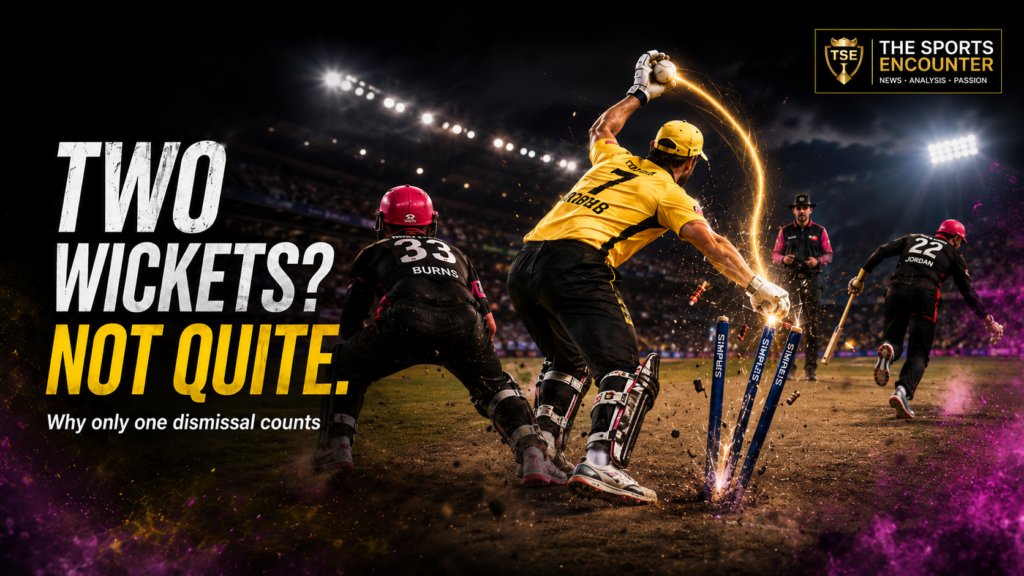
A fielder takes a clean catch, turns toward the stumps, and runs out the other batter before anyone has time to process what just happened.
For a split second, it looks like cricket has produced the perfect double play: two batters defeated by the same fielder from a single delivery.
The scorecard, however, records only one wicket.
The striker who was caught must leave the field. The apparent run-out of the non-striker does not count because the delivery effectively ended when the catch was completed.
The sequence captured in the video below offers a brilliant example of how cricket’s dismissal laws operate when two possible wickets appear to occur from the same ball.

Can Two Batters Be Dismissed From One Ball?
Under normal cricket laws, a team cannot lose two wickets from one legal delivery.
A single ball can create several valid-looking dismissal opportunities. The striker might edge the ball, a fielder might complete a catch, and the non-striker may also be standing outside the crease when the wicket is broken.
Only one dismissal is entered in the scorebook.
In the incident shown above, the striker hit the ball in the air. The fielder completed the catch and then immediately used the same ball to break the stumps at the non-striker’s end.
Both actions were impressive. Only the first one had legal force.
Why the Caught Batter Has to Leave
The decisive rule comes from Law 33 of the MCC Laws of Cricket.
Law 33.5 establishes that a caught dismissal takes precedence when the conditions for a fair catch have been satisfied. That remains the case even when another method of dismissal could also appear justified during the same passage of play.
Once the fielder gained complete control of the ball and of their own movement, the catch was completed. At that moment, the striker was out caught.
The striker therefore became the dismissed batter and had to leave the field.
Key Rule
When a fair catch is completed, the striker is out caught. A second dismissal cannot then be added from the same delivery.
Why the Run-Out Does Not Count
The answer lies in the dead-ball law.
Under MCC Law 20.1.1.3, the ball becomes dead when a batter is dismissed. It is treated as dead from the instant of the incident that caused the dismissal.
Here, that incident was the completion of the catch.
Anything that happened afterward formed part of the visual sequence, but it could not create a second wicket because the ball was already dead in law.
The fielder could still throw the ball, remove the bails, or celebrate the apparent double dismissal. None of those actions could change the legal outcome.
The Sequence in Simple Terms
- The striker hits the ball in the air.
- The fielder completes a fair catch.
- The striker is dismissed caught.
- The ball becomes dead at the instant the catch is completed.
- The fielder then breaks the stumps at the other end.
- The non-striker cannot be run out because the ball is no longer in play.
What Does “Caught Takes Precedence” Mean?
Cricket deliveries can become complicated because more than one form of dismissal may seem possible.
A batter could edge the ball onto the pad, offer a catch, collide with the stumps, or leave the crease during the same fast-moving passage. Umpires need a clear hierarchy to determine which dismissal should be recorded.
The caught law supplies that hierarchy in this situation.
If the catch is fair and the striker has not already been bowled, the striker is out caught. The law gives that dismissal priority over another possible decision involving either batter.
That wording matters because it prevents one delivery from removing two batters through overlapping events.
Was the Fielder’s Run-Out Attempt Pointless?
From a legal perspective, yes. From a sporting perspective, it was still a remarkable display of awareness.
The fielder completed the catch, recognized that the non-striker was away from the crease, and reacted immediately. That combination of control, speed, and presence of mind explains why the clip feels so unusual.
Fielders are trained to finish every play. They may not always know whether a catch was completed cleanly, whether a no-ball has been called, or whether the umpire has recognized the dismissal. Breaking the stumps can protect the fielding side if the first dismissal is later ruled invalid.
Suppose the catch had been dropped or judged incomplete. The ball would have remained live, and the run-out might then have become the valid dismissal.
That possibility gives the fielder a practical reason to continue the play.
What If the Catch Had Not Been Completed?
The outcome could have changed completely.
A catch is only completed when the fielder has full control of the ball and their movement. Brief contact with the ball is insufficient. The fielder must secure it without grounding the ball or losing control during the completion process.
If the fielder had failed to complete the catch but recovered quickly enough to break the wicket, the non-striker could have been run out, provided that batter was outside the crease and the ball remained live.
In that version of events:
- The striker would remain not out because the catch was incomplete.
- The non-striker could be dismissed run out.
- Only the run-out would appear on the scorecard.
The same movement could therefore produce a different dismissed batter depending on whether the catch was legally completed.
What If It Was a No-Ball?
A no-ball introduces another layer.
A striker generally cannot be dismissed caught from a no-ball. A batter can, however, still be run out in certain circumstances.
If the delivery in the video had been called a no-ball, the catch would not dismiss the striker. The ball would remain live, and the subsequent run-out could potentially count if all conditions under Law 38 on run-outs were met.
That would leave the non-striker as the dismissed batter instead of the striker.
This is one reason fielders are taught to continue until the umpire makes the situation clear.
Can a Bowler Take Two Wickets With One Delivery?
No. A bowler can create two dismissal opportunities, but the batting side can lose only one wicket from that ball.
The scorecard records the dismissal that legally occurred first or the one given priority under the Laws.
A bowler might hit the stumps while the batter also offers a catch. In that case, bowled usually settles the matter before the catch becomes relevant because the striker has already been dismissed when the wicket is put down by the delivery.
Similarly, a catch followed by a run-out still produces one wicket because the catch completes the dismissal and kills the ball.
Could Two Wickets Ever Fall Without Another Ball Being Bowled?
Yes, but they would not both come from the same delivery.
For example, a new batter could be timed out after the previous batter was dismissed. The two wickets might occur close together on the scorecard, even though only one resulted from the delivery.
A batter may also retire out between deliveries under specific circumstances. Again, that would create another wicket without a fresh ball, but it would remain a separate dismissal event.
The distinction is important. Two wickets can fall between consecutive deliveries, but one live delivery does not remove two batters.
Why the Rule Makes Sense
Allowing two wickets from one ball would create major problems for scoring, strike rotation, appeals, and the order in which batters are dismissed.
Cricket therefore treats each delivery as capable of producing one completed dismissal.
The rule also creates a clean stopping point. Once a batter is out, the ball becomes dead, the dismissal is recorded, and the game prepares for the next batter or the next delivery.
Without that certainty, umpires would need to decide whether fielders could continue attempting dismissals after the first wicket had already fallen. A catch near the boundary could be followed by throws at both ends, turning one delivery into a chain of possible wickets.
The dead-ball rule prevents that confusion.
Why the Clip Is So Satisfying to Watch
The moment works because the fielder’s actions resemble a double play from baseball.
The catch removes the striker. The instant attack on the stumps appears to remove the non-striker. Visually, both batters have been beaten by the same piece of fielding.
Cricket’s scorebook tells a more restrained story.
The fielder earned one dismissal, while the second action became an impressive but legally irrelevant finish.
It is also a useful reminder that the most memorable moments in cricket do not always come from sixes, yorkers, or dramatic final-ball victories. Sometimes a five-second fielding sequence can open an entire discussion about how the game works.
The Hundred has regularly produced such fast, unusual moments. Its compressed format leaves fielders little time to reset and encourages the kind of urgent decision-making seen in this clip. Recent matches have also delivered a record-breaking batting assault at Headingley, a historic low-score defense by Southern Brave, and a controlled Welsh Fire chase against Southern Brave.
One Delivery, One Dismissal
The fielder in the video did almost everything required to dismiss two batters.
The catch was completed. The non-striker was short of the crease. The stumps were broken while the fielder still held the ball.
The order of events decided the outcome.
The catch came first, so the striker was out. That dismissal made the ball dead, which meant the apparent run-out could not remove the non-striker.
The official result was one wicket from one ball, even though the fielder’s brilliance made it look like two.
Fans looking for more tactical analysis and match coverage can also read how Nicholas Pooran transformed MI London’s opening chase, how Phil Salt adapted on a difficult Southampton pitch, and how Liam Livingstone nearly overturned Manchester Super Giants at Lord’s.
Frequently Asked Questions
Can two wickets fall from one ball in cricket?
No. One delivery can create more than one possible dismissal, but only one batter can be recorded as out from that delivery.
Why did the run-out not count after the catch?
The ball became dead when the catch was completed and the striker was dismissed. The later breaking of the stumps therefore could not produce another wicket.
Which batter is out when there is a catch and a run-out?
The striker who was caught is out because a valid caught dismissal takes precedence over the later run-out attempt.
Could the run-out count if the catch was dropped?
Yes. If the catch was incomplete, the ball would remain live and the non-striker could be run out while outside the crease.
Could the run-out count from a no-ball?
Potentially, yes. A striker cannot normally be dismissed caught from a no-ball, but a run-out may still be valid.
Does the bowler receive credit for the wicket?
The bowler receives credit when the striker is dismissed caught. A bowler does not receive credit for a run-out.