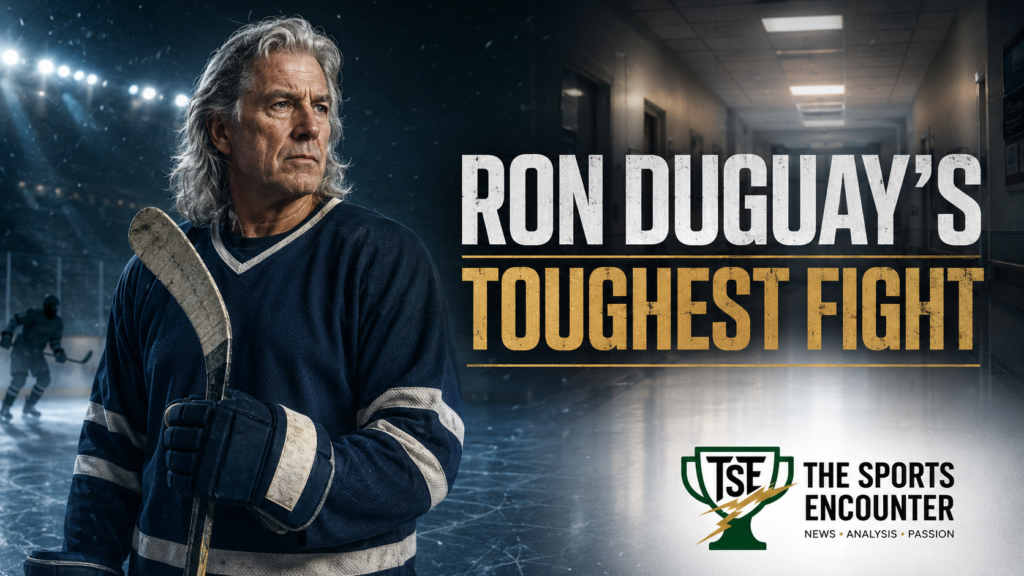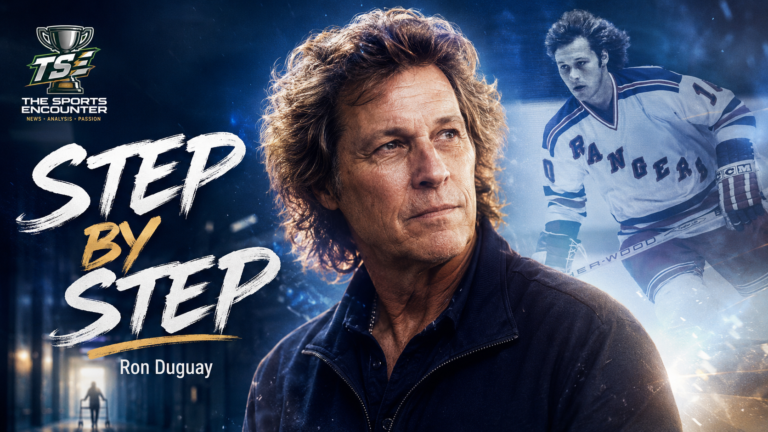
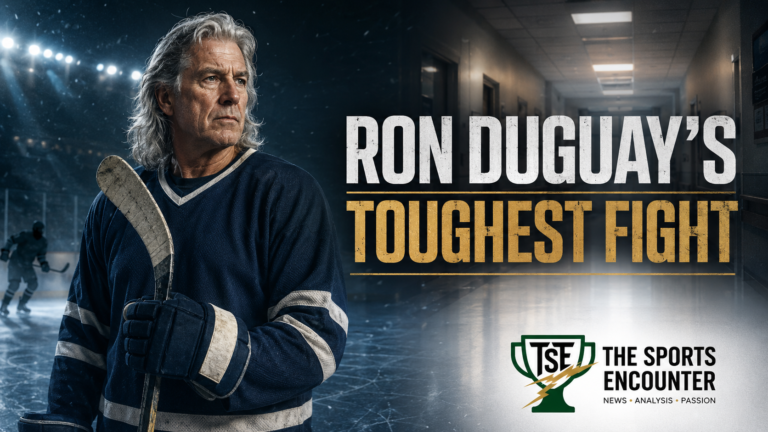
Ron Duguay Hospitalized After Collapse as Cancer Battle Takes a Dangerous Turn
Former New York Rangers star Ron Duguay remains hospitalized after collapsing at home, losing several teeth and suffering internal bleeding amid his Stage 4 colon cancer battle.
Former New York Rangers star Ron Duguay remains under hospital monitoring after losing consciousness at home, suffering facial injuries and losing several teeth. Doctors also identified internal bleeding and serious complications connected to pressure around his cancer-affected liver.
Ron Duguay spent much of his hockey career absorbing hits, playing through pain and competing in an era when toughness often meant saying very little about physical suffering.
His latest injuries did not happen on the ice.
The 69-year-old former Rangers forward was taken to a hospital by ambulance after fainting at home on Friday, July 24, according to an update shared by his daughter, Shay Thomas. Duguay was unconscious following the fall, injured several areas of his face and knocked out multiple teeth.
The damaged teeth produced a moment of dark humor from the former NHL All-Star. Duguay later posted a photograph on Instagram with the message, “Found my teeth on the bedroom floor.”
Behind that lighthearted response sits a far more serious medical situation.
Doctors found that Duguay was extremely dehydrated after struggling to eat while feeling ill. His family said medical testing also revealed varices, portal hypertensive gastropathy, internal bleeding and an ulcer.
As of Monday, he remained under hospital observation and was receiving blood transfusions, according to an update from his family. The immediate concern has moved beyond the fall itself to the bleeding and pressure building around a liver already affected by cancer and treatment.
Duguay has been fighting Stage 4 colon cancer that spread to his liver. His family publicly disclosed the diagnosis in February 2026 after he had already been living with the disease for more than a year.
Ron Duguay Health Update at a Glance
| Key detail | Latest information |
|---|---|
| Age | 69 |
| Medical condition | Stage 4 colon cancer involving the liver |
| Latest incident | Fainted at home and was found unconscious |
| Injuries from fall | Facial injuries and several lost teeth |
| Additional findings | Severe dehydration, varices, portal hypertensive gastropathy, internal bleeding and an ulcer |
| Hospital treatment | Continued monitoring and blood transfusions |
| Previous procedures | Appendix and gallbladder removed |
| Fundraising support | More than $160,000 raised by Tuesday morning |
| NHL career | 274 goals, 346 assists and 620 points in 864 games |
What Caused Ron Duguay’s Latest Medical Emergency?
Duguay’s family has not identified one confirmed cause for his loss of consciousness. The update, however, describes several conditions capable of leaving a patient seriously weakened.
He had been struggling to eat and was found to be extremely dehydrated. Doctors also discovered internal bleeding, which can reduce the body’s circulating blood volume and contribute to fatigue, dizziness, weakness or fainting.
The medical picture is complicated by cancer in his liver and the physical strain created by surgery, chemotherapy and a treatment pump.
Thomas explained that pressure had built inside the liver because of the cancer and everything the organ had endured during treatment. That pressure could move backward toward the stomach and contribute to bleeding.
She added that the ulcer still required further evaluation, while the bleeding and liver pressure represented the family’s main concerns.
Portal hypertension occurs when blood encounters increased resistance while moving through the liver. The pressure can enlarge veins in the digestive system and make them vulnerable to bleeding. Portal hypertensive gastropathy affects blood vessels in the stomach lining and can also produce gastrointestinal blood loss.
Only Duguay’s treating physicians can determine how each diagnosis contributed to the collapse. The combination of dehydration, poor nutritional intake, internal bleeding and advanced cancer nevertheless explains why he remains under close observation.
The Lost Teeth Became the Most Visible Injury
The photograph of Duguay’s lost teeth quickly drew public attention because it provided a stark image of the fall’s physical impact.
It also reflected the personality that made him one of hockey’s most recognizable players during the late 1970s and 1980s.
Duguay has approached portions of his cancer treatment with humor, faith and the competitive language of a former professional athlete. His response to the dental injuries followed that pattern, but it should not obscure the severity of his hospitalization.
Facial injuries can be treated, while missing teeth may eventually be replaced. Internal bleeding, liver-related pressure and the difficulty of maintaining hydration and nutrition during advanced cancer treatment present a much more complicated challenge.
The fall appears to have exposed how quickly several medical problems can converge. A patient who feels sick may eat and drink less. Dehydration and blood loss can deepen physical weakness, while the underlying disease and its treatment reduce the body’s ability to recover.
Health challenges can change the final stage of any athlete’s public story. The Sports Encounter previously examined how chronic illness and long-term physical complications shaped Jonathan Toews’ emotional retirement from hockey.
Duguay’s Stage 4 Colon Cancer Battle
Duguay announced in February that he had been diagnosed with Stage 4 colon cancer the previous year. Subsequent family accounts indicated that he had fought the disease privately for more than a year before seeking wider public support.
The cancer spread to his liver, and his treatment has included surgery and chemotherapy. He has also lost his appendix and gallbladder during the course of that battle.
Earlier updates described considerable weight loss, difficult treatment cycles and the financial burden of traveling for care. Duguay lives in Florida but has received treatment in California, adding transportation and accommodation expenses to an already costly medical process.
His daughters, Shay Thomas and Amber Stavros, launched a fundraising campaign to assist with medical care, travel and other treatment-related expenses. Contributions had exceeded $160,000 by Tuesday morning.
The campaign has also become a central channel through which the family provides health updates. The response reflects the affection Duguay still commands among Rangers supporters and fans who remember his playing career.
Asking for assistance reportedly did not come naturally to him. Duguay had been more comfortable helping other people, but treatment limited his ability to work while creating expenses that extended well beyond routine medical bills.
Why Ron Duguay Still Matters to Rangers Fans
Duguay was selected by the Rangers with the No. 13 overall pick in the 1977 NHL Draft and immediately became one of the franchise’s most distinctive players.
His long hair, speed and attacking style made him highly visible in New York. The celebrity surrounding him occasionally overshadowed his production, particularly among audiences who remember the image more readily than the player.
The numbers provide a necessary correction.
Duguay scored 20 goals as a rookie and helped the Rangers reach the 1979 Stanley Cup Final during his second season. New York eventually lost the championship series to the Montreal Canadiens, but Duguay recorded five goals and four assists during the postseason run.
His best Rangers campaign came in 1981-82. Duguay scored 40 goals and produced 76 points across 72 games, earning the only NHL All-Star selection of his career.
That peak deserves a place within the wider history of elite hockey performance. The Sports Encounter’s evidence-based ranking of the 10 best NHL players ever shows why scoring must be considered alongside era, playoff influence, durability and cultural impact.
Duguay played 499 regular-season games for New York across two spells. He spent his first six seasons with the Rangers before returning for parts of the 1986-87 and 1987-88 campaigns.
Between those periods, he produced some of his strongest offensive numbers with the Detroit Red Wings. Duguay recorded 80 points in 1983-84 before setting career highs with 51 assists and 89 points the following season.
He also played for the Pittsburgh Penguins and Los Angeles Kings. Across 12 NHL seasons from 1977 to 1989, Duguay accumulated 274 goals and 346 assists for 620 points in 864 regular-season games.
His complete playing record can be found through Duguay’s official NHL player profile.
After retiring, Duguay remained close to hockey through coaching and broadcasting. He worked as an analyst on Rangers coverage for MSG Network from 2007 until 2018, allowing another generation of supporters to know him through television.
Duguay’s Rangers Connection Still Runs Deep
The Rangers have changed considerably since Duguay’s era, but former players remain an important part of the franchise’s identity. Current roster decisions, including the trade that sent Adam Edstrom to the Nashville Predators, continue to connect New York’s history with its search for a more competitive future.
Duguay belongs to an earlier Rangers generation that helped turn individual players into enduring New York personalities. Fans followed his career, remembered his Stanley Cup run and later heard his analysis of the team on television.
That relationship helps explain why the response to his illness extends beyond ordinary nostalgia. Supporters are rallying around someone who remained visible within the Rangers community long after his final shift.
Hockey’s Support Network Rallies Around a Former Star
Fans have donated, shared messages and followed the family’s updates. Former teammates, hockey personalities and longtime supporters have also offered encouragement.
The reaction arrives during a period when hockey has been looking more carefully at how it remembers former players. The Hockey Hall of Fame Class of 2026 recently renewed discussion about leadership, longevity and the different ways players remain important after their careers end.
Duguay’s public health battle has also given supporters an unfiltered view of advanced cancer treatment. The process involves far more than appointments and chemotherapy sessions. Appetite loss, dehydration, travel, surgery, financial pressure and secondary complications can reshape daily life for patients and their families.
His latest hospitalization illustrates that reality with painful clarity.
A collapse at home produced visible facial injuries, yet testing revealed that the deeper danger was developing internally. Blood transfusions and continued observation became necessary while doctors evaluated the source and severity of the bleeding.
Duguay’s Story Reaches Hockey During a Period of Renewed Attention
The former Rangers forward’s hospitalization comes at a time when the NHL is attracting greater national attention. The 2026 postseason delivered a significant television increase, with the Stanley Cup Final reaching its strongest audience in seven years.
That growth gives the league a larger platform for both present-day stars and the former players who helped build its history.
Recent stories have shown how powerfully fans respond when championship memories return to the foreground. Patrick Kane’s reunion with Chicago, covered in The Sports Encounter’s report on Kane’s Blackhawks homecoming, carried emotional value because supporters remembered what he meant to an entire era.
Duguay never won a Stanley Cup, but his Rangers identity remains similarly durable. His personality, scoring peak, 1979 playoff run and broadcasting career gave New York supporters several different ways to form a connection with him.
What Happens Next for Ron Duguay?
The family has not published a timetable for Duguay’s release or provided a long-term prognosis following the collapse.
Doctors still need to evaluate the ulcer, control the bleeding and manage the pressure associated with his liver condition. Restoring hydration and helping him regain enough strength to eat will also form important parts of his immediate recovery.
Any further cancer treatment will depend on his medical stability and the decisions made by his care team.
The situation also reminds fans that a player’s legacy cannot be reduced to current headlines. Hockey history continues to evolve as modern contracts and financial records grow, including the agreement explored in The Sports Encounter’s report on the richest player signing in NHL history. Former players such as Duguay, however, remain part of the emotional foundation supporting that growth.
Final Word
Duguay remains hospitalized with his family maintaining a cautious but hopeful outlook. His brief joke about finding his teeth captured the resilience supporters recognize, although this episode represents one of the most concerning turns in his cancer battle.
The player Rangers fans once watched race down the ice now faces a challenge that cannot be measured through goals, assists or games played.
His humor remains intact. The hospital care, blood transfusions and continuing evaluation reveal how hard his body is fighting beneath it.
Readers can follow further league news, player stories and historical analysis through The Sports Encounter’s NHL coverage hub.
Editor's Choice
Vinícius Júnior Set to Stay at Real Madrid as Contract Talks Enter Decisive Stage
Vinícius Júnior is set to remain at Real Madrid beyond the summer as the club closes the door on a sale and works toward a new contract.
Real Madrid have closed the door on a summer sale of Vinícius Júnior and remain confident that one of their most influential forwards will agree a new contract, despite continued interest from Arsenal and uncertainty surrounding his current deal.
Vinícius Júnior is expected to remain at Real Madrid beyond the summer transfer window, according to Sky Sports News, with the Spanish club making it clear that it has no intention of selling the Brazilian international.
The decision brings temporary clarity to a transfer story that has gathered momentum because Vinícius has entered the final year of his contract. His existing agreement runs until June 30, 2027, leaving Madrid under pressure to secure an extension before one of world soccer’s most valuable attackers moves closer to free-agency territory.
Arsenal have monitored the situation and explored whether the contract uncertainty could create an opening. Madrid’s stance, however, remains firm. The club values Vinícius highly, and head coach José Mourinho reportedly considers the 26-year-old an important part of his plans for the 2026-27 season.
The immediate transfer question appears settled. The more important issue now concerns the contract itself, including Vinícius’ salary, status within Madrid’s changing attack and the length of the next agreement.
Vinícius Júnior’s Real Madrid Situation at a Glance
| Key issue | Current position |
|---|---|
| Summer transfer status | Real Madrid have no intention of selling |
| Current contract expiry | June 30, 2027 |
| Madrid’s expectation | Vinícius will agree a new contract |
| Premier League interest | Arsenal have monitored his situation |
| Saudi interest | Long-standing but no agreement reported |
| First-team debut season | 2018-19 |
| Major Madrid milestone | Scored in the 2022 and 2024 Champions League finals |
| Immediate priority | Reach a renewal before the contract enters its final months |
Why Real Madrid Refuse to Sell Vinícius Júnior
Madrid’s position reflects the sporting reality surrounding Vinícius. Elite clubs can recruit talented wingers, but very few available players combine his pace, direct running, one-on-one ability, big-match experience and global profile.
Vinícius joined Real Madrid from Flamengo as an 18-year-old in 2018. He endured early criticism over his finishing and decision-making before developing into one of the most dangerous attacking players in Europe.
His rise has been shaped by decisive contributions on the biggest stage. He scored the winning goal against Liverpool in the 2022 Champions League final and found the net again when Madrid defeated Borussia Dortmund in the 2024 final. Those performances gave him a place in the club’s modern European history that cannot be measured through league production alone.
By April 2025, Vinícius had recorded 200 victories, 105 goals and 14 trophies across 311 appearances for Madrid. His numbers have continued to grow, but the larger point remains unchanged. Madrid developed him from a gifted teenager into a proven match-winner and global superstar.
Selling him at 26 would remove a player entering what should be the strongest years of his career. Any replacement carrying similar quality, age and commercial influence would command an enormous transfer fee and salary.
The Sports Encounter’s earlier analysis of why Vinícius became the summer’s hottest transfer story examined how contract pressure, Premier League interest and Saudi financial power turned a complicated negotiation into a global story.
The Contract Still Matters More Than the Transfer Decision
Keeping Vinícius for the coming season resolves only the first part of the problem.
Madrid announced his current contract in October 2023, confirming an agreement through June 2027. With less than a year remaining, the club risks losing negotiating leverage if talks stretch deep into the season.
A player entering the final six months of his contract can generally negotiate a pre-contract agreement with foreign clubs. Madrid are unlikely to allow the situation to reach that stage without making every reasonable effort to complete a renewal.
Vinícius publicly addressed his future before Madrid’s Champions League quarterfinal against Bayern Munich in April 2026. He said he wanted to remain for a long time, described Madrid as the club of his dreams and expressed confidence that a renewal would be completed at the appropriate moment.
Those comments remain the clearest indication of his personal preference. The challenge involves turning that intention into an agreement acceptable to both sides.
Salary expectations may determine the pace of negotiations. Vinícius can reasonably argue that his performances, Champions League record, international profile and commercial reach place him among soccer’s leading stars. Madrid must recognize that value while protecting a wage structure that includes Kylian Mbappé, Jude Bellingham and several other high-profile players.
How Kylian Mbappé Changed the Vinícius Conversation
Mbappé’s arrival altered Madrid’s attacking hierarchy because both forwards have traditionally produced their most dangerous football from the left side.
Vinícius prefers to receive the ball wide, isolate a defender and accelerate toward the penalty area. Mbappé also likes attacking from the left before moving centrally, where he can use his pace and finishing.
The overlap does not make the partnership unworkable. It requires clear movement, defensive responsibility and tactical balance around them.
Vinícius said in April that he shared a strong relationship with Mbappé on and off the field. He also dismissed claims that the partnership could not work in important matches, pointing to the French forward’s goals and influence.
Mourinho must now develop a structure that gives both players enough freedom without leaving Madrid exposed after losing possession. Vinícius may begin on the left, but he will need to interchange positions, attack central spaces and contribute consistently when the team defends.
Jude Bellingham adds another layer because his forward runs frequently take him into areas occupied by the attackers. The connection between elite talent, individual status and team balance has also shaped the wider discussion around Bellingham’s journey from Dortmund prospect to Real Madrid leader.
Arsenal’s Interest Was Ambitious but Always Difficult
Arsenal’s reported interest made sense from a sporting perspective. Vinícius would give the Premier League club an established match-winner capable of transforming its left side and deciding tight Champions League games.
Any serious move would have required one of the largest financial commitments in Arsenal’s history. The transfer fee, salary, signing incentives and agent costs would have placed enormous pressure on the club’s wage structure.
Madrid’s refusal to negotiate removes the most important condition needed for a transfer. Arsenal could monitor the renewal talks and remain informed in case circumstances change, but there is currently no indication that Madrid are inviting offers.
The English club may therefore redirect its attention toward another attacking target. Interest in Paris Saint-Germain winger Bradley Barcola has already been discussed as Arsenal review alternative options.
For Madrid, the Arsenal link still served as a useful warning. When a contract approaches its final year, even a club that does not want to sell can no longer control every part of the conversation. Interested teams can contact representatives, examine salary expectations and wait for negotiations to become more difficult.
Saudi Interest Still Influences the Negotiation
Saudi Arabia’s interest has followed Vinícius for several transfer windows and remains part of the financial background.
Previous reports described an extraordinary long-term proposal that could have made him one of the highest-paid athletes in the world. Madrid have always been able to point toward the €1 billion release clause contained in his contract, while Vinícius has consistently emphasized his desire to remain in European soccer.
The Saudi option still creates leverage because it demonstrates that his market is not limited to the usual salary ranges offered by European clubs. His representatives know that a prime-age Brazilian star carries sporting, commercial and strategic value for an emerging league seeking worldwide credibility.
Madrid cannot be expected to match every theoretical offer from outside Europe. They must instead sell Vinícius a wider vision involving sporting legacy, Champions League contention, individual awards and the opportunity to become one of the defining players of his generation.
His growing importance to Brazil strengthens that argument. Vinícius scored twice as the Seleção defeated Scotland to win its World Cup group, a performance covered in The Sports Encounter’s report on Vinícius leading Brazil past Scotland.
He also scored during Brazil’s earlier victory against Haiti, helping the team recover momentum during the group stage. That match demonstrated how his direct running could transform a controlled performance into a decisive result, as explored in our analysis of Brazil’s response against Haiti.
Why Madrid’s Other Attacking Moves Created Confusion
Reports linking Real Madrid with RB Leipzig winger Yan Diomande contributed to speculation that the club might be preparing for life after Vinícius.
Madrid’s interest in a young winger can also be understood as squad building. A club competing across La Liga, the Champions League, domestic cups and international club competitions needs depth. Young attackers require time to develop, and injuries can quickly reduce apparently strong options.
Diomande’s potential arrival would increase competition, provide tactical flexibility and give Mourinho another direct runner. His recruitment would not automatically make him a replacement for Vinícius.
Madrid have often signed elite young players before a first-team vacancy becomes obvious. That approach allows the club to develop internal solutions instead of entering the market under pressure.
The decision to retain Vinícius suggests Madrid see additional attacking recruitment as reinforcement rather than succession. Mourinho would then carry responsibility for keeping a deep, expensive and ambitious forward line productive.
What Vinícius Must Prove in 2026-27
A new contract would confirm his long-term status, but the coming season will still carry significant personal pressure.
Vinícius experienced difficult periods during the previous campaign, including a prolonged scoring drought, reduced minutes under Xabi Alonso and criticism from sections of the Madrid support. His form later improved, with the forward speaking openly about learning from the experience.
He must now show consistency across the entire season. Defensive effort, emotional control and his combination with Mbappé will receive as much attention as goals and assists.
His World Cup performances reinforced his ability to carry responsibility for Brazil. The key moments from World Cup Day 14 showed how his goals helped turn Brazil’s final group match into a statement before the knockout phase.
The presence of Neymar during Brazil’s campaign also highlighted how leadership passes between generations. The Sports Encounter’s feature on Neymar’s final World Cup journey placed Vinícius within a Brazilian attack gradually moving toward a new central figure.
What Happens Next?
Madrid’s immediate position is clear: Vinícius will stay, and the club expects him to renew.
The next meaningful development should come from formal contract progress rather than further transfer speculation. Until an extension is signed, Arsenal, Saudi clubs and other wealthy teams will continue watching.
A successful renewal would protect Madrid from losing a prime asset for nothing, give Mourinho greater certainty and allow Vinícius to focus on his football. It would also clarify the club’s attacking hierarchy during a period of significant squad change.
If negotiations remain unresolved near the end of 2026, pressure will return quickly. Every omission, substitution, wage report and attacking signing would then be interpreted through the contract dispute.
Madrid have prevented the summer market from dictating the player’s immediate future. Completing the renewal will determine whether they have solved the story or merely delayed its next chapter.
Final Verdict
Real Madrid’s refusal to sell Vinícius Júnior is a logical sporting decision. He remains a rare attacker with elite pace, Champions League pedigree, international influence and enough time ahead of him to shape another era at the Bernabéu.
Arsenal’s interest showed how quickly Europe’s wealthiest clubs would respond if Madrid allowed even a small opening. Saudi Arabia’s financial reach added further pressure, but Vinícius’ public comments and Madrid’s confidence continue to point toward a renewal.
The contract must now convert mutual intent into long-term security. Madrid need to recognize the player’s value without creating wider financial problems, while Vinícius must decide how strongly legacy, status and sporting ambition outweigh the enormous alternatives available elsewhere.
For now, he is staying. The transfer question has an answer. The contract question is moving toward its decisive stage.
Official squad news, player information and club announcements are available through the official Real Madrid website.
For more transfer reporting, international soccer news and tactical analysis, visit The Sports Encounter’s soccer coverage hub.
Editor's Choice
Roberto Mancini Returns as Italy Coach With Claudio Ranieri Leading Azzurri Rebuild
Roberto Mancini has returned as Italy coach, with Claudio Ranieri appointed technical director to rebuild the four-time world champions after a third consecutive World Cup failure.
Italy have reunited with the coach who restored their pride at Euro 2020, while Claudio Ranieri takes control of the wider technical structure after a chaotic search exposed divisions inside the federation.
Roberto Mancini has returned as Italy head coach nearly three years after his unexpected departure, accepting one of the most difficult rebuilding assignments in international soccer.
Italian Football Federation President Giovanni Malagò confirmed Mancini’s appointment following Tuesday’s Federal Council meeting. Claudio Ranieri has joined the project as FIGC technical director and president of Club Italia, giving the former Leicester City manager oversight of technical operations and elite development across Italy’s national-team structure.
Mancini replaces Gennaro Gattuso, who left in April after Italy failed to qualify for the 2026 FIFA World Cup. The four-time world champions have now missed three consecutive editions of the tournament, extending an absence that began after their final group match at the 2014 World Cup.
The appointments provide Italy with two respected and highly experienced coaches. They also carry a clear tension. Mancini previously rebuilt the national team, won the European Championship and established a world-record unbeaten run. His first tenure still ended with Italy missing the 2022 World Cup and with his sudden resignation in August 2023.
Italy are therefore returning to a coach who represents both their greatest modern success and one of their most painful failures.
Mancini and Ranieri Appointments at a Glance
| Key detail | Information |
|---|---|
| Italy head coach | Roberto Mancini |
| Technical director | Claudio Ranieri |
| Additional Ranieri role | President of Club Italia |
| Outgoing coach | Gennaro Gattuso |
| Outgoing technical director | Paolo Maldini |
| Mancini’s first Italy tenure | 2018 to 2023 |
| Matches during first tenure | 58 |
| Major achievement | European Championship winner in 2021 |
| Record unbeaten run | 37 matches |
| Immediate challenge | Restore Italy after missing three consecutive World Cups |
Why Italy Returned to Roberto Mancini
Malagò described Mancini as the best person for the position, but the decision followed a coaching search that moved through several prominent candidates and generated another institutional crisis.
Pep Guardiola was reportedly Italy’s preferred option. The former Manchester City manager declined the opportunity, leaving the federation to explore alternatives.
Andrea Pirlo then became the leading candidate with the support of technical director Paolo Maldini and adviser Leonardo. His proposed appointment was blocked amid concerns surrounding his commercial relationship with a Russian betting company.
Maldini and Leonardo resigned shortly afterward, only 16 days after entering their federation roles. The full sequence intensified questions about authority, background checks and strategic control within the FIGC. The Sports Encounter previously examined how Maldini’s rapid departure exposed Italy’s deeper governance problems.
Mancini offered Malagò an experienced alternative who required little introduction to the national setup. He understands the federation, knows many of the available players and has already shown that he can restore confidence after a World Cup qualification failure.
His appointment also carries less coaching risk than the proposed move for Pirlo. The former Italy midfielder brought enormous symbolic value, but his managerial record remained relatively modest for a national team facing this level of pressure. Our earlier analysis of why Italy considered Pirlo after Guardiola’s refusal explored the attraction and uncertainty surrounding that plan.
Mancini Already Knows How to Revive a Wounded Italy
Mancini first became Italy coach in May 2018 after the country failed to reach the World Cup in Russia. The national team had lost confidence, supporters had become disconnected, and the squad appeared caught between generations.
He responded by changing both the mood and the style.
Italy moved away from the excessively cautious football that had shaped perceptions of the national team. Mancini encouraged pressing, short passing, positional movement and greater involvement from technical midfielders. The Azzurri began playing with freedom while retaining enough defensive intelligence to control difficult matches.
That transformation produced a 37-game unbeaten sequence consisting of 30 wins and seven draws. Italy scored 93 goals and conceded only 12 during the run, which became a men’s international record before Spain ended it in the 2021 UEFA Nations League semifinal.
The defining achievement came at the delayed Euro 2020 tournament. Italy defeated Turkey, Switzerland and Wales in the group stage before overcoming Austria, Belgium and Spain. Mancini’s side then beat England on penalties at Wembley to win the country’s first European Championship since 1968.
The victory temporarily restored Italy’s international authority. It also reconnected the current team with an older tradition of players who carried enormous national expectations, including the unforgettable figure explored in The Sports Encounter’s feature on Roberto Baggio and Italy’s emotional 1994 World Cup journey.
The Failure Mancini Cannot Escape
Italy’s European triumph makes Mancini’s return understandable. What happened afterward explains why the reunion cannot rely on nostalgia.
The Azzurri failed to qualify for the 2022 World Cup after losing to North Macedonia in a playoff semifinal. Italy dominated possession and produced a high volume of shots, yet lacked the efficiency and penalty-area authority needed to turn control into goals.
That failure exposed weaknesses concealed by the European Championship victory. Italy struggled to replace important players, several attackers failed to develop consistently, and the team lost the freshness that had defined its unbeaten run.
Mancini remained in charge and began another rebuilding process. His relationship with the federation later deteriorated, however, and he resigned in August 2023. He subsequently managed Saudi Arabia and returned to club football in Qatar.
Italy must now establish what has changed. If Mancini returns with the same ideas, the same personnel preferences and the same institutional frustrations, the federation may reproduce the conditions that ended his first tenure.
His second spell requires a sharper selection policy, a clearer attacking plan and closer coordination with Italy’s youth teams. The modern international game rewards countries that continually regenerate. Spain’s success with a new generation, illustrated by Lamine Yamal’s rise during the 2026 World Cup, shows the value of giving exceptional young players meaningful responsibility.
Ranieri Gives the Project More Than a Famous Name
Ranieri’s appointment may eventually prove as important as Mancini’s return.
The 74-year-old will serve as technical director and president of Club Italia, placing him above the day-to-day work of the senior national team. His responsibilities are expected to include technical coordination, elite development and greater alignment across Italy’s national sides.
Ranieri brings experience across several football cultures and competitive environments. His greatest achievement came in 2016, when he led Leicester City to one of the most unlikely Premier League titles in English soccer history.
That triumph was built on clear roles, tactical discipline, emotional intelligence and an ability to create trust within a squad that richer clubs had underestimated. Those qualities should help him evaluate Italy’s problems without becoming trapped by reputation or nostalgia.
His relationship with Mancini will still require clearly defined authority. Maldini’s departure showed how quickly a technical structure can collapse when the federation and its football leadership disagree over the head coach.
Ranieri must have genuine influence over development strategy and national-team coordination. Mancini, meanwhile, needs enough control to select and coach the senior side without feeling that changes are being imposed around him.
Malagò said he needed a technical director with whom he could share the decision on the coach. That statement suggests Ranieri entered the role with greater agreement over Mancini than Maldini had over Pirlo. The next test involves turning that personal alignment into a functioning governance model.
What Mancini Must Fix First
Find a dependable source of goals
Italy’s recurring attacking problems have outlived several coaches. The team can move the ball intelligently and control territory, but possession has too often ended without enough penalty-area presence.
Mancini must identify forwards who can complement one another rather than continually rotating players in search of an ideal solution. Wide attackers need clear responsibilities, while midfielders must contribute more runs and goals.
Build around the next generation
The squad needs renewal without discarding experienced players who can still contribute. Mancini gave young footballers opportunities during his first spell, and he must show the same courage again.
Selection should reward form, tactical suitability and development potential. Club reputation alone cannot determine who carries Italy into the next cycle.
Create a modern tactical identity
Italy cannot simply recreate the football of 2021. Opponents have evolved, player availability has changed, and international tournaments increasingly demand athletic range, pressing resistance and tactical flexibility.
Mancini needs a structure that can control weaker opponents without becoming vulnerable to transitions. He must also prepare Italy to manage momentum inside major matches. The dangers of losing control after taking the lead were evident in The Sports Encounter’s analysis of England’s tactical retreat against Argentina.
Italy’s Crisis Extends Beyond the Senior Team
No coach can repair Italian soccer alone.
Italy still produces intelligent players, accomplished coaches and tactically sophisticated clubs. Serie A remains internationally relevant. The national team, however, has struggled to turn those strengths into a stable supply of experienced Italian talent.
Young domestic players often face limited opportunities at leading clubs. Some spend crucial developmental years moving through loans or playing outside the highest level. Others arrive in the national squad without enough experience in Champions League matches, title races or high-pressure knockout football.
Ranieri’s technical role matters because those problems require coordination beyond international windows. Italy need stronger connections among youth national teams, club academies, coaching education and the senior side.
The 2026 World Cup provided another reminder that historic status offers no protection. Germany’s elimination, covered in our report on Paraguay’s World Cup upset over Germany, showed how quickly a traditional power can fall when execution and emotional control disappear.
Italy did not even reach that tournament. Supporters can revisit the competition’s major results, tactical stories and international trends through The Sports Encounter’s FIFA World Cup 2026 coverage.
Can Mancini and Ranieri Take Italy Forward?
The appointments solve the immediate vacancies, but they do not erase the disorder that preceded them.
Mancini knows how to restore belief, build relationships and give Italy a more ambitious playing identity. Ranieri brings calm judgment, immense experience and a reputation for improving teams through clarity rather than noise.
Their credentials give the new structure credibility. Their age and experience also mean Italy have chosen established authority instead of presenting the project as a radical generational reset.
That approach can work if Mancini remains open to tactical evolution and Ranieri creates a sustainable pathway beneath the senior team. It will fail if the federation expects two respected coaches to compensate for weak planning, limited development opportunities and unclear decision-making.
Mancini’s return is emotionally powerful because Italian supporters remember Wembley, the unbeaten run and a team that briefly made the country believe again. The harder memory involves North Macedonia, another missed World Cup and a resignation that arrived without a stable succession plan.
Italy are placing both versions of Mancini’s legacy back on the touchline.
Final Verdict
Roberto Mancini is a logical choice to lead Italy’s immediate recovery. He has already succeeded in this exact environment, understands the emotional demands of the position and owns a stronger international record than most available alternatives.
Claudio Ranieri gives the federation a respected technical leader capable of examining the wider structure. His appointment should provide Mancini with an experienced partner while creating greater continuity between the senior team and Italy’s development system.
The arrangement will be judged by more than early results. Italy need a recognizable style, productive young players, a more reliable attack and a development pathway that survives future coaching changes.
Mancini once helped Italy rise from the shock of missing a World Cup. His second attempt begins after the problem has grown much worse.
Official announcements, national-team information and technical updates are available through the official Italian Football Federation website.
For more international football news, coaching developments and tactical analysis, visit The Sports Encounter’s soccer coverage hub.
Editor's Choice
Moïne Chaabani Takes Charge of Tunisia Until 2030 After World Cup Collapse
Tunisia have appointed Moïne Chaabani as national-team coach until 2030, handing the African club champion a long-term rebuilding job after their disastrous World Cup campaign.
Tunisia have handed one of African club football’s most accomplished young coaches a four-year mandate to rebuild a national team damaged by tactical decline, institutional instability and its worst World Cup campaign.
Tunisia have appointed Moïne Chaabani as head coach of the senior men’s national team on a contract running until 2030, placing their immediate recovery and longer-term reconstruction in the hands of a coach who understands Tunisian football from the inside.
The appointment carries greater significance than an ordinary change in the dugout. Chaabani becomes Tunisia’s seventh coach since 2024, inheriting a team that lost every match at the 2026 FIFA World Cup and conceded 12 goals across three damaging group-stage defeats.
The Tunisian Football Federation confirmed that its executive committee had appointed a new senior-team coaching staff led by the 45-year-old. Chaabani succeeds Hervé Renard, who managed Tunisia’s final two World Cup matches after Sabri Lamouchi was dismissed during the tournament.
The four-year agreement represents a public commitment to stability. Whether Tunisia honor that commitment through difficult results will determine if Chaabani can build a genuine football project or become another name in a rapidly growing list of short-lived appointments.
Moïne Chaabani’s Tunisia Appointment at a Glance
| Key detail | Information |
|---|---|
| New head coach | Moïne Chaabani |
| Age | 45 |
| Contract | Four years, until 2030 |
| Previous club | Renaissance Sportive de Berkane |
| Major achievements | Two CAF Champions League titles, one CAF Confederation Cup and one Moroccan league title |
| National-team experience | First senior national-team coaching role |
| Immediate competition | 2027 Africa Cup of Nations qualifying |
| AFCON qualifying group | Group H with Uganda, Libya and Botswana |
| Tunisia’s recent coaching turnover | Seven appointments since 2024 |
| Long-term target | Rebuild toward the 2030 World Cup cycle |
Why Tunisia Chose Chaabani After Its Worst World Cup
Chaabani arrives at a moment when Tunisia need authority, cultural understanding and tactical repair in roughly equal measure.
The national team entered the 2026 World Cup hoping to reach the knockout stage for the first time. Instead, the tournament exposed how far its defensive identity and competitive confidence had deteriorated.
Sweden inflicted the first blow with a 5-1 victory in Monterrey. Tunisia struggled to manage transitions, protect spaces around the penalty area or recover emotionally once the match moved away from them. The Sports Encounter’s report on Sweden’s ruthless World Cup win over Tunisia showed how quickly an anticipated contest became a rout.
That defeat cost Lamouchi his job only months after he had signed a contract running until 2028. Renard was brought in as an emergency replacement, but he had almost no time to change Tunisia’s structure, preparation or confidence.
Japan then delivered an even more controlled performance, winning 4-0 through speed, movement and clinical finishing. Tunisia rarely disrupted their rhythm and offered little evidence of an immediate response to the opening loss. The problems behind the result are examined in The Sports Encounter’s analysis of Japan’s dominant victory over Tunisia.
A 3-1 defeat against the Netherlands completed a grim campaign. Tunisia finished with no points, three losses and a minus-nine goal difference. It was the first time the country had lost every match at a World Cup.
The final group game produced a brief response when Hazem Mastouri scored from a Hannibal Mejbri corner, but another defensive lapse quickly ended any hope of a comeback. The full picture of that elimination can be found in The Sports Encounter’s report on how the Netherlands defeated Tunisia to top Group F.
Chaabani therefore inherits more than a team coming off three losses. He takes over a national football structure that needs clarity about its identity, selection policy and tactical direction.
Chaabani Brings a Proven Record in African Club Football
The strongest argument behind the appointment is Chaabani’s record across different North African football environments.
He built his reputation at Espérance Sportive de Tunis, initially working as an assistant before becoming head coach. His rise was rapid, but his continental success was sustained enough to establish him as one of the region’s most respected coaches.
Chaabani led Espérance to consecutive CAF Champions League titles in 2018 and 2019. Winning Africa’s leading club competition once can be shaped by timing, individual talent or a favorable route. Retaining the trophy requires deeper qualities, including squad management, tactical adaptability and the ability to survive difficult away matches.
His work with Renaissance de Berkane expanded his résumé beyond Tunisia. Chaabani guided the Moroccan club to its first domestic league championship in the 2024-25 season and added the CAF Confederation Cup, defeating Tanzania’s Simba SC 3-1 on aggregate in the final.
The double showed that his success at Espérance was not limited to familiarity with one club. He adapted to a different league, managed high expectations and helped Berkane turn years of continental competitiveness into a historic domestic breakthrough.
Chaabani left Berkane earlier in July after a productive spell lasting approximately two and a half years. His return to Tunisian football now comes with a different kind of responsibility. Club coaches can recruit players, work with them daily and correct problems across a full season. A national coach receives limited training time and must build solutions around the available player pool.
What Chaabani Must Fix First
Tunisia’s World Cup results highlighted several areas requiring immediate attention.
Restore defensive coordination
Tunisia historically competed through organization, patience and an ability to make stronger opponents uncomfortable. That identity disappeared during the World Cup.
Conceding 12 goals across three matches pointed to collective failure rather than the poor form of one defender or goalkeeper. The midfield offered insufficient protection, the defensive line struggled with movement behind it, and marking inside the penalty area repeatedly broke down.
Chaabani does not need to make Tunisia excessively conservative, but he must rebuild the distances between the team’s units. A side that becomes stretched after losing possession will continue to suffer against quick international opponents.
Create a more reliable attacking plan
Tunisia scored only twice at the tournament. One arrived after Sweden had established control, while the other came from a set piece against the Netherlands.
Hannibal Mejbri offers creativity and competitive energy, yet Tunisia cannot place the entire burden of progression and chance creation on one midfielder. Chaabani must decide how to involve wide players, support the striker and create attacks that do not depend on isolated moments.
His Berkane teams showed the value of defensive control, set-piece strength and efficient attacking execution. Applying those principles to international football could make Tunisia harder to beat without leaving them creatively restricted.
Establish a stable squad hierarchy
Frequent coaching changes often produce repeated alterations in selection, formation and player responsibility. Veterans can lose defined roles, while younger players receive opportunities without a clear development plan.
Chaabani’s knowledge of Tunisian football should help him evaluate domestic players alongside those competing abroad. His task will involve building a dependable core while creating genuine pathways for emerging talent.
Readers can revisit Tunisia’s full tournament experience and the wider stories that shaped the competition through The Sports Encounter’s FIFA World Cup 2026 coverage hub.
The 2027 AFCON Qualifiers Bring Immediate Pressure
Chaabani will not receive a long introductory period. Tunisia begin their 2027 Africa Cup of Nations qualifying campaign in September, facing Uganda, Libya and Botswana in Group H.
On reputation and tournament history, Tunisia should expect to qualify. They have been regular participants at the Africa Cup of Nations and won the competition on home soil in 2004. Recent instability, however, makes complacency dangerous.
Libya will bring the emotional and tactical complications of a North African rivalry. Uganda can make games physical and uncomfortable, while Botswana will have little pressure compared with the group favorite.
Qualification alone should represent the minimum target. Chaabani must also use those matches to restore habits that disappeared at the World Cup. Tunisia need to control games more calmly, concede fewer clear chances and develop a recognizable route from midfield possession to meaningful attacking opportunities.
The 2027 AFCON campaign will provide the first measurable judgment of the new project. Points will matter, but the quality and consistency of Tunisia’s performances will reveal whether the structural problems are being addressed.
Seven Coaches Since 2024 Reveal the Deeper Problem
The most concerning number surrounding Chaabani’s appointment is not Tunisia’s 12 World Cup goals conceded. It is the seven coaches used since 2024.
That level of turnover prevents a team from building tactical memory. Every appointment brings new staff, training priorities, selection preferences and communication methods. Players eventually begin preparing for the next change instead of fully investing in the current plan.
Lamouchi’s short spell illustrates the pattern. He was appointed in January 2026 on a deal intended to run through July 2028. Five months later, a 5-1 World Cup defeat ended his tenure.
Removing a coach during a disastrous tournament can be understandable. Continually issuing long contracts and abandoning them after a small number of matches points to weak planning above the technical staff.
The decision to hire Chaabani until 2030 only becomes meaningful if the federation defines clear performance measures. These should include AFCON qualification, squad renewal, defensive improvement, the integration of younger players and progress through the next World Cup qualifying cycle.
A contract date alone cannot create stability. Stable leadership comes from resisting emotional decisions when the team experiences an ordinary setback while remaining firm when longer-term performance indicators show genuine decline.
Can Club Success Translate to International Football?
Chaabani’s first national-team position creates legitimate uncertainty.
At club level, he could reinforce tactical ideas through daily training and recruit for specific positions. International windows compress that process into a few sessions before competitive matches. The coach must communicate simply, recognize player form across several leagues and adjust when injuries remove important options.
His experience in continental knockout football should still transfer well. CAF competitions demand practical decision-making, emotional control and preparation for different conditions across the continent. Those qualities will matter in AFCON qualifying and future tournament football.
Chaabani also enters the job with immediate credibility among Tunisian players and supporters. He knows the domestic environment, understands public expectations and has already won the biggest club prize in African football twice.
The challenge will be protecting that credibility when difficult decisions arrive. Selecting players from rival clubs, phasing out established internationals and balancing domestic talent with Europe-based options can quickly create pressure around a national coach.
What Success Would Look Like by 2030
The four-year timeline gives Tunisia an opportunity to move beyond short-term repairs.
The first stage should focus on qualifying confidently for the 2027 Africa Cup of Nations and restoring defensive structure. The next phase must involve competing credibly at the tournament, expanding the player pool and establishing a core capable of carrying the team through the next World Cup cycle.
By 2030, success should mean more than reaching another World Cup. Tunisia have qualified for multiple editions without progressing beyond the group stage. The country needs a team capable of entering the tournament with a realistic plan for reaching the knockouts.
A broader view of how African teams performed and adapted during the 2026 tournament can be found through The Sports Encounter’s analysis of whether Morocco could challenge the Netherlands in the World Cup knockouts. Morocco’s recent progress provides a useful regional example of how tactical identity, player development and institutional ambition can reinforce each other.
Final Verdict
Appointing Moïne Chaabani is a logical and potentially important decision for Tunisia. He is Tunisian, understands the country’s football culture and has proved his ability to win major trophies in two competitive North African leagues.
His Champions League titles with Espérance and historic double with Berkane demonstrate tactical competence and leadership under pressure. Those achievements do not guarantee success with a national team, but they provide a stronger foundation than reputation alone.
The larger question concerns the federation. Tunisia have changed coaches so frequently that even a four-year contract now requires evidence before it can be treated as a long-term commitment.
Chaabani must repair the team’s defensive structure, clarify its attacking identity and guide it through AFCON qualifying. The federation must give him the time, authority and institutional support required to complete that work.
If both sides honor the project, the 2026 World Cup collapse could become the painful beginning of a more stable era. Another reactionary dismissal would only confirm that Tunisia’s deepest problem has never been limited to the coach.
Official national-team announcements, competition information and federation updates are available through the official Tunisian Football Federation website.
For more international football reports, coaching news and tactical analysis, visit The Sports Encounter’s soccer coverage hub.