Pavithran Delivers Under Pressure as Malaysia End the Philippines’ Semifinal Dream
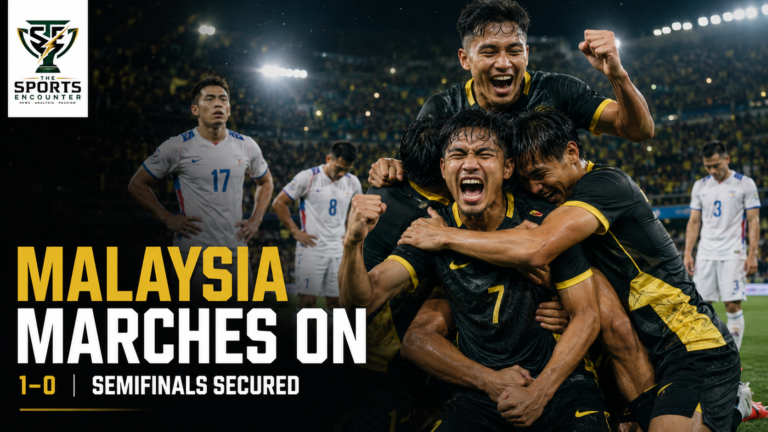
Pavithran Gunalan’s decisive header earned Malaysia a tense 1-0 victory over the Philippines, secured second place in Group B and set up a semifinal against Vietnam.
Malaysia entered its final Group B match knowing there was no room for hesitation. Pavithran Gunalan needed only 16 minutes to provide the goal that settled the tension, carried the Harimau Malaya into the semifinals and ended the Philippines’ ASEAN Championship 2026 campaign.
The 21-year-old converted Wan Kuzain Wan Kamal’s delivery to secure a hard-fought 1-0 victory at Kuala Lumpur Football Stadium on Saturday, August 8. It was Pavithran’s first senior international goal and the defining moment of a match shaped by pressure, defensive discipline and qualification stakes.
Malaysia finished second in Group B with nine points, three behind perfect group winner Thailand. The Philippines ended the stage in fourth place with three points after struggling to turn competitive performances into results.
TL;DR
- Malaysia defeated the Philippines 1-0 to qualify for the ASEAN Championship semifinals.
- Pavithran Gunalan scored the winning goal in the 16th minute, his first at senior international level.
- Wan Kuzain supplied the assist and helped Malaysia control the center of the field.
- Malaysia’s defense protected a narrow lead despite late Philippine pressure.
- Javier Mariona, Aliff Haiqal and Manuel Ott received yellow cards. No player was sent off.
- Malaysia will face Group A winner Vietnam in a two-legged semifinal.
Malaysia vs Philippines: Match Information
| Detail | Information |
|---|---|
| Match | Malaysia vs Philippines |
| Competition | ASEAN Championship 2026, Group B |
| Result | Malaysia 1-0 Philippines |
| Goalscorer | Pavithran Gunalan, 16th minute |
| Assist | Wan Kuzain Wan Kamal |
| Venue | Kuala Lumpur Football Stadium |
| Date | Saturday, August 8, 2026 |
| Player of the Match | Pavithran Gunalan |
| Yellow cards | Javier Mariona, Aliff Haiqal, Manuel Ott |
| Red cards | None |
| Group impact | Malaysia qualified for the semifinals; Philippines eliminated |
| Next match | Malaysia vs Vietnam, semifinal first leg |
Malaysia Finds Its Breakthrough Early
The opening exchanges reflected the importance of the occasion. Malaysia pressed with greater urgency, pushed its wide players forward and tried to prevent the Philippines from settling into a compact defensive rhythm.
The decisive attack arrived in the 16th minute. Wan Kuzain created the opening with an accurate delivery, and Pavithran attacked the space to score the most important goal of his young international career.
The finish rewarded Malaysia’s brighter start. It also forced the Philippines to move away from a purely reactive approach much earlier than planned.
Pavithran’s contribution went beyond the goal. He stretched the Philippine back line, made aggressive runs off the ball and remained a threat whenever Malaysia moved forward quickly. His performance earned him the official Player of the Match award, his second of the tournament.
Readers following the regional competition can find broader coverage in The Sports Encounter’s soccer section and its wider international football coverage.
Malaysia Manages the Match
Malaysia controlled 58.7 percent of possession and produced seven shots, with three on target. Those figures did not point to overwhelming dominance, but they reflected the home side’s ability to determine where much of the game took place.
Wan Kuzain served as the link between midfield and attack. He found useful positions, moved the ball efficiently and delivered the assist that separated the teams. Sergio Aguero also helped Malaysia retain possession in advanced areas, particularly when the Philippines attempted to raise its pressure.
At the back, Ubaidullah Shamsul and Rodney Celvin Akwensivie dealt calmly with direct balls and crosses. Goalkeeper Azri Ghani faced only one shot on target, but his concentration mattered as the Philippines committed more players forward late in the contest.
Malaysia showed maturity after the break. It did not chase a second goal recklessly or leave unnecessary space behind its midfield. The approach lacked spectacle at times, yet it matched the demands of a decisive group fixture.
That control represented a useful response after a group campaign that had already produced several important qualification battles, including Thailand’s narrow victory over the Philippines and Myanmar’s nine-goal win over Laos.
Philippines Compete but Lack a Finishing Touch
The Philippines did enough defensive work to stay within one goal, but its attack never developed the fluency required to rescue the result.
Patrick Deyto helped keep the contest alive with important interventions, while Jaime Rosquillo provided resistance in the back line. Javier Mariona carried much of the attacking responsibility, and Pocholo Bugas tried to create openings through movement between Malaysia’s midfield and defense.
The visitors finished with three shots and only one on target. That limited output told the central story of their performance. They reached potentially useful areas but struggled to produce the final pass or clean shooting opportunity.
Malaysia’s compact defensive shape also pushed the Philippines toward lower-percentage deliveries. Without sustained possession around the penalty area, the visitors could not isolate defenders or generate enough second-ball opportunities.
The Philippines leaves the tournament with one win and three defeats. Its five goals across four matches showed moments of attacking promise, but seven conceded goals and a lack of consistency against the group’s strongest sides ended its semifinal hopes.
Cards and Match Discipline
The match contained several physical exchanges but never lost control.
Javier Mariona received the first yellow card in the 20th minute. Malaysia’s Aliff Haiqal was booked during first-half stoppage time, while Manuel Ott received the Philippines’ second caution in the 66th minute.
There were no red cards. Malaysia committed 13 fouls and the Philippines 16, reflecting a competitive contest in which both teams understood the consequences of losing midfield duels.
Updated ASEAN Championship 2026 Group B Table
| Position | Team | Played | Won | Drawn | Lost | Goals | Goal Difference | Points |
|---|---|---|---|---|---|---|---|---|
| 1 | Thailand | 4 | 4 | 0 | 0 | 10-0 | +10 | 12 |
| 2 | Malaysia | 4 | 3 | 0 | 1 | 7-3 | +4 | 9 |
| 3 | Myanmar | 4 | 2 | 0 | 2 | 12-7 | +5 | 6 |
| 4 | Philippines | 4 | 1 | 0 | 3 | 5-7 | -2 | 3 |
| 5 | Laos | 4 | 0 | 0 | 4 | 3-20 | -17 | 0 |
Thailand and Malaysia advance to the semifinals. Myanmar, the Philippines and Laos are eliminated.
The final table confirmed Malaysia’s reward for winning three of its four group matches. It also underlined the cost of the Philippines’ narrow defeats. Competitive displays provided encouragement, but points remained the decisive measure.
Vietnam Presents Malaysia’s Next Test
Malaysia will now face Group A winner Vietnam in a two-legged semifinal. The first leg is scheduled for August 16 in Malaysia, with the return match in Hanoi on August 19.
Vietnam enters the tie with confidence after defeating Indonesia 3-0 and later overcoming Cambodia to win Group A.
Malaysia will need the same defensive organization it displayed against the Philippines, but the semifinal will demand greater attacking precision. Vietnam can punish loose possession and offers more variety in the final third.
For now, Malaysia can celebrate a job completed under pressure. Pavithran’s first international goal arrived at exactly the right time, giving the Harimau Malaya another home match, a place among the final four and an opportunity to challenge one of the tournament’s strongest teams.
Breaking News
Paul Walter, Tim Seifert Power Manchester Super Giants Amid Disappointing Weekend Hundred Attendance
Paul Walter and Tim Seifert shared a 119-run opening stand as Manchester Super Giants beat Southern Brave by 10 runs in Match 26 of The Hundred 2026. Tristan Stubbs fought back with an unbeaten 53, but Brave fell short as questions over disappointing weekend crowds continued.
Manchester Super Giants defeated Southern Brave by 10 runs at the Utilita Bowl on Saturday, August 8, after Paul Walter and Tim Seifert built a spectacular opening partnership before their bowlers survived Tristan Stubbs’ late resistance.
The result of Match 26 of The Hundred Men’s Competition 2026 mattered considerably to Manchester’s qualification hopes. The atmosphere surrounding it may ultimately matter almost as much to the tournament itself.
Walter smashed 64 from 32 balls and Seifert made 55 from 34 as Manchester reached 149 for eight from their 100 balls. Southern Brave responded with 139 for six despite Stubbs carrying his bat for an unbeaten 53 from 38 deliveries.
Manchester therefore collected four important points and moved to 16 after seven matches, while Southern Brave remained stranded on eight points after suffering their fifth defeat in seven games.
The quality of the contest deserved attention. The apparent lack of a compelling weekend atmosphere at Southampton raised another question about whether The Hundred is losing some of its pull with English cricket supporters.
Southern Brave vs Manchester Super Giants: Match 26 Scorecard
| Competition | The Hundred Men’s Competition 2026 |
| Match | Match 26 |
| Date | August 8, 2026 |
| Venue | Utilita Bowl, Southampton |
| Toss | Manchester Super Giants elected to bat |
| Manchester Super Giants | 149/8 from 100 balls |
| Southern Brave | 139/6 from 100 balls |
| Result | Manchester Super Giants won by 10 runs |
| Manchester top scorer | Paul Walter, 64 from 32 balls |
| Southern Brave top scorer | Tristan Stubbs, 53* from 38 balls |
| Best Manchester bowling | Gus Atkinson 2/19, Liam Dawson 2/24 |
| Best Southern Brave bowling | Adil Rashid 2/17 |
| Points | Manchester Super Giants 4, Southern Brave 0 |
Walter and Seifert Build Manchester’s Innings Almost by Themselves
Manchester’s final total of 149 for eight disguises how unusual their innings became.
For 63 balls, Southern Brave could not dismiss either opener.
Walter and Seifert put together 119 runs, accounting for almost 80 percent of Manchester’s eventual total before the first wicket fell. Walter provided the greater acceleration, hitting six fours and four sixes during a 32-ball 64 at a strike rate of exactly 200.
Seifert complemented him brilliantly. His 55 came from 34 deliveries, with four fours and two sixes, giving Manchester both stability and scoring pressure from the other end.
It continued an excellent tournament for Seifert, who had already played a decisive role when Manchester demolished Welsh Fire in only 69 balls.
Southern Brave had a dangerous bowling attack containing Jofra Archer, Adil Rashid, Chris Jordan, Luke Wood and Moeen Ali. Walter and Seifert simply refused to allow that reputation to control the opening phase.
Then the entire innings changed.
From 119 Without Loss to 149 for Eight
The first breakthrough arrived when Walter was caught by Chris Jordan off Nikhil Chaudhary on ball 63.
What followed was one of the stranger collapses of The Hundred season.
Jos Buttler made only one from four balls before Jordan removed him. Seifert was run out for 55. Heinrich Klaasen faced four deliveries without scoring and fell to Rashid.
Leus du Plooy was then run out for one.
Manchester had gone from 119 without loss to 125 for five in only 13 deliveries.
The collapse carried additional significance because Buttler entered the contest shortly after becoming the highest run-scorer in men’s T20 cricket history. This time, Southern Brave prevented him from building another destructive innings.
Adil Rashid was particularly impressive. His 20 balls cost only 17 runs while producing the wickets of Klaasen and Michael Bracewell.
Jordan conceded nine from 10 balls and removed Buttler, while Chaudhary took Walter’s valuable wicket for figures of one for 14.
Those spells dragged Manchester back from the possibility of a much bigger total.
Tom Moores added 16 from 12 balls and Gus Atkinson finished unbeaten on six as Manchester scraped their way to 149.
Given what had happened after the opening partnership, Southern Brave would have considered the chase manageable.
Gus Atkinson Gives Manchester the Perfect Start
Southern Brave needed 150.
Three balls later, they were already in trouble.
Michael Pepper was bowled by Atkinson without scoring, giving Manchester exactly the type of start required when defending a competitive rather than overwhelming total.
Jamie Smith and Stubbs then attempted to rebuild.
The pair added 54 for the second wicket, but the partnership required 49 deliveries. That pace gradually pushed the required rate upward.
Smith scored 26 from 25 balls before Liam Dawson removed him.
Three deliveries later, Dawson struck again.
Moeen Ali departed without scoring.
Southern Brave had gone from 54 for one to 54 for three.
Stubbs Gives Southern Brave a Route Back Into the Match
Stubbs understood that simply surviving would no longer be enough.
Marcus Stoinis joined him and immediately changed the tempo, making 21 from 12 balls with two fours and a six.
The pair moved Southern Brave to 94 before Josh Tongue dismissed Stoinis after 76 balls.
The problem remained the number of deliveries already consumed.
Southern Brave reached 100 only after 80 balls. That left them needing 50 from the final 20.
Stubbs continued fighting.
The South African reached his half-century from 37 balls, with three sixes providing most of the acceleration. His unbeaten 53 eventually came from 38.
David Miller could not provide the finishing surge Brave needed. Michael Bracewell removed him for seven from eight balls.
Chaudhary briefly created another opening, striking four boundaries during a 10-ball 19.
Atkinson ended that threat on ball 99.
Chris Jordan hit the final delivery for four, but the outcome had already been decided.
Southern Brave finished 10 runs short.
Atkinson and Dawson Win the Middle Battle
Manchester’s bowling numbers explain why Stubbs could never completely unlock the chase.
Atkinson produced 11 dot balls among his 20 deliveries and finished with two wickets for 19 runs.
Dawson took two for 24, dismissing Smith and Moeen at precisely the stage when Brave needed to increase the pace.
Bracewell conceded only 12 from 10 deliveries and dismissed Miller.
Noor Ahmad went wicketless but allowed only 25 from his full allocation.
Tongue was more expensive at 36 from 20 balls, although Stoinis’ wicket justified his contribution in a critical phase.
Manchester effectively made Stubbs bat around a required rate that kept climbing.
The Hidden Turning Point: Southern Brave Never Recovered From Their First 55 Balls
The scorecard points toward Walter and Seifert as the headline performers, but Southern Brave probably lost the chase earlier than the final 20 balls suggest.
Their mandatory 25-ball powerplay produced only 26 runs and the wicket of Pepper.
They needed 48 deliveries to reach 50.
Smith and Stubbs produced a valuable rebuilding partnership after the early wicket, yet Manchester were comfortable allowing singles while the equation became steadily harder.
By the time Brave reached 54, more than half their innings had disappeared.
Then Dawson removed Smith and Moeen within three deliveries.
That sequence forced Stoinis, Miller, Chaudhary and Stubbs to chase an accelerating required rate against a bowling attack able to vary pace and matchups.
Stubbs’ innings kept the scoreboard respectable. Manchester had already created the conditions that made the chase increasingly improbable.
Manchester Super Giants Join the Qualification Fight on 16 Points
The victory carried major table consequences.
Manchester entered the fixture with 12 points from six games following three victories and three defeats. Their four points at Southampton lifted them to 16 from seven.
That puts them directly into a crowded qualification battle with several teams around the upper section of the standings.
The turnaround has been important because Manchester had looked vulnerable following their 45-run defeat against MI London.
The response since then has been impressive.
They crushed Welsh Fire by nine wickets before beating Southern Brave away from home.
Manchester now have a genuine pathway toward the knockout stage.
Southern Brave face the opposite reality.
They remain on eight points after seven games, having won only twice. Their problems are becoming particularly difficult to explain because the squad contains Archer, Rashid, Stoinis, Stubbs, Miller, Moeen and Jordan.
They have repeatedly produced competitive passages without controlling complete matches.
The pattern was visible earlier when Welsh Fire defeated Southern Brave despite another promising bowling effort.
The latest loss leaves their qualification prospects hanging by a thread.
A Saturday Evening at The Hundred Should Look and Feel Bigger Than This
There was another story around the cricket at Southampton.
The Hundred was playing a Saturday double-header during the English summer, at a major international venue, with some of the most recognizable names in world cricket involved.
But the broader attendance discussion surrounding the 2026 competition refuses to disappear.
No reliable official attendance number for this specific men’s match had been publicly established at the time of writing, so it would be misleading to attach an unverified figure to the contest.
The trend around the competition, however, is already documented.
Early reporting showed attendance across the opening six men’s matches of The Hundred 2026 falling by more than 18 percent compared with the corresponding fixtures in 2025. The Utilita Bowl was among the venues where crowd levels had also attracted attention.
The Sports Encounter has already examined the issue after noticeable empty seats appeared during a competitive Trent Rockets match at Trent Bridge.
That fixture officially attracted 11,988 spectators, yet significant gaps remained visible around the stadium.
The Southampton concern deserves attention because Saturday fixtures should represent one of The Hundred’s strongest opportunities to attract families and casual sports fans.
This season also has bigger salaries, increased overseas-player allowances and substantially greater private investment. The playing standard has generally risen.
The commercial challenge is turning that investment into stronger emotional attachment among local supporters.
The tournament can point toward broadcasting figures, digital engagement and the quality of its cricket. Those are valid measurements.
Fuller grounds remain one of the clearest public measures of whether people feel compelled to attend.
The Cricket Has Improved. The Event Still Needs More Oomph
That contradiction is becoming one of the defining themes of The Hundred 2026.
On the field, supporters are seeing extraordinary performances.
Sunrisers Leeds have produced record totals. Trent Rockets have become one of the tournament’s strongest teams. Manchester have Buttler, Seifert and Klaasen. MI London have assembled an intimidating group of international stars.
Only hours before this Southampton contest, Mitchell Santner powered Trent Rockets past MI London at The Oval to strengthen their position near the top of the competition.
The talent level provides plenty to sell.
The crowd conversation suggests the product still has work to do when converting sporting quality into urgency, attachment and matchday demand.
That becomes especially noticeable when a weekend fixture involving Buttler, Archer, Rashid, Klaasen, Stoinis, Miller, Stubbs and Dawson fails to generate the type of visual atmosphere such a collection of players should command.
What This Result Means for Manchester Super Giants
Manchester suddenly look dangerous again.
They have batting firepower throughout the order, while Atkinson, Dawson, Noor, Tongue and Bracewell give them several different bowling options.
Walter’s innings also matters structurally.
Manchester cannot expect Buttler and Seifert to carry every chase or powerplay. Walter scoring 64 from 32 gives the lineup another aggressive option and makes their batting less predictable.
The concern will be the collapse from 119 without loss to 149 for eight.
Against a stronger chase, that could easily have cost them the game.
What Went Wrong for Southern Brave?
Brave once again found themselves chasing the match rather than controlling it.
The bowlers recovered impressively after Walter and Seifert’s opening assault. Restricting Manchester to 149 after they had reached 119 without losing a wicket was an outstanding comeback.
The batting failed to capitalize.
A target of 150 required an average of 1.5 runs per ball.
Southern Brave scored only 26 from their first 25 and 50 from their first 48.
That forced their middle and lower order into increasingly high-risk cricket.
Stubbs played the situation intelligently and remained unbeaten, but an innings can become stranded when too much catching up is required at the other end.
Southern Brave now need more than improved individual performances. Their season also depends heavily on the wider qualification picture.
Key Takeaways From Southern Brave vs Manchester Super Giants
- Manchester Super Giants defeated Southern Brave by 10 runs.
- Manchester scored 149 for eight from their 100 balls.
- Paul Walter struck 64 from 32 balls with six fours and four sixes.
- Tim Seifert made 55 from 34 balls.
- Walter and Seifert shared a 119-run opening partnership.
- Manchester then collapsed from 119/0 to 149/8.
- Adil Rashid took two wickets for only 17 runs from 20 balls.
- Southern Brave finished on 139 for six.
- Tristan Stubbs remained unbeaten on 53 from 38 deliveries.
- Gus Atkinson took 2/19 and delivered 11 dot balls.
- Liam Dawson claimed 2/24.
- Manchester moved to 16 points from seven matches.
- Southern Brave remained on eight points after their fifth loss.
- The match also continued the wider conversation around The Hundred’s declining 2026 attendances.
Final Verdict
Manchester Super Giants won because they controlled the most important sections of the contest.
Walter and Seifert created the scoreboard advantage. Atkinson struck immediately. Dawson interrupted Southern Brave’s recovery. Manchester then kept enough pressure on Stubbs to ensure his half-century never became a winning one.
For Southern Brave, the frustrating part is that their bowlers gave them a genuine opportunity after Manchester’s dramatic collapse.
Their batting tempo gave that opportunity away.
The larger concern belongs to The Hundred.
Saturday evening cricket involving a collection of international stars should feel like a major sporting event. As the competition approaches its decisive stage, English cricket has to pay attention to whether the tournament is generating enough demand inside the grounds to match the investment, talent and spectacle being built around it.
The cricket at Southampton was competitive.
The race for qualification became more interesting.
The conversation about The Hundred’s ability to fill grounds will continue.
For official fixtures, results and competition information, visit The Hundred’s official website.
Frequently Asked Questions
Who won Southern Brave vs Manchester Super Giants in The Hundred 2026?
Manchester Super Giants defeated Southern Brave by 10 runs at the Utilita Bowl in Southampton on August 8, 2026.
What was the score in Southern Brave vs Manchester Super Giants?
Manchester Super Giants scored 149 for eight from 100 balls. Southern Brave finished on 139 for six from their 100 deliveries.
How many runs did Paul Walter score?
Paul Walter scored 64 from 32 balls, hitting six fours and four sixes at a strike rate of 200.
How many runs did Tim Seifert score?
Tim Seifert made 55 from 34 balls, including four fours and two sixes.
How big was Walter and Seifert’s opening partnership?
Walter and Seifert added 119 runs for Manchester’s first wicket before Walter was dismissed on ball 63.
How many runs did Tristan Stubbs score?
Tristan Stubbs finished unbeaten on 53 from 38 balls. He hit one four and three sixes.
Who were Manchester Super Giants’ best bowlers?
Gus Atkinson took two wickets for 19 runs from 20 balls, while Liam Dawson claimed two for 24.
How many points do Manchester Super Giants have after Match 26?
Manchester moved to 16 points from seven matches following their fourth victory of the 2026 competition.
Can Southern Brave still qualify for The Hundred playoffs?
Southern Brave remained on eight points after seven matches and have only one group-stage fixture remaining. Their position makes qualification extremely difficult and dependent on other results as well as their own final performance.
What was the attendance for Southern Brave vs Manchester Super Giants?
A reliable official attendance figure for the August 8 men’s match had not been established in the available sources at the time of publication. The game took place against the backdrop of a documented fall in The Hundred’s 2026 crowds.
Breaking News
NFL Training Camp Roundup: Lane Johnson Eyes Farewell, Bears Fear Burden Injury as Broncos and Jaguars Reshape Depth
Lane Johnson says 2026 will probably be his final NFL season, while Luther Burden III leaves Bears practice injured, Matt Henningsen suffers another Achilles tear, and the Jaguars add veteran tackle Geron Christian.
Four developments across the NFL on Saturday captured the very different pressures teams are managing as the 2026 regular season approaches: Philadelphia Eagles legend Lane Johnson acknowledged that this will probably be his final season, Chicago Bears receiver Luther Burden III left practice with a leg injury, Denver Broncos defensive lineman Matt Henningsen suffered another devastating Achilles tear, and the Jacksonville Jaguars added veteran offensive tackle Geron Christian.
The stories come from different teams and different stages of player careers, yet they connect through one central training-camp reality.
Plans can change quickly.
For Philadelphia, the question concerns succession after one of the greatest offensive linemen in franchise history.
Chicago is waiting to learn whether one of its most important young offensive weapons will miss time.
Denver has lost Henningsen for a second consecutive season in almost unimaginably cruel circumstances.
Jacksonville, meanwhile, has responded to its own roster needs by adding an experienced tackle with 25 NFL starts.
Readers can follow all of the latest roster movement, injuries and preseason developments through The Sports Encounter’s NFL coverage.
Saturday’s NFL Developments at a Glance
| Team | Player | Development | Immediate Meaning |
|---|---|---|---|
| Philadelphia Eagles | Lane Johnson | Says 2026 will “probably” be his final season | Philadelphia must prepare for life after its longtime right tackle |
| Chicago Bears | Luther Burden III | Left practice with apparent leg injury | Uncertainty around a projected major offensive role |
| Denver Broncos | Matt Henningsen | Tore Achilles for second straight year | Expected to miss a second consecutive season |
| Jacksonville Jaguars | Geron Christian | Signed as veteran offensive-line depth | Adds 63 games and 25 starts of NFL experience |
TL;DR
- Lane Johnson says the 2026 season will probably be his last with the Philadelphia Eagles.
- The 36-year-old cited changing family priorities and perspective outside football.
- Johnson has won two Super Bowls, made six Pro Bowls and started 168 regular-season games.
- Bears receiver Luther Burden III left Saturday’s practice after landing awkwardly on his leg.
- Burden is expected to play a larger role following DJ Moore’s offseason trade to Buffalo.
- Broncos defensive lineman Matt Henningsen tore an Achilles exactly one year after tearing the other Achilles.
- He is expected to miss a second consecutive season.
- Jacksonville signed veteran tackle Geron Christian, who has appeared in 63 NFL games.
- Christian has made 25 career starts, almost all at left tackle.
- The four stories illustrate the constant tension between roster planning, player health and long-term succession during NFL training camp.
Lane Johnson Says 2026 Is “Probably” His Last Season
The most significant long-term development came from Philadelphia.
Lane Johnson told reporters Saturday that the 2026 season will probably be the final year of his NFL career.
The veteran right tackle did not frame the decision around declining affection for football.
His reasoning was more personal.
“As you get older, things change in your life, priorities. Your children get older, parents get older. Just puts things into perspective.”
Johnson, who turned 36 in May, said priorities beyond football are increasingly beginning to overlap with his professional life.
“This is potentially going to be, probably, my last year.”
He added that publicly acknowledging those thoughts helped “put my mind at ease.”
This Is More Than an Ordinary Retirement Hint
Johnson has been one of the defining Eagles players of the past 13 years.
Philadelphia selected him fourth overall in the 2013 NFL Draft.
Since then, he has started 168 regular-season games and 15 playoff contests.
His résumé includes two first-team All-Pro selections, six Pro Bowl appearances and two Super Bowl championships.
That gives the potential retirement considerably greater importance than a standard veteran departure.
Johnson has been part of the structural identity of Philadelphia’s offensive line for more than a decade.
When healthy, he has consistently allowed the Eagles to treat right tackle as one of the least uncertain positions on the roster.
If 2026 truly becomes his final season, that certainty disappears next offseason.
Johnson Nearly Walked Away After 2025
The possibility has been building for months.
Johnson missed the final seven games of the 2025 regular season because of a Lisfranc injury.
He also missed Philadelphia’s NFC wild-card loss to the San Francisco 49ers.
That injury reportedly caused him to consider retirement before deciding in February to return for another season.
The NFL confirmed earlier this year that Johnson intended to return for a 14th campaign, making his Saturday comments a notable change in tone from simply focusing on rehabilitation and another run.
The Sports Encounter recently examined a very different kind of late-career decision in our feature on Trystan Colon’s retirement at age 28.
Johnson’s situation sits at the other end of the spectrum.
He has already built a decorated championship career.
The question is now how he wants it to end.
Philadelphia Must Treat 2026 as a Succession Year
The Eagles can still enter the season believing Johnson is capable of elite football.
That does not remove the need to prepare for his departure.
Offensive-line succession is particularly difficult because teams rarely replace experience with a single draft pick overnight.
A new right tackle must learn protection calls, blitz recognition, quarterback depth, guard combinations and run-blocking timing.
That transition becomes easier when a team prepares before the veteran disappears.
Johnson’s comments effectively give Philadelphia advance notice.
The Eagles now have an entire season to evaluate internal options and determine whether the eventual successor already exists on the roster.
Luther Burden Injury Creates Immediate Concern in Chicago
While Philadelphia received clarity about a possible future transition, Chicago received uncertainty about the present.
Luther Burden III left Bears practice Saturday after landing awkwardly while attempting a contested catch on a go route.
The second-year receiver appeared to place most of his weight on an extended leg during the play.
Trainer Andre Tucker accompanied Burden as he walked gingerly from the field and into Halas Hall.
The initial reports described the issue only as an apparent leg injury.
No specific diagnosis or timetable was available in the material provided.
That distinction matters.
Chicago has reason to be concerned, but any conclusion about severity would be premature until the Bears provide a medical update.
Burden Had Become One of the Biggest Stories of Bears Camp
The timing makes the injury especially frustrating.
Burden had been one of Chicago’s most impressive offensive players during training camp.
Head coach Ben Johnson had publicly praised his progress and compared the potential impact of his development to the influence Amon-Ra St. Brown had in Detroit.
Earlier in the offseason, Johnson said he was “buying Luther Burden stock right now.”
The Bears’ own recent coverage has also highlighted Burden’s rapid development and increased comfort within the offense.
That improvement matters because his role was already expected to expand significantly in 2026.
DJ Moore’s Departure Changed the Opportunity
Chicago traded DJ Moore to the Buffalo Bills during the offseason.
That move removed a major target from the receiving corps and created additional responsibility for the players remaining around quarterback Caleb Williams.
Burden appeared positioned to become one of the primary beneficiaries.
He caught 53 passes for 718 yards and two touchdowns across his rookie season, including playoff games.
Those numbers established a base.
The training-camp reports suggested the Bears expected something more explosive in Year 2.
Ben Johnson Believes Burden’s Speed Is Becoming Football Speed
Burden has always possessed athletic speed.
The development Chicago has noticed concerns how quickly that athleticism is now showing up inside actual offensive concepts.
Johnson explained that timed speed does not automatically become functional NFL speed.
Players must understand their assignments well enough to stop thinking through every movement.
According to Johnson, that process was beginning to happen with Burden.
His confidence with Williams and familiarity with the offense were allowing his natural acceleration to appear more consistently.
That is why Saturday’s injury deserves attention beyond a standard camp knock.
Chicago appeared close to unlocking a more dangerous version of Burden.
The Bears Now Have to Wait for the Medical Update
Until the club provides more information, Chicago’s best option is caution.
The regular season matters far more than an August practice.
Wide receivers place enormous stress on their lower bodies through repeated acceleration, deceleration and sharp directional changes.
A player who relies heavily on speed cannot afford to return before his leg is fully functional.
The Bears have already dealt with significant training-camp injury management elsewhere on the roster, reinforcing how quickly one practice can alter personnel plans.
The broader pattern is familiar across the league. The Sports Encounter’s previous NFL injury roundup examined similar uncertainty around Josh Jacobs, Kenyon Sadiq and Elic Ayomanor.
Matt Henningsen Suffers a Brutal Second Achilles Tear
Denver’s update is far more definitive.
Matt Henningsen reportedly tore his Achilles during Friday’s Broncos practice and had to be carted off the field.
The injury is expected to cost the defensive lineman his entire 2026 season.
The circumstances are unusually cruel.
Henningsen tore the Achilles in his other leg exactly one year earlier.
That means the 27-year-old is now facing the prospect of missing two consecutive seasons because of separate Achilles ruptures occurring one year apart.
Henningsen Had Already Lost One Season
Denver selected Henningsen in the sixth round of the 2022 NFL Draft out of Wisconsin.
He played all 17 games during each of his first two seasons.
Across those campaigns, he recorded 40 tackles and one sack.
He spent the entire 2024 season on Denver’s practice squad before the first Achilles injury derailed the following year.
Now another rehabilitation begins.
The physical challenge is obvious.
The psychological challenge may be even greater.
Back-to-Back Achilles Injuries Create a Different Career Problem
An NFL player recovering from one major injury usually works toward a clear objective.
Return to the previous physical level.
Henningsen must now attempt that process for the second straight year and with the opposite leg.
Defensive-line play demands explosive first steps, lower-body leverage and the ability to drive through contact.
Achilles rehabilitation therefore affects many of the exact movements that define his position.
His situation also illustrates how thin the margin can be for depth players.
Established stars often receive multiple opportunities to recover from major injuries.
Players fighting for rotation roles face far less certainty because teams constantly add younger and healthier alternatives.
Denver Must Replace Practice Reps as Well as Roster Depth
Training-camp injuries create two problems.
The first is the eventual 53-man roster.
The second is immediate practice structure.
Henningsen’s absence removes a defensive lineman capable of absorbing repetitions through the rest of camp and the preseason.
Other players must now take those snaps.
That increases workload across the position and can force the front office to consider another addition.
The Sports Encounter has been tracking this exact roster-building dynamic throughout August, including Friday’s NFL training-camp roundup, where teams were already balancing discipline, injuries and returning players.
Jacksonville Takes the Opposite Approach: Add Experience Before It Is Needed
The Jaguars’ move carried considerably less drama.
It may still prove useful.
Jacksonville signed veteran offensive tackle Geron Christian on Saturday, and the 29-year-old immediately participated in practice.
The Jaguars officially announced the transaction and also placed offensive lineman Garrett DiGiorgio on injured reserve.
Christian brings 63 career NFL appearances and 25 starts.
Almost all of those starts have come at left tackle.
Geron Christian Has Been Around the League
Christian entered the NFL as a third-round pick by Washington in 2018.
His career has since taken him through several organizations.
- Washington Commanders
- Houston Texans
- Kansas City Chiefs
- Cleveland Browns
- Los Angeles Rams
- Dallas Cowboys
- Denver Broncos
- Jacksonville Jaguars
He started a career-high nine games for Cleveland in 2023 and logged 604 offensive snaps that season.
Christian did not appear in a regular-season game in 2025 after spending time on the practice squads of Dallas and Denver.
Jacksonville is therefore not signing him based on recent starting production.
The Jaguars are buying experience and positional insurance.
Why Veteran Tackles Still Have Value in August
Offensive-line depth looks unimportant until a starter misses time.
Then it can become one of the most important roster issues on the team.
Tackle is particularly difficult because replacements must survive one-on-one situations against some of the NFL’s fastest and most powerful edge rushers.
A veteran who has already started 25 games understands the speed of regular-season pass protection.
That does not guarantee Christian will make the final roster.
It does give Jacksonville a more experienced option during camp.
San Francisco recently made a similar depth-focused move by signing another veteran lineman, a development examined in our report on the 49ers adding Kion Smith.
Christian Also Gives Jacksonville Left-Tackle Insurance
Christian’s starting history matters because nearly all of his 25 NFL starts have come at left tackle.
Backup offensive linemen often earn roster spots through versatility.
However, prior experience protecting a quarterback’s blind side carries additional value.
If an injury forces Jacksonville to reshuffle its line, the coaching staff now has a veteran who has already handled that assignment in regular-season games.
These Four Stories Show the Four Faces of Training Camp
Saturday’s developments could hardly be more different.
Johnson is contemplating the natural end of a decorated career.
Burden is trying to begin the breakout phase of his.
Henningsen is confronting another rehabilitation before he can restart his.
Christian is trying to extend his career by proving he can still provide value as an experienced reserve.
That range is what makes training camp more consequential than a simple preseason preparation period.
Every roster contains players living through entirely different football timelines.
Lane Johnson Represents Certainty Becoming Uncertainty
Philadelphia has spent more than a decade knowing who its right tackle is.
That luxury appears close to ending.
Johnson’s possible farewell should make the Eagles more deliberate about offensive-line planning even if he remains productive throughout 2026.
The lesson becomes clearer when compared with teams already investing heavily in line stability.
Tennessee recently made Peter Skoronski the NFL’s highest-paid guard with a four-year, $100 million extension.
The Sports Encounter’s analysis of the Skoronski deal showed how aggressively teams are paying to remove uncertainty from critical offensive-line positions.
Philadelphia may soon have to solve the opposite problem.
Burden Represents Potential That Must Be Protected
Chicago is not worrying about succession.
It is worrying about development.
Burden has already shown enough to make the Bears believe he can become a larger part of the offense.
Every missed practice now carries opportunity cost.
He loses timing with Williams.
He loses repetitions against NFL defensive backs.
He loses chances to refine route spacing and coverage recognition.
That is why the medical diagnosis will matter even if the injury proves relatively minor.
Henningsen Represents the Cruelty of Roster Competition
Henningsen’s story has a different emotional weight.
A second Achilles tear one year after the first means another season of rehabilitation instead of football.
For a player who was once building a role through availability, consecutive lost seasons change the career equation dramatically.
The Broncos must move forward with the roster.
Henningsen must begin again.
Christian Represents Why Teams Never Stop Searching for Depth
Jacksonville’s decision provides the final part of the picture.
Teams know injuries are coming.
They rarely know where or when.
That uncertainty drives constant roster churn.
A veteran with 63 games of experience can move from a practice squad season into another NFL camp because teams value players capable of stepping into an emergency.
The same pattern has appeared elsewhere this month as clubs respond rapidly to injuries and availability concerns.
Our recent NFL roster roundup detailed another wave of signings and injury-driven adjustments around the league.
The NFL’s August Paradox
Teams need physical practices to prepare for the regular season.
Those same practices can damage the roster they are trying to prepare.
Coaches want young players like Burden operating at full speed.
They want defensive linemen like Henningsen fighting through contact.
They need veterans like Johnson taking enough repetitions to regain regular-season timing.
Every additional snap also adds risk.
That tension cannot be eliminated.
It can only be managed.
Roster Depth Is Becoming a Competitive Advantage
The strongest training-camp rosters are rarely the ones with only the best starting lineups.
They are the ones capable of absorbing bad news without changing their entire season plan.
That is why teams continue signing veteran linemen, adding receivers and adjusting depth charts throughout August.
The 49ers have already added Kion Smith.
Jacksonville has now added Christian.
Other teams are making similar moves as injuries reshape camp.
The Sports Encounter also examined this larger pattern in our wider NFL 2026 roster and availability update.
Aaron Donald’s Situation Shows Another Side of Veteran Decisions
Johnson may be approaching retirement while another legendary veteran is considering returning.
Aaron Donald recently completed an official workout with the Los Angeles Rams, raising the possibility that the three-time NFL Defensive Player of the Year could return after retirement.
The contrast is fascinating.
Johnson is thinking about priorities away from football.
Donald is testing whether football still belongs inside his priorities.
The Sports Encounter explored that possibility in our analysis of Aaron Donald’s potential Rams comeback.
What Happens Next for Lane Johnson?
The answer is straightforward for now.
He plays.
Johnson said his focus is on performing as well as possible and staying healthy.
That approach makes sense after the Lisfranc injury that ended his 2025 season prematurely.
There is also no guarantee that “probably” becomes definite.
Players sometimes reassess retirement plans once a season ends.
His comments should therefore be treated as a strong indication rather than a formal retirement announcement.
What Happens Next for Luther Burden?
The Bears need a diagnosis.
Until that arrives, everything else is speculation.
If the injury is minor, Chicago can protect Burden and resume his development gradually.
If he misses significant time, the Bears will need to redistribute receiving repetitions and possibly reevaluate how quickly they planned to expand his offensive role.
What Happens Next for Matt Henningsen?
Henningsen faces another long rehabilitation.
A second consecutive missed season means his next meaningful football opportunity would come after two years without regular-season action.
The Broncos must meanwhile replace his defensive-line depth during camp.
What Happens Next for Geron Christian?
Christian now enters a roster competition.
His experience gives him credibility.
It does not guarantee a job.
Jacksonville will evaluate whether he can still provide reliable tackle play and whether his experience outweighs the developmental upside of younger linemen.
Final Analysis: Four Careers, Four Different August Realities
Lane Johnson is trying to decide how a great career should end.
Luther Burden is trying to establish how big his career can become.
Matt Henningsen is trying to recover enough to continue his.
Geron Christian is trying to prove his still has another chapter.
Those situations explain NFL training camp better than any depth chart.
August is where franchises build toward September.
It is also where careers can suddenly change direction.
Philadelphia may be watching the final camp of a franchise legend.
Chicago is waiting anxiously for information about one of its most promising young playmakers.
Denver has already lost a player for the season.
Jacksonville has added another veteran because every team knows it may be one practice away from needing him.
That is the reality beneath the optimism of training camp.
Teams are preparing to play.
At the same time, they are constantly preparing for plans to fail.
Frequently Asked Questions
Is Lane Johnson retiring after the 2026 NFL season?
Johnson said the 2026 season will “probably” be his last, but he has not formally announced his retirement.
How old is Lane Johnson?
Johnson turned 36 in May 2026.
How many Super Bowls has Lane Johnson won?
Johnson is a two-time Super Bowl champion with the Philadelphia Eagles.
How many Pro Bowls has Lane Johnson made?
He has been selected to six Pro Bowls and has twice earned first-team All-Pro honors.
What happened to Luther Burden III?
Burden left Chicago Bears practice after landing awkwardly while attempting a contested catch. He walked off gingerly with a trainer. No confirmed diagnosis was included in the initial report.
How did Luther Burden perform as a rookie?
Burden caught 53 passes for 718 yards and two touchdowns across his rookie campaign, including playoff games.
What injury did Matt Henningsen suffer?
Henningsen reportedly tore his Achilles during Denver Broncos practice and is expected to miss the 2026 season.
Why is Henningsen’s injury particularly unusual?
He tore the Achilles in his other leg exactly one year earlier, meaning he now faces missing a second consecutive season because of separate Achilles injuries.
Who is Geron Christian?
Christian is a 29-year-old veteran offensive tackle who has played 63 NFL games and made 25 starts across multiple teams.
Which team signed Geron Christian?
The Jacksonville Jaguars signed Christian on August 8, 2026.
How many NFL starts does Geron Christian have?
Christian has made 25 career starts, with all but one coming at left tackle.
Where can readers follow more NFL training-camp news?
Readers can follow injuries, signings, depth-chart developments and preseason analysis through The Sports Encounter’s NFL section.
Breaking News
Jorge Messi Dies at 68: Lionel Messi’s Father and Longtime Adviser Passes Away
Jorge Messi, the father and longtime adviser of Lionel Messi, has died at 68 in Rosario after a long illness. Barcelona, Newell’s Old Boys, Real Madrid and the Argentine FA were among those paying tribute.
Jorge Messi, the father and longtime adviser of Lionel Messi, has died at the age of 68 in Rosario, Argentina, after a long illness, ending the life of one of the most influential figures behind the career of the greatest Argentine footballer of his generation.
Messi’s family confirmed the death to Reuters, saying Jorge died on Friday night at a medical clinic in Rosario.
He had spent his final months moving between a medical center and his home, accompanied by his wife Celia Cuccittini and his children Rodrigo, Matías and María Sol.
Lionel Messi had also spent time with his father following the 2026 FIFA World Cup before returning to Inter Miami.
The news has triggered tributes across Argentine and international football, including from the Argentine Football Association, Newell’s Old Boys and clubs connected with Lionel Messi’s career. :contentReference[oaicite:1]{index=1}
Jorge Messi’s public profile was always significantly smaller than that of his son.
His influence was not.
For more than two decades, he stood at the center of Lionel Messi’s football journey as a parent, confidant, adviser and representative, accompanying him from his childhood in Rosario through Barcelona and into the global fame that followed.
Jorge Messi: Key Facts
| Detail | Information |
|---|---|
| Full name | Jorge Horacio Messi |
| Age | 68 |
| Place of death | Rosario, Argentina |
| Death confirmed | August 8, 2026 |
| Wife | Celia Cuccittini |
| Children | Lionel, Rodrigo, Matías and María Sol |
| Role in Lionel Messi’s career | Father, longtime adviser and representative |
| Football connection | Longtime Newell’s Old Boys supporter |
The Man Lionel Messi Always Looked Toward
The relationship between Lionel and Jorge Messi was never merely professional.
Lionel has previously described how deeply he valued his father’s judgment, even after becoming one of football’s greatest players.
“I always needed my dad’s approval, ever since I was a kid,” Messi said in remarks cited by Reuters. “After every match, I’d ask him what he thought of how I played.” :contentReference[oaicite:2]{index=2}
That sentence reveals more about Jorge’s place in Messi’s life than any contract negotiation or transfer story.
Even after Ballon d’Or awards, Champions League titles, Copa América triumphs and a World Cup, Lionel continued to measure performances partly through the opinion of the man who had watched him from the beginning.
From Rosario to Barcelona
Jorge Messi’s defining contribution began long before Lionel became famous.
He helped guide his son through the earliest stages of his football development in Rosario before the family took the extraordinary step of moving toward Barcelona when Lionel was still a teenager.
Barcelona’s own historical account of Messi’s youth career records that Jorge was closely involved in looking after Lionel during the difficult early period in Spain, including when injuries interrupted his progress through the club’s academy. :contentReference[oaicite:3]{index=3}
That period is easy to romanticize in hindsight.
At the time, there were no guarantees.
The family was backing the development of a gifted but physically small teenager thousands of miles from home.
The decision ultimately became one of the most consequential family choices in modern football history.
Jorge Messi Became Much More Than a Football Parent
As Lionel’s career accelerated, Jorge’s responsibilities expanded with it.
He became one of the central people handling his son’s professional affairs and representation.
That meant navigating contracts, club relationships, commercial decisions and some of the most closely watched moments of Messi’s career.
Yet he generally remained more comfortable behind the scenes than in front of cameras.
The contrast became part of the family dynamic.
Lionel became one of the most recognizable people on the planet.
Jorge remained the person working around the edges of that fame.
Newell’s Old Boys Remember the Man Behind Messi’s Journey
Newell’s Old Boys, the Rosario club where Lionel Messi spent part of his youth career, issued one of the most personal tributes.
The club described Jorge as a devoted Newell’s supporter and emphasized his role alongside Celia in sustaining Lionel’s development from his earliest footballing years.
Newell’s said Jorge had supported his son’s career through a combination of vision, rigor and affection, from Lionel’s beginnings in Rosario through to the highest level of international football. :contentReference[oaicite:4]{index=4}
The tribute is particularly significant because Newell’s occupies a unique place in the Messi story.
Barcelona made Lionel a global superstar.
Rosario made him a footballer.
Jorge was part of both chapters.
The AFA Mourns Jorge Messi
The Argentine Football Association also issued an official statement following his death.
The federation expressed its “deepest sorrow” over the death of Jorge Horacio Messi and offered support to Lionel and the wider family. :contentReference[oaicite:5]{index=5}
The AFA went further by ordering a minute’s silence before matches across its competitions in Jorge’s memory. An official federation resolution dated August 8 confirmed the tribute. :contentReference[oaicite:6]{index=6}
That reaction illustrates the unusual position Jorge occupied in Argentine football.
He was never an international player.
He was never a national-team coach.
Yet his life became inseparable from the career of Argentina’s captain.
The 2026 World Cup Had Already Revealed Messi Was Carrying Something Personal
The timing of Jorge’s death also casts Lionel Messi’s emotional 2026 World Cup into a more personal light.
During Argentina’s opening match against Algeria, Messi scored a hat-trick but became visibly emotional while celebrating his first goal.
When asked about his reaction later, Messi explained that it came from something outside football and referred to several difficult days.
His family subsequently acknowledged that Jorge was undergoing medical treatment. Reuters reported that Lionel spent time with his father after the tournament before returning to Inter Miami. :contentReference[oaicite:7]{index=7}
Those moments now carry a different weight.
The World Cup was being judged externally through goals, records and Argentina’s run through the tournament.
Messi was simultaneously dealing with a private family crisis.
A Father Present Through Every Version of Lionel Messi
Jorge witnessed almost every stage of Lionel Messi’s transformation.
He saw the child playing in Rosario.
He saw the teenager trying to establish himself in Barcelona.
He watched the young first-team player become a superstar.
He lived through the pressure that surrounded Messi’s early years with Argentina.
Then came the international breakthrough.
Copa América success.
The 2022 World Cup.
Another Copa América.
And eventually the closing stages of a career that transformed modern football.
Jorge’s Influence Was Often Most Visible During Difficult Decisions
Much of the public discussion around Jorge Messi focused on negotiations.
That was inevitable because Lionel’s contracts became some of the most significant in world sport.
But limiting Jorge’s role to business would miss the more important relationship.
He was part of Lionel’s decision-making structure long before commercial stakes became enormous.
His presence began when the biggest question was whether his son would receive the opportunity to develop his talent at all.
Every later contract came after that original leap of faith.
Barcelona Pays Tribute
Barcelona also acknowledged Jorge’s role following his death.
Reuters reported that the club thanked him for his commitment and for entrusting Barcelona with the beginning and most successful years of Lionel Messi’s football career. :contentReference[oaicite:8]{index=8}
The wording is significant.
Messi’s Barcelona story belongs to football history, but it began as a family decision.
Jorge was one of the people who had to believe that Barcelona was the right place for his son before anyone knew how extraordinary the outcome would become.
Real Madrid and the Wider Football World Send Condolences
Tributes were not limited to clubs traditionally associated with Messi.
Reuters reported that Real Madrid was among the clubs expressing condolences to the family. :contentReference[oaicite:9]{index=9}
That response reflects the scale of the moment.
The rivalry surrounding Lionel Messi defined a generation of Spanish football.
Personal loss transcends those boundaries.
The reaction across the sport has focused on the family rather than competition.
Jorge Messi’s Legacy Cannot Be Separated From Lionel’s
It would be easy to describe Jorge Messi simply as the father of a famous footballer.
His influence was more substantial.
Modern elite football careers are rarely individual projects.
Behind great players are often networks of family members, coaches, advisers, doctors and representatives making decisions years before the public begins paying attention.
Jorge occupied several of those roles simultaneously.
His involvement started before Lionel had professional contracts, sponsors or international fame.
That gives his place in the Messi story unusual permanence.
The Approval Messi Never Stopped Seeking
Perhaps the most revealing part of their relationship remains Lionel’s admission that he continued seeking his father’s assessment after matches.
Elite athletes receive endless analysis.
Coaches review them.
Journalists grade them.
Fans debate them.
Statistics quantify almost every movement.
Yet Messi still wanted to know what his father thought.
That is not the relationship of a superstar and an agent.
It is the relationship of a son and the person whose judgment mattered before fame existed.
What Happens With Lionel Messi and Inter Miami?
Reuters reported that Inter Miami were scheduled to face Monterrey in the Leagues Cup later Saturday.
At the time of Reuters’ report, the club had not publicly responded to its request for comment regarding Jorge’s death. :contentReference[oaicite:10]{index=10}
Any decision concerning Messi’s availability should therefore be treated separately from the family announcement until Inter Miami provides official confirmation.
The sporting implications are secondary to the circumstances.
Messi has lost the person he repeatedly described as one of the central influences in his life.
A Football Career Built Around Family
Lionel Messi’s public image has often differed from that of many other global superstars.
Family has consistently remained close to the center of it.
Jorge and Celia belonged to the story before Barcelona.
They remained part of it after Barcelona.
The family connection helped preserve continuity while everything surrounding Lionel changed.
Clubs changed.
Countries changed.
Teammates changed.
Managers changed.
His father remained.
Final Perspective: Football Knew Lionel Messi, Jorge Knew the Boy Before the Legend
Football will remember Jorge Messi primarily because of his son.
That is unavoidable when the son is Lionel Messi.
But the relationship worked in the opposite direction long before the world was watching.
Jorge knew the child before the trophies.
He saw the talent before the contracts.
He helped make the decisions before Barcelona became home.
He remained an adviser after his son no longer needed introduction anywhere in the world.
And Lionel, even after achieving virtually everything available in football, still wanted his father’s opinion after a match.
Jorge Messi died aged 68 in Rosario.
His influence survives in a career that changed football history.
Frequently Asked Questions
When did Jorge Messi die?
Jorge Messi died following a long illness in Rosario, Argentina. His death was confirmed publicly on August 8, 2026.
How old was Lionel Messi’s father?
Jorge Messi was 68 years old.
What was Jorge Messi’s role in Lionel Messi’s career?
Jorge was Lionel Messi’s father, longtime adviser and representative. He accompanied and supported his son from his youth in Rosario through Barcelona and the later stages of his professional career.
Who is Lionel Messi’s mother?
Lionel Messi’s mother is Celia Cuccittini, Jorge Messi’s wife.
How many children did Jorge Messi have?
Jorge and Celia had four children: Lionel, Rodrigo, Matías and María Sol.
Did Jorge Messi help Lionel move to Barcelona?
Yes. Jorge played an important role during Lionel’s early move from Argentina to Barcelona and remained closely involved during his development in Spain.
What did the Argentine Football Association say about Jorge Messi?
The AFA expressed its deepest sorrow and offered condolences to Lionel Messi and his family. It also ordered a minute’s silence across its competitions in Jorge’s memory. :contentReference[oaicite:11]{index=11}
What did Newell’s Old Boys say about Jorge Messi?
Newell’s described Jorge as a devoted supporter and emphasized the vision, discipline and affection with which he and Celia supported Lionel’s career from his earliest years in Rosario. :contentReference[oaicite:12]{index=12}
Was Jorge Messi ill during the 2026 World Cup?
Yes. Messi’s family had confirmed during the tournament that Jorge was receiving medical treatment. Reuters reported that he had been suffering from a long illness. :contentReference[oaicite:13]{index=13}
Will Lionel Messi play for Inter Miami following his father’s death?
That should depend on official confirmation from Inter Miami. At the time of the initial Reuters report, no definitive club announcement regarding Messi’s availability had been cited. :contentReference[oaicite:14]{index=14}