Breaking News
Mexico Break the Wall as Hosts Shut Out Ecuador and March Into World Cup 2026 Round of 16
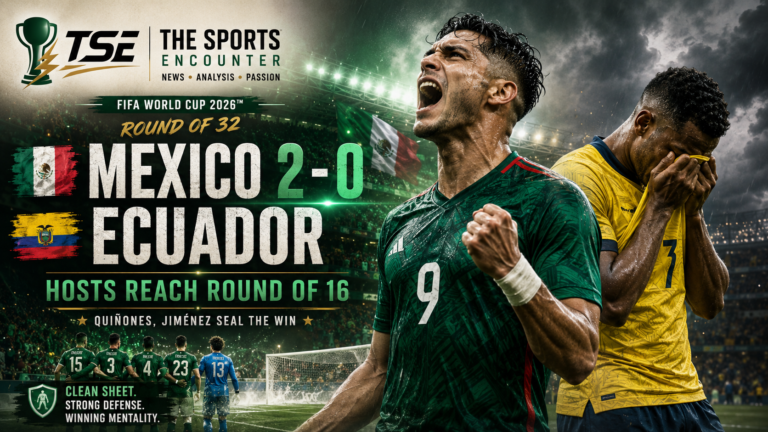
Mexico kept their World Cup 2026 dream alive with a 2-0 Round of 32 win over Ecuador, as Julián Quiñones and Raúl Jiménez struck before halftime and El Tri’s defense stood firm after the break. Ecuador pushed hard, but their night ended in heartbreak and a stoppage-time red card for Piero Hincapié.
Mexico City had waited too long for this kind of night.
The storm delayed the start. The pressure filled every corner of the Azteca. Ecuador arrived with enough courage, pace, and South American edge to make the hosts uncomfortable. Yet when the final whistle came, Mexico stood exactly where its fans wanted them to be: in the FIFA World Cup 2026 Round of 16, still unbeaten, still unbroken, and still protected by a defense that has turned clean sheets into a national mood.
Mexico beat Ecuador 2-0 in their Round of 32 clash, with Julián Quiñones and Raúl Jiménez scoring in the first half to carry El Tri past a dangerous Ecuador side whose tournament ended in frustration, heartbreak, and a stoppage-time red card for Piero Hincapié.
For Mexico, this was a result with weight. The hosts entered the knockout round after a perfect group-stage campaign, and The Sports Encounter’s Mexico vs Ecuador preview framed this match as their first real emotional test. They passed it with control, patience, and defensive courage.
They are now one step deeper into a tournament that keeps giving host nations reasons to believe. Canada had already reached the last 16 after beating South Africa, and Mexico followed with a sharper, cleaner statement in front of their own people. Read more on Canada’s Round of 16 breakthrough for the broader host-nation storyline.
Mexico Strike Early and Take Control
Mexico did not wait for the match to settle into Ecuador’s rhythm.
Quiñones opened the scoring in the 22nd minute, giving the hosts the early release they needed after a delayed kickoff and a tense opening spell. The goal changed the noise inside the stadium. What had started as expectation turned into belief.
Raúl Jiménez doubled the lead in the 31st minute, and that second goal gave Mexico the exact platform Javier Aguirre would have wanted. A one-goal lead can invite nerves. A two-goal lead allows a team with a strong defensive base to manage space, tempo, and emotion.
Jiménez’s return to the starting lineup mattered. His presence gave Mexico a focal point, a physical reference, and a calm attacking figure who understood the size of the moment. Mexico’s attacking play never became reckless. They used width, second balls, and quick pressure after turnovers to keep Ecuador from building comfort.
Ecuador, to their credit, refused to disappear. They had already shown their resilience in the group stage, especially with their comeback win over Germany, one of the stories highlighted in The Sports Encounter’s Lucky 8 knockout picture. La Tri entered this match with belief that they could hurt a bigger stage again.
This time, Mexico never gave them the same opening.
Ecuador Fight, But Mexico’s Defense Owns the Second Half
Ecuador’s second half had energy, possession, and urgency. What it lacked was the final action that turns pressure into panic.
Moises Caicedo tried to drive Ecuador forward from midfield. Hincapié pushed with determination down the left. Ecuador searched for earlier balls, crosses, and set-piece moments, but Mexico’s defensive shape kept answering every question.
The second half became a test of concentration rather than style. Mexico dropped deeper at times, but they did not collapse into desperation. César Montes and Johan Vásquez gave the back line presence. The fullbacks held their zones better as the match moved on. The midfield stopped taking unnecessary risks and focused on denying Ecuador clean central lanes.
That mattered because Ecuador needed one goal to change everything. One loose clearance, one missed duel, one cheap foul near the box could have shifted the emotional weight back toward La Tri.
Mexico allowed pressure, but they denied chaos.
That is the real strength of this performance. The first half won the match. The second half protected the meaning of it.
Ecuador’s Heartbreak Ends With Frustration
For Ecuador, this defeat will hurt because they were never a passive team.
They came into the knockout round after fighting their way through the expanded format, and their tournament had already carried one major emotional high. They pushed Mexico in the second half, tried to stretch the defensive block, and kept searching even when the match started slipping away.
But knockout football can punish teams that do not turn effort into precision.
Ecuador’s final-third choices lacked composure. Their corners and wide deliveries did not cause enough damage. Their late attacks carried emotion, but Mexico’s defense read the danger early and cleared the decisive moments before they became drama.
The ending made it worse.
Kendry Páez received a yellow card in the 90+4 minute after a frustrated challenge in midfield. One minute later, Piero Hincapié was shown a red card in stoppage time, a painful final image for one of Ecuador’s most committed players on the night.
Hincapié had played with intensity and pushed forward late, but his dismissal at 90+5 turned Ecuador’s exit into an even colder moment. The red card did not decide the result. Mexico had already done the hard work. Still, it captured Ecuador’s emotional collapse as the dream ran out.
Cards: Yellow and Red Card Details
The key disciplinary moments came late in stoppage time.
Kendry Páez was booked in the 90+4 minute as Ecuador’s frustration grew. Piero Hincapié then received a red card in the 90+5 minute, leaving Ecuador to finish their World Cup exit with 10 men.
Mexico avoided the kind of late disciplinary damage that can follow a tense knockout match. That discipline matters now because the tournament only gets harder from here.
Mexico’s Clean-Sheet Run Is Becoming Their Identity
Mexico have now reached the Round of 16 without conceding a goal in the tournament.
That number gives El Tri more than a statistical talking point. It gives them a way to survive the emotional violence of knockout football. Teams that defend this well can win even when their attack has quiet spells. They can absorb momentum without losing control. They can make opponents feel rushed.
Against Ecuador, Mexico showed exactly that.
The Azteca crowd wanted celebration, but the match also required restraint. Mexico’s players understood when to press, when to slow down, when to clear, and when to accept that Ecuador could have the ball without owning the match.
That maturity will matter in the next round.
Who Will Mexico Play in the Round of 16?
Mexico will face the winner of England vs DR Congo in the Round of 16.
That creates a fascinating next step. If England advance, Mexico will meet one of the tournament’s major contenders in a match loaded with tactical and emotional pressure. If DR Congo pull off an upset, Mexico will face a fearless underdog with nothing to lose.
Either way, Mexico have earned the right to think bigger.
The hosts are no longer only carrying home pressure. They are carrying evidence. Four matches. Four wins. No goals conceded. A knockout victory over Ecuador. A defense that keeps growing in authority.
The old “fifth game” conversation has followed Mexico for decades. This team has now moved toward the place where that burden can finally become fuel.
For more World Cup 2026 knockout coverage, visit The Sports Encounter’s FIFA World Cup 2026 hub. You can also read how Brazil survived Japan’s scare and how Morocco turned stoppage-time survival into penalty shootout glory as the Round of 32 continues to reshape the tournament.
The Sports Encounter’s World Cup 2026 coverage focuses on fixtures, team news, match analysis, fan stories, tournament trends, and the biggest talking points from football’s global stage.
Breaking News
Kane’s Late Brilliance Saves England as DR Congo Push World Cup Favorite to the Edge
Harry Kane rescued England with two late goals, including a stunning winner, as DR Congo came within 15 minutes of one of the biggest shocks of World Cup 2026.
Match Facts
| Detail | Information |
|---|---|
| Match | England vs DR Congo |
| Competition | FIFA World Cup 2026, Round of 32 |
| Venue | Atlanta Stadium, Atlanta |
| Result | England 2-1 DR Congo |
| Goals | Brian Cipenga 7’, Harry Kane 75’, Harry Kane 86’ |
| Yellow Cards | Jude Bellingham 19’, Noah Sadiki 28’ |
| Red Cards | None reported |
| Next Match | England vs Mexico, Round of 16 |
England survived. That is the cleanest way to say it.
For 75 minutes in Atlanta, DR Congo played with the nerve, discipline, and belief of a team ready to tear up the bracket. Brian Cipenga’s early goal gave the Leopards a lead they protected with courage and intelligence. Lionel Mpasi made key saves. Aaron Wan-Bissaka and Axel Tuanzebe threw themselves into blocks. Noah Sadiki and Samuel Moutoussamy worked across midfield with a calmness that made England look rushed for long spells.
Then Harry Kane changed the night.
The England captain scored twice in the final 15 minutes to drag England into the FIFA World Cup 2026 Round of 16, where they will now face hosts Mexico. The first goal brought relief. The second brought disbelief. Kane’s 86th-minute winner, a sharp turn and rising finish from the edge of the area, already has a fair case as the goal of the tournament so far.
For England, this was a warning wrapped inside a win. For DR Congo, it was heartbreak with honor.
DR Congo Scored First and Made England Panic
DR Congo did not wait for England to settle. Cipenga struck in the 7th minute after a sharp move exposed England’s right side and gave the Leopards the perfect start.
That goal changed the rhythm of the match. England wanted control, but DR Congo forced them into doubt. Every misplaced pass drew louder noise from the Congolese support. Every clearance felt like a small victory. The underdog had the scoreboard, and for long stretches, they had the clearer emotional grip on the game.
This performance also fit the wider story of DR Congo’s tournament. Their comeback win over Uzbekistan had already sent them into this historic knockout clash with England, and their earlier draw against Portugal showed they could trouble elite opposition. Readers can revisit that journey here: DR Congo Fight Back in Atlanta to Reach Historic World Cup Knockout Clash With England and DR Congo Stun Portugal as Ronaldo’s World Cup Question Grows Louder.
Against England, they came within 15 minutes of turning a brave campaign into a landmark upset.
Bellingham Carried England Before Kane Arrived
Before Kane found the net, Jude Bellingham looked like England’s only player willing to bend the match by force of personality.
He pressed. He demanded the ball. He attacked space. He tried to lift the crowd and pull England out of their slow, nervous rhythm. His yellow card in the 19th minute showed the danger of playing on that edge, but it also reflected how much emotional weight he carried in the first half.
Bellingham’s header before halftime forced one of Mpasi’s biggest saves. He kept finding pockets between DR Congo’s midfield and defense, but England lacked the final touch until the late surge. For a long time, this looked like another knockout night where Bellingham would have to do too much alone.
That changed when England finally started to stretch DR Congo after the second-half hydration break.
Hydration Breaks Changed England’s Shape and Mood
The hydration breaks became more than pauses. They acted like tactical reset buttons.
In the first half, England looked different after the break. They moved the ball with more urgency, pushed Djed Spence higher, and started to find more deliveries into the box. It still looked messy, but the tempo improved.
The second-half hydration break mattered even more. Thomas Tuchel used that window to sharpen England’s structure, calm the panic, and reinforce the need for wider service. England’s earlier crossing had often looked hopeful rather than planned. After the reset, the attacks carried more purpose.
Anthony Gordon’s delivery for Kane’s 75th-minute equalizer showed why those changes mattered. England finally attacked the spaces between DR Congo’s center backs and full backs with timing rather than frustration. Kane’s header changed the match, but the setup came from a tactical adjustment England had been chasing all night.
Tuchel will not call this a complete performance. He should not. Still, the second-half changes worked when England needed them most.
Kane’s Winner Was Captaincy in One Moment
Kane’s equalizer was a striker’s goal. His winner was something else.
With extra time closing in, Kane received the ball near the edge of the area, turned away from pressure, shifted across the D, and whipped a rising finish into the top corner. It was clean, cold, and technically brutal. DR Congo had defended with discipline for most of the night. That finish gave them almost nothing to defend.
Great tournament forwards often live for these moments. Kane had spent much of the match fighting through traffic, blocked shots, and tight marking. He stayed patient enough to remain dangerous and ruthless enough to punish one brief opening.
England did not play like champions for most of the night. Kane finished like one.
For more on the question England carried into this game, read: Can Harry Kane Guide England Past DR Congo and Into the Round of 16?
Cards and Discipline
The match had two reported yellow cards.
Bellingham was booked in the 19th minute after a sliding challenge during England’s poor opening spell. Sadiki received DR Congo’s yellow in the 28th minute after fouling Spence shortly after the first hydration break.
No red card was reported in the match feeds checked for this report.
That discipline helped the match keep its tactical shape. DR Congo stayed aggressive without losing control, while England had to manage Bellingham’s emotional edge for more than 70 minutes.
What This Means for England and DR Congo
England move on, but Mexico will have watched this with interest. The hosts beat Ecuador to reach the Round of 16, and they now face an England side still searching for a complete knockout performance. Read more here: Mexico Break the Wall as Hosts Shut Out Ecuador and March Into World Cup 2026 Round of 16.
England have Kane, Bellingham, depth, and enough late-game quality to survive bad spells. They also have defensive gaps, slow starts, and a worrying habit of needing crisis before clarity.
DR Congo leave with pain, but also with proof. They scored first against England, led deep into the second half, and made one of the tournament favorites search for answers until Kane produced two moments of elite finishing.
The Leopards lost the match. They did not lose respect.
The Sports Encounter’s World Cup 2026 coverage focuses on fixtures, team news, match analysis, fan stories, tournament trends, and the biggest talking points from football’s global stage.

Breaking News
USA vs Bosnia: A Home Knockout Night That Could Define the USMNT’s World Cup
The USA enter their Round of 32 clash against Bosnia with home pressure, attacking talent, and one uncomfortable warning from their group-stage defeat to Türkiye.
The United States have reached the match every host nation dreams about and quietly fears.
A home World Cup knockout game should feel like a gift. The crowd is behind you. The stadium energy belongs to you. The tournament story is waiting for you to take ownership of it. Yet for the USA, this Round of 32 clash against Bosnia and Herzegovina also carries the kind of pressure that can tighten legs, slow decisions, and turn a manageable opponent into a dangerous one.
Canada have already found their way into the Round of 16 after a hard 1-0 win over South Africa. Mexico followed with a composed 2-0 victory over Ecuador. Now the USA have a chance to become the third host nation to move through.
That is the opportunity.
The warning is just as clear. Bosnia arrive with nothing to lose, a disciplined shape, and the freedom that often makes third-place qualifiers awkward knockout opponents. As The Sports Encounter explained in its Lucky 8 World Cup 2026 analysis, these third-place survivors can become dangerous once the knockout bracket resets the pressure.
Match Snapshot
Match: USA vs Bosnia and Herzegovina
Competition: FIFA World Cup 2026
Stage: Round of 32
Venue: San Francisco Bay Area Stadium, Santa Clara
Date: July 1, 2026
Stakes: Winner advances to the Round of 16
Big Question: Can the USA become the third host nation to reach the last 16?
USA Carry Talent, Home Energy, and One Fresh Warning
The USA have done enough to reach the knockout stage, but their group campaign did not end with the clean rhythm Mauricio Pochettino would have wanted.
Their final Group D defeat to Türkiye changed the mood around the team. The result did not stop the USA from advancing, but it exposed a few soft edges at the wrong time. Conceding three goals before knockout football is never ideal. Losing a game after already qualifying can happen in tournament football, especially with rotation and risk management, but the manner of the defeat gave Bosnia a few clips worth studying.
That defeat also gave the USA a useful warning before the knockout rounds. Türkiye left the tournament with pride after shocking the hosts, a result The Sports Encounter covered in its report on how Türkiye stunned the USA before bowing out of World Cup 2026.
The USA still have more attacking variety than Bosnia. Christian Pulisic gives them direct threat and big-game personality. Folarin Balogun can stretch the back line. Weston McKennie brings physical presence and midfield timing. Gio Reyna, if used well, can help unlock compact defensive blocks with the kind of pass that turns pressure into a real chance.
This game will test their patience as much as their quality.
Bosnia are unlikely to give the USA open grass from the first whistle. They will try to keep the game narrow, slow the tempo when needed, and make the home side work through traffic. That means the Americans must avoid the emotional trap of forcing the game too early. Knockout matches can punish teams that mistake energy for control.
Bosnia’s Route: Third Place, But Not a Soft Story
Bosnia and Herzegovina reached the Round of 32 through the Lucky 8 route, finishing third in Group B behind Switzerland and Canada. That path can sound lucky, but Bosnia earned their survival the hard way.
Their 3-1 win over Qatar in the final group match gave their campaign a pulse when pressure was at its highest. Kerim Alajbegovic’s opener settled nerves. An own goal gave Bosnia breathing space. Qatar pulled one back before halftime, but Ermin Mahmic’s late strike restored control and kept Bosnia alive.
That victory mattered because Bosnia had very little margin left. They had drawn with Canada earlier in the group, then lost to Switzerland, leaving the Qatar match as a test of maturity and nerve. A team that fails that kind of night usually goes home. Bosnia handled it, as covered in The Sports Encounter’s match report on Bosnia and Herzegovina beating Qatar 3-1 to keep their World Cup dream alive.
Now they enter this knockout tie as outsiders, which may suit them.
They do not need to dominate possession to make the USA uncomfortable. Bosnia can defend in numbers, look for direct outlets, and turn set pieces into pressure moments. Veteran leadership also matters in these games. Bosnia know they will not control the atmosphere, so they must control the rhythm whenever the crowd starts pushing the USA forward.
Can the USA Join Canada and Mexico?
This is where the host-nation storyline becomes bigger than one match.
Canada became the first team into the Round of 16 after Stephen Eustáquio’s stoppage-time goal against South Africa. That result carried its own emotion, and The Sports Encounter captured the moment in its report on how Canada edged South Africa to become the first team into the World Cup 2026 last 16.
Mexico then delivered one of the strongest host performances of the knockout stage so far, beating Ecuador 2-0 and protecting another clean sheet under serious second-half pressure. Their defensive control and emotional lift were central to The Sports Encounter’s coverage of how Mexico shut out Ecuador and marched into the Round of 16.
The USA now face a different kind of test. Canada had to survive late tension. Mexico had to manage expectation in front of a demanding home crowd. The USA must do both while carrying the extra weight of being the tournament’s biggest commercial host.
That pressure can help or hurt.
If the USA score early, the match may open in their favor. The crowd will grow louder, Bosnia will have to take more risks, and the Americans’ pace in transition can become decisive. If the game stays level deep into the second half, the mood changes. Every missed chance will feel heavier. Every Bosnia counterattack will carry more noise. Every set piece will test American concentration.
That is why the first 25 minutes matter.
The USA do not need chaos. They need clean possession, intelligent pressing, and enough attacking patience to pull Bosnia out of shape. A fast start would help, but a reckless start could give Bosnia exactly the kind of broken game they want.
Tactical Battle: Width, Patience, and Defensive Restarts
The USA’s best route may come from wide areas. Bosnia’s compact defensive approach can clog the middle, especially if the Americans try to force too many passes into crowded central pockets. Quick switches, overlapping fullbacks, and early balls across the box could stretch Bosnia enough to create gaps.
Pulisic will naturally attract attention. That should open space elsewhere. If the USA move the ball quickly enough, they can make Bosnia’s defensive block shift repeatedly and tire over time.
Balogun’s movement will also be key. Against a deeper defense, the striker cannot only wait for service. He must drag defenders, attack blindside spaces, and create lanes for runners from midfield. McKennie’s late arrivals could become important if Bosnia defend too close to their own box.
For Bosnia, the plan will likely center on discipline and selective risk. They cannot spend 90 minutes pinned deep without suffering. Their best moments may come after USA turnovers, especially if the hosts commit fullbacks too aggressively. Bosnia will also view set pieces as a serious opportunity, not a bonus.
The USA defense must stay alert even during long spells of possession. Knockout football often turns on the first mistake after a team feels comfortable.
That has already been one of the themes of this expanded tournament. As The Sports Encounter noted in its broader World Cup 2026 knockout picture and Lucky 8 explainer, the new format gives more teams a second life, but it also creates tricky knockout matchups where favorites must manage both expectation and uncertainty.
Prediction: USA Have the Edge, But Bosnia Can Make It Nervy
On paper, the USA should advance. They have stronger individual quality, home support, better attacking depth, and the motivation to keep the host-nation surge alive after Canada and Mexico did their part.
Still, Bosnia are not here by accident. Their win over Qatar showed composure under pressure, and their third-place route gives them a dangerous psychological freedom. They can make this ugly. They can slow the game. They can force the USA to prove they have more than talent and noise.
That is the real test for Pochettino’s side.
A good USA performance would not need to be spectacular. It would need to be mature. Control the ball. Avoid cheap turnovers. Use the crowd without getting carried away by it. Finish chances when they arrive.
If the USA manage that, they should become the third host nation to reach the Round of 16.
If they let the match drift into anxiety, Bosnia have enough structure and belief to turn a home celebration into a long, uncomfortable night.
For more fixtures, match reports, team news, fan stories, and tournament analysis, follow The Sports Encounter’s full FIFA World Cup 2026 coverage.
The Sports Encounter’s World Cup 2026 coverage focuses on fixtures, team news, match analysis, fan stories, tournament trends, and the biggest talking points from football’s global stage.

Breaking News
From Revolution to Reckoning: How Bazball Changed and Exposed England
Ben Stokes and Brendon McCullum changed England Test cricket, but Stokes’ sudden retirement and England’s collapse against New Zealand have left Bazball facing its hardest question yet.
Ben Stokes and Brendon McCullum gave England Test cricket its pulse back. That part should never get lost in the noise.
When they came together in 2022, England looked tired, timid, and trapped by their own red-ball failures. The batting carried fear. The dressing room lacked spark. The results had flattened belief. Then Stokes took the captaincy, McCullum arrived as coach, and England suddenly started playing Test cricket as if risk itself had become a weapon.
For a while, it worked beautifully.
Now, after Stokes’ sudden retirement from international cricket and England’s 2-1 home series defeat to New Zealand, that same weapon looks blunt, exposed, and sometimes self-inflicted. The latest collapse at Trent Bridge felt like more than another bad chase. As covered in The Sports Encounter’s match report on England’s defeat to New Zealand, it felt like a verdict arriving at the worst possible moment.
For more red-ball coverage, visit The Sports Encounter Cricket Hub.
Stokes-McCullum Era Snapshot
| Category | England Under Stokes-McCullum |
|---|---|
| Era began | 2022 |
| Core identity | Aggressive batting, attacking fields, result-first cricket |
| Early surge | 10 wins in first 12 Tests |
| Major high | 3-0 away win in Pakistan in 2022 |
| Major frustration | No marquee five-Test series win over Australia or India |
| Recent slump | Seven defeats in nine Tests |
| Latest blow | 2-1 home series loss to New Zealand |
| Leadership issue | Stokes retired, Harry Brook now leads succession debate |
What Bazball Fixed
Bazball began with a clear purpose. England wanted to remove fear from Test cricket. Stokes and McCullum encouraged players to attack, trust their instincts, and treat pressure as something to push back at the opposition.
The numbers support that early revolution. England won 10 of their first 12 Tests under the new regime. They chased totals that previous England teams might have treated as survival exercises. Their 2022 win in Rawalpindi, part of a historic 3-0 series victory in Pakistan, gave Bazball real credibility because England forced a result on a flat pitch where many teams would have drifted toward a draw.
The batting tempo also changed. England’s scoring rate under Bazball jumped sharply, and that made opponents uncomfortable. Bowlers had less time to settle. Captains had to defend sooner. Matches moved faster. Fans came back into Test cricket conversations with energy.
That is the strongest defense of the Stokes-McCullum partnership. They made England relevant, watchable, and dangerous again.
Where Bazball Started to Hurt England
The problem came when bravery turned into habit.
Test cricket rewards controlled aggression. Bazball too often looked like aggression looking for a reason. England batters began manufacturing shots when the match asked for patience. They attacked short balls straight to deep fielders. They chased tempo instead of reading the session. They sometimes treated defensive fields as an insult rather than a trap.
Sky Sports’ Michael Atherton captured the mood after the New Zealand defeat with the line that “Bazball dies where it began.” The phrase hit hard because it landed at Trent Bridge, against New Zealand, four years after the Stokes-McCullum project first caught fire against the same opposition.
Nasser Hussain’s criticism felt just as important. He did not attack ambition. He attacked the lack of honesty around errors. His argument was simple: McCullum’s positivity cannot cover tactical mistakes, loose batting, poor plans, and England’s recent record. That matters because great Test teams review mistakes without hiding behind identity.
The Oval and Trent Bridge exposed that gap. New Zealand played the old Test virtues better than England did. They showed patience, discipline, repeatable plans, and enough aggression at the right moments. England showed bursts of brilliance, then lost control.
The Sports Encounter had already explored this pressure around Stokes in The Curious Case of Ben Stokes and His Opponents. That wider leadership tension has now become England’s central cricket problem.
Did Bazball Cost England the Ashes?
The perception has substance.
England did not lose every Ashes opportunity because of Bazball, but their approach damaged them in key moments. The 2023 Ashes finished 2-2, yet England started that series loosely. The first-day declaration at Edgbaston became a permanent talking point. At Lord’s, England’s batters repeatedly attacked Australia’s short-ball plan even when the field screamed trap. Australia had lost Nathan Lyon to injury, but England still helped them stay in control.
That series did not prove Bazball was useless. England fought back strongly. Stokes played one of the great Ashes innings at Lord’s. England won at Headingley and The Oval. Rain also hurt them at Old Trafford.
Still, the central question remains fair: would a more controlled England have regained the Ashes?
Probably, yes.
The same issue followed them into bigger contests. England failed to win a marquee five-Test series against India or Australia under Stokes and McCullum. They drew at home but lost heavily away. That does not erase the excitement of the era, but it shows the ceiling. Bazball made England better against many teams. It did not consistently make England smarter against the best.
Stokes’ Retirement Changes the Whole Equation
Stokes was never only a captain in this system. He was the emotional engine.
He gave Bazball credibility because he lived its risk. He set fields others would not set. He declared when others would hesitate. He asked players to be fearless because he had built a career on dragging England through impossible cricket situations.
His retirement, confirmed during the New Zealand series and covered by The Sports Encounter’s Stokes retirement report, leaves McCullum without the one figure who made the philosophy feel authentic rather than performative.
That is why this moment feels bigger than a captaincy vacancy. England must decide whether Bazball can survive without Stokes or whether it now needs a sharper, more mature version.
England’s final series defeat also made the timing harsher. New Zealand had already forced the decider with a crushing win in the second Test, where McCullum confirmed Stokes would return as captain. That context now reads differently after New Zealand’s series-leveling win over England became the beginning of the end for the Stokes era.
Is Harry Brook the Right Captain Against Pakistan?
Harry Brook is the obvious candidate. He is England’s white-ball captain, was vice-captain under Stokes, and has said Test captaincy would be an honor and a privilege. He also sits near the top of the ICC Test batting rankings, which confirms his elite status as a player.
But captaincy requires more than talent.
Brook’s biggest weakness as a Test batter has become England’s biggest cultural concern. He can dominate attacks, but he also gives opponents chances through loose shots. His dismissals often look like a batter trying to impose himself before earning control. That matters because Pakistan will test England differently. They can use spin, reverse swing, uneven tempo, and emotional pressure. A captain facing Pakistan must read sessions carefully, not only attack them.
Brook could become a strong England captain, but only if England separate leadership from entertainment. His job cannot be to preserve Bazball as a brand. His job must be to win Test matches.
Joe Root’s value in this debate also matters. Root remains England’s most complete Test mind and the standard-bearer for batting judgment. The Sports Encounter recently covered his continued rise in Joe Root Reclaims No. 1 Test Ranking as England’s Modern Great Keeps Defying Time. If Brook leads, England should keep Root close as the tactical balance in the dressing room.
Final Verdict: Bazball Needs Reform, Not Burial
Bazball did not destroy England Test cricket. It rescued England from fear, gave players belief, and gave fans a team worth watching again.
But the Stokes-McCullum era now demands a more honest judgment. England’s problem has not been aggression itself. The problem has been aggression without enough match awareness. Test cricket still asks batters to leave well, absorb pressure, respect spells, and earn dominance. Technique, patience, and temperament still decide the biggest series.
Atherton’s line about Bazball dying where it began may become the phrase attached to this moment. The better reading is slightly different.
Bazball as a rescue mission has ended.
Bazball as a serious Test-winning method now has to grow up.