Ricky Martin and Pedro Sampaio to Turn NFL’s First Rio Game into a Maracanã Spectacle
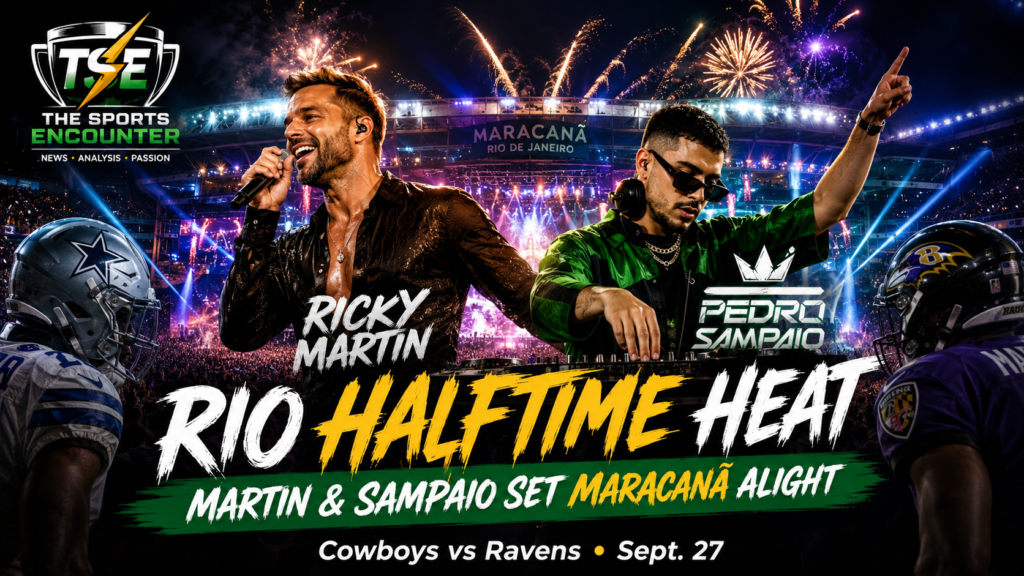
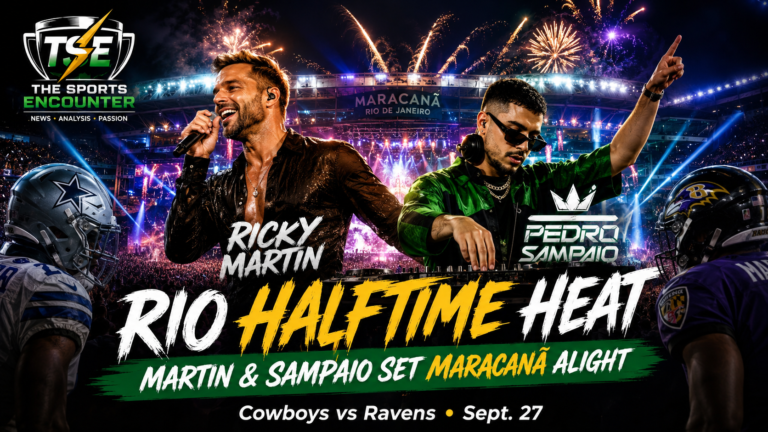
The NFL is turning its first Rio de Janeiro game into a full-scale cultural event, with Ricky Martin and Pedro Sampaio performing at halftime when the Dallas Cowboys face the Baltimore Ravens at Maracanã.
The NFL is not treating its first regular-season game in Rio de Janeiro like an ordinary overseas fixture.
It is building a show around it.
Ricky Martin and Brazilian DJ Pedro Sampaio will perform at halftime when the Dallas Cowboys face the Baltimore Ravens at Maracanã Stadium on September 27, giving the league a music lineup designed as deliberately as the football matchup itself.
Martin brings global recognition.
Sampaio brings Rio.
The combination tells us exactly what the NFL wants this game to become.
Not an American event transplanted into Brazil.
A Brazilian night built around American football.
The league has confirmed that the Week 3 matchup will kick off at 5:25 p.m. local time in Rio, with Dallas serving as the designated home team. It will be the first NFL regular-season game staged in the city and the first at the Maracanã, one of world sport’s most recognizable venues.
For a league that has spent years expanding aggressively outside the United States, the entertainment choice matters because Rio offers something different from London, Munich, Madrid or Melbourne.
It offers a city where music, football, carnival culture and stadium spectacle are already inseparable.
NFL Rio Game 2026: Key Details
| Detail | Information |
|---|---|
| Game | Baltimore Ravens vs Dallas Cowboys |
| Date | September 27, 2026 |
| Venue | Maracanã Stadium, Rio de Janeiro |
| Kickoff | 5:25 p.m. local time |
| Halftime performers | Ricky Martin and Pedro Sampaio |
| Broadcast | CBS and Paramount+ |
| Designated home team | Dallas Cowboys |
| Historical significance | First NFL regular-season game in Rio de Janeiro |
The NFL’s official announcement confirms Martin and Sampaio as the halftime performers, while the league’s international schedule places Ravens-Cowboys at Maracanã in Week 3.
Ricky Martin Gives the NFL Instant Global Recognition
Martin is one of the most recognizable Latin pop performers of the past three decades.
His breakthrough as a solo global star arrived in the late 1990s, when “Livin’ la Vida Loca” became one of the defining crossover hits of the era.
His catalog gives the NFL exactly what international halftime entertainment requires.
Recognition across generations.
Music that translates immediately inside a large stadium.
A performer comfortable in front of enormous live audiences.
Martin also arrives with recent NFL history behind him after appearing during the Super Bowl LX halftime show in Santa Clara earlier this year.
That gives the league continuity.
He already understands the scale and production language of an NFL halftime event.
Pedro Sampaio Makes the Booking Feel Like Rio
If Martin gives the show international reach, Sampaio gives it local authenticity.
The Brazilian DJ grew up in Rio de Janeiro and has developed into one of the country’s most commercially successful modern music acts.
His presence prevents the halftime show from feeling like a generic celebrity booking.
He belongs to the city.
That relationship was obvious in his reaction to the announcement.
“I grew up in Rio de Janeiro, seeing Maracanã Stadium as a place where history was made.”
Sampaio described performing there for the first time alongside Martin as something he never imagined while growing up in the city.
That emotional connection is exactly what the NFL needs.
International expansion becomes more convincing when local audiences feel included rather than targeted.
Maracanã Changes the Scale of the Event
The venue carries its own mythology.
Maracanã is associated with World Cups, Brazilian football, major finals, packed crowds and some of the loudest sporting nights South America has produced.
American football arrives there as a guest.
That makes the choice significant.
The NFL could have selected a newer venue built around commercial efficiency.
Instead, it chose a stadium with cultural weight.
That decision places the league inside a story much older than its presence in Brazil.
For one Sunday, the field normally associated with Brazil’s football identity becomes home to Lamar Jackson, Dak Prescott and an NFL spectacle.
The Cowboys Are the Perfect Team for This Kind of International Event
Dallas remains one of the NFL’s most recognizable brands.
The Cowboys carry international familiarity even among sports fans who do not follow the league closely.
That makes them a logical centerpiece for Rio.
The game will also mark Dallas’ first regular-season international appearance since 2014, when the Cowboys beat Jacksonville in London.
The organization enters Rio with a 1-0 international regular-season record.
From a marketing perspective, “America’s Team” playing at Maracanã is almost too obvious a pairing.
The contrast itself creates attention.
One of American sport’s most famous franchises enters one of Brazilian sport’s most famous stadiums.
Baltimore Brings the Football Star Power
The Ravens give the game another layer.
Lamar Jackson is one of the league’s most recognizable quarterbacks and one of its most visually exciting players.
His mobility makes him unusually accessible to new NFL viewers because the athleticism is immediately obvious even without deep tactical knowledge.
That matters in an international game.
A newcomer may not understand protection schemes or route combinations.
Everyone understands a quarterback escaping pressure and accelerating into open space.
Dallas and Baltimore therefore offer a strong balance between brand recognition and elite athletic entertainment.
The Halftime Show Is Part of a Much Bigger NFL Strategy
The Rio booking should be viewed alongside the rest of the league’s 2026 international calendar.
The NFL will stage nine regular-season games outside the United States this season, with events scheduled across Rio de Janeiro, Melbourne, London, Munich, Madrid, Mexico City and Paris.
The league has moved far beyond experimenting with one or two overseas games.
International football is becoming a recurring part of the regular season.
The NFL’s official international-games schedule confirms the scale of that expansion.
Rio is one of the most important additions because Brazil represents a huge sports market with an established appetite for American football.
Brazil Is No Longer an Experimental NFL Market
The league’s decision to commit to multiple games in Rio over several years shows that this is not a one-night test.
The NFL announced a multiyear commitment to play at least three regular-season games in Rio across a five-year period.
That transforms the city from a novelty destination into a recurring international market.
The halftime show should therefore be read as part of a longer courtship.
The league wants Brazilian fans to build emotional attachment to the event.
Music helps.
Local stars help.
Maracanã helps.
Eventually, the goal is for the game itself to feel normal.
Why Music Matters More in an International NFL Game
American audiences already understand the rituals surrounding an NFL Sunday.
International audiences may engage with the event differently.
Some arrive for the football.
Others arrive because the occasion feels culturally significant.
Halftime entertainment broadens the entry point.
A Ricky Martin fan may buy a ticket without being able to explain cover-two defense.
A Pedro Sampaio follower may attend because a major Rio artist is performing at Maracanã.
Once those fans enter the stadium, the NFL has an opportunity to convert spectacle into sporting interest.
That is why the entertainment is not decorative.
It is part of audience acquisition.
Rio Offers the NFL Something London Cannot
London has become familiar territory for the league.
Germany has developed rapidly.
Madrid and Paris offer enormous European commercial potential.
Rio brings a different emotional character.
Brazilian sports culture is loud, expressive and deeply connected to music.
The Maracanã setting amplifies that.
The NFL does not need Rio to imitate an American stadium.
The smarter strategy is to let Rio change the NFL experience.
Martin and Sampaio fit that philosophy perfectly.
Sampaio Understands What Maracanã Means
The most important quote in the announcement may belong to Sampaio.
“Maracanã is part of the history of both sports and music.”
That observation captures why the booking works.
Maracanã has never functioned solely as a football stadium.
It is a cultural venue.
Major performers have shared the same space as some of the greatest players in Brazilian football history.
The NFL is inserting itself into that tradition rather than asking the city to forget it for a day.
Ricky Martin Knows What Brazilian Crowds Can Produce
Martin’s own statement emphasized the energy of Brazilian audiences.
“There’s nothing quite like the energy of the Brazilian people.”
That may sound like standard promotional language.
In Rio, it has practical importance.
The success of the first Maracanã game will be judged partly by atmosphere.
If the crowd responds with the intensity associated with major Brazilian events, the broadcast will immediately look different from a typical overseas NFL game.
That visual and acoustic identity matters to the league’s global ambitions.
The NFL Is Learning From the Super Bowl Model
The Super Bowl long ago became bigger than the game itself.
Halftime entertainment, commercials, celebrity attendance and cultural conversation expanded the audience beyond traditional football fans.
The international schedule appears to be borrowing some of that logic.
Not every overseas game needs a Super Bowl-scale production.
But marquee entertainment can turn an ordinary regular-season fixture into a destination event.
Rio is ideally suited to that approach.
The Jonas Brothers Booking in Melbourne Shows a Pattern
The league has already announced the Jonas Brothers for its Melbourne international game between the Los Angeles Rams and San Francisco 49ers.
Martin and Sampaio continue the same strategy.
The NFL is attaching recognizable musical acts to major new international markets.
That suggests entertainment may increasingly become a standard feature when the league enters a city for the first time.
The logic is straightforward.
Football gets people interested.
Entertainment makes the occasion harder to ignore.
The Sports Story Still Has to Deliver
There is one risk in building so much spectacle around the event.
The football cannot become secondary.
Dallas and Baltimore have to provide a game worthy of the setting.
International fans are increasingly sophisticated NFL viewers.
They do not need novelty alone.
They want competitive games, recognizable stars and meaningful regular-season stakes.
Week 3 provides enough early-season importance to make the result matter.
The Sports Encounter will follow that matchup through our NFL coverage as the 2026 season develops.
TSE Analysis: The Real Win Would Be Making the NFL Feel Brazilian for One Night
The easiest way to stage an international sporting event is to reproduce the home product somewhere else.
The smarter way is to let the host city reshape it.
Rio should not feel like Dallas with palm trees.
It should feel like Rio.
That means music.
That means a crowd with its own rhythm.
That means using Maracanã’s history rather than covering it with NFL branding.
Martin and Sampaio give the halftime show exactly that possibility.
One represents Latin pop on a global scale.
The other represents the city itself.
If the NFL gets the balance right, viewers may remember the entire night rather than only the score.
The League Is Competing for Attention, Not Only Fans
Global sports expansion is increasingly a battle for entertainment time.
The NFL is not merely competing against other American sports.
It competes against football, Formula 1, concerts, streaming platforms, esports and every other major event demanding a weekend audience.
That makes cultural relevance valuable.
A standalone Cowboys-Ravens game will attract NFL fans.
A Cowboys-Ravens game at Maracanã with Ricky Martin and Pedro Sampaio can attract people who might otherwise never schedule their Sunday around American football.
That is a much larger opportunity.
Frequently Asked Questions
Who is performing at the NFL Rio halftime show?
Ricky Martin and Brazilian DJ Pedro Sampaio will perform at halftime of the 2026 NFL Rio Game.
Which teams are playing in Rio?
The Baltimore Ravens will face the Dallas Cowboys.
When is the NFL game in Rio?
The game is scheduled for Sunday, September 27, 2026.
Where will the game be played?
The matchup will take place at Maracanã Stadium in Rio de Janeiro.
What time does Ravens vs Cowboys start?
The game is scheduled for 5:25 p.m. local time in Rio, which corresponds to 4:25 p.m. ET.
Is this the first NFL game in Rio de Janeiro?
Yes. It will be the first NFL regular-season game played in Rio de Janeiro.
Has Ricky Martin performed at an NFL event before?
Yes. Martin appeared during the Super Bowl LX halftime show in February 2026.
Who is Pedro Sampaio?
Pedro Sampaio is a Brazilian DJ, producer and singer from Rio de Janeiro who has become one of Brazil’s most successful contemporary music artists.
Will the NFL return to Rio after 2026?
The league has announced a multiyear commitment that includes at least three regular-season games in Rio over five years.
Maracanã Is About to Get a Different Kind of Sunday
For generations, Maracanã has belonged to football in the Brazilian sense of the word.
On September 27, the other football arrives.
The Cowboys bring one of America’s most famous sporting brands.
The Ravens bring Lamar Jackson and a team capable of providing genuine competitive quality.
Ricky Martin brings international star power.
Pedro Sampaio brings Rio.
The NFL could have staged a game and left it at that.
Instead, it is building an event around the city.
That may prove to be the more important decision.
If the football is good, the music hits and Maracanã responds the way Maracanã usually does, the NFL’s first night in Rio could become much more than another international fixture.
It could become the night American football finally feels at home in the city.
Breaking News
Vietnam Break Malaysia’s Resistance as Xuân Son Double Sets Up Thailand Final Rematch
Nguyễn Xuân Son came off the bench to score twice as defending champion Vietnam completed a 4-0 aggregate semifinal victory and booked another ASEAN final against Thailand.
Malaysia survived an hour in Hanoi with their comeback hopes technically alive. Within three minutes of Nguyễn Xuân Son entering the contest, those hopes had all but disappeared.
The striker scored twice after coming off the bench as Vietnam defeated Malaysia 2-0 at a packed Mỹ Đình National Stadium on Wednesday, August 19. Combined with their two-goal first-leg victory in Kuala Lumpur, the result carried the defending champions into the ASEAN Hyundai Cup 2026 final with a convincing 4-0 aggregate win.
Vietnam will now face Thailand in a repeat of the 2024 final. Kim Sang-sik’s team enters the decider with greater momentum, while the seven-time champion has an additional recovery day and will host Saturday’s opening leg in Bangkok.
TL;DR
- Vietnam defeated Malaysia 2-0 in the semifinal second leg and advanced 4-0 on aggregate.
- Substitute Nguyễn Xuân Son scored in the 62nd and 89th minutes.
- Xuân Son earned the official Hyundai Player of the Match award.
- Malaysia goalkeeper Azri Ghani made seven saves and delayed Vietnam’s breakthrough.
- No yellow or red cards appeared in the accessible official ASEAN and Google event feeds.
- Vietnam will visit Thailand on August 22 before hosting the return leg on August 26.
Vietnam vs Malaysia Match Information
| Detail | Information |
|---|---|
| Competition | ASEAN Hyundai Cup 2026 |
| Stage | Second semifinal, second leg |
| Result | Vietnam 2-0 Malaysia |
| Aggregate Result | Vietnam won 4-0 |
| Venue | Mỹ Đình National Stadium, Hanoi |
| Date | Wednesday, August 19, 2026 |
| Goalscorer | Nguyễn Xuân Son 62’, 89’ |
| Player of the Match | Nguyễn Xuân Son |
| Turning Point | Xuân Son scored three minutes after entering as a substitute |
| Yellow Cards | None listed in the accessible official ASEAN or Google event feeds |
| Red Cards | None listed |
| Final | Thailand vs Vietnam, August 22 and 26 |
The score, goalscorer and official match award were confirmed by the ASEAN Championship’s match report. Additional national-team updates are available through the Vietnam Football Federation and the Football Association of Malaysia.
Vietnam Control the Tie Before Xuân Son Finishes It
Vietnam began with the authority expected from a team protecting a 2-0 advantage. Nguyễn Đình Bắc attacked the right channel inside the opening minute, while Đoàn Văn Hậu forced Azri into an important intervention after 10 minutes.
Pressure continued through Đình Bắc, Nguyễn Quang Hải and Văn Hậu. Malaysia’s goalkeeper repeatedly prevented an early goal, including a flying save when Đình Bắc appeared ready to find the top corner.
Vietnam recorded 26 shots, with 10 reaching the target. Their 11 corners reflected the amount of time spent around Malaysia’s penalty area. The hosts had already shown this attacking depth while winning Group A against Cambodia and during their 3-0 victory over Indonesia.
Malaysia remained level at halftime because Azri performed superbly and Vietnam missed several presentable openings. Holding out was only part of the visitors’ task, however. They still needed two goals to force extra time.
Nguyễn Xuân Son Turns Pressure Into Goals
Kim introduced Xuân Son in the 59th minute after Vietnam’s starting attack had created chances without finding the finish.
The decision produced an almost immediate return. Azri saved Xuân Son’s first close-range header, but the striker remained alert when Trương Tiến Anh’s effort was blocked in the 62nd minute. He collected the loose ball and converted from close range.
Xuân Son added his second in the 89th minute, powering down the left, cutting inside and beating Azri to complete the semifinal.
His six shots and four attempts on target made him the match’s most dangerous player despite spending only half an hour on the field. The double took his tournament total to five goals, level with Đình Bắc at the top of Vietnam’s scoring chart.
Xuân Son’s influence also strengthens Vietnam’s final prospects. Their route to the semifinals had already demonstrated that goals could come from different areas. Now the forward who scored eight times during the 2024 title campaign has found his sharpest form at the ideal moment.
Patrik Lê Giang Preserves Another Clean Sheet
Malaysia enjoyed its best spell shortly after halftime. G. Pavithran forced Patrik Lê Giang into a reaction save before Paulo Josué’s follow-up was deflected over.
Those opportunities offered Malaysia a brief route back into the semifinal. A goal would have reduced the aggregate deficit and placed pressure on a home side growing frustrated by Azri’s saves.
Lê Giang ended the match with four stops and another clean sheet. His calm handling prevented Malaysia from building momentum and allowed Vietnam to continue attacking without panic.
The goalkeeper had also played an important role in Kuala Lumpur. His consistency across both legs helped Vietnam complete a semifinal without conceding.
Malaysia Compete, but Lack the Required Cutting Edge
Malaysia held 52 percent possession and completed 363 accurate passes, yet much of that control occurred away from Vietnam’s most vulnerable areas.
Tan Cheng Hoe’s team needed an early goal but struggled to place runners behind Vietnam’s back three. Paulo Josué lacked sustained service, while Malaysia’s wide attacks rarely created clear opportunities before the interval.
Azri was Malaysia’s outstanding performer. His seven saves kept the game scoreless for 61 minutes and prevented the aggregate margin from becoming heavier.
Reaching the semifinals still represented a respectable campaign. Malaysia secured qualification by defeating the Philippines in their final group game, but losses to Thailand and Vietnam exposed the gap between a competitive semifinalist and the tournament’s two strongest teams.
Vietnam vs Thailand: Who Has the Advantage in the Final?
The ASEAN Championship semifinal history pointed toward another meeting between the region’s dominant programs. Both have arrived, although their semifinal performances created different moods.
Vietnam enters as the slight favorite. The defending champion won both semifinal legs, kept two clean sheets and produced a 4-0 aggregate victory. Kim can also introduce Xuân Son from the bench or restore him to the starting lineup.
Thailand holds the logistical advantage before the opening leg. Anthony Hudson’s players have one additional recovery day and remain in Bangkok, where Saturday’s match will take place. Thailand also won all four group matches and scored 10 unanswered goals before the semifinals.
Concern emerged during their 2-1 home defeat to Singapore. After progressing 4-3 on aggregate, Hudson admitted he was “disappointed with the performance” and said there were “a lot of things we need to fix.”
Vietnam will host the second leg in Hanoi, which gives the defending champion the more valuable structural advantage. If Kim’s team remains level or close after Bangkok, the title will be decided before its own crowd at Mỹ Đình.
Thailand brings seven titles, a record 12th final appearance and the experience of surviving uncomfortable knockout situations. Vietnam carries stronger form, a deeper range of scorers and home advantage in the decisive leg.
The 2024 final ended with Vietnam defeating Thailand 5-3 on aggregate. Two years later, the War Elephants have a chance to settle that account, while Vietnam can confirm that Southeast Asian football’s balance of power has shifted.
Follow continuing tournament analysis through The Sports Encounter’s soccer coverage, its ASEAN Championship qualification archive and the broader FIFA World Cup 2026 hub.https://chatgpt.com/backend-api/sentinel/frame.html?sv=20260810913b
Breaking News
Harry Sawyer Breaks APIA Hearts as Melbourne Victory Reach Australia Cup Semifinals
Harry Sawyer came off the bench to score the decisive extra-time goal as Melbourne Victory edged APIA Leichhardt 1-0 at Leichhardt Oval and booked a Hahn Australia Cup 2026 semifinal against Sydney FC.
SYDNEY, August 19, 2026: Melbourne Victory needed 120 minutes to end APIA Leichhardt’s latest Australia Cup challenge, with substitute Harry Sawyer scoring the decisive extra-time goal in a tense 1-0 quarterfinal victory at Leichhardt Oval.
The result makes Victory the second team through to the Hahn Australia Cup 2026 semifinals and sets up a heavyweight meeting with Sydney FC for a place in the final.
According to the official Australia Cup match report, APIA frustrated the two-time Cup winners through 90 scoreless minutes before Sawyer finally found the breakthrough in the first half of extra time.
Victory had been warned repeatedly that this would not be a routine assignment. The Sports Encounter’s quarterfinal preview highlighted APIA’s home advantage, strong NPL NSW form and history of eliminating A-League opposition.
That warning proved accurate.
Melbourne had more of the ball for long periods, but APIA stayed organized, threatened after halftime and even had the ball in the net before an offside decision preserved the deadlock.
Sawyer eventually supplied the difference, continuing an impressive personal Australia Cup run and ensuring Giovanni Savarese’s side survived another difficult knockout night in New South Wales.
APIA Leichhardt 0-1 Melbourne Victory: Match Summary
| Competition | Hahn Australia Cup 2026 |
| Round | Quarterfinal |
| Result | APIA Leichhardt 0-1 Melbourne Victory after extra time |
| Scorer | Harry Sawyer |
| Venue | Leichhardt Oval |
| Melbourne Victory coach | Giovanni Savarese |
| Full-time score | 0-0 |
| Semifinal opponent | Sydney FC |
Melbourne Victory Control the Ball but Find No Easy Route Through APIA
Victory entered the quarterfinal as favorites, but the opening half quickly demonstrated why APIA had reached the last eight.
The NPL NSW side defended with discipline and refused to allow Melbourne’s possession to translate into clear chances.
Keegan Jelacic became increasingly involved as Victory tried to build through midfield, while Louis D’Arrigo sent a left-footed effort narrowly wide during one of the visitors’ better first-half moments.
APIA were without two important attacking options from the starting lineup, with Presley Ortiz and Michael Konestabo having dealt with illness during the week. Both were available from the bench.
The absences contributed to a cautious opening, although APIA gradually grew into the contest.
Jordan Segreto tested his range from a free kick late in the first half, while Frans Deli went down seeking a penalty after contact with Jordi Valadon. The appeal did not produce a spot kick.
At halftime, the game remained 0-0.
APIA Turn Up the Pressure After the Break
The balance changed after halftime.
APIA began pushing forward with greater confidence, forcing Melbourne to defend rather than simply dictate possession.
Jack Stewart created one of the first genuine moments of danger when he drove toward goal from a tight angle. Victory goalkeeper Jack Duncan stood firm, and Jason Davidson then blocked an effort from Deli during the same attacking sequence.
Moments later, Leichhardt Oval thought the underdogs had found their breakthrough.
Sean Symons converted at the back post following a well-delivered set piece, only for the assistant referee’s flag to rule the goal out for offside.
It was the type of moment that can completely change a knockout game.
APIA had gone from believing they were ahead to watching Victory immediately attack at the other end.
Matthew Grimaldi was given an excellent opportunity at the back post but sent his attempt over the crossbar.
APIA’s Defensive Resistance Pushes Victory Toward Extra Time
Melbourne continued to have more possession, yet APIA’s defensive structure held.
Victory manager Giovanni Savarese eventually turned to his bench.
Harry Shillington entered before Sawyer was introduced to give the visitors a stronger central presence in the penalty area.
The move nearly paid off quickly when a Jason Davidson cross reached Sawyer at the far post, forcing Oliver Kalac to remain alert.
The match then moved toward the type of finish APIA wanted.
Every scoreless minute increased the pressure on the A-League side while strengthening the belief inside the home ground.
Victory almost avoided extra time entirely.
Deep in second-half stoppage time, Jelacic and Grimaldi both found shooting opportunities in dangerous positions, only for APIA defenders to block the efforts and preserve the 0-0 score.
Ninety minutes had not been enough.
Harry Sawyer Changes Another Australia Cup Tie
Sawyer had already established himself as one of Melbourne Victory’s important Cup figures before arriving at Leichhardt Oval.
He scored in extra time against Western Sydney Wanderers in the previous round before Victory eventually advanced through a penalty shootout.
The striker delivered again when another knockout match required a decisive intervention.
Victory patiently moved possession through midfield before Valadon found Jelacic in space. Jelacic spotted Sawyer’s movement inside the penalty area and threaded the ball into his path.
Sawyer finished across goal into the bottom corner.
After more than 90 minutes of frustration, Melbourne finally had the lead.
The official Melbourne Victory match report credited the move to patient buildup through Valadon and Jelacic before Sawyer supplied the finishing touch.
Sawyer Is Building an Australia Cup Reputation Quickly
There is an interesting pattern developing around the striker.
Sawyer joined Victory during the offseason and has not needed long to become influential in knockout competition.
He scored his first competitive goal for the club during the Round of 16 against Western Sydney.
Now another extra-time goal has taken Victory into the semifinals.
Those are valuable contributions from a player who does not necessarily need to dominate entire matches to change them.
In cup competition, that quality can become decisive.
The difference between elimination and progression is frequently one movement, one pass or one composed finish after more than an hour of tactical stalemate.
Sawyer has now delivered those moments twice.
Jack Duncan Makes Sure Sawyer’s Goal Is Enough
The story could easily have changed again after Melbourne went ahead.
APIA had little choice but to commit more players forward.
Presley Ortiz, introduced from the bench, provided the home side with another attacking threat and eventually forced Duncan into an important save during the second period of extra time.
Duncan moved across his goal to keep out Ortiz’s low attempt and protect Melbourne’s advantage.
His contribution continues an excellent Cup campaign.
The goalkeeper was already Victory’s hero against Western Sydney, where he saved three penalties during the Round of 16 shootout.
This time he did not need penalties.
He still produced the intervention Melbourne required.
APIA Leave the Australia Cup With Their Reputation Enhanced
The result ends APIA Leichhardt’s tournament, but the manner of the defeat deserves context.
They took an established A-League club beyond 90 minutes and were separated by a single extra-time goal.
Their quarterfinal appearance was built on substance rather than novelty.
APIA entered the match as NPL NSW leaders and had already survived a dramatic penalty shootout against Sydney United 58 in the previous round.
The Sports Encounter’s pre-match analysis also noted the club’s previous Australia Cup victories over A-League opposition, including its memorable win against Melbourne Victory in 2018.
Another upset did not arrive in 2026.
The possibility remained alive until extra time.
Victory Avoid Another Australia Cup “Cupset”
The 2026 tournament has again demonstrated why professional status provides no guarantee in one-off knockout soccer.
NPL clubs have repeatedly tested A-League opponents, and several have already eliminated professional teams.
Melbourne understood that danger better than most.
APIA had beaten them in this competition before.
The location was the same.
The home crowd understood the history.
Victory therefore deserve credit for avoiding the emotional trap that can consume favorites in cup competition.
They did not panic when APIA stayed level.
They survived the disallowed goal.
They continued building attacks even as the game moved deeper into uncomfortable territory.
Eventually, their professional depth provided the answer.
Sydney FC vs Melbourne Victory Is Now Confirmed
Victory’s reward is one of the biggest fixtures available in Australian domestic soccer.
Sydney FC will face Melbourne Victory in the semifinals, renewing the Big Blue rivalry with a place in the Australia Cup final at stake.
Sydney became the first team through after beating SD Raiders 1-0, a match covered in full in The Sports Encounter’s Sydney FC vs SD Raiders quarterfinal report.
Takahiro Sekine scored the only goal at Fairfield Showground, although the Raiders pushed Sydney much harder than the final score might suggest.
The official Sydney FC quarterfinal report confirmed the Sky Blues’ progression after their 1-0 win.
The Big Blue Adds a Different Dimension to the Semifinal
Australia Cup knockout matches involving NPL clubs often draw attention because of the possibility of an upset.
Sydney against Victory brings a different type of pressure.
Both clubs will believe they should reach the final.
Both have major domestic histories.
Neither will carry the psychological freedom APIA or SD Raiders enjoyed in the quarterfinals.
The semifinal will therefore become a more traditional battle between two professional squads with expectations attached.
Sydney are chasing another Australia Cup trophy.
Melbourne Victory are two-time winners and are now one victory away from returning to the final.
Giovanni Savarese’s Victory Keep Finding Ways to Win
The result also continues Giovanni Savarese’s encouraging start at Melbourne Victory.
His side have experienced very different tests during this Cup run.
They comfortably handled Kingborough Lions United in the Round of 32.
Western Sydney Wanderers forced them through extra time and penalties.
APIA then turned the quarterfinal into another long, tactical contest.
Victory progressed from all three.
That adaptability matters at this stage of preseason.
Savarese is still developing combinations and assessing his squad ahead of the domestic campaign, yet the Australia Cup offers no room for experimental defeats.
Every match has consequences.
Australian Soccer’s Knockout Summer Keeps Delivering Tight Margins
There has been a familiar theme running through Australian soccer in 2026: knockout matches refusing to follow simple expectations.
The Socceroos experienced exactly that at the FIFA World Cup.
Australia opened the tournament with an impressive 2-0 victory over Türkiye, before tactical questions emerged following their defeat against the United States.
They then survived a demanding 0-0 draw with Paraguay to reach the knockout stage.
Australia’s run eventually ended when Egypt eliminated the Socceroos on penalties.
The circumstances are different, but the competitive lesson travels well.
Knockout soccer rewards teams that remain emotionally stable when the match does not follow the expected script.
Melbourne Victory did that at Leichhardt.
Australia Cup 2026 Quarterfinal Picture
| Quarterfinal | Result/Status |
|---|---|
| SD Raiders vs Sydney FC | Sydney FC won 1-0 |
| APIA Leichhardt vs Melbourne Victory | Melbourne Victory won 1-0 after extra time |
| Lions FC vs North Sunshine Eagles | Upcoming |
| Preston Lions vs South Melbourne | Upcoming |
The wider tournament can be followed through The Sports Encounter’s soccer coverage, while our FIFA World Cup 2026 hub provides additional coverage of Australia’s international campaign and the major soccer stories shaping 2026.
TSE Turning Points
APIA’s disallowed goal
Sean Symons putting the ball into the net early in the second half briefly changed the atmosphere inside Leichhardt Oval. The offside flag prevented APIA from gaining the kind of lead that could have transformed the final half-hour.
Grimaldi misses at the other end
Victory immediately generated a major opportunity after APIA’s disallowed goal, but Matthew Grimaldi could not keep his attempt down. Both teams had their chance to seize control during the same frantic period.
APIA’s stoppage-time blocks
Jelacic and Grimaldi both saw late attempts blocked as APIA forced the match beyond 90 minutes.
Sawyer changes the game
Melbourne’s substitutes ultimately mattered. Sawyer found the space and finish that had been missing throughout regulation time.
Duncan denies Ortiz
APIA still created one last major opportunity, but Duncan’s late extra-time save ensured Sawyer’s goal remained enough.
TSE Verdict: Victory Were Tested, and That May Help Them Against Sydney
Melbourne Victory did not dominate APIA Leichhardt into submission.
They had to solve them.
That distinction is important.
APIA defended intelligently, grew into the match and came close enough to an upset that Victory were forced into extra time before finally finding the decisive opening.
Sawyer deserves the headline because his finish separated the teams.
Duncan deserves considerable credit because APIA still had an opportunity to take the semifinal away from Melbourne after falling behind.
Jelacic’s involvement in the winning move also reflected his growing influence throughout the contest.
For Savarese, the most encouraging part may be the variety of ways Victory have progressed through this tournament.
They have won comfortably.
They have survived penalties.
Now they have survived a difficult away quarterfinal against an NPL club that had every reason to believe another upset was possible.
Sydney FC will present a very different challenge.
The Sky Blues have professional depth, Cup pedigree and their own warning from the quarterfinal after SD Raiders pushed them hard.
The semifinal therefore arrives with both teams already reminded that reputation does not win Australia Cup matches.
Victory escaped Leichhardt.
The Big Blue now decides which A-League heavyweight reaches the final.
Frequently Asked Questions
Who won APIA Leichhardt vs Melbourne Victory?
Melbourne Victory defeated APIA Leichhardt 1-0 after extra time in the Hahn Australia Cup 2026 quarterfinal.
Who scored the winning goal for Melbourne Victory?
Harry Sawyer scored the only goal of the match during the first half of extra time.
What was the score after 90 minutes?
The match was 0-0 at the end of regulation time.
Did APIA Leichhardt score against Melbourne Victory?
APIA put the ball in the net during the second half through Sean Symons, but the goal was ruled out for offside.
Who will Melbourne Victory play in the Australia Cup semifinal?
Melbourne Victory will face Sydney FC in the semifinals.
How did Sydney FC reach the semifinal?
Sydney FC defeated SD Raiders 1-0, with Takahiro Sekine scoring the decisive first-half goal.
Did Jack Duncan make an important save in extra time?
Yes. Duncan denied substitute Presley Ortiz as APIA pushed for an equalizer after Melbourne had taken the lead.
Has Harry Sawyer scored in consecutive Australia Cup rounds?
Yes. Sawyer also scored in extra time against Western Sydney Wanderers in the Round of 16 before scoring the quarterfinal winner against APIA.
How many Australia Cup titles have Melbourne Victory won?
Melbourne Victory are two-time winners of the competition and are now chasing a third title.
Where can fans follow official Australia Cup updates?
Fixtures, results, match reports and tournament information are available through the official Australia Cup website.
Breaking News
Real Madrid Officially Unveil Bernardo Silva as Mourinho Gains His Midfield Swiss Army Knife
Bernardo Silva has been officially presented as a Real Madrid player after signing a two-year contract through June 2028. The former Manchester City midfielder will wear No. 20 and gives José Mourinho a versatile new option across midfield.
MADRID, August 19, 2026: Bernardo Silva has been officially presented as a Real Madrid player, completing the ceremonial side of a move that could become one of the most tactically important additions of the club’s summer rebuild.
According to Real Madrid’s official website, the Portuguese midfielder was welcomed at Ciudad Real Madrid on Wednesday by club president Florentino Pérez before signing the contract that will keep him at the Santiago Bernabéu until June 30, 2028.
Bernardo was then presented with a replica of the stadium, a watch and his new Real Madrid jersey carrying the No. 20. Honorary president José Martínez “Pirri” also attended the ceremony. :contentReference[oaicite:1]{index=1}
The formal presentation arrives several weeks after Madrid first announced the agreement and after Bernardo had already begun training and appearing in preseason under José Mourinho. What happened on Wednesday therefore felt less like the beginning of his Madrid career and more like confirmation that one of European soccer’s most experienced midfielders is now fully embedded in Mourinho’s new project.
The Sports Encounter has already followed that project closely, including José Mourinho’s return to Real Madrid, Yan Diomande’s major summer arrival and the resolution of Vinícius Júnior’s future.
Bernardo Silva at Real Madrid: Key Details
| Player | Bernardo Silva |
| Club | Real Madrid |
| Contract | Until June 30, 2028 |
| Shirt number | 20 |
| Position | Midfielder |
| Previous club | Manchester City |
| Real Madrid coach | José Mourinho |
| Official presentation | August 19, 2026, Ciudad Real Madrid |
Real Madrid Make the Bernardo Silva Era Official
Real Madrid had already announced in June that Bernardo would join the club for the next two seasons. Wednesday’s ceremony completed the traditional institutional welcome attached to major Madrid arrivals. :contentReference[oaicite:2]{index=2}
The symbolism was familiar.
Florentino Pérez received him inside the boardroom. The contract was signed. The shirt was presented. The new player was formally placed inside the institutional history of the club.
For Bernardo, however, the football had already started.
He joined Madrid’s preseason group following Portugal’s World Cup campaign and completed his first training sessions at Ciudad Real Madrid earlier this month. The club has already used him in friendly competition, meaning Mourinho has had several weeks to begin defining the role he wants the 32-year-old to perform. :contentReference[oaicite:3]{index=3}
Why No. 20 Fits Bernardo Better Than a Superstar Number
The No. 20 shirt may not carry the immediate glamour associated with Madrid’s historic attacking numbers, but that almost suits Bernardo.
His game has rarely depended on celebrity positioning.
He wins influence through movement, repetition, intelligence and technical reliability.
The official Real Madrid player profile lists him simply as a midfielder, but his actual role has always been more fluid. :contentReference[oaicite:4]{index=4}
He can receive deep during buildup.
He can operate between the lines.
He can move wide and create overloads.
He presses intelligently and understands how to manipulate space without needing to dominate possession individually.
That versatility is precisely why Mourinho wanted him.
Mourinho Has Gained a Midfielder Who Can Solve Several Problems
Madrid’s midfield has enough athletic power.
Jude Bellingham can drive through pressure and arrive inside the penalty area. Federico Valverde provides range and intensity. Eduardo Camavinga can carry the ball and defend large spaces. Aurélien Tchouaméni can anchor deeper positions.
Bernardo brings something slightly different.
Control.
His value appears most clearly when a match becomes slow, narrow or technically difficult.
Madrid will face plenty of opponents this season who defend in compact blocks and refuse to give Kylian Mbappé or Vinícius Júnior open grass to attack.
Those games demand players capable of changing angles, sustaining pressure and knowing when to accelerate rather than simply trying to play faster.
Bernardo has spent years doing exactly that.
The Sports Encounter’s recent report on Real Madrid’s Teresa Herrera win over Deportivo already showed how his positional intelligence can help Mourinho control tighter matches.
His First Madrid Appearances Have Already Offered Clues
Bernardo’s integration did not wait for Wednesday’s presentation.
He has already featured in preseason and spoken about his willingness to adapt to whatever the team requires.
After his Real Madrid debut, Bernardo explained that he can contribute deeper in buildup, press higher up the pitch or move into more advanced areas depending on the game. :contentReference[oaicite:5]{index=5}
That is more than convenient squad depth.
It gives Mourinho tactical freedom.
A coach can change the shape of a midfield without necessarily making a substitution if one player is capable of moving between several roles during the match.
Bernardo Arrives With Nine Years of Manchester City Habits
Madrid are also buying experience developed inside one of the most demanding positional systems in modern soccer.
Bernardo spent nine seasons at Manchester City, making 460 appearances and scoring 76 goals while winning 20 major trophies, according to Manchester City’s official farewell announcement. :contentReference[oaicite:6]{index=6}
That period placed him at the center of Pep Guardiola’s most successful era.
He won six Premier League titles, the Champions League, domestic cups and international club honors. Manchester City also identified him as the most-used player of Guardiola’s managerial career, underlining how consistently he earned trust inside a system built around positional discipline. :contentReference[oaicite:7]{index=7}
That background makes him unusually useful to Mourinho.
The two coaches approach soccer differently, but both demand intelligence without the ball and clarity inside team structures.
From Guardiola to Mourinho Is a Fascinating Tactical Shift
Bernardo spent most of the last decade playing under a coach who wants possession to control territory.
He now joins a coach whose best teams have often been more willing to change rhythm, defend deeper and attack space directly.
That does not make Bernardo a poor fit.
It may make him more valuable.
Mourinho’s Madrid already contain enormous transition threat through Mbappé, Vinícius and the club’s younger attacking options.
The missing ingredient in some matches may be the ability to slow everything down.
Bernardo can provide that.
The Manchester City Exit Also Marks the End of an Era
For City, Bernardo’s departure represents more than losing another midfielder.
He was part of the core that transformed the club from domestic powerhouse into European champion.
His movement, pressing and ability to play through pressure made him central to some of the defining matches of that era.
That history also creates an unusual Madrid connection.
Bernardo produced one of the greatest performances of his City career against Real Madrid, scoring twice in the 4-0 Champions League semifinal victory at the Etihad in 2023.
Now the player who once helped dismantle Madrid on a historic European night will wear white.
Bernardo Is Joining a Much Bigger Summer Rebuild
His arrival cannot be viewed in isolation.
Real Madrid have spent the summer restructuring the squad around Mourinho.
Marc Cucurella arrived to reshape the left side, a move The Sports Encounter examined when Mourinho made the Spanish full-back one of his first major additions.
Yan Diomande later joined in a deal reported at €125 million, bringing speed and long-term attacking upside. Our analysis of the Diomande transfer showed how aggressively Madrid have invested in immediate improvement.
At the same time, Vinícius Júnior’s future has been stabilized after months of speculation. Madrid’s refusal to sell and subsequent long-term planning removed one of the biggest distractions surrounding the attack. The earlier Vinícius transfer saga had shown how quickly uncertainty around one star could dominate the club’s summer.
Bernardo Gives Bellingham Something He Has Not Always Had
One of the most interesting tactical consequences could involve Jude Bellingham.
Bellingham is most dangerous when he is allowed to move.
His ability to arrive late in attacking areas, carry the ball and attack the penalty box becomes less useful if he must spend too much time controlling every possession from deeper positions.
Bernardo can absorb some of that responsibility.
That may allow Bellingham to operate more aggressively without making Madrid’s midfield structurally careless.
Bellingham remains one of the central players in Madrid’s next era, a status reinforced during the World Cup when his performances for England further strengthened his profile as a global star.
Where Could Bernardo Actually Play?
There are several realistic options.
As a No. 8
This may be the most natural role.
Bernardo can play on either side of midfield, receive under pressure and connect deeper players with Madrid’s forwards.
As a deeper controller
He is not a traditional holding midfielder, but against weaker opponents he can drop into buildup and help Madrid play through the first line of pressure.
As a No. 10
Mourinho can use him behind the forwards when he wants additional creativity between the lines.
From the right side
Bernardo has spent significant parts of his career starting wide before drifting inside.
That option could be especially useful when Madrid want to overload midfield without losing width elsewhere.
Bernardo May Be More Important Against Smaller Teams Than Against Giants
The obvious temptation is to imagine how he changes Champions League nights.
His biggest week-to-week impact may come somewhere less glamorous.
Real Madrid regularly face domestic opponents who defend deep, slow the tempo and ask the favorites to solve a crowded final third.
Those matches often decide league titles.
Madrid rarely lack players capable of producing moments of brilliance.
The harder task is consistently turning territorial control into clear chances.
Bernardo’s patience could become crucial there.
The Rodri Story Shows Why Madrid Wanted More Control
Madrid’s interest in central control has been visible throughout the summer.
The club had previously been linked with Rodri, another Manchester City midfielder whose positioning and game management offered an obvious solution to Madrid’s need for greater structure.
The Sports Encounter examined that possibility in our analysis of the Real Madrid-Manchester City battle for Rodri.
Rodri ultimately moved elsewhere, but Bernardo gives Madrid a different route toward the same broader objective.
He does not protect midfield in the same way.
He does help control it.
Age Is the Main Question
Bernardo turned 32 earlier this month. Real Madrid therefore have not signed him as a decade-long project. :contentReference[oaicite:8]{index=8}
The two-year contract reflects that reality.
Madrid are buying immediate intelligence, experience and technical quality rather than future resale value.
That creates a clear expectation.
Bernardo needs to matter now.
His Game Could Age Better Than Most
The encouraging part is that his greatest strengths are not built primarily on raw pace.
His game depends on awareness, touch, balance, passing angles and timing.
Those qualities generally age more gracefully than explosive acceleration.
He may lose some ability to press at the extraordinary volume associated with his prime Manchester City years.
He can compensate by reading situations earlier.
The No. 20 Shirt Arrives With a Different Kind of Expectation
Bernardo is unlikely to become the face of Real Madrid.
He does not need to.
Mbappé, Vinícius and Bellingham already carry enormous commercial and attacking attention.
Bernardo’s responsibility is more subtle.
Make the team function better.
That can be just as valuable.
TSE Verdict: Madrid Have Signed a Problem-Solver
The official presentation completes the formal story.
The football story is more interesting.
Real Madrid have not signed Bernardo Silva to become their next global superstar.
They have signed him because superstars need structure around them.
Mourinho already has pace.
He has power.
He has attackers capable of winning matches individually.
Bernardo adds control, intelligence and the ability to solve different tactical problems without changing personnel.
His Manchester City career proves he understands how elite teams manage possession and pressure.
His early Real Madrid appearances suggest he is comfortable adapting.
The contract length makes the expectation immediate.
Two seasons.
No long development period.
No need to build a future resale market.
Madrid want the version of Bernardo Silva capable of helping them win now.
Wednesday’s ceremony gave him the shirt.
The next stage is showing why No. 20 could become one of the most important numbers in Mourinho’s first season back at the Bernabéu.
For continuing Real Madrid, La Liga and European soccer coverage, follow The Sports Encounter’s soccer section.
Frequently Asked Questions
Has Bernardo Silva officially joined Real Madrid?
Yes. Real Madrid formally presented Bernardo Silva at Ciudad Real Madrid on August 19, 2026.
How long is Bernardo Silva’s Real Madrid contract?
His contract runs until June 30, 2028.
What shirt number will Bernardo Silva wear at Real Madrid?
Bernardo Silva will wear the No. 20 shirt.
Who welcomed Bernardo Silva at Real Madrid?
Club president Florentino Pérez welcomed him during the official presentation ceremony. Honorary president José Martínez “Pirri” also attended.
Where did Bernardo Silva play before Real Madrid?
He spent nine seasons with Manchester City from 2017 to 2026.
How many appearances did Bernardo Silva make for Manchester City?
Manchester City’s official records list 460 appearances and 76 goals across his nine seasons at the club.
How many trophies did Bernardo Silva win at Manchester City?
Manchester City credited him with 20 major trophies during his time at the Etihad Stadium.
What position will Bernardo Silva play for Real Madrid?
He is officially listed as a midfielder, but he can operate as a No. 8, in a deeper buildup role, as a No. 10 or from the right side.
Who is Real Madrid’s coach for the 2026-27 season?
José Mourinho is Real Madrid’s coach following his return to the club.
Has Bernardo Silva already played for Real Madrid?
Yes. He joined preseason training before his official presentation and has already featured in friendly matches.