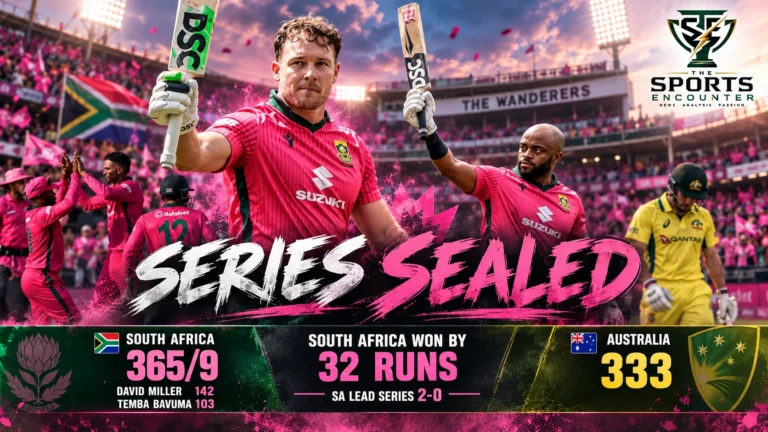
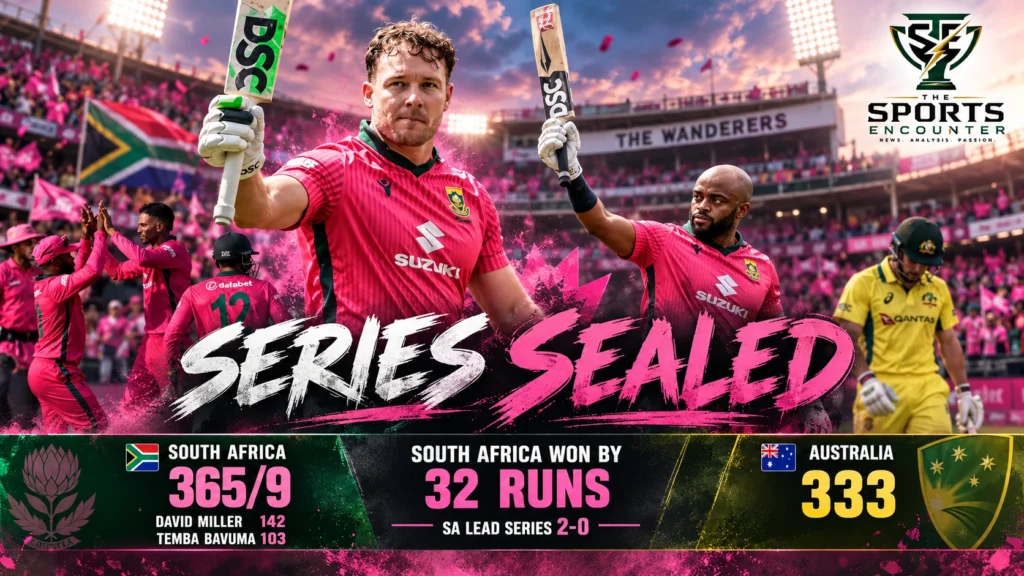
JOHANNESBURG, South Africa, September 27, 2026: Australia reached 130 without loss chasing 366 at the Wanderers and, for a while, threatened to turn South Africa’s Pink Day celebration into a record-breaking pursuit. By the end, the more revealing numbers were 142, 103, 84 and 84.
David Miller and Temba Bavuma converted. Mitchell Marsh and Travis Head did not.
Miller’s career-best 142 from 93 balls and Bavuma’s 103 carried South Africa from 93/3 to 365/9 before the hosts’ spinners dismantled Australia’s promising chase through the middle overs. Australia eventually reached 333 in 49.5 overs, losing by 32 runs as South Africa secured an unassailable 2-0 lead and a sixth successive bilateral ODI series victory over Australia.
The result also continued a pattern established in South Africa’s 67-run victory in the first ODI at Durban. Australia again produced a powerful start. South Africa again changed the match once spin entered the contest.
Story at a glance
How Did South Africa Recover From 93/3?
Australia could hardly have started better.
David Miller Turns Stability Into Destruction
Miller joined Bavuma with South Africa still vulnerable. He left with Australia facing 366.
Jack Edwards Gave Australia a Five-Wicket Lifeline
Australia’s bowling figures could easily have looked much worse.
Why Did Australia’s Chase Look So Dangerous at 130/0?
Mitchell Marsh played as though 366 could be reduced to something ordinary.
How South Africa’s Spinners Broke Australia’s Middle Order
The most important phase of the match came between Marsh’s dismissal at 130/1 and Alex Carey’s wicket at 203/4.
For a South African side missing several preferred fast bowlers, the series has become evidence that its ODI attack can win through variation as well as pace. For Australia, Wednesday’s final match in Potchefstroom has become less about rescuing the series and more about solving a problem that has now appeared twice in four days.
South Africa vs Australia 2nd ODI: Match at a Glance
| Match Detail | Information |
|---|---|
| Match | South Africa vs Australia, 2nd ODI |
| Series | Australia tour of South Africa 2026 |
| Date | September 27, 2026 |
| Venue | DP World Wanderers Stadium, Johannesburg |
| Toss | Australia won the toss and elected to field |
| South Africa | 365/9 in 50 overs |
| Australia | 333 all out in 49.5 overs |
| Result | South Africa won by 32 runs |
| Series Position | South Africa lead 2-0 with one match remaining |
| Player of the Match | David Miller, 142 from 93 balls |
| Match Number | ODI No. 5019 |
How Did South Africa Recover From 93/3?
Australia could hardly have started better.
Josh Hazlewood removed Aiden Markram with the first delivery of the match. Quinton de Kock followed for 15 at 36/2, and Jack Edwards dismissed Matthew Breetzke for 34 after the young batter had briefly counterattacked.
At 93/3 after 15.3 overs, Australia had created exactly the type of opening required after losing the first ODI.
Bavuma changed the tempo without trying to dominate it.
His 103 took 116 balls and contained 10 fours and two sixes. The innings was built around accepting periods when Australia’s seamers were difficult to attack, keeping the scoreboard moving and ensuring Miller did not have to begin his innings as a rescuer and finisher simultaneously.
South Africa had selected experience for precisely these situations when Bavuma, Miller, de Kock and other senior players returned for the Australia series.
That decision paid off at the Wanderers.
David Miller Turns Stability Into Destruction
Miller joined Bavuma with South Africa still vulnerable. He left with Australia facing 366.
The left-hander scored 142 from 93 balls, striking 12 fours and nine sixes at a strike rate of 152.68. He reached fifty from 45 deliveries, accelerated to his hundred from 73 and continued attacking even after Bavuma departed.
The pair added 156 for the fourth wicket from 132 balls.
What made Miller’s innings decisive was where much of the damage landed.
Adam Zampa conceded 77 from nine overs, Cooper Connolly 27 from four and Matt Renshaw 29 from three. Australia’s three spin options therefore combined for 133 runs from 16 overs without taking a wicket.
On a surface Bavuma later said offered more spin than expected, that imbalance became one of the defining tactical differences between the sides.
Miller was named Player of the Match and described the 142 as a particularly satisfying innings against an Australian side he called intensely competitive.
Pink Day Made Miller’s 142 Even More Personal
The innings carried another layer because it came during the Wanderers’ annual Pink Day, an event supporting breast cancer awareness and treatment.
Miller played with the name of his mother, Jenny, on his shirt. She is a breast cancer survivor.
His career-best ODI score therefore became both the innings that won South Africa the series and one of the defining individual performances of the Pink Day tradition.
Jack Edwards Gave Australia a Five-Wicket Lifeline
Australia’s bowling figures could easily have looked much worse.
Nathan Ellis managed only four overs after suffering a side problem, leaving Mitchell Marsh with an unexpected hole in the attack. Edwards responded superbly.
Playing only his second ODI, the all-rounder removed Breetzke, Bavuma, Tristan Stubbs, Marco Jansen and finally Miller to finish with 5/67 from 10 overs.
Hazlewood added 3/70 and Xavier Bartlett took the remaining wicket.
Edwards’ performance was particularly relevant because Australia’s selectors are using this African tour to examine players who could form the next ODI core. That process began during the Zimbabwe tour, when Matt Renshaw and Nathan Ellis drove the opening win in Harare, before Travis Head and Adam Zampa sealed the series.
Australia ultimately completed a 3-0 whitewash when Josh Inglis and Ellis survived the third ODI.
South Africa have provided a considerably harsher test of those developing combinations.
Why Did Australia’s Chase Look So Dangerous at 130/0?
Mitchell Marsh played as though 366 could be reduced to something ordinary.
The Australian captain reached fifty from 32 balls and eventually struck 84 from only 53, with 10 fours and five sixes. Head played the steadier role early, allowing Marsh to dictate the required rate.
Australia reached 77 without loss in the first 10 overs and 130 without loss after 16.
At that stage, South Africa were under genuine pressure.
Then Bjorn Fortuin bowled Marsh for 84 from the final delivery of the 17th over.
The entire chase changed shape.
How South Africa’s Spinners Broke Australia’s Middle Order
The most important phase of the match came between Marsh’s dismissal at 130/1 and Alex Carey’s wicket at 203/4.
Cooper Connolly made 10 from seven before Lizaad Williams removed him. Head continued to 84 from 76 but Aiden Markram trapped him lbw at the end of the 25th over.
Keshav Maharaj then removed Carey for 17 and later Matt Renshaw for 32.
Bjorn Fortuin returned to dismiss Cameron Green for 17.
South Africa’s three spin options produced a combined 30 overs, conceding 179 runs and taking five wickets:
| South Africa Spinner | Overs | Runs | Wickets | Economy |
|---|---|---|---|---|
| Keshav Maharaj | 10 | 54 | 2 | 5.40 |
| Aiden Markram | 10 | 55 | 1 | 5.50 |
| Bjorn Fortuin | 10 | 70 | 2 | 7.00 |
| Combined | 30 | 179 | 5 | 5.97 |
The economy rate was useful in a chase requiring more than seven runs per over, but the wickets mattered more.
Australia’s captain acknowledged the recurring problem afterward. Marsh said Australia had set up both innings in the series well but had failed to execute through the middle phases.
That is now the central Australian problem heading into Potchefstroom.
Marsh and Head Made 84 Each, but the Missing Centuries Mattered
The scorecard contains the clearest comparison of the afternoon.
South Africa’s two senior batters reached 103 and 142.
Australia’s two dominant batters both reached 84.
Marsh had already scored quickly enough to transform the chase. Head had spent enough time at the crease to control its middle phase. Neither stayed long enough to finish the job.
Bavuma and Miller did.
The difference between an excellent start and a match-winning innings was therefore 19 runs for Bavuma, 58 for Miller and an entire ODI series for South Africa.
Xavier Bartlett’s 50 Gave Australia One Last Opening
Australia were 251/6 when Cameron Green departed in the 40th over. At that point, South Africa had done enough to place the required rate beyond a conventional chase.
Bartlett refused to concede.
He attacked with five sixes and two fours, reaching fifty from 26 deliveries before finishing with 50 from 28. Together with Edwards, he helped add 61 for the seventh wicket and pushed Australia past 300.
Marco Jansen then removed Edwards for 25 and Adam Zampa for a first-ball duck in successive deliveries.
Lizaad Williams trapped Bartlett lbw for 50 before eventually dismissing Hazlewood to complete the innings at 333. Williams finished with 3/54, while Marco Jansen took 2/53.
What Does the Series Win Say About South Africa Before the 2027 World Cup?
This series matters beyond another trophy.
South Africa are preparing to co-host the 2027 ODI World Cup, and Cricket South Africa has explicitly positioned the current home season as part of that preparation. The official CSA squad announcement emphasized the need to develop combinations and define middle-order roles before the tournament.
The first two ODIs have supplied evidence in several areas.
Matthew Breetzke made 112 in Durban. Bavuma and Miller made centuries in Johannesburg. Maharaj and Fortuin have repeatedly influenced Australia’s middle order.
That depth also follows a month in which South Africa’s wider player pool was tested heavily. A younger side sealed the Namibia ODI series through Connor Esterhuizen’s century and a new-ball burst, before Fortuin helped complete a 3-0 sweep.
The Australia series has restored the senior core without removing the competition underneath it.
South Africa have achieved all of this despite entering the series without several frontline fast-bowling options. The ICC confirmed Lungi Ngidi’s withdrawal after Kagiso Rabada and Ottneil Baartman had already been ruled out.
Two matches later, South Africa have still taken 20 Australian wickets.
Why Australia’s ODI Problem Is Now Bigger Than One Defeat
Australia arrived from Zimbabwe with a 3-0 sweep and several positive selection developments.
South Africa have changed the context.
Durban exposed Australia’s decision-making after Marsh’s aggressive opening. Johannesburg exposed the same weakness after an even stronger foundation.
That is why the concern is structural rather than statistical.
Australia’s broader transition was already visible in TSE’s analysis of an ageing core and the next generation competing for permanent roles. Younger players such as Edwards, Connolly, Bartlett and Renshaw are receiving genuine opportunities.
The unanswered question is whether those combinations can handle opponents who change pace, field shape and bowling type through the middle overs.
South Africa have asked that question twice.
Australia have not yet answered it.
South Africa Extend a Remarkable ODI Hold Over Australia
The result gives South Africa a sixth successive bilateral ODI series victory over Australia, continuing a run that stretches back to the 2016/17 period.
Continue the Cricket Story
 A Celebration of 5000 ODIsA Celebration of 5000 ODIs Match 35: Williamson Holds His Nerve as South Africa Let Another World Cup Escape Slip Away
 CricketMarsh Blasts Australia to 90/0, Then South Africa Turn a Runaway Chase Into a 67-Run Statement
 A Celebration of 5000 ODIsA Celebration of 5000 ODIs Match 30: Sarfaraz’s Six Catches Help Pakistan Survive De Villiers’ Defiance
That is particularly striking given the history between these sides.
Few international rivalries carry more ODI baggage, from Australia’s famous World Cup escapes to South Africa’s later bilateral dominance. The deepest scar remains the 1999 semifinal, revisited in TSE’s account of the Edgbaston tie that eliminated South Africa.
The modern bilateral story looks very different.
South Africa have learned how to make Australia uncomfortable repeatedly, particularly when spin and scoreboard pressure combine.
South Africa vs Australia 2nd ODI Full Scorecard
South Africa Batting: 365/9 in 50 Overs
| Batter | Dismissal | R | B | 4s | 6s | SR |
|---|---|---|---|---|---|---|
| Aiden Markram | c Connolly b Hazlewood | 0 | 1 | 0 | 0 | 0.00 |
| Quinton de Kock | c Carey b Hazlewood | 15 | 13 | 0 | 2 | 115.38 |
| Temba Bavuma (c) | c Bartlett b Edwards | 103 | 116 | 10 | 2 | 88.79 |
| Matthew Breetzke | c Carey b Edwards | 34 | 28 | 6 | 0 | 121.42 |
| David Miller | c Green b Edwards | 142 | 93 | 12 | 9 | 152.68 |
| Tristan Stubbs | c Carey b Edwards | 6 | 8 | 1 | 0 | 75.00 |
| Marco Jansen | c Carey b Edwards | 19 | 15 | 1 | 2 | 126.66 |
| Duan Jansen | not out | 27 | 18 | 4 | 0 | 150.00 |
| Bjorn Fortuin | c Carey b Hazlewood | 5 | 5 | 0 | 0 | 100.00 |
| Keshav Maharaj | lbw b Bartlett | 4 | 2 | 1 | 0 | 200.00 |
| Lizaad Williams | not out | 1 | 1 | 0 | 0 | 100.00 |
| Extras | 3 lb, 6 w | 9 | ||||
| Total | 50 overs | 365/9 | Run rate: 7.30 | |||
Fall of wickets: 0/1 Markram (0.1), 36/2 de Kock (6.6), 93/3 Breetzke (15.3), 249/4 Bavuma (37.3), 261/5 Stubbs (39.3), 307/6 Marco Jansen (43.6), 331/7 Miller (46.3), 353/8 Fortuin (48.5), 360/9 Maharaj (49.3).
Australia Bowling
| Bowler | O | M | R | W | Econ | Wd | NB |
|---|---|---|---|---|---|---|---|
| Josh Hazlewood | 10 | 0 | 70 | 3 | 7.00 | 1 | 0 |
| Xavier Bartlett | 10 | 1 | 70 | 1 | 7.00 | 3 | 0 |
| Nathan Ellis | 4 | 0 | 22 | 0 | 5.50 | 1 | 0 |
| Adam Zampa | 9 | 0 | 77 | 0 | 8.55 | 0 | 0 |
| Cooper Connolly | 4 | 0 | 27 | 0 | 6.75 | 0 | 0 |
| Jack Edwards | 10 | 0 | 67 | 5 | 6.70 | 1 | 0 |
| Matt Renshaw | 3 | 0 | 29 | 0 | 9.66 | 0 | 0 |
Australia Batting: 333 All Out in 49.5 Overs
| Batter | Dismissal | R | B | 4s | 6s | SR |
|---|---|---|---|---|---|---|
| Mitchell Marsh (c) | b Fortuin | 84 | 53 | 10 | 5 | 158.49 |
| Travis Head | lbw b Markram | 84 | 76 | 12 | 1 | 110.52 |
| Cooper Connolly | c Markram b Williams | 10 | 7 | 2 | 0 | 142.85 |
| Alex Carey | lbw b Maharaj | 17 | 21 | 0 | 0 | 80.95 |
| Matt Renshaw | lbw b Maharaj | 32 | 34 | 4 | 0 | 94.11 |
| Cameron Green | c Marco Jansen b Fortuin | 17 | 34 | 0 | 0 | 50.00 |
| Jack Edwards | c Breetzke b Marco Jansen | 25 | 30 | 0 | 1 | 83.33 |
| Xavier Bartlett | lbw b Williams | 50 | 28 | 2 | 5 | 178.57 |
| Adam Zampa | c Maharaj b Marco Jansen | 0 | 1 | 0 | 0 | 0.00 |
| Nathan Ellis | not out | 7 | 5 | 1 | 0 | 140.00 |
| Josh Hazlewood | c Markram b Williams | 2 | 10 | 0 | 0 | 20.00 |
| Extras | 1 b, 2 lb, 2 w | 5 | ||||
| Total | 49.5 overs | 333 | Run rate: 6.68 | |||
Fall of wickets: 130/1 Marsh (16.6), 157/2 Connolly (19.6), 191/3 Head (24.6), 203/4 Carey (27.2), 241/5 Renshaw (36.2), 251/6 Green (39.3), 312/7 Edwards (46.2), 312/8 Zampa (46.3), 322/9 Bartlett (47.4), 333/10 Hazlewood (49.5).
South Africa Bowling
| Bowler | O | M | R | W | Econ | Wd | NB |
|---|---|---|---|---|---|---|---|
| Marco Jansen | 7 | 0 | 53 | 2 | 7.57 | 1 | 0 |
| Lizaad Williams | 7.5 | 0 | 54 | 3 | 6.89 | 0 | 0 |
| Duan Jansen | 5 | 0 | 44 | 0 | 8.80 | 0 | 0 |
| Keshav Maharaj | 10 | 0 | 54 | 2 | 5.40 | 0 | 0 |
| Aiden Markram | 10 | 0 | 55 | 1 | 5.50 | 0 | 0 |
| Bjorn Fortuin | 10 | 0 | 70 | 2 | 7.00 | 1 | 0 |
What Did Bavuma and Marsh Say After the Match?
Bavuma described the victory as another complete team performance and highlighted the unexpected assistance available to the spinners.
“There was a lot more spin than was expected. I think the way the spin complemented our attack was great.”
Marsh’s assessment went directly to Australia’s biggest problem.
“We’ve set up the innings really well but haven’t been able to execute in those middle phases.”
That is now the question Australia must answer before the Test series begins.
When Is the Third South Africa vs Australia ODI?
The third and final ODI will be played on Wednesday, September 30 at JB Marks Oval in Potchefstroom.
South Africa will have an opportunity to complete a 3-0 sweep. Australia need a result both to prevent the whitewash and to carry some positive momentum into the Test series.
The official Cricket Australia series schedule confirms the Potchefstroom finale before the teams move into three Tests beginning in Durban on October 9.
Australia have already demonstrated that they can dominate weaker opposition and recover from setbacks. South Africa are providing a more revealing examination.
Two ODIs in, the recurring question is no longer whether Australia can start a chase.
It is whether they can control the 30 overs that come after the start.
South Africa vs Australia 2nd ODI FAQs
Who Won the Second ODI Between South Africa and Australia?
South Africa won by 32 runs after scoring 365/9 and dismissing Australia for 333 in 49.5 overs.
Who Was Player of the Match?
David Miller was named Player of the Match after scoring a career-best 142 from 93 balls, including 12 fours and nine sixes.
How Many Runs Did Temba Bavuma Score?
Bavuma scored 103 from 116 balls, with 10 fours and two sixes. He added 156 with Miller for the fourth wicket.
Who Took Five Wickets for Australia?
Jack Edwards took 5/67 from 10 overs, dismissing Matthew Breetzke, Temba Bavuma, Tristan Stubbs, Marco Jansen and David Miller.
How Many Runs Did Mitchell Marsh and Travis Head Score?
Both scored 84. Marsh made his runs from 53 balls, while Head faced 76 deliveries.
Why Did Australia’s Chase Collapse?
South Africa’s spin trio of Keshav Maharaj, Aiden Markram and Bjorn Fortuin took five wickets across the middle overs after Australia had reached 130 without loss.
Has South Africa Won the ODI Series?
Yes. South Africa lead the three-match series 2-0 and have secured their sixth successive bilateral ODI series victory over Australia.
When Is the Third ODI?
The third ODI is scheduled for September 30, 2026 at JB Marks Oval in Potchefstroom.
When Does the South Africa vs Australia Test Series Begin?
The three-Test series begins in Durban on October 9, followed by matches in Gqeberha and Cape Town.
Australia
- Miller’s 142 Drives South Africa to Sixth Straight ODI Series Win over Australia
- Marsh Blasts Australia to 90/0, Then South Africa Turn a Runaway Chase Into a 67-Run Statement
- Nathan Ellis Steals Harare Thriller After Josh Inglis Ton as Australia Complete 3-0 Zimbabwe Whitewash
- A Celebration of 5000 ODIs Match 28: Williamson’s Six Saves New Zealand From Starc’s Stunning Fightback
- Ashes 2005: How England Broke Australia’s 16-Year Hold And Why England’s Two-Run Escape Still Matters