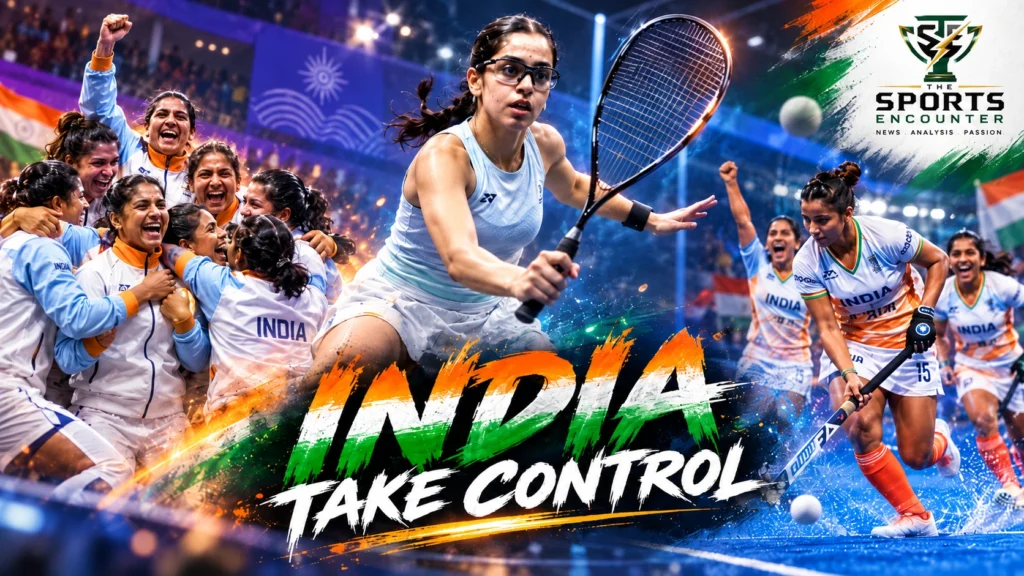
NAGOYA, Japan, September 25, 2026: Three different sports produced three different measures of Indian control at the Asian Games on Friday.
India’s defending women’s kabaddi champions beat Nepal 48-24 to reach another gold-medal match. Eighteen-year-old Anahat Singh needed only 15 minutes to dismiss compatriot Tanvi Khanna 11-2, 11-5, 11-3 and reach the women’s squash semifinals. In Kakamigahara, India’s women’s hockey team beat host Japan 3-1 for its fourth consecutive victory and secured a place in the semifinals.
Taken individually, each result moved an Indian medal campaign forward. Put together, they revealed something larger about India’s Aichi-Nagoya 2026 performance: established dominance in kabaddi, emerging elite talent in squash and an unbeaten hockey team producing extraordinary scoring numbers.
India’s wider campaign had already delivered major moments, including Smriti Mandhana’s historic performance as India retained the women’s cricket gold and Lakshya Sen’s remarkable seven-point comeback against Japan. Friday added another layer by showing strength across three very different competitive environments.
Story at a glance
India’s Women’s Kabaddi Team Has Never Missed an Asian Games Final
The score against Nepal mattered. The history behind it mattered even more.
Anahat Singh Needed Only 15 Minutes to Reach the Squash Semifinals
If kabaddi represented institutional strength, Anahat Singh supplied the individual statement.
India’s Hockey Women Have Scored 59 Goals in Four Matches
The women’s hockey result supplied perhaps the strongest numerical evidence of India’s current momentum.
Why These Three Results Say More Than Another Good Indian Day
India are not controlling the overall Asian Games medal table. China remains the continental benchmark, a theme already established when China took early control after the first full medal day and reinforced through record-breaking performances such as Sheng Lihao and China’s world-record air-rifle team.
What Comes Next for India in Kabaddi, Squash and Hockey?
The kabaddi women play for gold on September 26 as they attempt to win a fourth Asian Games title in five editions.
India’s Three-Sport Asian Games Statement at a Glance
| Sport | Indian Result | Why It Matters |
|---|---|---|
| Women’s Kabaddi | India beat Nepal 48-24 | India reached the women’s final for the fifth consecutive Asian Games |
| Women’s Squash | Anahat Singh beat Tanvi Khanna 11-2, 11-5, 11-3 | The 18-year-old reached the semifinals in only 15 minutes |
| Women’s Hockey | India beat Japan 3-1 | Fourth straight win and semifinal qualification confirmed |
India’s Women’s Kabaddi Team Has Never Missed an Asian Games Final
The score against Nepal mattered. The history behind it mattered even more.
Women’s kabaddi entered the Asian Games program in 2010. India have now reached the final in every edition since.
| Asian Games | India Women’s Result |
|---|---|
| Guangzhou 2010 | Gold |
| Incheon 2014 | Gold |
| Jakarta 2018 | Silver |
| Hangzhou 2022 | Gold |
| Aichi-Nagoya 2026 | Finalist |
That makes Friday’s semifinal considerably more meaningful than another comfortable victory by a traditional kabaddi power.
According to Pro Kabaddi’s official match report, India led Nepal 31-17 at halftime, produced 35 out points and inflicted three All-Outs during the 48-24 victory at Tokai Citizens Gymnasium.
Sanju Devi again played an important role in an attack that Nepal struggled to contain.
The semifinal also continued an unbeaten Indian campaign. India opened by beating Bangladesh 42-21, defeated Iran 37-23 and then overwhelmed host Japan 50-25 before facing Nepal.
Across those four matches, India have scored 177 points and conceded 93. That is an aggregate advantage of 84 points, or an average winning margin of 21 per game.
The program’s historical position is even stronger. India won the women’s title in 2010 and 2014, lost only the 2018 final to Iran and recovered to reclaim gold in Hangzhou.
The fifth consecutive final confirms that India’s supremacy in Asian women’s kabaddi has survived changes in captains, generations and opponents.
Anahat Singh Needed Only 15 Minutes to Reach the Squash Semifinals
If kabaddi represented institutional strength, Anahat Singh supplied the individual statement.
The 18-year-old junior world champion dismantled fellow Indian Tanvi Khanna 11-2, 11-5, 11-3 at the Nagoya Kinjo-Futo Arena. The entire quarterfinal lasted only 15 minutes.
Anahat took the opening game 11-2 in five minutes, controlled the second 11-5 and then closed the match 11-3 without allowing Khanna to develop sustained pressure.
Olympics.com’s Asian Games squash results and schedule tracks India’s campaign across the singles, doubles and team disciplines.
The quarterfinal carried an additional sign of Indian depth because both players represented India. One Indian athlete had to eliminate another for the semifinal place to be decided.
Anahat will now face Japan’s Satomi Watanabe, one of the strongest players in Asian squash and a bronze medalist at the previous Asian Games.
The semifinal provides a different examination. Anahat controlled an opponent she knew well on Friday. Against Watanabe, she faces a home player with far greater senior-level experience and the pressure of an Asian Games medal round.
Her rise also fits one of the themes identified in The Sports Encounter’s Aichi-Nagoya 2026 preview: a new generation of Asian athletes using these Games as a bridge between junior success and major senior competition.
India has already seen similar youth-driven narratives elsewhere at these Games. TSE’s coverage of Mirabai Chanu’s weightlifting silver behind Ri Song-gum’s three world records illustrated just how quickly the competitive standards across Asian sport are moving.
India’s Hockey Women Have Scored 59 Goals in Four Matches
The women’s hockey result supplied perhaps the strongest numerical evidence of India’s current momentum.
India defeated host Japan 3-1 at Kawasaki Juko Stadium in Kakamigahara, securing a fourth victory from four Pool B matches and confirming a semifinal place with one pool game still to play.
Lalremsiami opened the scoring in the fifth minute. Ishika Chaudhary converted a rebound in the 30th minute before Navneet Kaur made it 3-0 six minutes into the third quarter. Japan’s Shiho Kobayakawa pulled one back in the 46th minute.
Hockey India’s official report confirmed the result, scorers and India’s semifinal qualification.
The Japan match stands apart from India’s first three pool games because it demanded something different.
India had started the tournament with a 19-0 victory over Uzbekistan, followed by a 17-1 win against Indonesia and a 20-1 victory over Thailand. Those games were overwhelming attacking performances.
Japan offered home support, stronger resistance and greater counterattacking threat. India still controlled the match sufficiently to lead 3-0 before the hosts finally scored in the fourth quarter.
| Opponent | Result |
|---|---|
| Uzbekistan | India won 19-0 |
| Indonesia | India won 17-1 |
| Thailand | India won 20-1 |
| Japan | India won 3-1 |
| Four-match aggregate | India 59-3 opponents |
India have therefore scored 59 goals and conceded only three across their first four games, a goal difference of plus-56.
The scoring volume is extraordinary, but the Japan result may tell the coaching staff more than the earlier routs. India had to manage a stronger opponent, defend transitions and retain control after the home side found a way back onto the scoreboard.
India will complete the pool stage against Singapore on September 27 before turning fully toward the medal rounds.
Why These Three Results Say More Than Another Good Indian Day
India are not controlling the overall Asian Games medal table. China remains the continental benchmark, a theme already established when China took early control after the first full medal day and reinforced through record-breaking performances such as Sheng Lihao and China’s world-record air-rifle team.
Friday’s Indian story is more specific.
It shows how competitive strength can develop through different systems.
Women’s kabaddi has become a dynasty. Every Asian Games edition featuring the event has ended with India contesting the final.
Anahat represents a younger pathway. At 18, she is trying to turn junior-level excellence into continental senior success while competing in a sport that will enter the Olympic program at Los Angeles 2028.
Women’s hockey sits somewhere between those two models. India possess a long international tradition, but this particular team is building momentum through aggressive scoring, fitness and structured pressure.
The broader Indian delegation has also shown that spread elsewhere. Mandhana’s cricket gold delivered one form of championship control, while Lakshya Sen’s comeback against Japan required an entirely different kind of resilience.
Thursday’s Asian Games action had already broadened India’s medal sources across athletics, rowing and shooting, as documented in TSE’s full report on a breakthrough-heavy day in Japan.
Friday’s three women’s stories now give the Indian campaign another defining thread.
What Comes Next for India in Kabaddi, Squash and Hockey?
The kabaddi women play for gold on September 26 as they attempt to win a fourth Asian Games title in five editions.
Anahat Singh faces Satomi Watanabe in the women’s squash semifinal, a match that will test whether the teenager can turn one of Friday’s most dominant performances into a place in the final.
The hockey women still have Singapore to play on September 27 before the semifinals. With qualification already secured, the remaining pool match offers India an opportunity to maintain rhythm while preparing for a considerably tighter knockout environment.
India’s Asian Games have already contained medals, records and dramatic comebacks. Friday offered something different: three competitions moving simultaneously toward the medal stages, each carrying evidence that Indian athletes are increasingly difficult to dislodge once they establish control.
That pattern has developed steadily since the early days of the Games, when India’s team-sport strength began emerging alongside the first major medal stories.
Continue the Asian Games 2026 Story
 Asian Games 20260.317 Seconds to History: Cho Gwang-hee and Kim Hyo-bin Become Korea’s First Double Gold Medalists
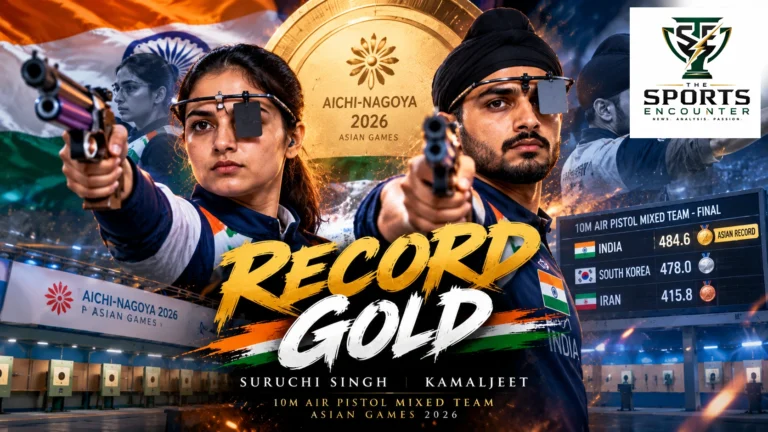 Asian Games 2026Last-Minute Pairing, Asian Record, Gold: How Suruchi and Kamaljeet Rescued India’s Pistol Campaign
 Asian Games 2026Ohashi Smashes World Record as Yulo, Japan and Indonesia End Long Asian Games Waits
Frequently Asked Questions
Did India reach the 2026 Asian Games women’s kabaddi final?
Yes. India defeated Nepal 48-24 in the semifinal to reach the gold-medal match.
Has India reached every Asian Games women’s kabaddi final?
Yes. Women’s kabaddi was introduced at the Asian Games in 2010, and India have reached the final in 2010, 2014, 2018, 2022 and 2026.
How many Asian Games women’s kabaddi gold medals has India won?
India have won three so far, taking gold in 2010, 2014 and 2022. They won silver in 2018 and will play for another gold in 2026.
Who did Anahat Singh beat in the Asian Games squash quarterfinal?
Anahat Singh defeated fellow Indian Tanvi Khanna 11-2, 11-5, 11-3.
How long did Anahat Singh’s quarterfinal take?
The match lasted only 15 minutes.
Who will Anahat Singh play in the Asian Games squash semifinal?
She will face Japan’s Satomi Watanabe.
What was the India vs Japan women’s hockey score?
India defeated host Japan 3-1 in Pool B.
Who scored for India against Japan?
Lalremsiami, Ishika Chaudhary and Navneet Kaur scored India’s three goals.
How many goals have India scored in women’s hockey at the 2026 Asian Games?
India have scored 59 goals across their first four Pool B matches while conceding only three.
Has India qualified for the Asian Games women’s hockey semifinals?
Yes. The 3-1 victory over Japan confirmed India’s semifinal place with one pool match against Singapore still remaining.