TOYOTA, Japan, September 25, 2026: Less than a day after neither Suruchi Singh nor Kamaljeet had reached an individual 10m air pistol final, India changed the combination for the mixed team event.
The decision could hardly have produced a bigger return.
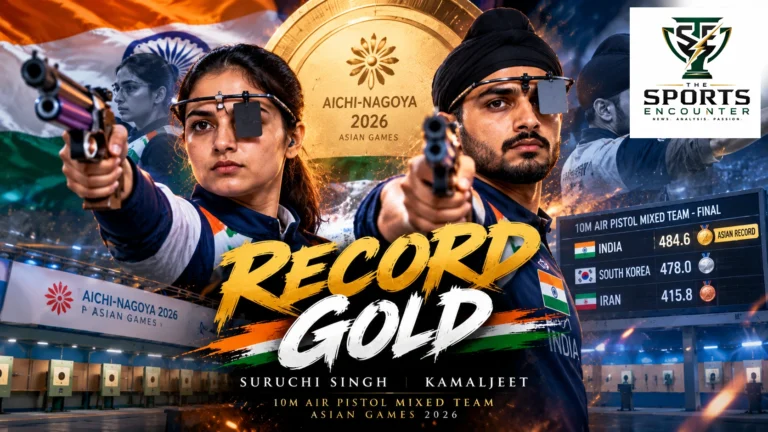
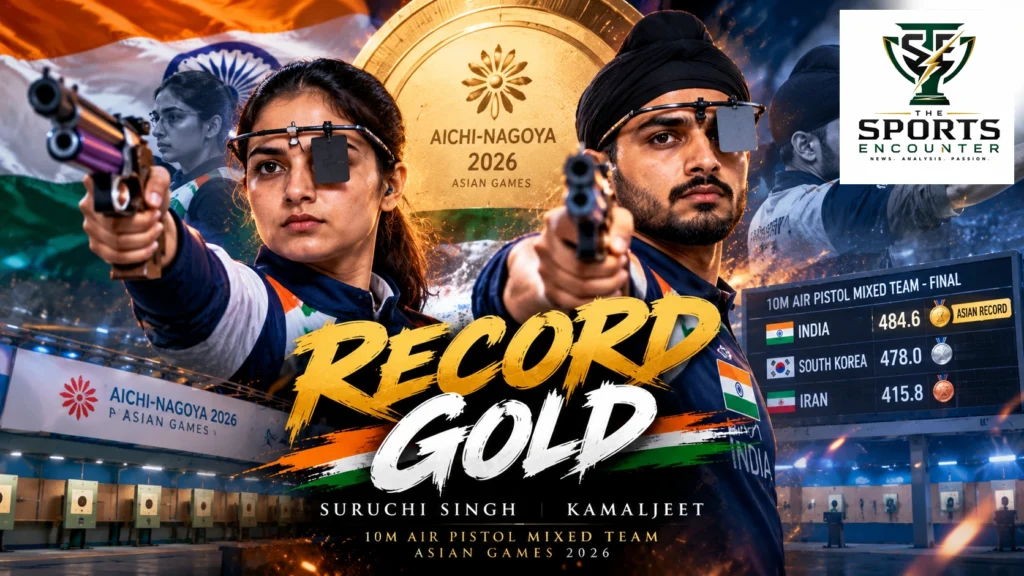
Suruchi and Kamaljeet topped qualification, controlled the final from the opening series and finished with 484.6 points to win the Asian Games mixed team gold on Friday at the Aichi Prefectural General Shooting Gallery.
The score broke the previous Asian continental record of 481.3 and carried India 6.6 points clear of South Korea’s Choo Ga-eun and Hong Su-hyeon, who finished with 478.0. Iran took bronze with 415.8.
Story at a glance
The Last-Minute Change That Altered India’s Pistol Story
The most important decision may have been made before either shooter entered the mixed-team firing point.
India Announced Its Intent in Qualification
The pairing produced evidence almost immediately that the change had worked.
Suruchi Went From 26th to Asian Games Champion
Suruchi’s turnaround was the more dramatic of the two.
Kamaljeet Turned One Point of Individual Frustration Into Gold
Kamaljeet’s individual disappointment had been different.
India Led the Final From the Opening Series
The medal round did not require a late rescue.
It was India’s first shooting gold of Aichi-Nagoya 2026 and the country’s second gold medal overall after the women’s cricket team had already defeated Sri Lanka for the title.
The result matters for more than the medal table. India entered the mixed event with its 10m air pistol campaign in danger of ending without a medal. Suruchi had finished 26th in the women’s individual qualification. Kamaljeet had come much closer, placing ninth in the men’s event and missing the final by a single point.
Then came the selection change.
Kamaljeet replaced Suruchi’s originally designated mixed-team partner, Kedarling Balakrishna Uchaganve. A combination assembled late became India’s most successful pistol pairing of the Games.
TL;DR: How Suruchi Singh and Kamaljeet Won Asian Games Gold
- Suruchi Singh and Kamaljeet won the 10m air pistol mixed team gold with 484.6 points.
- The score established a new Asian continental record.
- South Korea took silver with 478.0, 6.6 points behind India.
- Iran won bronze with 415.8.
- India had changed the mixed-team pairing shortly before the event, bringing Kamaljeet in for Kedarling Balakrishna Uchaganve.
- Kamaljeet had finished ninth in the men’s individual qualification, while Suruchi was 26th in the women’s event.
- The Indian pair topped mixed-team qualification with 587 and 29 inner 10s.
- The medal was India’s first shooting gold and second overall gold of Aichi-Nagoya 2026.
Asian Games 10m Air Pistol Mixed Team Final
| Position | Nation | Shooters | Final Score |
|---|---|---|---|
| Gold | India | Suruchi Singh / Kamaljeet | 484.6, Asian record |
| Silver | South Korea | Choo Ga-eun / Hong Su-hyeon | 478.0 |
| Bronze | Iran | Haniyeh Rostamiyan / Vahid Golkhandan | 415.8 |
The Last-Minute Change That Altered India’s Pistol Story
The most important decision may have been made before either shooter entered the mixed-team firing point.
Kedarling Balakrishna Uchaganve had originally been selected to partner Suruchi. Kamaljeet then produced the strongest Indian performance in the men’s individual qualification, scoring 580 and finishing ninth, only one point outside the final.
Kedarling finished 35th with 568.
India responded by changing the combination and placing Kamaljeet alongside Suruchi for the mixed event, according to reporting on the late selection decision.
It was an aggressive call because mixed-team shooting rewards more than the simple addition of two individual scores. Rhythm matters. Pressure is shared. One poor series can drag both athletes into an elimination battle.
Suruchi and Kamaljeet had little time to build a competitive partnership.
They did not look like a newly assembled team once the shooting began.
India Announced Its Intent in Qualification
The pairing produced evidence almost immediately that the change had worked.
Suruchi and Kamaljeet opened qualification with 196 points, followed it with 195 and finished with another 196.
The result was 587 points and 29 inner 10s.
That placed India first entering the four-team medal round.
The qualification performance also changed the psychological shape of the competition. India were no longer trying to salvage a medal from a difficult 10m pistol program. They entered the final as the team everyone else had to catch.
That represented a sharp reversal from the individual events.
Suruchi Went From 26th to Asian Games Champion
Suruchi’s turnaround was the more dramatic of the two.
The 19-year-old had entered the Games with growing international expectations but finished only 26th in women’s 10m air pistol qualification and never reached the medal round.
South Korea’s Choo Ga-eun eventually won that individual title with an Asian-record 246.3, one of the major shooting performances covered in The Sports Encounter’s September 23 Asian Games report.
Two days later, Suruchi met Choo again.
This time they were shooting for mixed-team gold.
This time Suruchi finished ahead.
The contrast explains why Friday’s medal should not be treated as another entry in India’s medal count. Elite shooting gives athletes very little time to process disappointment. The same technical movement must be repeated while the consequences of the previous failure remain fresh.
Suruchi responded by producing her most important shooting of the Games when India had run out of other medal opportunities in the discipline.
Kamaljeet Turned One Point of Individual Frustration Into Gold
Kamaljeet’s individual disappointment had been different.
He had not been far from the final.
He finished ninth with 580, missing qualification for the medal round by only one point.
That performance also became the reason India’s coaches had a decision to make.
Instead of allowing ninth place to define his Asian Games, Kamaljeet’s score effectively earned him another route into medal contention.
The opportunity came quickly.
So did the response.
India Led the Final From the Opening Series
The medal round did not require a late rescue.
India established control early.
Suruchi and Kamaljeet opened with 103.0 points in the first series. Their cumulative score moved to 202.4 and then 303.5 by the end of Stage 1.
South Korea sat second on 300.2.
The gap was meaningful because the format becomes increasingly unforgiving once Stage 2 begins.
After the first 30 team shots, the remaining pairs fire elimination series, with the lowest-scoring team dropping out as the competition progresses. Yonhap’s report from the final detailed how India maintained its advantage as Indonesia fell first and Iran secured bronze.
India reached 364.7 and then 424.9 while South Korea remained the only team capable of applying serious pressure.
The Koreans could not close the gap.
Suruchi and Kamaljeet ended on 484.6.
South Korea finished on 478.0.
The 484.6 Was Bigger Than an Asian Games Record
The previous Asian continental benchmark was 481.3, established by Uzbekistan’s Nigina Saidkulova and Mukhammad Kamalov at the Asian Shooting Championships in New Delhi in February.
The International Shooting Sport Federation’s official results list that 481.3 performance as the Asian record at the time.
India improved it by 3.3 points.
That is a substantial jump in a final decided shot by shot in decimal scoring.
The record also continues a striking pattern at these Asian Games. Shooting has repeatedly produced performances beyond previous continental and global standards.
China’s Sheng Lihao, Ma Sihan and Zhang Changhong broke the men’s air rifle team world record earlier in the competition, a performance analyzed in TSE’s breakdown of China’s record-setting rifle day.
Choo then broke the Asian women’s air pistol record.
On Thursday, China added another world record through Lyu Jianlin and Jiang Yiting in mixed-team skeet, part of TSE’s report on a record-heavy September 24.
Suruchi and Kamaljeet have now added India’s name to that sequence.
Why This Was India’s Most Important Shooting Gold So Far
India had hardly been absent from the shooting podium before Friday.
Elavenil Valarivan won silver in the women’s 10m air rifle and also contributed to a team silver on the opening medal day. TSE’s first Asian Games medal-day report documented how shooting immediately became India’s primary source of medals.
India added more success in the men’s air rifle.
Rudrankksh Patil, Himanshu Dhillon and Parth Mane won team silver before Dhillon took individual silver and Rudrankksh bronze.
Those results helped establish the shooting depth explored in The Sports Encounter’s September 21 consolidated report.
But silver and bronze medals do not answer the same question as gold.
India had arrived in Japan after winning 22 shooting medals at Hangzhou 2023, including seven golds. Expectations were therefore based on victories, not simply podium volume.
Friday finally produced the breakthrough.
The Gold Also Changed India’s Overall Asian Games Campaign
India’s first gold had come through women’s cricket.
Smriti Mandhana scored 79 and passed 11,000 international runs as India defeated Sri Lanka by 147 runs, a performance covered in TSE’s full report on India’s first gold of the Games.
The second arrived from an individual sport in which India has invested heavily and entered with major expectations.
That distinction matters to the medal campaign because India’s path toward another large Asian Games total depends on success across multiple disciplines rather than one exceptional team.
The Sports Encounter’s Aichi-Nagoya 2026 preview identified shooting, athletics, combat sports and India’s defending team champions as important parts of that wider medal strategy.
Shooting had already supplied quantity.
Suruchi and Kamaljeet finally supplied gold.
A Late Pairing Became a Lesson in Selection Under Pressure
The temptation after a result like this is to treat the late change as proof that coaches should constantly disrupt planned combinations.
That would simplify what happened.
India had fresh evidence available.
Kamaljeet had just been its strongest men’s 10m air pistol shooter in qualification. Kedarling had struggled. Suruchi needed a partner for an event that represented India’s last chance to salvage something from the 10m air pistol program.
The selectors responded to current form.
The athletes then justified the risk.
That separation is important.
The decision created an opportunity. The 587 in qualification and 484.6 in the final were produced by the shooters themselves.
India’s Shooting Campaign Has a Different Shape Now
Only a few days ago, India’s shooting story was becoming one of close finishes.
Elavenil came within 0.6 points of individual gold. India’s men’s air rifle shooters repeatedly pushed China without dislodging them. Mixed rifle also ended without a medal.
The broader competition kept moving toward increasingly demanding standards.
The same trend appeared elsewhere across Aichi-Nagoya. Ri Song-gum broke three world records in one weightlifting competition, a performance examined in TSE’s analysis of North Korea’s historic 49kg gold.
At these Games, strong performances have repeatedly been insufficient unless athletes push beyond previous standards.
Suruchi and Kamaljeet did exactly that.
They did not merely win India’s first shooting gold.
They broke Asia’s record to get it.
Continue the Asian Games 2026 Story
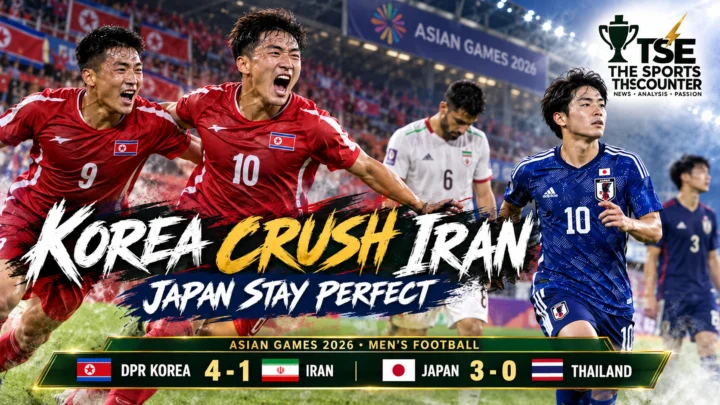
 SoccerAsian Games: North Korea Turn Elimination Night Into a Rout as Iran Crash Out and Japan Stay Perfect
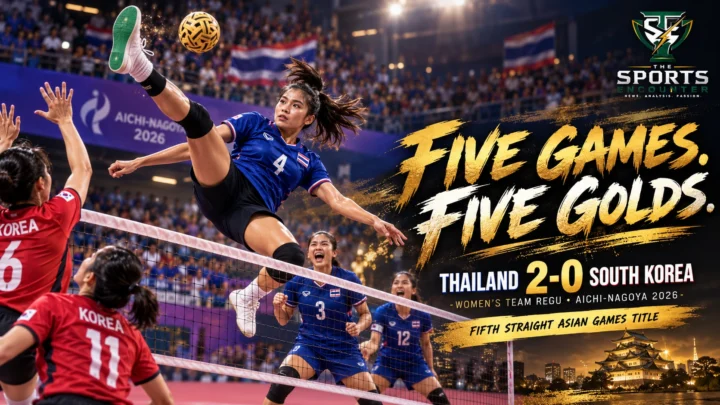
 Asian Games 2026Five Games, Five Golds: Thailand Extend Sepaktakraw Dynasty as Korea Fall Short Again
 Asian Games 20260.317 Seconds to History: Cho Gwang-hee and Kim Hyo-bin Become Korea’s First Double Gold Medalists
Frequently Asked Questions
Who won the 10m air pistol mixed team gold at the 2026 Asian Games?
India’s Suruchi Singh and Kamaljeet won the gold medal with a final score of 484.6.
What record did Suruchi Singh and Kamaljeet break?
The Indian pair broke the Asian continental record in the 10m air pistol mixed team final. The previous mark was 481.3, set by Uzbekistan at the 2026 Asian Shooting Championships.
Who finished second behind India?
South Korea’s Choo Ga-eun and Hong Su-hyeon won silver with 478.0 points, finishing 6.6 behind India.
Who won bronze?
Iran’s Haniyeh Rostamiyan and Vahid Golkhandan took bronze with 415.8.
Were Suruchi and Kamaljeet originally supposed to compete together?
No. Kedarling Balakrishna Uchaganve had originally been designated as Suruchi’s partner. Kamaljeet was brought into the pairing after producing India’s best performance in the men’s individual qualification.
How did Suruchi and Kamaljeet perform in qualification?
They topped qualification with 587 points and 29 inner 10s after series of 196, 195 and 196.
How did Suruchi Singh perform in the individual event?
Suruchi finished 26th in women’s 10m air pistol qualification and did not reach the individual final.
How did Kamaljeet perform individually?
Kamaljeet finished ninth in the men’s qualification with 580 points, missing the final by one point.
Was this India’s first gold medal of the 2026 Asian Games?
No. It was India’s second gold overall. The women’s cricket team had already won the country’s first gold by defeating Sri Lanka in the final.
Was this India’s first shooting gold at Aichi-Nagoya 2026?
Yes. India had already collected several shooting silver and bronze medals, but Suruchi and Kamaljeet delivered the country’s first shooting gold of the Games.