NAGOYA, Japan, September 23, 2026: Ri Song-gum did not merely win the Asian Games weightlifting title. She turned the women’s 49kg competition into a demonstration of how far one athlete could separate herself from the rest of Asia.
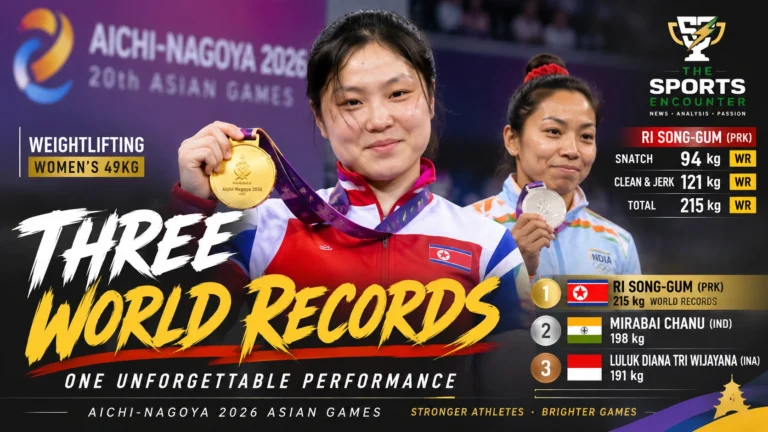
The North Korean lifted 94kg in the snatch, 121kg in the clean and jerk and 215kg overall at the Nagoya City Trade and Industry Center.
All three finished as world records.
Ri won gold by 17kg over India’s Mirabai Chanu, delivered North Korea’s first gold medal of the Aichi-Nagoya 2026 Asian Games and became the first woman to win three Asian Games weightlifting titles.
Story at a glance
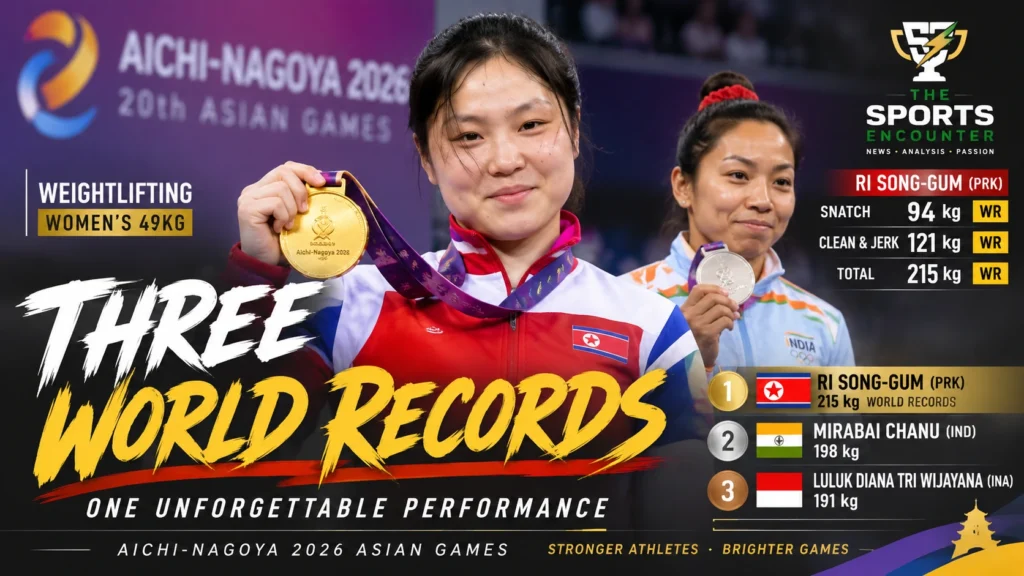
Ri Song-gum’s Three World Records at a Glance
Ri’s 94kg snatch moved one kilogram beyond the world standard of 93kg established for the new 49kg category.
Ri Waited While the Rest of the Field Lifted
The structure of the competition revealed the gap before the medals were decided.
One Clean and Jerk Secured Gold, the Next Changed the Record Book
Ri’s first clean and jerk attempt was 116kg.
Seventeen Kilograms Explain the Scale of Ri’s Victory
World records naturally dominate the headline.
Mirabai Chanu Finally Wins the Asian Games Medal She Was Missing
Ri owned the gold-medal story, but Chanu’s silver carried substantial history of its own.
Chanu took silver with 198kg, finally securing the Asian Games medal that had remained missing from one of weightlifting’s most decorated careers. Indonesia’s Luluk Diana Tri Wijayana claimed bronze with 191kg.
At an Asian Games already producing teenage swimming breakthroughs, shooting records, remarkable comebacks and historic first medals, Ri’s performance may be the clearest demonstration of outright individual superiority yet.
For the wider tournament picture, follow The Sports Encounter’s complete Asian Games 2026 coverage.
Ri Song-gum’s Three World Records at a Glance
| Lift | Ri Song-gum | Result |
|---|---|---|
| Snatch | 94kg | World record |
| Clean and jerk | 121kg | World record |
| Total | 215kg | World record |
Ri’s 94kg snatch moved one kilogram beyond the world standard of 93kg established for the new 49kg category.
Her 121kg clean and jerk exceeded the 115kg benchmark by six kilograms, while her 215kg total went seven kilograms beyond the previous world standard of 208kg.
The International Weightlifting Federation established new world standards after revised bodyweight categories came into force on August 1, 2026. When an athlete surpasses one of those standards in recognized competition, the performance becomes the new world record.
That context matters.
Ri was not chasing numbers that had stood untouched for decades. She was attacking standards created for a newly revised weight category.
She still had to lift them.
And she did not edge past them.
She moved decisively beyond all three.
Ri Waited While the Rest of the Field Lifted
The structure of the competition revealed the gap before the medals were decided.
Ri requested 90kg for her opening snatch.
No other lifter began that high.
That meant she could remain off the platform while much of the field completed its early attempts. By the time Ri entered the competition, the other contenders had already started showing where the medal line might settle.
She lifted 90kg comfortably.
Then came 94kg.
The bar went overhead and the first world record of the afternoon belonged to her.
There was no need for a third snatch attempt.
The competition had already begun to move away from everyone else.
One Clean and Jerk Secured Gold, the Next Changed the Record Book
Ri’s first clean and jerk attempt was 116kg.
Combined with her 94kg snatch, that gave her a 210kg total and effectively settled the gold-medal contest.
Chanu could not reach her.
Wijayana could not reach her.
The title was secure.
Ri then asked for 121kg.
At that point the competition stopped being about who would win and became a test of how far she could push the numbers.
She completed the lift.
The clean and jerk record moved to 121kg.
The total moved to 215kg.
Three categories on the record sheet now carried the same name.
The official Aichi-Nagoya weightlifting program lists the Nagoya City Trade and Industry Center as the Games venue, where the women’s 49kg and 53kg medals opened the weightlifting program on September 23.
Seventeen Kilograms Explain the Scale of Ri’s Victory
World records naturally dominate the headline.
The winning margin deserves equal attention.
Ri totaled 215kg.
Chanu finished on 198kg.
Wijayana took bronze on 191kg.
A 17kg difference between gold and silver in the lightest senior women’s category is enormous.
It means the competition was not decided by one missed attempt, tactical loading or bodyweight tiebreak.
Ri operated at a different level.
The gap becomes even more striking because Chanu is hardly an ordinary silver medalist. She arrived in Japan as an Olympic silver medalist, former world champion and multiple Commonwealth Games champion.
Ri still finished 17 kilograms ahead.
Mirabai Chanu Finally Wins the Asian Games Medal She Was Missing
Ri owned the gold-medal story, but Chanu’s silver carried substantial history of its own.
The Indian lifted 87kg in the snatch and 111kg in the clean and jerk for a 198kg total.
That gave her the first Asian Games medal of her career after years of frustration at the continental event.
It also ended India’s 28-year wait for an Asian Games weightlifting medal. Karnam Malleswari had won silver in the women’s 63kg category at Bangkok 1998.
Chanu’s career already contained Olympic, World Championship, Commonwealth Games and Asian Championship medals.
The Asian Games had remained the obvious omission.
She finished ninth on her Asian Games debut in 2014, missed the 2018 edition because of injury and finished fourth at Hangzhou after another injury disrupted her challenge.
Nagoya finally put her on the podium.
For India, the silver adds to an Asian Games campaign already containing major individual and team stories. Smriti Mandhana’s 11,000-run landmark accompanied women’s cricket gold, while Lakshya Sen recovered from 14-19 down in the decider against Kodai Naraoka as India guaranteed a badminton medal.
Chanu’s silver belongs with those performances even though the gold medal was never realistically available once Ri began lifting.
Ri Song-gum Is Now a Three-Time Asian Games Champion
The world records are only one part of what Ri achieved.
She has now won the lightest women’s weightlifting category at three consecutive Asian Games.
Her run began with 48kg gold at Jakarta-Palembang 2018.
She returned to win the 49kg title at Hangzhou.
Nagoya completed the hat trick.
According to the post-event reporting, Ri became the first woman and only the fourth weightlifter overall to win three Asian Games gold medals.
That places her alongside a very small group in the competition’s weightlifting history.
It also continues a period of sustained global dominance. Ri won the world title in 2024 and again in 2025 before arriving in Japan as the athlete everyone in the 49kg field had to chase.
They could not.
North Korea Waited Four Days for Gold, Then Weightlifting Delivered
Ri’s victory also changed North Korea’s place in the Games.
The delegation had reached September 23 without a gold medal.
Its traditional strength sport changed that.
Ri supplied the first gold, and later Kang Hyon-gyong added another in the women’s 53kg competition, where she lifted 99kg in the snatch and 124kg in the clean and jerk for a 223kg total.
Ri’s victory therefore became both an individual record-breaking performance and the point at which North Korea’s medal campaign changed direction.
That broader medal-table story has been developing rapidly since the first weekend. TSE’s September 21 Asian Games analysis documented how China had already begun separating itself through swimming, shooting, gymnastics and other disciplines.
North Korea’s route is much narrower.
That makes dominance in weightlifting even more important.
How Do Ri’s Three Records Compare With the Other Great Performances of These Games?
Aichi-Nagoya has not lacked records.
China’s 13-year-old Yu Zidi produced one of the earliest extraordinary performances when she swam 2:06.10 in the women’s 200m individual medley, breaking the Asian and world junior records. TSE’s full analysis of Yu’s record-breaking swim showed that only Summer McIntosh had ever completed the event faster.
China also rewrote the record books in shooting. Sheng Lihao, Ma Sihan and Zhang Changhong combined for a men’s 10m air rifle team world record before Sheng won individual gold, covered in TSE’s analysis of China’s shooting breakthrough.
In the pool, Zhang Zhanshuo produced a remarkable anchor leg as China erased a 1.89-second deficit to Japan and lowered the Asian men’s 4x200m freestyle relay record to 7:00.17. That race is detailed in TSE’s 4x200m freestyle relay report.
Ri’s achievement belongs in the same conversation, but its structure is different.
Yu produced one extraordinary race.
China’s rifle team produced one record score.
The relay quartet produced one record time.
Ri finished the afternoon with world records in every measurable component of her event.
Snatch.
Clean and jerk.
Total.
There was nowhere else for her to set one.
The New Weight Categories Add Important Context to the Records
There is an important technical detail behind Wednesday’s record sheet.
The IWF changed its senior bodyweight categories again from August 1, 2026. The women’s lightest senior division is now 49kg, replacing the 48kg category used during the previous cycle.
Because the category changed, the IWF established new world standards using existing performances and a mathematical model rather than simply transferring old records into the new division.
That is why reports describing Ri as breaking three world records are correct, but the terminology requires context.
She surpassed the official world standards created for the new 49kg category.
The achievement remains significant because those standards were deliberately set at elite levels. They are designed to become records only when an athlete produces a performance strong enough to exceed them.
Ri did so immediately across all three measures.
Ri’s 215kg Total Is the Number That Best Explains the Performance
The individual lifts matter technically.
The total explains the dominance.
A 94kg snatch put Ri ahead.
A 121kg clean and jerk removed any remaining possibility of a contest.
Together they produced 215kg.
Chanu’s 198kg was good enough to end a 28-year Indian medal drought.
It was still 17kg short.
Wijayana’s 191kg secured an Asian Games bronze.
It was 24kg behind the winner.
Those gaps tell us more than the color of the medals.
Ri was not simply the strongest athlete in the field on Wednesday.
She established a reference point for everyone who competes in this new weight category from this point onward.
Aichi-Nagoya Is Becoming a Games Defined by Record Breakers
Before competition began, TSE’s complete Aichi-Nagoya 2026 preview framed the Games around more than 11,000 athletes and 469 titles spread across a changing Asian sporting landscape.
The first few days have justified that scale.
Teenagers are breaking continental swimming records.
Olympic champions are producing shooting records.
New sports are creating first-time medalists.
Sixteen-year-old Russel Pang lowered Singapore’s 1,500m freestyle national record even without reaching the medal podium.
Ri’s performance belongs at the other end of the competitive spectrum.
She was the favorite.
She had already won the Asian Games twice.
She had already won world championships.
The challenge was not announcing herself.
It was meeting enormous expectations and still finding another level.
Three world records suggest she did considerably more than that.
What Comes Next for Ri Song-gum?
Asian Games gold is no longer a new achievement for Ri.
A third consecutive title changes the historical question.
No weightlifter has won four Asian Games gold medals.
Ri is 28 and has now completed three consecutive championship cycles at the top of her continental division.
Whether she reaches another Asian Games will depend on longevity, future weight categories and the direction of North Korean participation in international weightlifting.
For now, the more immediate legacy is measurable.
The new women’s 49kg category has a world-record benchmark.
It reads 94kg in the snatch.
121kg in the clean and jerk.
215kg total.
All three belong to Ri Song-gum.
Continue the Asian Games 2026 Story
 AthleticsOhashi Smashes World Record as Yulo, Japan and Indonesia End Long Asian Games Waits
 SoccerAsian Games: North Korea Turn Elimination Night Into a Rout as Iran Crash Out and Japan Stay Perfect
 AthleticsAsian Games 2026: China Pull Away on a Day of New Records, Refreshed Rivalries, and Fine Margins
Frequently Asked Questions
How many world records did Ri Song-gum break at the 2026 Asian Games?
Ri finished the women’s 49kg competition with three world records: 94kg in the snatch, 121kg in the clean and jerk and a 215kg total.
What weight class did Ri Song-gum compete in?
Ri competed in the women’s 49kg category. The IWF introduced revised senior bodyweight categories from August 1, 2026.
Who won women’s 49kg weightlifting gold at the 2026 Asian Games?
North Korea’s Ri Song-gum won gold with a world-record total of 215kg.
Who won silver behind Ri Song-gum?
India’s Mirabai Chanu won silver with a 198kg total after lifting 87kg in the snatch and 111kg in the clean and jerk.
Who won bronze in the women’s 49kg event?
Indonesia’s Luluk Diana Tri Wijayana won bronze with a 191kg total.
How large was Ri Song-gum’s winning margin?
Ri finished 17kg ahead of silver medalist Mirabai Chanu, 215kg to 198kg.
How many Asian Games gold medals has Ri Song-gum won?
Ri has won three consecutive Asian Games weightlifting titles, beginning in 2018 and continuing through Hangzhou and Aichi-Nagoya 2026.
Was this North Korea’s first gold medal of the 2026 Asian Games?
Yes. Ri’s victory delivered North Korea’s first gold medal of Aichi-Nagoya 2026.
Why were new weightlifting world records available in 2026?
The International Weightlifting Federation revised its bodyweight categories from August 1, 2026 and established new world standards for categories that changed. Performances exceeding those standards become world records.
When did India last win an Asian Games weightlifting medal before Mirabai Chanu?
India’s previous Asian Games weightlifting medal came in 1998, when Karnam Malleswari won silver in the women’s 63kg category in Bangkok.