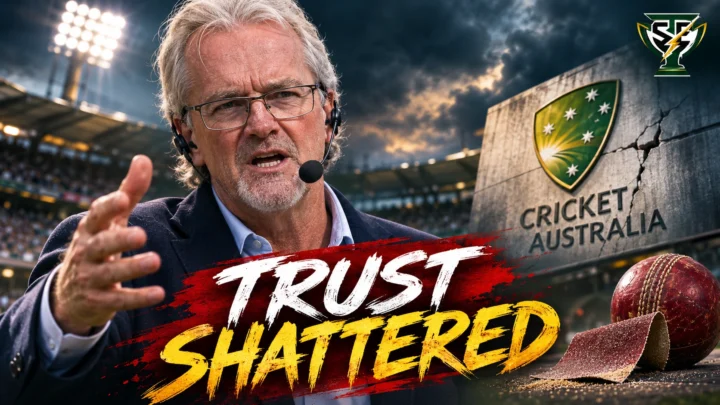
SYDNEY, Australia, November 25, 2026: Usman Khawaja has offered Cricket Australia a proposed collective acknowledgment of ball tampering on the 2018 tour of South Africa, even as he revealed how deeply Pat Cummins’ public response to his autobiography had hurt him. The latest chapter of Sandpapergate raises a difficult question for Australian cricket: can former teammates accept shared responsibility without agreeing on precisely what each of them knew?
Speaking on The Grade Cricketer podcast, the retired opener disclosed a message he sent Cricket Australia chief executive Todd Greenberg last Friday. His suggested statement would recognize the wider team’s knowledge of deliberate alterations to the ball, acknowledge the price paid by Steve Smith, David Warner and Cameron Bancroft, and leave the precise method of tampering outside the proposed agreement. No collective statement accepting those terms has been announced.
Key Takeaways
- Usman Khawaja has offered Cricket Australia a proposed collective acknowledgment of ball tampering on the 2018 tour of South Africa, even as he revealed how deeply Pat Cummins’ public response to his autobiography had hurt him.
- Khawaja said he had contacted Cummins privately before the captain’s November 13 press conference, hoping to find common ground.
- The original scandal concerned a specific act during the Cape Town Test in March 2018.
- On November 18, Cricket Australia announced an independent forum for players and staff to provide their accounts, without a new disciplinary investigation or further sanctions.
Sandpapergate: What Khawaja’s Peace Proposal Actually Requires
Khawaja has offered a concession over the specificity of the admission he wants. He is willing to leave the question of sandpaper itself out of the proposed statement, provided the squad acknowledges awareness of ball tampering. That distinction matters because Australia’s bowlers have repeatedly denied knowing about the use of sandpaper in Cape Town.
Story at a glance

Sandpapergate: What Khawaja’s Peace Proposal Actually Requires
Khawaja has offered a concession over the specificity of the admission he wants. He is willing to leave the question of sandpaper itself out of the proposed statement, provided the squad acknowledges awareness of ball tampering. That distinction matters because Australia’s bowlers have repeatedly denied knowing about the use of sandpaper in Cape Town.
Why Pat Cummins’ Response Hurt Khawaja
Khawaja said he had contacted Cummins privately before the captain’s November 13 press conference, hoping to find common ground. Instead, Cummins strongly disputed the account in Sabr, arguing that Khawaja’s allegations about the players’ knowledge were wrong. His response also prompted Warner to defend Khawaja, as TSE documented in its coverage of the confrontation between the three former teammates.
Three Questions the Sandpapergate Debate Keeps Conflating
The original scandal concerned a specific act during the Cape Town Test in March 2018. The wider controversy now involves allegations about the preceding Port Elizabeth Test and the culture of the Australian dressing room. The questions require different evidence and should be examined separately.
Why Cricket Australia’s Independent Forum Faces a Test of Credibility
On November 18, Cricket Australia announced an independent forum for players and staff to provide their accounts, without a new disciplinary investigation or further sanctions. The board subsequently reaffirmed its support for Cummins as Test and ODI captain on November 21.
What Would a Meaningful Sandpapergate Resolution Look Like?
Former England captain Nasser Hussain had already questioned why these divisions remained unresolved years after the suspensions ended, as explained in TSE’s coverage of his intervention. Australia must now consider whether it wants the forum principally to repair relationships, establish a historical record, or accomplish both.
According to the reported transcript of Khawaja’s podcast comments, Greenberg indicated that he would consult the other parties but doubted whether the suggested wording would gain acceptance. The message was a proposal from Khawaja, rather than an apology issued by Cricket Australia or agreed upon by the players.
There is a substantial obstacle to settling Sandpapergate through this compromise. A collective acknowledgment of deliberate ball tampering would still require people with different recollections to agree on a statement about their own knowledge. Removing the reference to sandpaper does not eliminate the underlying factual dispute. Anyone who denies knowing about deliberate alterations to the ball would have a reason to reject the wording.
| Issue | Effect of the proposal if accepted |
|---|---|
| Team knowledge of ball tampering | Collective acknowledgment |
| Knowledge of sandpaper specifically | Would remain unresolved by the wording |
| Individual responsibility for particular acts | Would not be determined by a collective statement |
| Impact on Smith, Warner and Bancroft | Recognition of the consequences they endured |
| 2018 disciplinary findings | No automatic revision |
Why Pat Cummins’ Response Hurt Khawaja
Khawaja said he had contacted Cummins privately before the captain’s November 13 press conference, hoping to find common ground. Instead, Cummins strongly disputed the account in Sabr, arguing that Khawaja’s allegations about the players’ knowledge were wrong. His response also prompted Warner to defend Khawaja, as TSE documented in its coverage of the confrontation between the three former teammates.
Khawaja subsequently described the criticism as personal, but also said, I will always love Pat.
He has continued to support Cummins remaining Australia’s captain. His position makes this episode of Sandpapergate particularly complicated: he wants a leader whose account he disputes to remain in the job and help resolve the disagreement.
Cummins, for his part, has a legitimate interest in defending his reputation against allegations he rejects. Khawaja’s disappointment with the manner of that defense does not establish that the captain’s denial is false. Both men can sincerely regard the public exchanges as damaging without their accounts of 2018 becoming any easier to reconcile.
Khawaja also revealed that Bancroft had thanked him after learning about the contents of his memoir. In the interview, Khawaja acknowledged why some former teammates might resent the timing of his revelations while they were still playing. That creates another difficult question for Cricket Australia: how can players raise concerns about wrongdoing while they are still dependent on the selection system for their careers? It is a question that reaches well beyond the particulars of Sandpapergate.
Three Questions the Sandpapergate Debate Keeps Conflating
The original scandal concerned a specific act during the Cape Town Test in March 2018. The wider controversy now involves allegations about the preceding Port Elizabeth Test and the culture of the Australian dressing room. The questions require different evidence and should be examined separately.
What Sandpapergate Established in 2018
The published account of Cricket Australia’s investigation identified Warner as the instigator of the Cape Town plan, Bancroft as the player enlisted to carry it out and Smith as the captain who knew of the plan but failed to prevent it. Smith and Warner received 12-month suspensions, while Bancroft was suspended for nine months. The findings treated the incident as isolated.
As TSE argued in its earlier examination of the case for a fresh investigation, new testimony can justify further scrutiny of an original finding. It cannot, by itself, establish the guilt of everyone named in subsequent allegations.
What Players Claim About the Earlier Tests
Bancroft’s lengthy statement released last week alleges that the use of sandpaper extended to Port Elizabeth and that awareness of his actions went beyond the three sanctioned players. TSE’s analysis of Bancroft’s testimony examined his departure from the account he gave investigators in 2018.
The renewed Sandpapergate allegations must be read alongside the joint denial issued by Cummins, Mitchell Starc, Josh Hazlewood and Nathan Lyon in 2021 concerning prior knowledge of the Cape Town sandpaper plan. Cummins has maintained his denial in 2026. The benefit a bowler might derive from an altered ball does not establish knowledge of how it was altered.
Who Was Responsible for the Team Culture?
A dressing room can have a problematic culture even when particular individuals are unaware of a specific breach of the rules. Cummins has acknowledged shortcomings in the Australian team’s culture of that period. Recognizing those shortcomings is a different proposition from admitting knowledge of a particular act of cheating. Khawaja’s proposed statement goes further than a general acknowledgment of cultural failings.
Continue the Cricket Story



Why Cricket Australia’s Independent Forum Faces a Test of Credibility
On November 18, Cricket Australia announced an independent forum for players and staff to provide their accounts, without a new disciplinary investigation or further sanctions. The board subsequently reaffirmed its support for Cummins as Test and ODI captain on November 21.
Those decisions address different institutional needs: continuity of leadership and the opportunity for participants to speak. For the Sandpapergate forum to produce a credible historical account, however, its independence must be demonstrable. TSE previously examined Mike Haysman’s concerns about the forum, including the challenge of establishing accountability without a conventional investigation.
The following chronology shows how Sandpapergate moved from competing public accounts to a proposed agreement.
| Date | Development | Consequence |
|---|---|---|
| November 13 | Cummins rejects Khawaja’s allegations; Warner responds | Conflicting accounts become a public leadership dispute |
| November 18 | Independent forum announced; Bancroft publishes his account | New testimony challenges the original record |
| November 20 | Khawaja says he sends Greenberg proposed wording | Negotiated acknowledgment becomes an option |
| November 21 | Board reaffirms support for Cummins | Captaincy continuity is confirmed |
| November 25 | Khawaja publicly discloses the proposal and his hurt | Terms of possible reconciliation become clearer |
What Would a Meaningful Sandpapergate Resolution Look Like?
Former England captain Nasser Hussain had already questioned why these divisions remained unresolved years after the suspensions ended, as explained in TSE’s coverage of his intervention. Australia must now consider whether it wants the forum principally to repair relationships, establish a historical record, or accomplish both.
A credible outcome would distinguish agreed facts from contested testimony, give individuals an opportunity to respond to allegations about them, and explain how any new evidence affects the original findings. These are possible measures of success, rather than confirmed features of the forum. Confidentiality may encourage candor, but an entirely private process would leave supporters unable to assess how competing accounts were evaluated.
There is also a sporting dimension. Hazlewood’s defense of Cummins and comments about his own international future, covered in our earlier report, showed how a historical dispute can affect the current playing group. The governing body’s challenge is to protect the team’s ability to compete while allowing former players to speak without prejudging their testimony.
Eight years after Cape Town, Sandpapergate cannot be resolved simply by removing one contested word from an apology. Khawaja’s offer has created a possible route toward reconciliation, but its acceptance would require agreement on a substantial factual admission. Until the competing accounts can be assessed fairly, Australian cricket must distinguish a desire to move forward from a demonstrated understanding of what happened.