

South Africa had reached 108/2 chasing 222. Jacques Kallis and AB de Villiers were together, the required rate remained manageable, and a World Cup semifinal looked within reach. Eight wickets later, their tournament was over.
New Zealand’s 49-run victory in Dhaka on March 25, 2011, earns its place in A Celebration of 5000 ODIs because it captures how quickly control can disappear in knockout cricket. Jesse Ryder supplied the foundation, Jacob Oram delivered the decisive interventions, and South Africa failed to stop one dismissal from becoming a collapse.
TL;DR
- New Zealand defended 221/8, dismissing South Africa for 172.
- Ryder’s 83 rescued New Zealand after both openers fell cheaply.
- Player of the Match Oram took 4/39 and held two catches.
- Nathan McCullum contributed 3/24 from 10 overs.
- South Africa lost their last eight wickets for 64 runs and exited at the quarterfinal stage.
Match at a glance
| Detail | Information |
|---|---|
| Match | New Zealand vs South Africa, third quarterfinal |
| Tournament | ICC Cricket World Cup 2011 |
| Date | March 25, 2011 |
| Venue | Sher-e-Bangla National Stadium, Mirpur, Dhaka |
| Totals | New Zealand 221/8; South Africa 172 |
| Result | New Zealand won by 49 runs |
| Player of the Match | Jacob Oram, 4/39 |
| Turning point | Kallis’s dismissal at 108/2 |
| Tournament impact | New Zealand advanced to the semifinals; South Africa were eliminated |
Jesse Ryder’s 83 kept New Zealand alive
At 16/2, New Zealand faced the possibility of a quarterfinal ending before their bowlers could influence it.
Ryder and Ross Taylor responded with a 114-run partnership. Their scoring remained restrained, but preserving wickets allowed New Zealand to recover against an attack offering few easy opportunities.
Ryder’s 83 from 121 balls included eight fours. Taylor supplied 43, accepting a supporting role. When their departures helped leave New Zealand 156/5, Kane Williamson’s unbeaten 38 provided the late runs that pushed the total beyond 220.
South Africa bowled well. Imran Tahir removed both established batters, while Morne Morkel’s three wickets prevented a substantial finishing surge. Their attack had created a favorable chase.
Jacob Oram’s catch changed the direction
Oram had already dismissed Graeme Smith when Kallis attempted to pull Tim Southee. His catch in the deep removed South Africa’s leading scorer for 47 and broke the partnership with de Villiers.
The significance extended beyond the wicket. South Africa now needed a new batter to settle against an attack gaining confidence.
Oram followed with the wickets of Johan Botha, Robin Peterson and Faf du Plessis. His height, bounce and movement suited the surface, a performance the ICC later ranked among New Zealand’s finest World Cup bowling efforts. His 4/39 earned the match award.
Nathan McCullum made rebuilding difficult
Nathan McCullum’s 3/24 supplied the control that made Oram’s breakthroughs so damaging.
He dismissed Hashim Amla in the opening over, bowled JP Duminy and later removed Dale Steyn. Alongside Daniel Vettori, he restricted the opportunities to relieve pressure through uncomplicated singles and boundaries.
The decisive sequence came when Duminy and de Villiers departed at 121. De Villiers’s run-out, completed by Martin Guptill and Brendon McCullum, removed another experienced batter before South Africa could stabilize.
Du Plessis resisted with 36, but the remaining partnerships lacked the substance required.
South Africa’s bowlers deserved better support
This defeat followed South Africa’s earlier failure to chase 172 against England. Again, the batting could not convert a strong bowling performance into victory.
The comparison with their escape against Lasith Malinga in 2007 highlights what was missing: a final partnership capable of surviving the crisis.
Unlike the rain-rule miscalculation behind their 2003 exit, this result came through wickets lost on the field. New Zealand maintained their discipline; South Africa could not rebuild.
Complete match scorecard
Batting and bowling figures below follow the archived match scorecard. c = caught; b = bowled; sub = substitute fielder.
New Zealand: 221/8 in 50 overs
| Batter | Dismissal | R | B | 4s | 6s |
|---|---|---|---|---|---|
| Martin Guptill | c Botha b Steyn | 1 | 14 | 0 | 0 |
| Brendon McCullum | c & b Peterson | 4 | 4 | 0 | 0 |
| Jesse Ryder | c sub Ingram b Tahir | 83 | 121 | 8 | 0 |
| Ross Taylor | c Kallis b Tahir | 43 | 72 | 1 | 1 |
| Scott Styris | b Morkel | 16 | 17 | 3 | 0 |
| Kane Williamson | Not out | 38 | 41 | 1 | 1 |
| Nathan McCullum | c Duminy b Steyn | 6 | 18 | 0 | 0 |
| Jacob Oram | b Morkel | 7 | 6 | 1 | 0 |
| Daniel Vettori | b Morkel | 6 | 4 | 1 | 0 |
| Luke Woodcock | Not out | 3 | 3 | 0 | 0 |
| Tim Southee | Did not bat | — | — | — | — |
Extras: 14 (b 4, lb 4, w 6). Total: 221/8.
Continue A Celebration of 5000 ODIs
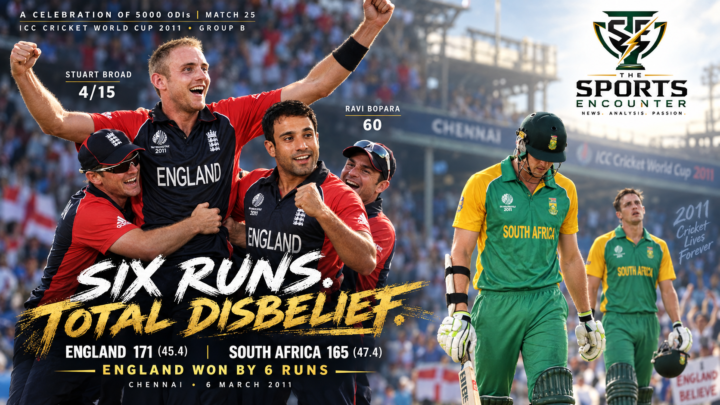
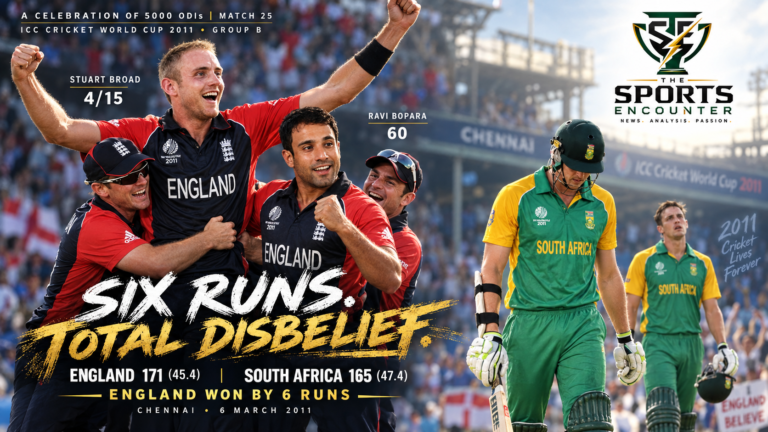 A Celebration of 5000 ODIsA Celebration of 5000 ODIs Match 25: England Defend 171 as South Africa Lose Their Grip
 A Celebration of 5000 ODIsA Celebration of 5000 ODIs Match 21: Malinga Takes Four in Four, but South Africa Escape the Last Wicket
 A Celebration of 5000 ODIsA Celebration of 5000 ODIs Match 20: Boucher Hits Six, but South Africa Miscalculate Their Way Out
Fall of wickets: 5/1 (B. McCullum, 2.1), 16/2 (Guptill, 5.6), 130/3 (Taylor, 32.6), 153/4 (Styris, 37.2), 156/5 (Ryder, 38.5), 188/6 (N. McCullum, 45.3), 204/7 (Oram, 48.1), 210/8 (Vettori, 48.5).
| South Africa bowler | O | M | R | W | Econ |
|---|---|---|---|---|---|
| Robin Peterson | 9 | 0 | 49 | 1 | 5.44 |
| Dale Steyn | 10 | 0 | 42 | 2 | 4.20 |
| Johan Botha | 9 | 0 | 29 | 0 | 3.22 |
| Morne Morkel | 8 | 0 | 46 | 3 | 5.75 |
| Imran Tahir | 9 | 0 | 32 | 2 | 3.56 |
| Jacques Kallis | 3 | 1 | 6 | 0 | 2.00 |
| JP Duminy | 2 | 0 | 9 | 0 | 4.50 |
South Africa: 172 all out in 43.2 overs
| Batter | Dismissal | R | B | 4s | 6s |
|---|---|---|---|---|---|
| Hashim Amla | c Vettori b N. McCullum | 7 | 5 | 1 | 0 |
| Graeme Smith | c sub How b Oram | 28 | 34 | 2 | 0 |
| Jacques Kallis | c Oram b Southee | 47 | 75 | 3 | 0 |
| AB de Villiers | Run out (Guptill/B. McCullum) | 35 | 40 | 4 | 0 |
| JP Duminy | b N. McCullum | 3 | 12 | 0 | 0 |
| Faf du Plessis | c Southee b Oram | 36 | 43 | 3 | 1 |
| Johan Botha | b Oram | 2 | 10 | 0 | 0 |
| Robin Peterson | c B. McCullum b Oram | 0 | 5 | 0 | 0 |
| Dale Steyn | c Oram b N. McCullum | 8 | 18 | 1 | 0 |
| Morne Morkel | c sub How b Woodcock | 3 | 17 | 0 | 0 |
| Imran Tahir | Not out | 0 | 1 | 0 | 0 |
Extras: 3 (lb 2, w 1). Total: 172 all out.
Fall of wickets: 8/1 (Amla, 0.6), 69/2 (Smith, 14.2), 108/3 (Kallis, 24.1), 121/4 (Duminy, 27.4), 121/5 (de Villiers, 27.6), 128/6 (Botha, 32.5), 132/7 (Peterson, 34.2), 146/8 (Steyn, 37.4), 172/9 (du Plessis, 42.5), 172/10 (Morkel, 43.2).
| New Zealand bowler | O | M | R | W | Econ |
|---|---|---|---|---|---|
| Nathan McCullum | 10 | 1 | 24 | 3 | 2.40 |
| Daniel Vettori | 10 | 0 | 39 | 0 | 3.90 |
| Tim Southee | 9 | 0 | 44 | 1 | 4.89 |
| Jacob Oram | 9 | 1 | 39 | 4 | 4.33 |
| Luke Woodcock | 5.2 | 0 | 24 | 1 | 4.50 |
Why Dhaka belongs in this celebration
New Zealand advanced because contributions connected: Ryder’s recovery, Williamson’s finish, McCullum’s control and Oram’s decisive wickets.
Within our 5000 ODIs archive and wider cricket coverage, this match rewards attention beyond the final margin. Forty-nine runs suggests comfort. The defining achievement was creating that margin from a position where South Africa appeared to hold the advantage.
World Cup
- A Celebration of 5000 ODIs Match 27: New Zealand Turn South Africa’s Comfortable Chase Into World Cup Heartbreak
- Australia Bring Their World Cup Questions to a Zimbabwe Side That No Longer Fears Them
- Spain Crush Australia 89-66 to Join the Best Four in the FIBA World Cup 2026
- Gianni Infantino Will Run Again in 2027: How FIFA’s Failed World Cup Deal Turned Re-Election Into a Global Power Fight
- Tottenham Teammates Give Pedro Porro Guard of Honour After Spain’s World Cup Triumph