


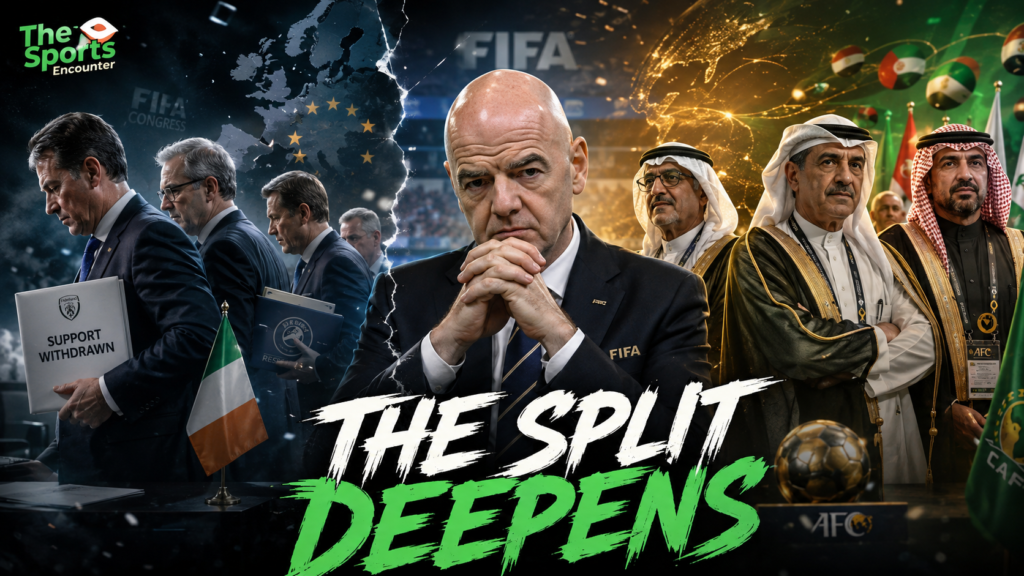
Ireland has withdrawn its support for Gianni Infantino’s re-election as FIFA president, adding another national association to a rebellion that has moved well beyond a dispute over one failed commercial deal.
The Football Association of Ireland confirmed the decision on August 13 following a board meeting. The FAI rescinded the letter of support it had supplied earlier this year and informed FIFA of its reasoning.
The significance lies in the language Ireland used to explain the reversal. The association acknowledged FIFA’s financial and developmental support for Irish football, then pointed directly to concerns over “governance, transparency and the lack of meaningful consultation.”
For an organization that has spent years rebuilding trust after its own governance failures, the FAI said it felt a particular responsibility to advocate for best practice.
That turns Ireland’s decision into something larger than another lost endorsement for Infantino. What began in late July as anger over an abandoned plan to bring private investors into FIFA’s commercial business is increasingly becoming a referendum on how world football should be governed, who holds authority inside FIFA, and whether the president still commands the trust needed to lead 211 national associations.
The latest development adds another chapter to The Sports Encounter’s continuing FIFA and World Cup governance coverage, which has followed the crisis from the collapse of the investment proposal to the growing battle over Infantino’s political future.
What Ireland Actually Announced
The FAI’s official statement left little room for ambiguity.
It confirmed that the board had decided to withdraw the association’s backing for Infantino’s re-election and that FIFA had been formally contacted after the decision.
Ireland had previously provided a letter supporting another Infantino term. That matters because withdrawing an existing endorsement carries more political weight than simply declining to support him in the first place.
The FAI also made clear that its decision was not an attack on everything FIFA has done for Irish football. It expressed gratitude for FIFA’s support while arguing that recent developments had created concerns serious enough to outweigh that relationship.
Its reference to Ireland’s own governance history gives the statement another layer of meaning. The association has undergone extensive reforms after years of financial and governance turmoil, and its board effectively argued that those lessons created an obligation to demand higher standards from international football as well.
That is why Ireland’s withdrawal deserves attention even if one vote alone cannot determine the outcome of next year’s election.
Why Ireland Matters More Symbolically Than Numerically
Every FIFA member association gets one presidential vote. Ireland therefore carries exactly the same formal voting power as Brazil, Germany, Argentina, Morocco, Japan or the United States.
One federation changing sides does not overturn an election. The political value comes from accumulation.
Wales, England and other European associations had already moved away from Infantino before Ireland acted. The English FA’s formal withdrawal of support represented a particularly visible blow because of England’s commercial and historical influence within the game.
Ireland extends the pattern in a different way. It demonstrates that the backlash is filtering through national boards rather than remaining limited to statements from powerful confederation presidents or Europe’s biggest federations.
That process matters because confederations do not cast presidential ballots on behalf of their members. National associations do.
UEFA can oppose Infantino. The Asian Football Confederation can criticize his conduct. CONCACAF can join them. CAF can endorse him. None of those confederations has a collective presidential vote that automatically binds its members.
When the ballot arrives, each eligible FIFA association makes its own decision.
The Crisis Began With a $4.2 Billion World Cup Proposal
The current revolt traces back to Infantino’s attempt to restructure part of FIFA’s commercial business through a private-investment model involving rights connected to major competitions, including the World Cup.
Under the proposal, FIFA would have created a commercial vehicle valued at roughly $20 billion and opened around 20 percent of it to private investors, potentially raising about $4.2 billion.
The concept collapsed rapidly after federations and confederations questioned how such a fundamental restructuring had advanced without wider consultation.
The Sports Encounter examined the initial fallout in FIFA’s World Cup Stake Plan Failed in Three Days. The Damage to Gianni Infantino May Last Much Longer.
The financial proposition itself quickly became secondary to the process behind it.
Critics wanted to know who authorized negotiations, which officials had been consulted, how private investors would influence football’s most valuable commercial properties, what governance protections would apply, and why associations that ultimately underpin FIFA’s authority learned so much about the concept only after it had advanced.
Those questions transformed a business dispute into a leadership crisis.
FIFA’s funding offer complicated the politics
The proposed structure also came with potentially enormous financial consequences for national associations.
Reuters reported that the plan included a $20 million grant for member associations during the next funding cycle, with the possibility of doubling that amount for associations participating in the proposed arrangement.
For smaller federations that depend heavily on FIFA development funding, amounts of that size can reshape infrastructure, youth programs, women’s football, coaching systems and national-team operations.
That financial reality helps explain why the political map remains complicated. The Sports Encounter explored this dynamic earlier in Infantino Looks to Smaller Nations After UEFA, CONCACAF Snub.
Opposition to Infantino cannot simply assume that dissatisfaction among major football nations will automatically produce the same response everywhere else.
UEFA, AFC and CONCACAF Turned a Dispute Into an Open Revolt
The pressure became far more serious when three of FIFA’s six continental confederations aligned publicly against Infantino’s handling of the proposal.
UEFA, the AFC and CONCACAF issued a joint letter accusing the FIFA president of breaking trust and acting without the collective consultation expected from the leader of world football.
Their intervention was covered in detail by The Sports Encounter in UEFA, AFC and CONCACAF Turn on Infantino as FIFA Crisis Becomes a Fight for His Presidency.
The three confederations collectively encompass 136 of FIFA’s 211 voting member associations. That sounds overwhelming on paper, but it does not translate into 136 automatic votes against Infantino.
The events of August 13 demonstrated exactly why.
Ireland Withdrew Support on the Same Day Six Arab Federations Backed Infantino
Hours around Ireland’s announcement also produced evidence that Infantino retains substantial political support.
The heads of the football associations of Qatar, Egypt, Lebanon, Morocco, Sudan and Mauritania issued a joint declaration backing the FIFA president and expressing confidence in his leadership.
Four of the six federation chiefs are also FIFA Council members, adding institutional weight to the endorsement.
The development is especially revealing because several of those associations sit within confederations that have criticized Infantino.
It provides an early warning against reading continental statements as guaranteed voting blocs.
| Latest FIFA Political Position | Current Situation |
|---|---|
| Ireland | Withdrew its previous letter supporting Infantino’s re-election |
| England and several European associations | Have withdrawn or withheld support |
| UEFA | Strongly critical of Infantino’s handling of the failed investment plan |
| AFC | Joined UEFA and CONCACAF in criticizing the FIFA president’s conduct |
| CONCACAF | Part of the joint challenge to Infantino’s leadership |
| CAF | Has publicly backed Infantino |
| Qatar, Egypt, Lebanon, Morocco, Sudan, Mauritania | Issued public support for Infantino on August 13 |
| FIFA presidential election | Scheduled for March 18, 2027 in Rabat, Morocco |
| Eligible FIFA member associations | 211, with one vote each |
Patrice Motsepe’s Response Goes to the Heart of the Election
CAF president Patrice Motsepe has pushed back against attempts to settle Infantino’s future through political pressure before the presidential ballot.
His position is straightforward: critics who want a different FIFA president should take that case to the election and allow the 211 member associations to decide.
That argument does not erase the governance questions surrounding Infantino. It does highlight the central problem facing his opponents.
Removing political support is easier than finding 106 votes for somebody else.
CAF has backed Infantino, but even Africa cannot be treated as a guaranteed bloc. African federations have repeatedly voted against their confederation’s preferred candidate in past FIFA elections.
When Infantino first won the presidency in 2016, CAF had formally endorsed Sheikh Salman bin Ibrahim Al Khalifa. A significant number of African associations broke ranks and helped Infantino win instead.
The same independence appeared during the vote for the 2026 World Cup host, when African associations supported the Canada-Mexico-United States bid despite CAF backing Morocco.
The lesson is useful in 2026: endorsements create momentum, but the secret ballot ultimately belongs to individual associations.
The Election Math Gives Both Sides Reason for Confidence
FIFA has 211 member associations, each holding one vote in a presidential election.
If Infantino faces only one challenger, a simple majority of 106 votes would be enough to win. If three or more candidates enter the election, a two-thirds majority of 141 votes would be required in the first round before the voting process potentially moves through further rounds.
Potential challengers must therefore solve two problems.
First, they need a candidate capable of holding together a coalition that stretches across continents. Second, they need national associations to convert public dissatisfaction into actual votes.
So far, the first challenge remains unresolved.
No single opposition candidate has consolidated the anti-Infantino movement. That leaves the incumbent weakened politically but still difficult to defeat electorally.
The 77th FIFA Congress is scheduled for March 18, 2027 in Rabat, Morocco, where Infantino intends to seek another term.
Reuters reports that prospective challengers have until November 18 to submit their candidacies.
Why CAF remains crucial
Africa could determine whether the revolt becomes an electoral threat or remains largely a political protest.
Infantino has cultivated strong relationships across the continent during his presidency, helped by increases in development funding and FIFA’s investment in smaller national associations.
Several African federations have already issued individual statements supporting him, while CAF itself remains publicly on his side.
At the same time, association leaders interviewed by Reuters have indicated that some are waiting to see whether a credible challenger emerges before committing publicly.
That means the election remains fluid.
FIFA Tried to Contain the Damage, but the Argument Changed
FIFA abandoned the investment proposal and later apologized to its member associations for mistakes in how the process had been handled.
The Sports Encounter covered that attempt to stabilize the organization in FIFA President Apologizes to Member Nations After FIFA World Cup Selloff Plan Fails to Inspire.
Senior FIFA officials also reaffirmed support for Infantino after a crisis meeting in Morocco.
The problem was that the dispute had already moved beyond whether the commercial proposal would survive.
By the time FIFA withdrew it, national associations and confederations were debating presidential authority, consultation, institutional checks and whether the episode represented a broader pattern of centralized decision-making.
FIFA later argued that a coordinated effort was underway to undermine its president, a defense examined in FIFA Says Infantino Is Being Undermined as Leadership Crisis Turns Into a Battle Over Legitimacy.
That response hardened both sides.
Donald Trump’s Support Added Another Political Layer
Infantino has also received high-profile political support outside football.
U.S. President Donald Trump publicly defended the FIFA president as the governance crisis intensified, bringing another dimension to an already unusual fight over football administration.
The Sports Encounter examined that intervention in Trump Backs Infantino as FIFA Power Struggle Deepens.
Trump’s involvement does not translate into FIFA votes. National football associations hold those ballots, not governments.
It does illustrate how far the controversy has moved beyond a technical debate over commercial rights.
How the Infantino Crisis Has Developed
| Period | Development |
|---|---|
| Late July 2026 | Infantino’s proposed private-investment structure for FIFA’s commercial rights becomes public and triggers immediate opposition. |
| Early August | The proposal is abandoned as UEFA and national associations demand greater transparency and accountability. |
| August 3 | Wales becomes an early association to withdraw backing as the crisis begins moving toward the 2027 election. |
| August 5 | More federations break ranks while pressure grows inside FIFA and across Europe. |
| August 6 | The English FA formally withdraws support. FIFA apologizes to member associations over mistakes in the handling of the plan. |
| August 9 | FIFA argues that Infantino is facing a coordinated effort to undermine his leadership. |
| August 10 | UEFA, AFC and CONCACAF jointly attack Infantino’s conduct and demand stronger accountability. |
| August 11 | Donald Trump publicly backs Infantino as the leadership fight becomes increasingly political. |
| August 13 | Ireland withdraws its support, while six Arab football federations publicly endorse Infantino. |
| March 18, 2027 | The FIFA presidential election is scheduled to take place at the 77th FIFA Congress in Rabat. |
The Sports Encounter Analysis: Ireland Shows Why This Crisis Is Getting Harder to Predict
Two weeks ago, FIFA’s problem looked easier to define.
Infantino proposed a radical commercial restructuring. Powerful stakeholders objected. The proposal collapsed.
That version of the story is finished.
The current dispute concerns authority and trust, and those are much harder to repair with a withdrawn proposal or an apology.
Ireland’s decision illustrates the shift particularly well because the FAI did not focus primarily on the economics of the failed deal. Its explanation centered on governance, transparency and consultation.
Those are institutional concerns. They survive even after the original commercial plan disappears.
Yet August 13 also demonstrated why declaring Infantino politically finished would be premature. As Ireland walked away, six Arab federations publicly moved toward him. CAF remains supportive. Individual African associations continue to back his record. Other federations have stayed quiet.
The crisis has therefore produced two parallel movements.
One coalition is demanding change in FIFA’s leadership culture. Another continues to value Infantino’s development record, financial support for smaller associations and expansion of football outside its traditional centers of power.
Neither side can simply impose its position through a continental confederation.
The battle is moving federation by federation.
That makes Ireland important.
Its single vote will never decide FIFA’s future by itself. Its reversal matters because the election will ultimately be decided through dozens of decisions exactly like it.
Infantino’s biggest advantage remains the absence of a unified rival
The opposition has energy, influential institutions and increasingly forceful language. What it still lacks is an agreed presidential candidate.
That gap may become the decisive issue between now and the November candidacy deadline.
A broad anti-Infantino coalition can agree that trust has been damaged while disagreeing completely about who should replace him, what reforms should follow, and how power should be distributed between FIFA and its confederations.
Until those questions are resolved, Infantino retains something every incumbent values: opponents who agree on the problem more easily than they agree on the alternative.
The Sports Encounter previously identified that contradiction as the crisis moved into a wider break between FIFA officials and national federations.
What Happens Next?
The next phase will reveal whether Ireland’s move becomes part of a steady stream of withdrawals or whether the rebellion begins to lose momentum.
Three developments now matter most.
1. More national associations must declare their positions
Statements from confederations have set the political tone, but presidential votes belong to associations. Every withdrawal, endorsement or refusal to commit provides a clearer picture of the actual election.
2. The opposition needs a candidate
A revolt without an alternative cannot win a presidential ballot. November 18 therefore becomes a critical date in the crisis.
3. FIFA must decide how far it wants to confront its critics
The governing body’s defense of Infantino has already framed parts of the opposition as an effort to undermine the president. Further escalation could deepen divisions just months after a World Cup that was supposed to showcase FIFA’s global unity.
The stakes are considerable. The argument now touches FIFA’s commercial model, development funding, the relationship between the president and member associations, future World Cups and the basic question of who ultimately controls the institution.
For additional context on how rapidly the confrontation developed, read The Sports Encounter’s earlier analysis, Infantino in Survival Mode After World Cup Stake Sale Idea Results in Global Revolt.
Frequently Asked Questions
Did Ireland withdraw support for Gianni Infantino?
Yes. The Football Association of Ireland confirmed on August 13, 2026 that its board had decided to rescind the letter supporting Infantino’s re-election that it supplied earlier in the year.
Why did Ireland withdraw its support?
The FAI cited concerns about governance, transparency and insufficient meaningful consultation following recent events at FIFA. It also referenced the governance challenges Irish football has faced in recent years and said those experiences created an obligation to advocate for best practice.
Is Ireland calling for Infantino to resign immediately?
The FAI’s statement confirmed withdrawal of support for his re-election. It did not, in that statement, explicitly demand his immediate resignation.
What caused the FIFA crisis?
The immediate trigger was Infantino’s failed proposal to create a commercial structure involving FIFA competition rights and sell roughly a 20 percent stake to private investors, potentially raising about $4.2 billion. Critics argued that the process lacked transparency and meaningful consultation.
Which confederations are opposing Infantino?
UEFA, the Asian Football Confederation and CONCACAF have jointly criticized his conduct over the failed investment proposal and challenged his leadership.
Does Infantino still have support?
Yes. CAF has publicly backed him, while individual associations including Qatar, Egypt, Lebanon, Morocco, Sudan and Mauritania issued a joint statement supporting him on August 13. Other national associations have also expressed support.
How many associations vote in a FIFA presidential election?
FIFA has 211 member associations, and each eligible association has one vote.
How many votes does Infantino need to win?
If only two candidates contest the election, 106 votes would represent the simple majority required to win. If three or more candidates contest the first ballot, a two-thirds majority of 141 is required initially.
When is the next FIFA presidential election?
The election is scheduled for March 18, 2027 at the 77th FIFA Congress in Rabat, Morocco.
When must challengers declare their candidacy?
Potential candidates are expected to submit their presidential candidacies by November 18, 2026.
Can UEFA remove Gianni Infantino by itself?
No. FIFA’s president is elected by member associations. UEFA can influence its members and take political positions, but European football alone cannot determine the presidential election.
Ireland’s Vote Is Small. The Pattern Is Not.
The easiest way to underestimate Ireland’s decision is to reduce it to election arithmetic.
One association withdrew one endorsement. Infantino still has powerful allies. The election remains seven months away, and no unified challenger has emerged.
All of that is true.
It also misses what has changed.
Every national association that withdraws support turns an institutional dispute into an electoral decision. Every federation that publicly backs Infantino demonstrates that confederation leaders cannot automatically deliver their members. Every undecided association becomes more valuable as March approaches.
Ireland has now made its choice.
Its board looked at FIFA’s recent conduct, considered its own experience with governance failures, and decided that the support it gave Infantino earlier this year could no longer stand.
The FIFA president’s future will ultimately be decided in Rabat, exactly as Patrice Motsepe argues.
Between now and then, however, 211 associations will be deciding what that vote should represent: continuity, development funding and Infantino’s global expansion of the game, or a demand for a different model of leadership after one of the most damaging governance disputes of his presidency.
Ireland’s withdrawal will not settle that argument.
It is another sign that the argument is spreading.