


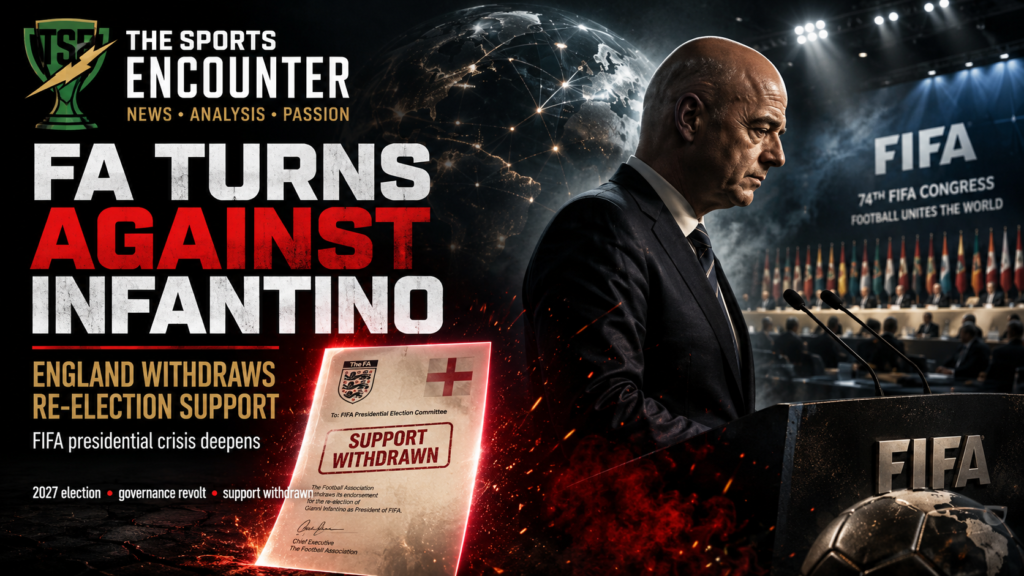
The English Football Association has formally withdrawn its support for Gianni Infantino’s attempt to secure another term as FIFA president, delivering one of the most significant political blows yet to his increasingly unstable re-election campaign.
The FA has sent a letter to FIFA confirming that it no longer endorses Infantino for the presidential election scheduled for March 18, 2027, in Rabat, Morocco.
England joins Wales, Finland, Serbia, Sweden, and a growing collection of European associations that have stepped away from Infantino after the collapse of his controversial plan to bring private investors into FIFA’s commercial operations.
The move does not remove Infantino from office and does not prevent him from standing for a fourth term. It does, however, show that the political fallout from the abandoned World Cup stake-sale proposal continues despite FIFA’s attempt to present a united front following emergency talks in Morocco.
Infantino retains the public support of FIFA’s management board. The wider election will be decided by the organization’s 211 member associations, each of which holds one vote.
FA Withdrawal at a Glance
| Key Detail | What It Means |
|---|---|
| Association | The English Football Association |
| Action | Formal withdrawal of support for Gianni Infantino |
| Election | FIFA presidential election |
| Election date | March 18, 2027 |
| Election venue | Rabat, Morocco |
| Infantino’s objective | A fourth term as FIFA president |
| Immediate effect | Loss of a major European endorsement |
| Removal from office | No |
| Can England still vote for him? | Technically yes, but the letter signals the opposite intention |
England Converts Private Concern Into Formal Opposition
The FA had been expected to reconsider its position after Wales became one of the first major associations to withdraw a previously submitted letter supporting Infantino.
That expectation has now become a formal act.
By writing directly to FIFA, England has moved beyond public unease and registered an institutional decision that will form part of the developing election picture.
That distinction matters.
Federations can criticize individual policies while continuing to support the president responsible for them. The FA has now separated itself from that position and made clear that its concerns are serious enough to affect the leadership vote.
The decision also carries symbolic importance because England remains one of football’s oldest and most commercially influential national associations.
The FA does not control the FIFA electorate. Its single vote is numerically equal to that of every other member association. Its public position can still influence political debate across UEFA and encourage other federations to review their endorsements.
The development follows the wider breakdown explored in The Sports Encounter’s analysis of the FIFA officials and federations breaking ranks with Infantino.
The World Cup Selloff Plan Triggered the Revolt
The immediate crisis grew from FIFA’s attempt to establish a new commercial structure linked to its major competitions.
The proposal involved creating a company reportedly valued at approximately $20 billion and selling a minority stake of about 20% to private investors.
That structure could have raised around $4.2 billion in immediate capital.
The plan was presented as a way to accelerate investment, strengthen FIFA’s commercial operations, and generate more money for football development.
Its critics saw something very different.
UEFA, Concacaf, the Asian Football Confederation, domestic leagues, national associations, player representatives, and senior figures inside FIFA challenged the project’s transparency, governance, and long-term consequences.
Many associations said they had not been properly consulted before a proposal involving the commercial future of the World Cup moved toward private investment discussions.
Senior FIFA officials also questioned how much information had been shared internally and whether the president’s office had moved too far without meaningful institutional approval.
The Sports Encounter documented the proposal’s collapse in FIFA’s World Cup Stake Plan Failed in Three Days.
The plan was eventually withdrawn, but ending the proposal did not repair the trust damaged during the process.
Why the FA’s Decision Matters
The withdrawal carries more importance than the loss of one vote.
1. England Gives the European Revolt Greater Weight
Several smaller European associations had already moved away from Infantino. England’s decision makes it harder to describe the opposition as limited, isolated, or politically insignificant.
The FA represents one of the world’s largest football economies and oversees the national association connected to the Premier League, England’s national teams, Wembley Stadium, and the FA Cup.
Its stance will attract attention from sponsors, broadcasters, governments, leagues, and other federations.
2. The Withdrawal Weakens Infantino’s Claim of Broad Unity
FIFA’s management board has publicly reaffirmed confidence in Infantino following crisis talks in Morocco.
That internal support allows the president to remain in office and continue his campaign.
The FA’s letter highlights the difference between support from FIFA’s senior management and support from the associations that will ultimately vote.
Infantino may have survived the internal emergency. The election remains a separate test.
3. Other Federations May Follow
England’s action gives hesitant associations political cover.
A federation may have concerns about withdrawing support alone, particularly if it relies heavily on FIFA development funding or fears losing influence within the organization.
Once several established associations act together, the personal and political cost of dissent becomes lower.
The Sports Encounter previously examined this changing coalition in how Infantino turned toward smaller nations after losing support across UEFA and Concacaf.
FIFA’s Apology Has Not Ended the Crisis
FIFA has apologized to its member associations for the way the commercial proposal was handled.
The organization acknowledged that consultation should have been broader and that the process created damaging divisions.
FIFA also confirmed that the proposal had been abandoned and promised a review intended to prevent similar governance failures.
Those steps helped Infantino retain the backing of the management board, including FIFA secretary general Mattias Grafström and other senior executives.
The apology did not persuade the English FA to restore its confidence.
That is one of the most important elements of the latest development.
The FA’s decision suggests that some associations now view the controversy as evidence of a larger leadership problem rather than a single poorly managed proposal.
Our detailed report on FIFA’s apology after the World Cup selloff plan collapsed explains why withdrawing the proposal failed to settle the wider governance debate.
Infantino Still Has a Route to Re-Election
The growing European opposition has damaged Infantino, but it has not yet defeated him.
FIFA’s presidential election follows a one-association, one-vote system.
England, Germany, Brazil, Argentina, and other major football nations each receive one vote, just like smaller associations with limited professional infrastructure or international success.
That system gives the FIFA president a powerful incentive to build support across Africa, Asia, Oceania, the Caribbean, and smaller European nations.
Many associations have benefited from FIFA Forward development funding, new pitches, training facilities, administrative programs, and direct financial assistance during Infantino’s presidency.
Those relationships may remain strong even when Europe’s largest federations withdraw their backing.
Infantino has also spent years cultivating personal ties with association presidents, government leaders, regional confederations, and football administrators.
Unless the opposition produces a credible candidate capable of uniting several regions, he could still win another term.
The Missing Piece Is a Serious Rival
The political rebellion has created an opportunity. It has not yet created a challenger.
Infantino confirmed at the 76th FIFA Congress that he intends to stand for re-election in 2027. FIFA has set the vote for March 18 in Rabat.
Any opposition campaign would need to assemble support across multiple confederations rather than relying on UEFA alone.
A candidate backed only by Europe would struggle to win a majority of the 211 votes.
The challenger would need a credible governance platform, strong personal relationships, financial knowledge, international football experience, and enough political independence to persuade associations that change would not threaten their development funding.
Potential successors have already entered public discussion, but no single figure has emerged as the clear candidate capable of defeating Infantino.
The longer the opposition waits, the more time Infantino has to rebuild alliances and frame the crisis as a temporary dispute that FIFA has already resolved.
England’s Position Could Reshape UEFA’s Strategy
UEFA’s 55 associations have already taken a hard line against the abandoned commercial proposal.
European federations threatened to boycott FIFA competitions if the plan continued, turning a governance dispute into a direct challenge to the authority of the world governing body.
The plan was later withdrawn, but UEFA has maintained pressure and demanded stronger assurances about FIFA’s future commercial and governance decisions.
England’s formal withdrawal may push UEFA closer to supporting a rival candidate rather than limiting its response to policy opposition.
The crisis has already reached the point where football figures have openly discussed what could happen if UEFA attempted to operate outside FIFA’s structures.
The Sports Encounter explored that possibility in our analysis of the UEFA boycott threat and the wider World Cup selloff revolt.
Breaking from FIFA would be an extreme and highly disruptive outcome. Building an election coalition to change the president would provide a more conventional path.
What Happens to England’s Previously Submitted Support?
Infantino reportedly entered the election cycle with endorsement letters from a large majority of FIFA’s members.
Those letters helped establish the appearance of overwhelming support and discouraged potential challengers from entering the race.
An endorsement is not the same as a final vote.
Associations can withdraw their letters, revise their position, and vote differently when the FIFA Congress meets.
England’s latest correspondence removes the FA from the group that Infantino can publicly present as supporting his re-election.
The withdrawal may also place greater scrutiny on how the original endorsement letters were requested, drafted, and collected.
Questions have emerged over whether federations faced pressure to declare support before the full election debate had begun.
Those concerns became particularly serious after Prince Ali bin Al Hussein of Jordan accused FIFA of using financial influence and threats connected to association funding.
FIFA has rejected allegations of improper political pressure.
Could an Extraordinary FIFA Congress Remove Infantino Earlier?
The March 2027 election is not the only theoretical route to leadership change.
FIFA’s statutes allow member associations to request an Extraordinary Congress if the required threshold is met.
With 211 member associations, at least 43 formal requests would represent one-fifth of the membership.
An Extraordinary Congress could create a platform for a vote of no confidence or another major institutional challenge, depending on the formal agenda and statutory process.
Reaching 43 associations would require opposition beyond a handful of European countries.
It would also demand coordination, legal preparation, and a willingness among federations to confront the sitting president months before the scheduled election.
For now, the more likely route remains political pressure followed by an organized electoral challenge.
The Commercial Plan Is Gone, but the Governance Questions Remain
The proposed private investment structure raised questions that extend beyond the abandoned deal.
- How much authority should the FIFA president hold over major commercial initiatives?
- When must the FIFA Council and member associations be consulted?
- Should investors ever own part of a company controlling World Cup revenues?
- How should potential conflicts between regulation and commercial growth be managed?
- Can FIFA’s internal leadership provide meaningful checks on presidential power?
- Does development funding create unhealthy political dependence?
Those questions explain why the crisis continues after the proposal’s withdrawal.
The original investment idea and its financial implications were examined in our report on whether the FIFA World Cup was still for sale after the plan collapsed.
The opposition is now focused on who made the decision, how the project advanced, what safeguards failed, and whether the same leadership structure could produce another crisis.
Concacaf’s Opposition Changed the Political Calculation
The revolt became much more dangerous for Infantino when it spread beyond UEFA.
Concacaf rejected the private-investment proposal after associations across North America, Central America, and the Caribbean raised concerns about governance and control.
That opposition was especially significant because the United States, Canada, and Mexico had just completed hosting the FIFA World Cup 2026.
The region had worked closely with FIFA for years on tournament delivery, commercial planning, stadium operations, security, visas, and government coordination.
Losing confidence in that relationship weakened the argument that only European politics drove the resistance.
Readers can revisit Concacaf’s rejection of FIFA’s World Cup stake-sale plan for the moment the crisis became genuinely global.
Resignations and Internal Dissent Added to the Pressure
The controversy also produced opposition from inside FIFA’s wider leadership structure.
Senior adviser Carlos Cordeiro resigned during the fallout. Other officials questioned the process, the flow of information, and the concentration of authority around the proposal.
Arsène Wenger distanced himself from the project, while Grafström’s language about serving FIFA as an institution rather than any individual attracted particular attention.
Those developments challenged the idea that the crisis was simply an external political attack.
The Sports Encounter followed the internal breakdown in our report on the resignations and staff revolt surrounding the World Cup investment plan.
What the FA’s Withdrawal Means for the 2027 Election
England’s letter changes the atmosphere of the election without determining its outcome.
Infantino can no longer rely on an uncontested image of global approval.
His opponents can now point to formal withdrawals from established federations, resistance across confederations, public criticism from political leaders, internal resignations, and ongoing questions about FIFA’s governance.
His supporters can point to the abandoned proposal, the management board’s backing, FIFA’s apology, record tournament revenues, and development investment across the global game.
The election may therefore become a contest between two competing arguments.
Infantino will present himself as the leader who expanded FIFA’s revenues, increased investment, delivered the largest World Cup in history, and gave smaller nations greater influence.
His opponents will argue that those achievements came with excessive centralization, weak consultation, political dependency, and a leadership model that placed too much authority around one person.
What Happens Next?
Attention will now turn to four developments.
- Further withdrawal letters: More associations may follow England and remove their endorsements.
- A challenger: UEFA and other opponents must decide whether to support a credible candidate.
- FIFA’s governance review: Member associations will judge whether the promised review produces meaningful reforms.
- Infantino’s coalition: The president will work to retain support across Africa, Asia, Oceania, South America, and smaller associations.
The crisis may also affect future debates over World Cup commercialization, the proposed 64-team tournament in 2030, FIFA development funding, and the balance of power between the global body and regional confederations.
Final Verdict
The English FA’s decision represents one of the clearest signs yet that Gianni Infantino’s re-election is no longer a routine formality.
England controls only one vote, but its withdrawal strengthens a broader political narrative: important football associations no longer trust the leadership process that produced the failed World Cup investment plan.
Infantino remains in office. He retains powerful allies, institutional resources, development relationships, and a global electoral structure that has traditionally favored incumbents.
The opposition still needs a candidate, a cross-confederation coalition, and a practical plan for governing FIFA after him.
Yet the political direction has changed.
Weeks ago, the central question was whether anyone would challenge Infantino. Now, major federations are formally withdrawing their support and forcing the football world to consider what a contested FIFA election could look like.
The World Cup selloff plan has disappeared. The leadership crisis it created is moving closer to the ballot box.
Follow The Sports Encounter’s soccer coverage for continuing updates on FIFA governance, the 2027 presidential election, World Cup policy, and the power struggle shaping international football.