


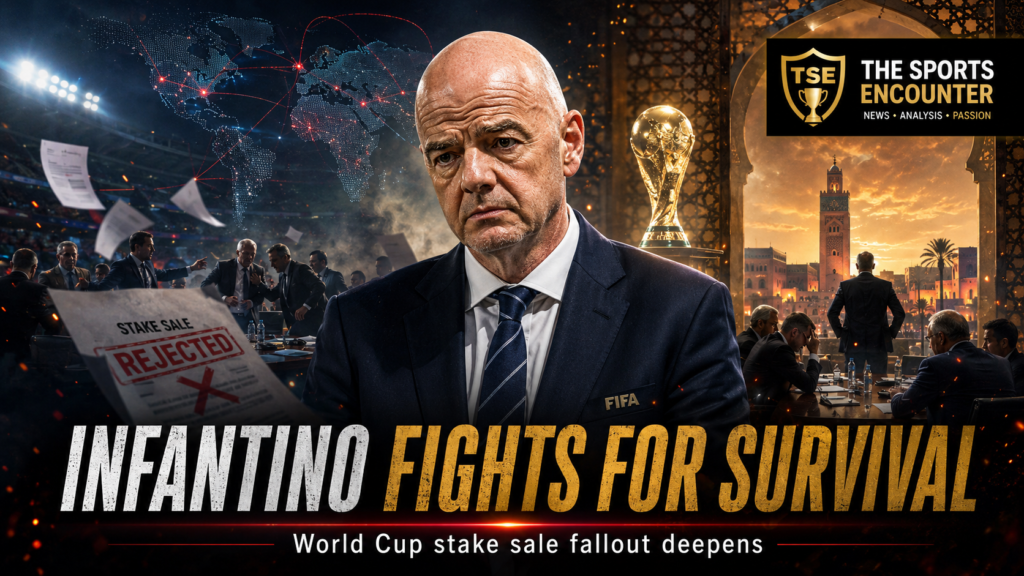
Gianni Infantino went to Morocco looking for support. The FIFA president now needs far more than reassuring photographs, private meetings, and declarations of loyalty from friendly football associations.
His abandoned proposal to sell a 20% stake in a new entity controlling valuable FIFA commercial rights has developed into the most serious leadership crisis of his presidency.
Senior FIFA officials have distanced themselves from the project. Carlos Cordeiro resigned as Infantino’s adviser. UEFA says it has lost confidence in him. Several European associations have withdrawn their support for his re-election. Former Portugal captain Luis Figo has called for him to leave.
Now Canadian Prime Minister Mark Carney has entered the argument with a statement that cuts directly into the issue Infantino has struggled to contain: governance.
Carney said he no longer had confidence in the FIFA president after learning that senior executives and board members had reportedly not been properly informed about such a consequential commercial proposal.
That intervention matters. Canada had recently helped host the largest World Cup in history, and Carney had appeared publicly alongside Infantino during the tournament. His criticism therefore comes from the leader of one of FIFA’s most important recent host countries, not from a distant political observer.
The controversy has moved through several stages in barely more than a week. It began as a dispute over private investment. It became an institutional revolt. The meeting at FIFA’s Africa office near Rabat now suggests Infantino understands that his position can no longer be treated as secure.
Infantino Crisis: Key Developments
| Development | Why It Matters |
|---|---|
| FIFA proposed a new $20 billion commercial entity | The body would have managed commercial and event operations connected to the World Cup and other competitions. |
| Up to 20% could have been sold to private investors | The transaction was expected to raise approximately $4.2 billion. |
| UEFA, Concacaf and AFC objected | The opposition extended across several of football’s most powerful regional bodies. |
| FIFA abandoned the proposal | Withdrawal failed to end criticism of how the project had been developed and presented. |
| Senior figures distanced themselves | Internal statements weakened the argument that this had been a broadly supported FIFA initiative. |
| Infantino held crisis talks in Morocco | The location placed him close to an important base of political support before the next presidential election. |
| Mark Carney withdrew his confidence | A leader from a recent World Cup host nation publicly questioned Infantino’s ability to govern. |
The Meeting in Morocco Was About Political Survival
Infantino met senior FIFA officials at the organisation’s Africa office in Sale, across the Bou Regreg river from Rabat.
FIFA Secretary General Mattias Grafström was also believed to have attended. Vehicles carrying senior officials were seen leaving the office after the discussions.
The official setting cannot disguise the political purpose.
Infantino needs to preserve enough support among FIFA’s 211 member associations to remain the favourite in the presidential election scheduled for March in Morocco. A contest that looked predictable only months ago has become much harder to read.
No confirmed challenger has yet assembled a campaign capable of defeating him. That remains Infantino’s strongest protection. Presidential crises inside FIFA are decided through votes, not newspaper columns or social media condemnation.
Under FIFA’s voting system, every member association receives one vote. San Marino carries the same formal electoral weight as Brazil, Argentina, Germany, or Spain.
This structure has always rewarded presidents who build strong relationships outside Europe’s richest football markets. Smaller associations often depend heavily on FIFA development funds for facilities, administration, competitions, and day-to-day operations.
Infantino has spent years cultivating those relationships. His presence in Morocco suggests he is now relying on them to contain a rebellion growing elsewhere.
Morocco will co-host the 2030 World Cup and its football leadership has continued to support him. Administrators from several African countries have also sent messages of backing, although the Confederation of African Football had not taken a collective position when the meeting was held.
Qatar, Kuwait, Lebanon, Sri Lanka, Indonesia, and the Philippines have also declared support.
Those endorsements may keep Infantino competitive. They do not resolve the questions surrounding the failed project.
A $4.2 Billion Proposal Built Without Enough Trust
FIFA planned to create FIFA Forward Enterprise, a new operation valued at approximately $20 billion.
The proposed organisation would have overseen commercial and event activities connected to FIFA competitions, including the World Cup. External investors could have acquired a minority stake of up to 20%, potentially raising around $4.2 billion for football development.
FIFA argued that it would retain control over governance and sporting decisions. Supporters of the concept could also point to the growing role of institutional capital across modern sport.
Private equity already influences leagues, clubs, media rights, sponsorship structures, data businesses, and competition financing. On a purely financial level, testing the value of FIFA’s commercial assets was not surprising.
The problem sat inside the process.
Regional confederations, member associations, executives, and other stakeholders said they had not received enough time, information, or meaningful consultation before being asked to assess a plan affecting football’s most valuable global property.
UEFA reacted with fury. Concacaf rejected the proposal after calling for better governance and transparency. The Asian Football Confederation criticised FIFA’s unilateral approach.
The controversy also drew scrutiny because of the reported involvement of an investment company linked through family relationships to US President Donald Trump.
The Sports Encounter has previously examined how political influence around FIFA can affect public confidence in football’s decision-making. The stake-sale episode has reopened the same concern on a much larger commercial scale.
For an organisation still carrying the historical weight of corruption scandals, consultation cannot be treated as administrative decoration. It forms part of the institution’s credibility.
Withdrawing the Plan Did Not End the Crisis
Infantino eventually abandoned the proposal after opposition spread across world football.
By then, the damage had already moved beyond the deal itself.
FIFA Chief Operating Officer Kevin Lamour reportedly told staff that they had been deceived and described the proposal as the work of one individual.
Grafström later sent an internal message lamenting the events that led to the project being permanently abandoned. His message did not directly name Infantino, but its emphasis on the institution surviving individuals carried an unmistakable political weight.
Arsène Wenger, FIFA’s Chief of Global Football Development, said he had not helped draft the proposal and regarded its withdrawal as necessary.
Cordeiro went further. He resigned as Infantino’s senior adviser and questioned why an organisation with substantial reserves and no debt needed to sell part of its most valuable commercial asset.
Each intervention weakened Infantino’s position.
A president can survive external opposition by presenting it as rivalry, regional politics, or resistance to reform. Internal criticism is harder to dismiss because it raises questions about who knew what, when they knew it, and whether senior FIFA officials trusted the decision-making process.
Mark Carney Changed the Political Temperature
Carney’s statement arrived while Infantino was trying to repair his coalition in Morocco.
The Canadian prime minister focused on the reported failure to brief close advisers, operational leaders, and board members before advancing a proposal of such magnitude.
He argued that this level of governance failure should destroy confidence in a leader.
The language was unusually direct for a serving head of government discussing the president of a sporting organisation.
Canada had worked closely with FIFA as one of the three hosts of the 2026 World Cup. Carney and Infantino had been photographed together during the tournament, including at Canada’s group-stage match against Qatar.
The Sports Encounter followed Canada’s World Cup journey through its eventual knockout defeat against Morocco. During that competition, the relationship between FIFA and Canada carried the public appearance of a successful host partnership.
Carney’s withdrawal of confidence punctures that image.
It also gives Infantino’s opponents something more powerful than criticism of the financial model. They can now argue that the project exposed a leadership method that excludes scrutiny until decisions are already moving toward approval.
UEFA’s Revolt Has Become Personal
UEFA originally attacked the substance of the proposal, accusing FIFA of placing football’s soul at risk.
The dispute soon became a judgment on Infantino himself.
European associations discussed the possibility of boycotting FIFA competitions if the commercial plan moved ahead. Several federations later withdrew support for Infantino’s re-election.
European Leagues, representing more than 1,300 clubs, warned against FIFA continuing to make unilateral decisions affecting clubs, players, and supporters.
The organisation also criticised the short period provided to study a separate proposal to expand the 2030 World Cup from 48 to 64 teams.
These disputes belong to the same governance argument.
FIFA’s tournament expansions, congested calendars, ticketing policies, commercial partnerships, and proposed investment structures affect people far beyond its Zurich headquarters.
The Sports Encounter previously examined the pressures facing organisers before the expanded tournament in our analysis of FIFA World Cup 2026’s largest operational challenges.
Those concerns did not disappear after the final. The financial future of the World Cup has now become part of a broader battle over who controls football’s most important decisions.
Figo’s Intervention Shows How Far Infantino Has Fallen
Luis Figo once considered running for the FIFA presidency and had previously supported Infantino’s rise.
His latest intervention removed any trace of diplomatic restraint.
The former Portugal captain accused Infantino of deeply self-interested behaviour and called for his departure.
Figo’s comments do not carry a vote by themselves. They matter because they influence how the crisis is understood by players, supporters, sponsors, and national associations.
Senior football figures rarely attack a sitting FIFA president with this level of force unless they believe his authority has become vulnerable.
Jordan Football Association President Prince Ali bin Hussein added another serious allegation by accusing FIFA of offering assistance with football problems in exchange for support for Infantino.
Prince Ali said Jordan had not endorsed Infantino before and would not do so now.
The allegations remain disputed, but they deepen the perception that the coming election could become a contest between institutional loyalty and demands for reform.
The Trump Connection Made Transparency Even More Important
The proposed investment structure faced additional scrutiny because one of the companies associated with the project reportedly had family links to Donald Trump.
FIFA later rejected reports that Infantino had sought political help from Trump after opposition to the proposal intensified.
FIFA has also denied claims that Infantino promised Morocco the right to stage the 2030 World Cup final in return for support.
There is no verified basis to present either allegation as established fact.
The existence of such reports, however, shows why a transparent process was essential from the beginning. When major decisions emerge through limited consultation, unanswered questions quickly become filled by suspicion.
FIFA has already faced criticism over World Cup ticket prices and the commercial cost of attending its biggest matches. The governing body’s revenue model also came under examination when secondary-market prices collapsed during the knockout stage.
Against that background, a proposal involving private ownership of World Cup-linked commercial rights was always going to require exceptional openness.
Can Infantino Survive Until the Election?
Infantino’s immediate objective is straightforward. He must prevent the opposition from becoming organised.
An Extraordinary FIFA Congress can be requested if at least 43 member associations submit a formal written demand. Reaching that threshold would intensify pressure well before the scheduled election.
His critics face their own problem. Anger does not automatically produce a challenger.
Several possible candidates have been discussed, including Concacaf President Victor Montagliani and Norwegian Football Federation President Lise Klaveness. Prince Ali has previously run for the presidency. None had formally emerged as the unified alternative when Infantino held his Morocco meeting.
That gives him time.
It also explains why meetings in Africa, Asia, the Middle East, and smaller football nations matter so much. Infantino does not need to win the approval of every critic. He needs enough votes to prevent a broad anti-Infantino alliance from controlling the Congress.
The next seven months will therefore involve two parallel campaigns.
One will take place publicly through statements about governance, transparency, private capital, and the protection of football.
The other will happen behind closed doors as national associations calculate funding relationships, regional alliances, future tournament decisions, and their place inside FIFA’s political system.
FIFA’s Commercial Success Cannot Settle the Governance Question
FIFA can point to enormous revenues, global tournament growth, development payments, and the commercial reach of the 2026 World Cup.
The competition became a vast marketing platform, as shown by Visa’s worldwide World Cup campaign and the wider battle among global brands.
Commercial performance, however, does not give a president unlimited freedom to restructure the organisation’s assets.
The World Cup belongs institutionally to FIFA’s member associations. Emotionally and culturally, it belongs to a much wider football public.
Any proposal involving outside ownership of the competition’s commercial engine will attract questions about influence, profit distribution, long-term control, tournament access, and accountability.
Those questions deserved a transparent process before associations were pushed toward a decision.
Infantino’s Real Problem Is No Longer the Failed Deal
The Morocco meeting may help Infantino secure declarations of loyalty. It may reassure associations that rely on FIFA funding. It may even prevent an immediate challenge from gaining enough votes.
None of that restores confidence among the officials who say they were excluded, the confederations that felt ignored, or the political leaders now questioning his judgment.
The commercial proposal has already been dropped. The crisis continues because the football world has started examining how the proposal reached such an advanced stage.
Infantino can argue that he listened and withdrew a divisive idea. His critics see a president who acted alone, encountered resistance, and changed direction only when his political survival came under threat.
That is why Morocco matters.
The meeting was not simply an attempt to explain a failed financial project. It was the opening move in Infantino’s campaign to survive the consequences.
Whether he remains FIFA president may now depend on how many associations consider development funding and political continuity more important than the governance failure exposed by the World Cup stake-sale affair.
The next election will answer that question. The damage to his authority is already visible.
The Sports Encounter’s World Cup 2026 coverage focuses on fixtures, team news, match analysis, fan stories, tournament trends, and the biggest talking points from football’s global stage.