


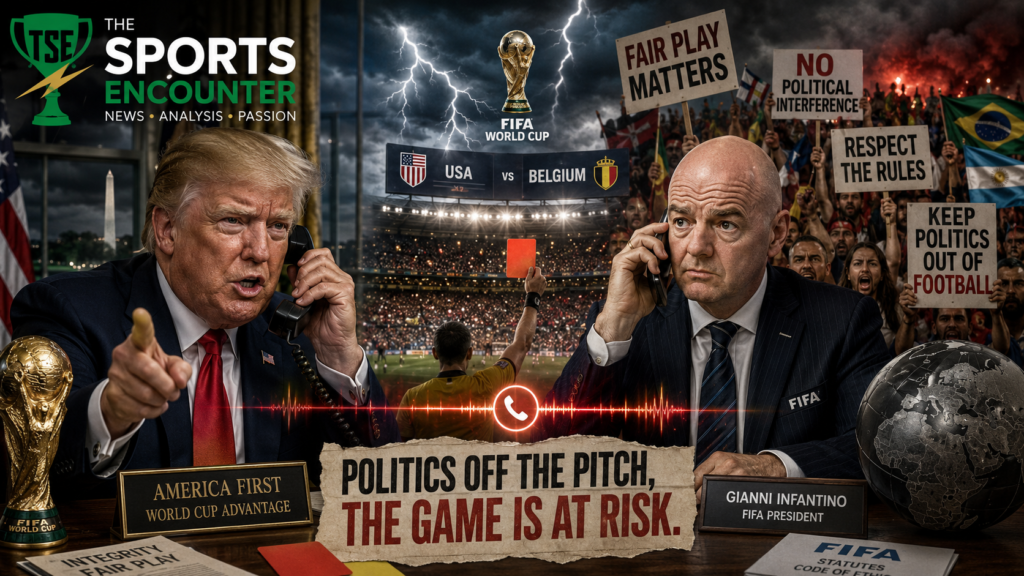
Seattle was supposed to host a World Cup knockout match. Instead, it now hosts a test of football’s trust.
USA vs Belgium already had enough tension. A host nation chasing a historic quarterfinal. A Belgian team trying to begin life after its golden generation. A young American forward, Folarin Balogun, carrying three World Cup goals and the emotional weight of a breakout tournament.
Then FIFA changed the story.
Key Facts Box
| Key Point | What It Means |
|---|---|
| Player involved | Folarin Balogun, United States striker |
| Original incident | Red card against Bosnia and Herzegovina |
| Normal red-card consequence | Automatic suspension for the next match |
| FIFA decision | Suspension of the ban, not cancellation of the red card |
| Rule cited by FIFA | Article 27 of the FIFA Disciplinary Code |
| Belgium’s objection | Red cards should trigger automatic next-match bans |
| Match affected | USA vs Belgium, FIFA World Cup 2026 Round of 16 |
| Bigger issue | Political influence, rule consistency, and tournament integrity |
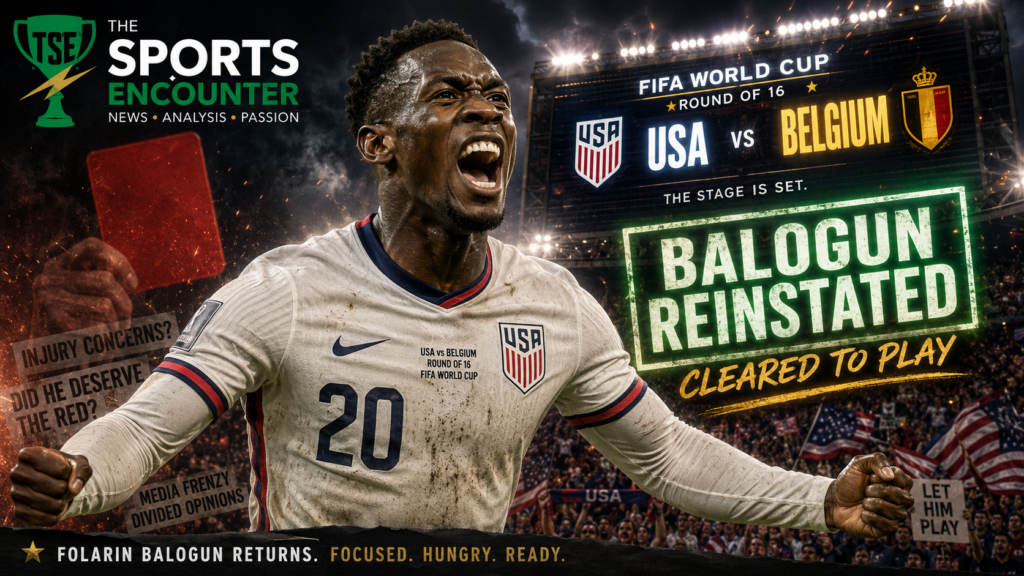
Balogun, sent off in the United States’ Round of 32 win over Bosnia and Herzegovina, has been cleared to face Belgium after FIFA suspended the implementation of his automatic one-match ban. The decision followed a reported call from U.S. President Donald Trump to FIFA President Gianni Infantino asking the governing body to review the sending-off.
FIFA did not erase the red card. That distinction matters. The card still stands. What FIFA suspended was the enforcement of the match suspension, placing Balogun under a one-year probationary period.
For American fans, this feels like a lifeline.
For Belgium fans, it feels like the ground moved under their feet.
For neutral fans, it creates one of the most uncomfortable questions of FIFA World Cup 2026: when politics enters the frame, can football still convince the world that the pitch remains fair?
For readers tracking the full knockout picture, this controversy now sits at the heart of the wider FIFA World Cup 2026 Round of 16 drama, where VAR, disciplinary calls, and emotional swings have already shaped the tournament’s most unpredictable phase.
The Red Card That Became Bigger Than the Match
Balogun’s tournament had been moving in one direction before the controversy: upward.
He scored his third goal of the World Cup in the United States’ 2-0 win over Bosnia and Herzegovina, strengthening his status as one of the host nation’s most important attacking players. The U.S. did not simply need his goals. They needed his presence, movement, pressing, and ability to stretch defensive lines.
Then came the challenge.
Balogun planted his boot into the ankle of Bosnia defender Tarik Muharemovic. After a VAR review, the referee showed him a red card. Under the normal understanding of tournament rules, that should have ruled him out of the next match.
That next match happened to be Belgium.
This is why the dispute exploded. This was not a minor disciplinary adjustment in a low-stakes game. This was a knockout tie. A Round of 16 match. A night where one elite forward’s availability can change both tactical plans and emotional confidence.
Belgium had every reason to prepare as if Balogun would miss the game. Then, less than 24 hours before kickoff, FIFA reopened the door.
The decision also lands in a World Cup already shaped by tight margins. The United States had reached this stage after a controlled performance against Bosnia, while other knockout stories, including Brazil’s devastating exit against Norway, showed how one moment can flip an entire tournament.
What FIFA Actually Did
To understand the anger, fans first need to understand the mechanism.
FIFA allowed Balogun to play without rescinding the red card. That means the governing body did not say the referee or VAR got everything wrong. Instead, FIFA used disciplinary discretion to suspend the enforcement of the one-match ban.
In simple terms, FIFA treated the punishment like a suspended sentence.
The sanction exists, but Balogun does not serve it immediately. If he commits another similar offense within the one-year probationary period, the suspended punishment can return, along with any additional sanction for the new offense.
FIFA’s official website remains the main reference point for tournament governance, disciplinary updates, and competition information. Readers can follow FIFA’s official tournament coverage and governance material through FIFA.com.
On paper, FIFA can argue that it used an available disciplinary tool. Article 27 of the FIFA Disciplinary Code gives its judicial bodies discretion to suspend the implementation of a sanction fully or partially.
That is the legal argument.
But World Cup fairness depends on more than legal language.
It depends on consistency. It depends on transparency. It depends on whether fans, players, coaches, and federations believe the same rules apply in the same way, no matter who is hosting, who is playing, or who makes a phone call.
Why Belgium Are Furious
Belgium’s anger comes from the automatic nature of red-card suspensions.
The Royal Belgian Football Association argued that a red card automatically results in suspension for the team’s next match. Belgium pointed to FIFA’s disciplinary code and the tournament regulations, which state that a player or team official sent off through a direct or indirect red card will automatically be suspended from the team’s subsequent match.
That word matters.
Automatically.
Belgium’s point is simple: if the World Cup regulations tell teams that a red card means suspension for the next game, then using a separate disciplinary article to suspend that enforcement at the knockout stage creates confusion.
From Belgium’s side, this is not just about Balogun.
It is about predictability.
Belgium prepared for one version of the match. Then FIFA delivered another. That changes defensive preparation, pressing triggers, video analysis, player matchups, and the emotional temperature of the dressing room.
Belgium coach Rudi Garcia called the decision an “April Fool’s Day” moment and said the issue was about football’s ethics and integrity. Goalkeeper Thibaut Courtois tried to keep the focus on the match, insisting Belgium must win on the pitch whoever plays, but even that calm response carried a deeper truth.
Belgium cannot control FIFA’s decision now.
They can only answer it through football.
That makes this Round of 16 match more than a tactical battle. It becomes a test of how Belgium’s new generation handles perceived injustice. Their earlier knockout path already carried danger and identity questions, especially after a tense buildup to the Belgium vs Senegal Round of 32 clash, where Belgium had to prove that reputation alone would not carry them.
Now they face an even sharper test.
Why Trump’s Reported Call Changes Everything
A U.S. president calling FIFA’s president during a home World Cup was always going to change the optics.
The reported call does not automatically prove FIFA acted under political pressure. FIFA can say its disciplinary committee acted independently and used the rulebook. That may be true.
But football is not judged only by internal procedure.
It is judged by public trust.
When the president of the host country reportedly contacts the FIFA president, and the host nation’s striker then becomes available for a knockout match, the story becomes impossible to separate from politics. Even if FIFA’s decision rests on a valid legal basis, the timing makes the ruling feel bigger than football.
That is why Belgium fans will feel this so intensely.
They are not only watching Balogun walk back into the American squad. They are watching a host nation gain from a decision that appeared after political intervention entered the story. In a tournament where one call, one card, one offside line, or one missed chance can end a country’s dream, perception matters almost as much as the official explanation.
World Cup history has always carried moments where rules and power collide. Sometimes the controversy comes through VAR. Sometimes it comes through scheduling. Sometimes it comes through refereeing. This time, it comes through disciplinary discretion and political proximity.
The tournament already had enough sporting drama, from Portugal’s tense Round of 32 battle with Croatia to the pressure-filled debates around host-nation momentum. Now FIFA has created a governance drama inside the football drama.
Was FIFA Right to Clear Balogun?
FIFA has a defensible case.
Disciplinary systems need flexibility. Every red card is not the same. A deliberate violent act, a reckless challenge, a denial of a goal-scoring opportunity, and a second yellow do not carry the same moral weight. A governing body should have space to assess severity.
If FIFA’s judicial body believed Balogun’s challenge deserved a suspended sanction rather than immediate enforcement, it can point to Article 27 as the legal basis.
There is also precedent for suspended sanctions in football. Cristiano Ronaldo was allowed to play in Portugal’s opening World Cup matches after FIFA suspended the remaining part of a ban he had received in qualifying. That does not make the Balogun decision automatically correct, but it shows FIFA has used suspended enforcement before.
So, legally, FIFA may have had the right tool.
The stronger question is whether it used that tool wisely.
A World Cup knockout match is not an ordinary disciplinary context. The timing was explosive. The opponent was Belgium. The beneficiary was the host nation. The reported political call involved the U.S. president. The red card came after VAR review. The normal public understanding was that Balogun would miss the next game.
All of that made this a high-trust decision.
FIFA needed more than a rule citation. It needed a detailed public explanation.
Was FIFA Wrong?
FIFA’s biggest problem is not the existence of Article 27.
Its biggest problem is how the decision looks.
Fans can accept difficult rulings when they understand the reasoning. They may disagree, but they can still follow the process. Here, many fans will see a red card, an automatic suspension rule, a reported call from Trump, and then Balogun’s reinstatement.
That sequence damages trust.
Belgium’s argument also has emotional power because red-card discipline is one of football’s clearest ideas. A player sent off normally pays the immediate price. If FIFA can suspend that price in a knockout match, supporters need to know why this case deserved exceptional treatment.
Otherwise, the decision creates a dangerous impression: rules are automatic until they are inconvenient.
That is the feeling FIFA must avoid.
For Belgium fans, this is where the pain sits. Their team is trying to build a new identity after the golden generation’s unfinished journey. Courtois remains a bridge to that era, but this squad carries younger players who want their own chapter. They should be walking into USA vs Belgium thinking only about tactics, courage, and execution.
Instead, they walk into a match shaped by a disciplinary debate.
For broader context on how emotional knockout pressure has already shaped this World Cup, The Sports Encounter’s report on England’s comeback against DR Congo showed how quickly a game can swing when pressure, timing, and belief collide.
Belgium now face that same emotional storm, with a governance dispute added on top.
What Balogun’s Return Means Tactically
Balogun’s availability changes the match.
The United States can now start its most dangerous tournament finisher. He gives Mauricio Pochettino a striker who can run behind Belgium’s back line, press from the front, and force defenders to turn toward their own goal.
That matters against Belgium.
If Belgium push their defensive line too high, Balogun can attack space. If they drop too deep, the U.S. midfield can move higher and give Christian Pulisic more freedom between the lines. Balogun also changes the emotional confidence of the U.S. attack. His teammates only found out through social media on the way to training, but the reaction was immediate: relief, surprise, and energy.
Belgium must now adjust quickly.
Courtois will need to organize the back line with authority. Belgium’s center backs must manage Balogun’s depth runs without losing sight of Pulisic. Midfield pressure will matter because the easiest way to stop Balogun is not always through the defender chasing him. It is often through stopping the pass that releases him.
The danger for Belgium is distraction.
Garcia’s players cannot spend the first 20 minutes playing against FIFA. They must play against the United States. Anger can sharpen a team, but it can also pull it out of shape. Belgium need controlled aggression, not emotional chaos.
This is where leadership matters.
Courtois has lived through World Cup pressure before. His voice may matter as much as his saves. Belgium do not need a speech about injustice. They need a plan for space, pressure, second balls, and transition defense.
Belgium’s New Era Gets Its First Fire Test
This controversy touches Belgium fans because it arrives at a symbolic moment.
The golden generation gave Belgium global status. It also gave Belgium pain. Quarterfinals in 2014. Semifinals in 2018. A group-stage exit in 2022. Talent, expectation, beautiful football, and unfinished business.
Now Belgium are trying to write something different.
Courtois has called this a new era. Younger players want to step out of the shadow of Eden Hazard, Kevin De Bruyne, Romelu Lukaku, and the names that made Belgium feel close to greatness without reaching the final step.
USA vs Belgium should have been the next sporting test.
Can Belgium control a host nation? Can they survive American intensity? Can they manage the pressure of Seattle? Can they turn a new squad into a real knockout team?
Now the test has become emotional too.
Can Belgium stay calm when they feel wronged?
Can they turn frustration into clarity?
Can they make FIFA’s ruling irrelevant by winning the match anyway?
This is why Belgium fans will connect deeply with the moment. It is not only about one striker being cleared. It is about the fear that a new Belgian dream could be complicated by forces outside the pitch.
The country has known enough tournament heartbreak. It does not want another chapter defined by a decision it never controlled.
The Bigger World Cup Problem
The Balogun case has now become a World Cup governance issue.
FIFA World Cup 2026 is already the largest edition in history. More teams, more matches, more cities, more travel, more money, more pressure. With that scale comes a bigger responsibility to explain decisions clearly.
FIFA cannot ask fans to trust the tournament while communicating only through narrow legal language.
If Article 27 can override or suspend the immediate effect of automatic red-card bans, fans need that explained before controversy erupts. Teams need to understand how often it can happen. Federations need to know what thresholds apply. Players need to know whether similar challenges will receive similar treatment.
This matters because the World Cup is not just a competition. It is a shared emotional contract.
Fans accept heartbreak when they believe the game was fair. They accept penalties, red cards, VAR lines, missed chances, and cruel exits when they believe the rules applied equally.
When they stop believing that, the tournament loses something no sponsor can replace.
Trust.
That trust has already been tested by other controversial elements in this World Cup, including hydration breaks becoming one of the tournament’s most divisive rules. Balogun’s case adds another layer: disciplinary transparency in the knockout stage.
Final Verdict: Legal, Maybe. Wise, Not Without a Better Explanation
FIFA may have had the legal authority to clear Balogun.
That does not mean the decision was handled well.
The governing body needed to explain why this case deserved suspended enforcement, how Article 27 interacts with automatic red-card suspension rules, and why the decision should not be viewed as political influence benefiting the host nation.
Without that explanation, Belgium’s anger is understandable.
Football does not need every decision to please every team. That is impossible. But it does need every major decision to feel explainable, consistent, and independent. In this case, FIFA has invited a credibility problem before one of the biggest matches of the Round of 16.
For the United States, Balogun’s return may become a defining boost.
For Belgium, it may become emotional fuel.
For FIFA, it is now a warning.
At the World Cup, rules do not live in documents alone. They live in the eyes of players, coaches, federations, and fans watching from every corner of the world.
When those fans believe the game is fair, football can survive almost anything.
When they begin to doubt it, even one red card can shake the whole tournament.
FAQs
Why did FIFA allow Folarin Balogun to play against Belgium?
FIFA allowed Folarin Balogun to play by suspending the enforcement of his one-match ban. The red card itself was not erased. FIFA used disciplinary discretion to delay the punishment under a probationary period, which means the sanction can return if Balogun commits a similar offense during that period.
Why are Belgium angry about FIFA’s Balogun decision?
Belgium are angry because a red card usually brings an automatic suspension for the next match. The Royal Belgian Football Association argued that FIFA’s decision went against the normal understanding of red-card discipline and created confusion before a World Cup knockout match.
Did Donald Trump influence FIFA’s decision?
Reuters reported that U.S. President Donald Trump called FIFA President Gianni Infantino to ask for the red card to be reviewed. FIFA can argue that its disciplinary body acted under the rulebook, but the timing of the reported call has created serious questions about optics, influence, and tournament fairness.
Was Balogun’s red card cancelled?
No. FIFA did not cancel Balogun’s red card. The governing body suspended the implementation of the match ban, which allowed him to play against Belgium while keeping the disciplinary sanction under probation.
What rule did FIFA use in the Balogun case?
FIFA relied on Article 27 of the FIFA Disciplinary Code, which allows its judicial bodies to suspend the implementation of a disciplinary sanction fully or partly. Belgium, however, pointed to rules that state a red card should automatically lead to suspension for the next match.
Why does this decision matter for USA vs Belgium?
Balogun’s availability changes the tactical and emotional balance of the match. The United States get back one of their most dangerous attacking players, while Belgium must adjust their defensive plan late and manage the frustration caused by the ruling.
Is FIFA’s decision fair?
The decision may have a legal basis under FIFA’s disciplinary code, but fairness depends on consistency, timing, and transparency. FIFA needed to explain clearly why this case deserved special treatment, especially because it involved the host nation, a knockout match, and a reported call from the U.S. president.