


The FIFA World Cup 2026 has changed the way fans read the group stage.
For years, the tournament followed a familiar rhythm. Four teams in a group. The top two moved on. Everyone else went home. Simple, brutal, easy to understand.
That old clarity is gone.
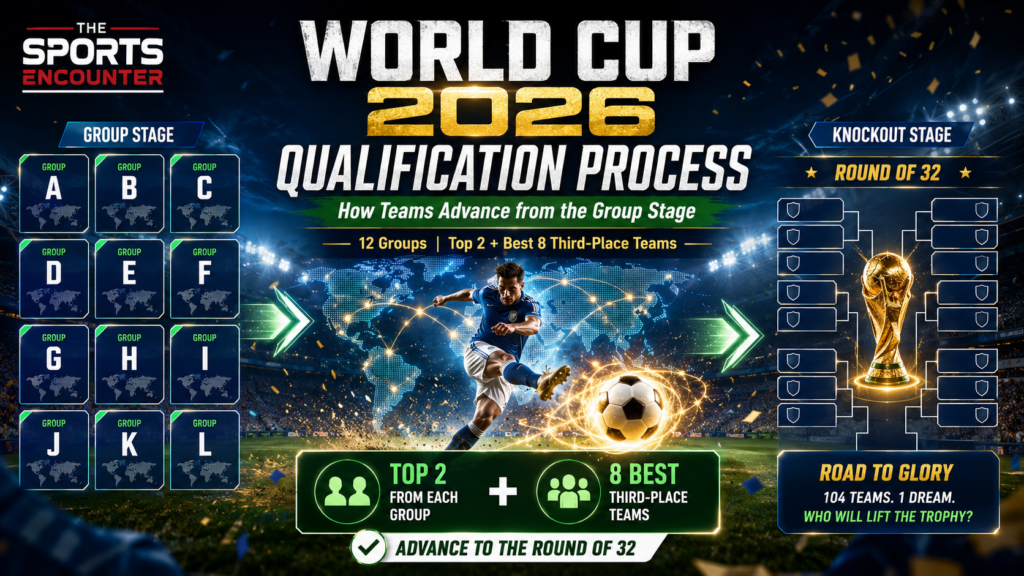
The 2026 edition has 48 teams, 12 groups, a new Round of 32, and a qualification system that keeps more countries alive for longer. That makes the tournament bigger and more dramatic, but it also makes the tables harder to read.
A team sitting third after two matches may still have a real path. A team sitting second may still feel nervous. One late goal in another group can change the mood halfway across the tournament.
For fans following the current group tables, fixtures and match reports, The Sports Encounter’s FIFA World Cup 2026 Hub is the best place to stay locked in.
The Basic FIFA World Cup 2026 Format
The FIFA World Cup 2026 features 48 teams.
Those teams are divided into 12 groups of four, labeled Group A through Group L. Each team plays three group-stage matches. That means every team faces the other three teams in its group once.
The group stage produces 72 matches.
After those matches, 32 teams move into the knockout rounds. That is the major difference from the old 32-team World Cup, which moved straight from the group stage to the Round of 16.
In 2026, there is an extra knockout round.
That new stage is the Round of 32.
How Many Teams Qualify from Each Group?
Two teams qualify automatically from each group.
That means the first-place team and second-place team in every group advance directly to the Round of 32.
With 12 groups, that creates 24 automatic qualifiers.
The remaining eight places go to the best third-place teams across the full tournament.
The complete group-stage qualification picture
- 12 group winners qualify
- 12 group runners-up qualify
- 8 best third-place teams qualify
- 16 teams are eliminated after the group stage
That final point matters.
In the old format, half the tournament field usually went home after the group stage. In 2026, two-thirds of the field moves on.
That changes everything.
Why Third Place Matters So Much in 2026
The third-place race is the biggest tactical twist of the expanded World Cup.
A team can finish third in its group and still qualify for the knockout rounds. But there is a catch. Only eight of the 12 third-place teams advance.
That means third-place teams are compared across different groups.
A third-place team in Group C may be competing against third-place teams from Group F, Group H, Group K and every other section. That creates a parallel table running underneath the group tables.
For coaches, that changes match management.
A 1-0 defeat may still leave a team alive. A 4-0 defeat can destroy a third-place route. A late goal scored in stoppage time may become the difference between going home and reaching the Round of 32.
This is why the final minutes of group-stage matches now carry even more weight.
Teams are no longer playing only for wins and draws. They are also playing for goal difference, goals scored, discipline records and survival margins.
For a current example of how one day can reshape the tournament mood, read The Sports Encounter’s five biggest highlights from FIFA World Cup 2026 Day 10.
How Group Standings Are Ranked
The group table starts with points.
A team earns three points for a win, one point for a draw and zero points for a defeat.
The team with the most points finishes highest in the group. If two or more teams finish level on points, FIFA uses tie-breakers to separate them.
That is where the tournament becomes more detailed.
Goal difference comes first. Goals scored come next. Then FIFA moves deeper into head-to-head results and disciplinary records if teams are still level.
That means every goal matters.
A team winning 3-0 does more than collect three points. It builds a cushion. A team losing 2-1 instead of 4-1 may still protect its third-place hopes. A team taking careless yellow cards may risk losing a tie-breaker later.
The standings are no longer just about the result.
They are about the shape of the result.
FIFA World Cup 2026 Group-Stage Tie-Breakers
When teams finish level on points, FIFA separates them through a structured tie-breaker system.
The key tie-breakers are:
- Goal difference in all group matches
- Goals scored in all group matches
- Points in matches between tied teams
- Goal difference in matches between tied teams
- Goals scored in matches between tied teams
- Fair-play points based on disciplinary records
- Drawing of lots if teams still cannot be separated
Fair-play points can become uncomfortable for teams that collect unnecessary cards.
A yellow card, second yellow, straight red or bench-related disciplinary issue can matter if teams are locked together on points, goal difference and goals scored.
That sounds extreme, but tournament football often lives in extreme margins.
One reckless tackle after a lost ball may look meaningless in the moment. A few days later, it can damage a team’s position in the table.
How the Eight Best Third-Place Teams Are Chosen
The eight best third-place teams are ranked separately across all 12 groups.
They are judged using similar tournament criteria: points, goal difference, goals scored, fair-play record and final drawing of lots if needed.
The most important target for any third-place team is usually four points.
Four points will often be enough to advance. Three points can be enough, but only if the team has a strong goal difference or if several other third-place teams perform worse. Two points may leave a team depending heavily on other results.
That is where the emotional chaos begins.
A team can finish its group, think it has done enough, and still wait for matches in other groups. Players may sit in hotels watching another country’s result decide their fate.
This is one of the strange beauties of the 48-team format.
The tournament keeps more teams alive, but it also makes some teams wait.
For more on the pressure surrounding the latest group-stage matches, read The Sports Encounter’s Day 11 FIFA World Cup 2026 preview.
Why Goal Difference Has Become a Tournament Weapon
Goal difference may become one of the most decisive details of World Cup 2026.
Because eight third-place teams qualify, goal difference will likely separate teams that finish with the same number of points.
That gives favorites a reason to keep attacking after taking control. It gives underdogs a reason to defend properly even when losing. It also gives coaches difficult decisions late in matches.
The late-game questions now matter more
Should a team chase an equalizer and risk conceding again?
Should a team protect a narrow defeat because goal difference may matter?
Should a favorite push for a fourth goal against a weaker opponent because group position and knockout seeding could depend on it?
These questions sit at the heart of the new format.
World Cup football has always rewarded match winners. In 2026, it may also reward teams that manage damage better than others.
Curaçao’s brave draw showed exactly why the best-third-place race can keep smaller nations alive, a theme explored in our report on Curaçao making World Cup history against Ecuador.
What Happens After the Group Stage?
Once 32 teams qualify, the knockout stage begins.
The Round of 32 is the first elimination round. From that point onward, there are no group tables, no second chances and no waiting for other results.
Win, and move on.
Lose, and go home.
The knockout path
- Round of 32
- Round of 16
- Quarterfinals
- Semifinals
- Third-place match
- Final
This extra knockout round adds another layer of difficulty for title contenders. The champion must survive one more elimination match than in the old format.
That means squad depth, injury management, travel recovery and yellow-card discipline all become even more important.
A team that dominates its group still needs to handle the Round of 32 before it can even reach the stage that used to begin the knockout phase.
Why Winning the Group Still Matters
Because third-place teams can qualify, some fans may think group position matters less.
It does not.
Winning the group still gives a team the cleanest route into the knockouts. Group winners generally receive more favorable matchups than runners-up or third-place qualifiers.
Finishing first also helps with psychology.
A group winner moves forward with authority. A runner-up may still feel comfortable. A third-place qualifier may arrive in the knockouts carrying relief, fatigue and pressure.
That difference matters in tournament football.
The best teams do not want to stumble into the next round. They want control, rhythm and a clear sense that their campaign is building.
That is why teams such as Germany, France, Argentina, England and the United States are not only chasing qualification. They are chasing position.
Why the New Format Helps Underdogs
The expanded tournament gives underdogs a longer runway.
In the old format, one defeat could leave a smaller team almost finished. In 2026, a country can lose one match, recover with a draw, win the final game and still move through. Even three points may be enough if goal difference holds.
That gives smaller nations more tactical options.
They can target one match as the must-win game. They can defend for a point against a favorite. They can treat a narrow defeat as a survival result rather than a total failure.
This has already made the tournament feel different.
Cape Verde’s resistance against Spain, Curaçao’s historic point against Ecuador and several tight group battles have shown why the expanded format can create powerful football stories. Bigger tournaments can create uneven games, yes, but they also open doors for nations that rarely get this stage.
That trade-off will remain part of the debate.
But from a storytelling point of view, the new format gives fans more lives to follow.
Why the New Format Creates More Confusion
The same system that helps underdogs also makes the tournament harder to track.
In a 32-team World Cup, the group equation was simple: top two go through, bottom two go home.
In 2026, fans need to track group winners, group runners-up, third-place teams, goal difference across groups, goals scored across groups, fair-play records and knockout bracket placement.
That is more complicated.
Some fans will love the added drama. Others will miss the clean old structure.
Both reactions make sense.
The 2026 format creates a bigger football festival, but it asks more from the audience. Casual fans may need explainers. Serious fans will spend more time checking tables, third-place rankings and potential Round of 32 matchups.
For publishers, this creates an opportunity.
Clear explainers, live tables, daily previews and knockout-path breakdowns will matter more than ever.
What Fans Should Watch During the Final Group Matches
The final group matches will be the real test of this format.
Five things matter most
- Which teams have already qualified
- Which teams need a win
- Which third-place teams have three or four points
- Which teams are protecting goal difference
- Which teams are at risk through fair-play records
The most dramatic situations will come when teams know a draw may be enough, but a win could change their opponent in the Round of 32.
That creates a tactical puzzle.
Do you gamble for first place?
Do you protect qualification?
Do you rest players?
Do you chase goals to improve goal difference?
Those decisions will define the final week of the group stage.
And because the last group fixtures are played at the same time within each group, coaches cannot fully rely on information from the other match in their section. They must make decisions in real time, often with incomplete information.
That is tournament football at its best and most stressful.
Tournament margins have always shaped World Cup history, as seen in our feature on how Zidane’s injury helped derail France’s 2002 World Cup defense.
The Human Side of the Qualification Race
The qualification process is not just math.
It is pressure.
A young defender trying to avoid a second yellow. A goalkeeper protecting goal difference while his team trails. A coach deciding whether to send on another forward. A fan refreshing third-place standings from another city. A squad watching late-night matches to see if its tournament continues.
The 2026 format stretches that emotional tension across more teams.
For the giants, qualification is expected. Anything less feels like failure.
For debutants and underdogs, one draw can become history. One goal can change how a country remembers a tournament.
That is why the qualification process inside the main World Cup matters so much. It is not only a route to the knockouts. It is the place where a tournament begins to create its identity.
Final Word
The FIFA World Cup 2026 group-stage qualification process is bigger, messier and more forgiving than the old format.
Forty-eight teams enter the tournament. Thirty-two survive the group stage. The top two from each of the 12 groups advance automatically, and the eight best third-place teams complete the Round of 32.
That gives more teams hope.
It also makes every goal, every card and every late substitution more important.
The old World Cup format had clean edges. The new one has more moving parts. But those moving parts are exactly what make FIFA World Cup 2026 feel different.
This tournament does not only ask who can win.
It asks who can survive the table, manage the margins and stay alive long enough for the knockout rounds to begin.
The Sports Encounter’s FIFA World Cup 2026 coverage focuses on match reports, tactical analysis, group-stage movement, player stories, daily previews, knockout scenarios and the moments that define football’s biggest tournament.
Internal Backlink to Add After Publishing
After publishing this article, add one backlink from an older related article such as the Day 11 preview or Day 10 highlights article using this anchor:
For readers still trying to understand the expanded tournament structure, our guide explains how teams qualify from the FIFA World Cup 2026 group stage.