


Paris, France – June 9, 2026: There are days at Roland Garros when tennis feels like a sport. Then there are days when it feels like confession. The 2026 French Open finals gave me both.
I watched Mirra Andreeva win her first Grand Slam title on Saturday with the stillness of someone much older than 19. I watched Alexander Zverev win his first major on Sunday with the exhaustion of someone who had been carrying the same question for years.
Two finals. Two first-time champions. Two completely different kinds of release.
Paris does this better than any city in tennis. The clay slows the ball, but it also slows the truth. You see the work. You see the doubt. You see the little hesitation before courage arrives.
By the end of the weekend, Court Philippe-Chatrier had not just crowned champions. It had exposed what they had to overcome to become champions.
Saturday Felt Like Watching a Girl Grow Up in Public
The women’s final between Mirra Andreeva and Maja Chwalińska began with a strange emotional balance.
On one side stood Andreeva, the prodigy everyone had been waiting for, a player with touch, timing, imagination, and that rare ability to make a tennis court feel wider than it is.
On the other side stood Chwalińska, the qualifier who had made a run so unlikely that it carried its own magic. You could feel how much the crowd wanted to believe in the story. Paris respects talent, but it has always had a soft spot for survival.
At first, I watched Andreeva’s face more than her racket.
That is what I do at finals. Everyone watches the ball. I watch the eyes.
Her eyes were calm.
Not empty. Not cold. Calm.
There was pressure in the air, of course. You could feel it before the first ball. A Grand Slam final does not need noise to feel heavy. Sometimes the pressure arrives in the quiet moments, when the ball kids are still, the towels are folded, and thousands of people wait for one teenager to prove she is ready.
Andreeva was ready.
She moved through the first set as if she had made a private agreement with herself. She did not need to hit every ball harder. She did not need to perform greatness. She simply trusted her patterns, opened the court, and refused to let the match become bigger than her.
That impressed me more than the score.
Young players often rush into history. Andreeva walked into it.
The Moment Andreeva Took the French Open Final Away
For me, the key moment of the women’s final was not one dramatic winner. It was the stretch when Chwalińska needed the match to become messy, and Andreeva refused to give her that gift.
That is where finals are often stolen.
A nervous service game. A double fault. A loose forehand. A crowd shift. Suddenly, a match that looked clear becomes dangerous.
Andreeva never allowed that emotional leak.
She stayed present. She accepted the small errors. She returned to the next point with the same face, the same rhythm, the same quiet refusal to panic.

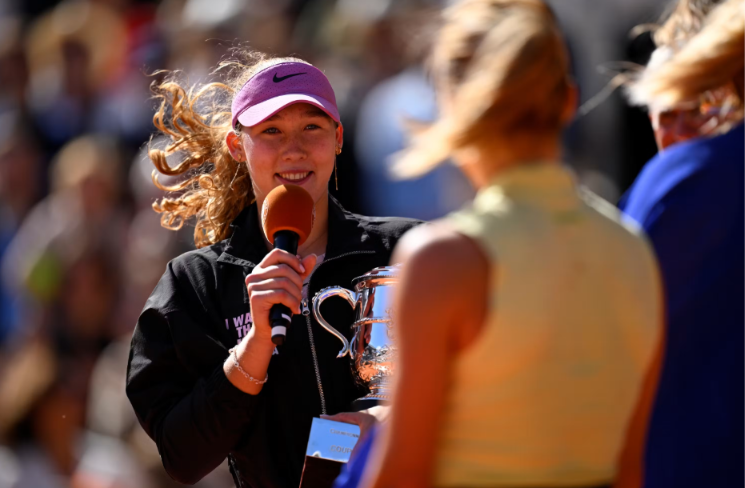
I remember thinking: this is not just a young player having a great tournament. This is a young player learning how to hold a room.
That matters at Roland Garros.
Chatrier is not only a tennis court. It is a public examination. The red clay does not let you hide. Every slide, every miss, every frustrated glance feels visible. Andreeva handled that exposure with unusual maturity.
When she closed the match 6-3, 6-2, the moment felt clean but not simple.
She smiled like a teenager. She won like a professional. Then she spoke like someone who understood that belief had been the real opponent all along.
When she thanked herself for believing in herself, I did not hear arrogance.
I heard relief.
I heard a young woman saying, maybe for the first time on the biggest stage, that she had not abandoned herself when the pressure arrived.
That stayed with me.
Sunday Was Heavier Before the First Ball
The men’s final felt different from the beginning.
Alexander Zverev versus Flavio Cobolli had a louder emotional weight. Cobolli brought youth, fire, and the wonderful danger of a player with nothing to lose. Zverev brought the past.
You could feel it.
This was not just another final for him. It was the fourth Grand Slam final of his career. It was Roland Garros, where he had already suffered so much. It was the same tournament where his ankle injury in 2022 became one of the most painful images modern tennis has seen.
I do not think athletes carry memories in a poetic way. I think they carry them physically.
In the shoulders. In the serve toss. In the first step after a missed chance. In the breath before a second serve.
Zverev looked strong early. He took the first set 6-1 and seemed to have control of the match. But tennis rarely gives first Grand Slam titles in a straight line. Cobolli began to fight his way into the final, and the Italian energy around Chatrier started to grow.
By the second set, the match had changed.
Cobolli was no longer just participating in Zverev’s story. He was trying to write his own.
Cobolli Made the Crowd Believe
I loved Cobolli’s resistance.
Not because I wanted Zverev to suffer, but because finals need friction. They need someone to push the favorite into the part of himself he would rather avoid.
Cobolli did that.
He played with nerve, especially after the first set threatened to run away from him. He found depth, emotion, and courage. He made Zverev hit more balls. He made the crowd louder. He made the final breathe.
When Cobolli took the fourth-set tiebreak, Chatrier felt electric.
That was the moment I felt the whole match tilt toward memory.
For Zverev, the danger was obvious. Another final. Another fifth set. Another possible chapter in the long story of almost.
I looked at him after the fourth set and wondered what he was hearing inside his own head.
That is the cruelty of tennis. No coach can walk onto the court and rescue you. No teammate can cover your weakness for five minutes. You are alone with the score, the crowd, the opponent, and whatever ghosts you brought with you.
Zverev brought many.
Then, somehow, he put them down.
The Fifth Set Felt Like a Man Escaping Himself
The final set was the emotional center of the weekend for me.
Zverev had been cramping. He had been stretched physically and mentally. The match had every ingredient for collapse. But instead of shrinking, he loosened.

That is what it looked like from the stands.
His shots became clearer. His decisions came faster. His serve had more authority. Cobolli, so brave for so long, suddenly looked like the man trying to keep up with someone who had found the exit from a locked room.
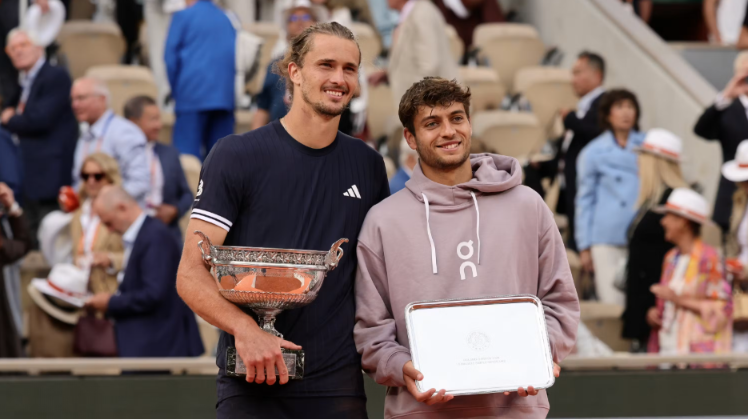
Zverev won the fifth set 6-1.
That number looks cold on paper. It did not feel cold in the stadium.
It felt like release.
When championship point ended, I watched Zverev carefully. There was joy, of course, but there was also disbelief. First Grand Slam titles often bring celebration. This one brought a kind of emotional silence before the celebration arrived.
That is what years of waiting can do.
You do not always explode immediately. Sometimes you need a second to understand that the thing chasing you has stopped.
Roland Garros Gave Zverev Proof
Zverev’s win mattered because it changed the sentence attached to his name.
Before Sunday, he was the great player still waiting for a major. After Sunday, he became a Grand Slam champion.
That change is not cosmetic. In tennis, it alters how a player is remembered, discussed, and judged. It also changes how he walks into the next pressure match.
Watching him lift the trophy, I thought about how unfair and beautiful sport can be.
For years, Zverev had lived with the question. Could he finish? Could he win the one that mattered most? Could he take the final step?
Paris answered him.
Not gently. Not easily. But completely.
French Open 2026: Two Champions, Two Different Lessons
What moved me most about the weekend was how different the two champions felt.
Andreeva’s victory was about protecting clarity before the world could take it from her.
Zverev’s victory was about finding clarity after the world had been questioning him for years.
One champion played like the future had arrived early. The other played like the past had finally loosened its grip.
Both stories felt deeply human.
That is why I love covering tennis in France. Roland Garros does not reward only power. It rewards patience, problem-solving, endurance, and emotional honesty. The clay asks questions that hard courts sometimes skip. It demands one more shot, one more adjustment, one more honest look at yourself.
Andreeva answered with calm.
Zverev answered with survival.
What I Will Remember
I will remember Andreeva’s face after match point, that mixture of disbelief and certainty that only young champions seem to carry.
I will remember Chwalińska walking away from a final she lost but did not fail.
I will remember Cobolli forcing a fifth set and making thousands of people believe that his dream still had room.
I will remember Zverev in the final set, no longer playing against all the finals he had lost, but playing toward the one he was finally about to win.
Most of all, I will remember the sound of Paris when each champion crossed the line.
For Andreeva, it sounded like discovery.
For Zverev, it sounded like release.
That is the beauty of Grand Slam tennis. Sometimes the trophy is not only a prize. Sometimes it is an answer.
At Roland Garros this year, Mirra Andreeva and Alexander Zverev did more than win.
They became easier to understand.