Breaking News
Alexander Zverev Beats Flavio Cobolli, Agony to Lift Maiden French Open Title

Paris, France – June 7, 2026: While some titles are won in two weeks, Alexander Zverev took years of frustration, injury, pressure, criticism, and painful near-misses to finally clinch the French Open 2026 title here at Roland Garros on Sunday.
An exclusive story by Jovana Zlatova.
The demons of failure seemed to follow him from one Grand Slam season to another over the years. However, Zverev was in no mood to let his fate decided by years of agony anymore.
When Alexander Zverev defeated Flavio Cobolli 6-1, 4-6, 6-4, 6-7(5), 6-1 in the Roland-Garros final, the scoreline told only part of the story. Yes, it was a five-set final. It gave him his first Grand Slam title. Yes, it made him Germany’s first men’s Grand Slam singles champion since Boris Becker won the Australian Open in 1996.
But the deeper story was about a player who had carried one of the heaviest labels in modern tennis: the best player not to win a major.
That label can sound harmless from the outside. In reality, it follows a player into every press conference, every tight set, every missed break point, and every late-stage Grand Slam match. It turns talent into a question, consistency into an accusation, and tells a player that everything he has done still has one missing line.
At the French Open 2026, Zverev finally erased that line.
The Impossible Weight Behind Alexander Zverev French Open 2026 Journey
Alexander Zverev did not arrive in Paris as a romantic underdog.
He was the No. 2 seed, ranked among the world’s best, and already the owner of a decorated career. He had won Olympic gold, lifted ATP Finals titles, reached major finals, and spent years as a permanent presence near the top of the game.
That is exactly why the pressure was so brutal.
Alexander Zverev’s title run was not built on one perfect match. It was built round by round, with enough control, pressure management, and late-tournament resilience to finally turn years of Grand Slam pain into a career-defining victory.
Alexander Zverev’s Road to French Open 2026 Glory
| Round | Opponent | Result | Score | Key takeaway |
|---|---|---|---|---|
| Round 1 | Benjamin Bonzi | Won | 6-3, 6-4, 6-2 | Clean opening win with no early drama |
| Round 2 | Tomas Machac | Won | 6-4, 6-2, 6-2 | Raised his level and controlled the match from the baseline |
| Round 3 | Quentin Halys | Won | 6-4, 6-3, 5-7, 6-2 | First dropped set, but recovered quickly |
| Round 4 | Jesper De Jong | Won | 7-6(7-3), 6-4, 6-1 | Managed pressure in the first set, then took full control |
| Quarterfinal | Rafael Jodar | Won | 7-6(7-3), 6-1, 6-3 | Survived a tight opener before dominating |
| Semifinal | Jakub Mensik | Won | 7-5, 6-2, 3-6, 6-3 | Dropped the third set but answered like a champion |
| Final | Flavio Cobolli | Won | 6-1, 4-6, 6-4, 6-7(5), 6-1 | Won his first Grand Slam after a five-set test |
For some players, reaching the second week of a major feels like success. For Zverev, anything short of the trophy had started to feel incomplete. He had already lost three Grand Slam finals before Roland-Garros 2026. He had also suffered one of the most painful injuries of his career on the same Paris clay in 2022, when an ankle injury forced him out during a semifinal battle with Rafael Nadal.
That moment became part of his tennis identity.
Paris had given him pain before it gave him peace.
Every return to Roland-Garros carried the memory of what had gone wrong. The physical recovery was only one part of it. The harder part was walking back onto the same stage and telling himself that the court did not own the final word.
That is what makes Alexander Zverev French Open 2026 story powerful. He did not simply win a tournament. He reclaimed a place that had once broken him.
Zverev’s Route to the Roland-Garros Title
Zverev’s title run was built on patience, control, and survival.
His path included wins over Benjamin Bonzi, Tomas Machac, Quentin Halys, Jesper De Jong, Rafael Jodar, Jakub Mensik, and then Cobolli in the final. On paper, some will argue the draw opened up after major contenders fell earlier than expected. That is how tennis works. Every champion needs opportunity. The great ones know what to do with it.
Zverev did not apologize for the draw. He handled it.
That is often the hardest part.
When the field opens, pressure does not disappear. It increases. Suddenly, a player is expected to win. Every match becomes a trap, every opponent plays with freedom, every missed chance begins to sound like the start of another familiar collapse.
Zverev’s greatest victory in Paris was not only technical. It was emotional. He had to keep his level stable while everyone around him waited to see whether the old story would return.
Against Jakub Mensik in the semifinal, he dropped the third set but recovered to close the match in four. That mattered. Grand Slam champions rarely avoid difficult moments. They identify them early, manage them, and prevent a bad spell from becoming a bad day.
Then came Cobolli.
The Final Against Flavio Cobolli Tested Everything
The French Open 2026 final could have been simple after the first set.
Zverev raced through the opener 6-1 and looked ready to turn the final into a statement. His serve was sharp, his baseline control looked heavy, and Cobolli seemed overwhelmed by the occasion.
Then the match changed.

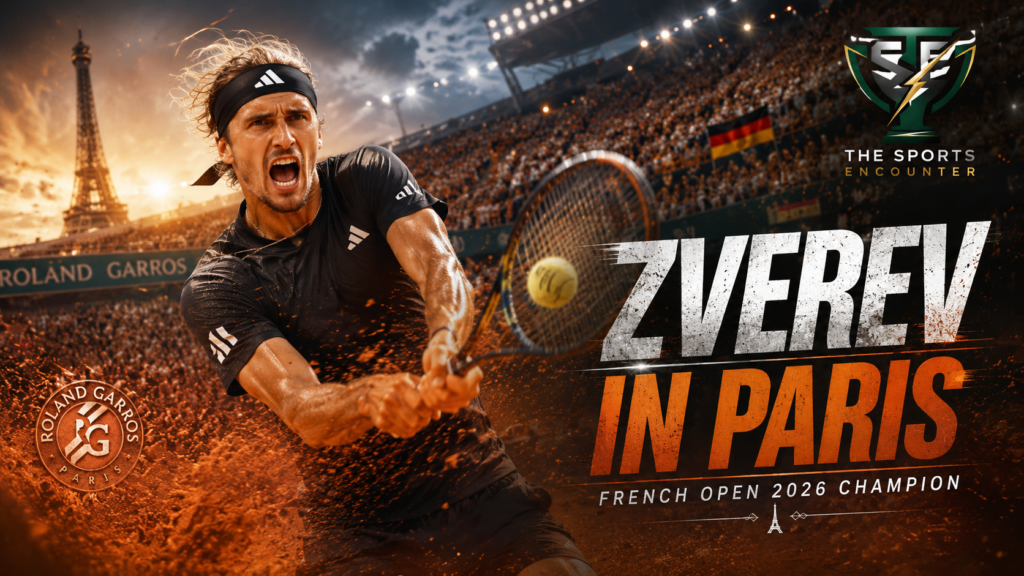
Cobolli fought back, took the second set 6-4, and reminded Zverev that Grand Slam finals never hand out gifts. Zverev regained control in the third, but the Italian pushed again in the fourth and won the tiebreak. Suddenly, the match had become dangerous.
For Zverev, this was the mental trap.
He had been here before. Close to the trophy. Close to the release. Almost there to feel the old fear crawling back in.
The fifth set showed why this version of Zverev was different.
He did not fade, did not rush, did not let the fourth-set disappointment define the final. He reset, trusted his serve, controlled the longer rallies, and took the decider 6-1.
That was not just a set of tennis.
That was a statement of emotional maturity.
Why Alexander Zverev French Open 2026 Title Inspires Fans
Fans often talk about champions as if they are born with certainty.
Zverev’s journey proves something more honest.
Great careers are rarely clean. They include injuries, criticism, bad timing, public pressure, tactical flaws, physical setbacks, and matches that stay in the memory for the wrong reasons. For years, Zverev’s career looked full of everything except the one thing that mattered most.
Then he kept going.
That is the part tennis fans should remember.
Alexander did not quit after major final defeats. He did not disappear after the 2022 ankle injury. The German did not allow the “best without a Slam” label to become a permanent identity. He went back to work, came back to Paris, and kept putting himself in the same high-pressure places where he had been hurt before.
That is courage.
Not the loud kind. The quiet kind. The kind that shows up in training when nobody is clapping. The kind that returns to the same court with the same ghosts and refuses to blink first.
The German Tennis Significance
Zverev’s win also mattered beyond one player.
German men’s tennis had waited decades for another Grand Slam singles champion after Boris Becker. Becker’s shadow still stretches across German tennis because he won early, won boldly, and became a global figure. For every German player after him, the comparison was impossible to avoid.
Zverev had long carried that national expectation.
Now he has his own line in history.
He did not win the French Open by copying Becker. He won it in his own way, through baseline endurance, serving power, clay-court patience, and years of slow emotional construction.
That matters for the next generation of German tennis players. They now have a modern champion who shows that greatness does not always arrive early, clean, or perfectly timed. Sometimes it arrives after the world has already started doubting whether it will ever come.
Paris Finally Gave Zverev His Answer
Alexander Zverev French Open 2026 victory was not perfect because his career has never been perfect.
That is why it worked.
He had to lose before he won; had to break before he rebuilt. He had to hear the same question for years before he finally answered it on the biggest clay court in the world.
For young tennis players, this is the lesson. Talent opens doors, but persistence keeps you in the building long enough to find the right room. Zverev had the game for years. What he found in Paris was the final layer: belief under pressure when history is leaning on your shoulders.
The final image was not only a champion lifting a trophy.
It was a man dropping years of emotional weight.
The impossible task became real because Zverev stayed close enough to the dream to suffer for it, and strong enough to return after every failed attempt.
That is what made the 2026 French Open men’s final more than a tennis match.
It was proof that a career can change in one afternoon, but only after years of refusing to walk away.