


Dallas carried the pressure before the result arrived.
Portugal had Cristiano Ronaldo, knockout history, and one more chance to stretch a World Cup story that has followed football for two decades. Spain had control, rhythm, and the growing feeling that this team had finally found the edge its possession game had missed in past knockout failures.
Then the match reached stoppage time.
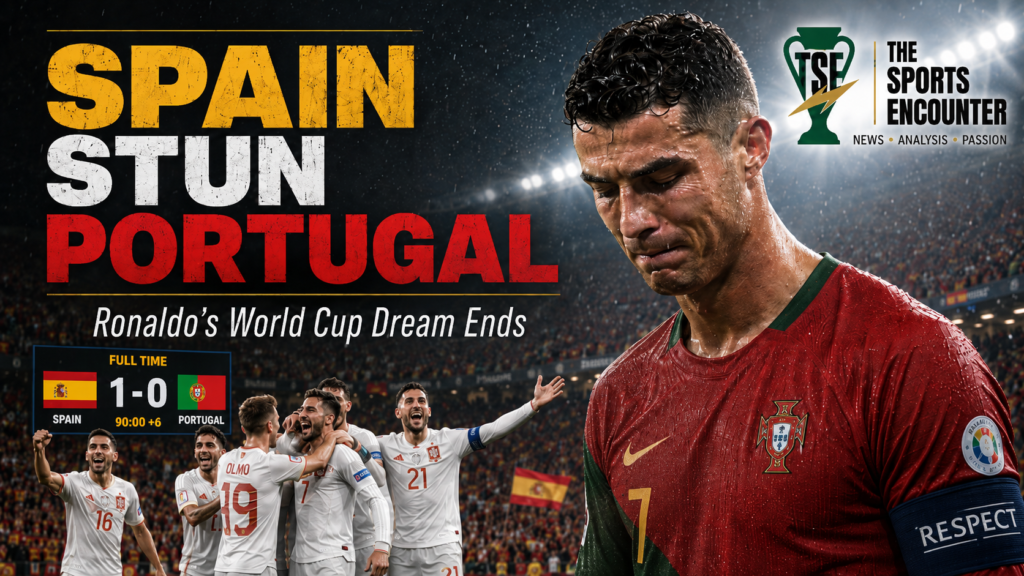
Mikel Merino broke Portugal in the 91st minute, finishing a quick Spain move that caught Roberto Martínez’s side half-asleep and sent La Roja into the FIFA World Cup 2026 quarterfinals with a 1-0 win. For Portugal, the defeat felt heavier than the scoreline. For Ronaldo, it felt like the end of a World Cup journey that refused to offer him one final rescue act.
Post-match footage from the ground added the emotional image that will stay with Portuguese fans. Ronaldo was spotted crying after the final whistle, visibly overwhelmed as Portugal’s World Cup ended and Spain’s players celebrated nearby.
Spain will now move on to face the winner of USA vs Belgium in the quarterfinals. Portugal leave with regret, few clear chances, and a difficult question around whether they built too much of their tournament around an icon whose influence no longer matched the weight of the moment.
For full tournament context, follow The Sports Encounter’s FIFA World Cup 2026 coverage, including Spain’s earlier rise in Spain finally finding their knockout edge against Austria and Portugal’s tense escape in the VAR-heavy win over Croatia.
TL;DR
- Spain beat Portugal 1-0 in the FIFA World Cup 2026 Round of 16.
- Mikel Merino scored the decisive goal in stoppage time.
- Spain controlled longer spells, created better attacking patterns, and looked more balanced.
- Portugal struggled to create enough clear chances despite Ronaldo starting.
- Cristiano Ronaldo’s disappointing World Cup ended with frustration, tears, and elimination.
- Portugal received two yellow cards, Spain received one, and no red cards were reported.
Match Key Information
| Detail | Information |
|---|---|
| Match | Portugal vs Spain |
| Result | Spain beat Portugal 1-0 |
| Competition | FIFA World Cup 2026, Round of 16 |
| Venue | Dallas Stadium, Dallas |
| Date | July 6, 2026 |
| Top Performer | Mikel Merino, decisive stoppage-time goal |
| Turning Point | Merino’s 91st-minute finish after Spain caught Portugal cold |
| What It Means | Spain advanced to the quarterfinals, Portugal were eliminated |
| Red Cards | None reported |
| Yellow Cards | Portugal: Bernardo Silva, Nélson Semedo. Spain: Ferran Torres |
Spain Waited, Controlled, and Then Struck
Spain did not win this match through chaos. They won it through control, patience, and one sharp moment when Portugal switched off.
Luis de la Fuente’s side looked more comfortable in possession for long stretches. Spain moved the ball with better structure, found cleaner passing lanes, and kept Portugal chasing across midfield. Rodri gave the team its base. Pedri and Dani Olmo helped Spain connect the game between the lines. Lamine Yamal kept asking questions on the right, even when Portugal tried to slow him with numbers and contact.
The goal came because Spain stayed awake when Portugal did not.
Rodri drew the foul around 40 yards from goal. Instead of allowing Portugal to reset, Spain took the free kick quickly. Ferran Torres slipped the ball into the channel, Merino timed his run, and the finish was calm enough for a moment that carried huge pressure. Diogo Costa had little time to adjust. Portugal’s defense had even less time to recover.
That was the difference between the two teams. Spain did not create a flood of chances, but they knew how to punish one lapse. Portugal waited for a moment that never properly came.
Portugal Had Names, but Spain Had the Shape
Portugal’s team sheet still looked powerful.
Ronaldo, Bruno Fernandes, João Félix, Pedro Neto, Vitinha, João Neves, Nuno Mendes, João Cancelo, and Rúben Dias gave Portugal enough quality to trouble any opponent. Yet the balance never fully worked against Spain. Too many attacks slowed before the final pass. Too many wide moves ended with hopeful service. Ronaldo’s presence still pulled attention, but Portugal rarely created the kind of clean penalty-box situations he needed.
The first half gave Portugal their best moments.
Ronaldo forced Unai Simón into a save with an improvised hooked effort after João Félix headed the ball across goal. Nuno Mendes also came close when his strike took a deflection and hit the crossbar. Those moments gave Portugal hope, but they did not become sustained pressure.
Spain’s goalkeeper had work to do, but he was never under siege.
Portugal’s deeper problem was rhythm. Their midfield had technical players, yet Spain’s structure made them uncomfortable. Bruno Fernandes tried to force the issue, but Spain limited the spaces where he usually hurts opponents. Vitinha offered control in patches, while Portugal still failed to turn possession into repeatable danger.
That made the final half-hour feel tense for Portugal rather than threatening for Spain.
Ronaldo’s World Cup Ends in Tears
This was a disappointing World Cup for Cristiano Ronaldo.
That sentence feels harsh because his career has earned more respect than most footballers can imagine. Yet knockout football rarely cares about reputation. Against Spain, Ronaldo looked frustrated, isolated, and increasingly dependent on service that Portugal could not provide.
There were flashes. His movement still created concern. His instincts inside the area still forced Spain to stay alert. Late in the match, he nearly pressured Unai Simón after a weak header back from Aymeric Laporte, but the flag went up and Spain survived the danger.
Those small moments were not enough.
Ronaldo could not drag Portugal into the quarterfinals. He could not turn a tight match into his match. By stoppage time, when Spain scored, the image became painfully familiar: Portugal looking for inspiration, Ronaldo demanding more, and the game slipping away anyway.
After the final whistle, the emotion finally came out. Ronaldo was spotted crying on the ground in the post-match footage, a painful scene for Portugal supporters and for neutral fans who have watched him carry World Cup hopes across six tournaments.
This was likely his last World Cup match. If that proves true, the exit will hurt because it came with so little attacking clarity around him. Portugal did not lose because Ronaldo alone failed. They lost because the team around him never built enough pressure, speed, or variety to make Spain panic.
For readers following Ronaldo’s full tournament arc, this result connects directly with Portugal’s earlier warning signs against DR Congo, when questions around Ronaldo dependence had already started to grow louder.
Spain Look Like a Team Growing Into the Tournament
Spain’s win over Austria in the Round of 32 suggested that La Roja had found a sharper edge. This win over Portugal confirmed something more important.
Spain can now win a tense knockout match without needing to play beautifully for 90 minutes.
That matters. World Cups rarely reward perfect football from start to finish. They reward teams that can manage pressure, survive flat spells, and finish when the door opens. Spain did that in Dallas.
Their dominance was controlled rather than spectacular. They did not tear Portugal apart, but they kept enough authority to stop the match becoming a Ronaldo rescue story. Spain defended transitions well, trusted their passing structure, and used substitutions with purpose. Ferran Torres’ involvement in the winner was especially important because it showed Spain’s bench could change the rhythm when the starting attack began to lose sharpness.
Merino’s goal will get the headline, and rightly so. The wider story is Spain’s maturity.
La Roja came into this tournament carrying old knockout scars. After 2010, too many World Cup exits came with the same pattern: possession, frustration, penalties, regret. This Spain side looks more direct, more flexible, and more willing to win ugly when required.
That makes them dangerous.
Cards and Discipline
The match did not turn into a card-heavy Iberian war, but the final minutes brought the expected tension.
Bernardo Silva received Portugal’s first yellow card in the 89th minute after cutting across Merino. Nélson Semedo was booked in stoppage time after clipping Lamine Yamal during a Spain break. Ferran Torres also received a late yellow card for Spain after a reckless challenge on Francisco Conceição.
No red cards were reported.
That discipline record matters because Spain move into the quarterfinals with momentum and without the immediate damage of a sending-off. Portugal, meanwhile, lost their composure late as the match moved away from them.
For official tournament information, fixtures, and competition updates, readers can also follow FIFA’s World Cup 2026 coverage.
What This Result Means for Portugal
Portugal’s tournament ends with a frustrating truth.
They had enough talent to go deeper. They had enough experience to manage knockout tension. Their squad offered options from the bench. Yet against Spain, they looked less like a complete team and more like a side waiting for individual quality to rescue a broken attacking rhythm.
Martínez will face questions.
Should Rafael Leão have played earlier? Should Gonçalo Ramos have had a bigger role after his late impact against Croatia? Did Portugal give Ronaldo too much structural weight at this stage of his career? Those questions will follow the team because the defeat was narrow, while the attacking performance was not convincing.
Portugal went out in a quieter, more worrying way: controlled by a better-balanced opponent and punished when concentration dropped.
For a team with Portugal’s names, that is a painful exit.
What This Result Means for Spain
Spain are into the quarterfinals with belief, control, and a cleaner tournament identity.
They beat Austria with authority. They beat Portugal with nerve. Those are different kinds of wins, and serious World Cup contenders usually need both.
Merino’s goal gave Spain the finish. Rodri’s control gave them the platform. Yamal’s threat stretched Portugal even when he did not dominate every minute. Diogo Costa kept Portugal alive for long spells, but Spain were the side with more clarity when the match demanded one final decision.
This was not a perfect Spain performance. It did not need to be.
It was a grown-up knockout win against a rival with enormous emotional weight. That is often more useful than a beautiful group-stage performance.
Spain move forward. Portugal go home. Ronaldo’s final World Cup image may now be one of tears and frustration, but Spain’s image is changing in the other direction: a team that can control, wait, and strike when the tournament tightens.
For a wider look at the knockout bracket and the stories still shaping the tournament, read The Sports Encounter’s Round of 16 preview.
The Sports Encounter’s World Cup 2026 coverage focuses on fixtures, team news, match analysis, fan stories, tournament trends, and the biggest talking points from football’s global stage.