


Portugal arrived with pedigree, star power, and one of the most recognizable players in football history.
DR Congo arrived with belief.
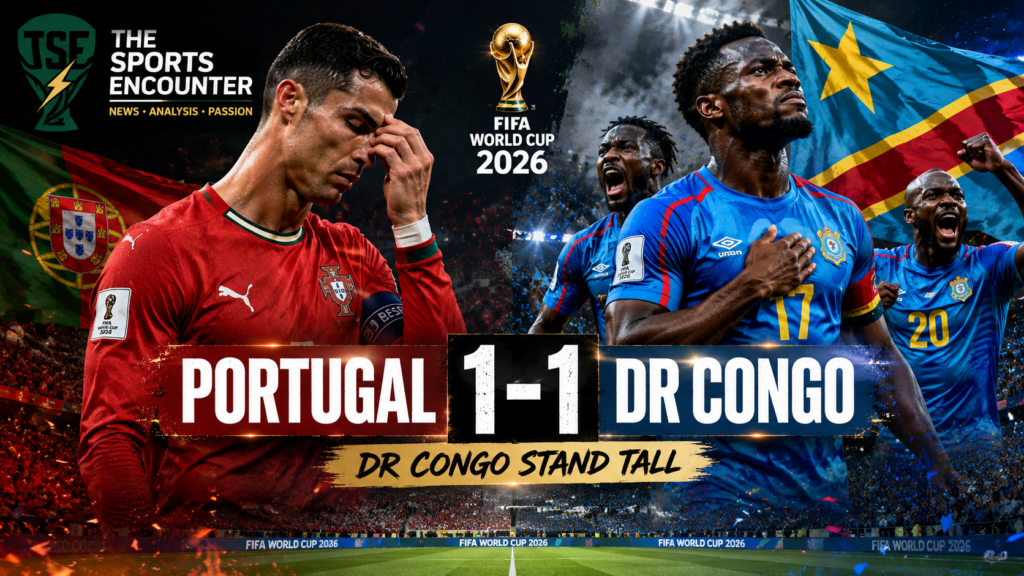
By full time, that belief had turned into one of the most meaningful results of the early FIFA World Cup 2026 group stage. Portugal were held to a 1-1 draw by DR Congo in Group K, and the result said plenty about both teams.
For Portugal, this was a missed chance to open the tournament with control. They scored early, moved the ball with confidence, and looked ready to turn the match into a routine win.
For DR Congo, this was not only a point. It was a statement of identity.
The Leopards refused to shrink under the pressure of facing Portugal and Cristiano Ronaldo on the World Cup stage. They defended with discipline, attacked with purpose, and found a deserved equalizer through Yoane Wissa before halftime.
This was another reminder that the gap between established European names and ambitious African teams is not as comfortable as it once looked.
Match Summary: Early Portugal Lead, Historic DR Congo Reply
Portugal made the perfect start.
João Neves put them ahead in the sixth minute after Pedro Neto delivered a dangerous cross into the box. Neves timed his run well and guided his header into the net, giving Portugal exactly the kind of early goal that should settle a favorite.
At that point, the match looked ready to follow a familiar script. Portugal would dominate the ball, stretch DR Congo across the pitch, and wait for the second goal to arrive.
It never did.
DR Congo absorbed pressure, stayed compact, and slowly grew into the match. They did not panic after conceding early. Instead, they kept their shape and waited for the right moment to hurt Portugal.
That moment came just before halftime.
Arthur Masuaku delivered from a corner, and Yoane Wissa attacked the ball with conviction. His header beat the Portuguese defense and changed the mood of the match completely.
Portugal had started like a favorite. DR Congo went into the break like a team that knew it belonged.
For more early tournament context, read our France vs Senegal World Cup 2026 match report, where Kylian Mbappe’s performance showed how elite sides can still punish African teams when given space.
DR Congo Played With Nerve, Not Fear
The best part of DR Congo’s performance was not only the goal.
It was the attitude.
Many underdogs defend deep, clear the ball, and wait for the final whistle against elite European opposition. DR Congo showed more courage than that. They were organized without becoming passive. They respected Portugal without looking intimidated.
Their defenders stayed tight in central areas, forcing Portugal to look wide and slowing the rhythm around Cristiano Ronaldo. When Portugal tried to overload the box, DR Congo bodies were there. When the ball dropped loose, they fought for second balls.
That structure gave them a platform.
Axel Tuanzebe and Chancel Mbemba provided the kind of defensive authority DR Congo needed. Their reading of crosses, physical duels, and late blocks kept Portugal from turning possession into real punishment.
Goalkeeper Lionel Mpasi also gave the team calmness. He managed pressure well, claimed what he could, and helped DR Congo reset during difficult spells.
The wider story was even more powerful. DR Congo were playing their first World Cup match in more than five decades, and Wissa’s goal carried historic weight. This was a country returning to the biggest stage and refusing to play like a guest.
Wissa’s Equalizer Was More Than a Goal
Yoane Wissa’s header gave DR Congo a result to chase.
It also gave their fans a moment to keep.
The timing mattered. Scoring before halftime meant Portugal could not go into the dressing room with control of the match narrative. The equalizer forced Roberto Martinez’s team to restart emotionally and tactically after the break.
The method also mattered.
DR Congo did not need a lucky deflection or a defensive mistake. They created pressure from a set piece, delivered the ball with quality, and finished with authority. That kind of goal travels well in tournament football because it gives a team something repeatable.
Set pieces can change group-stage math. DR Congo proved they have that tool.
For an African side facing one of Europe’s biggest teams, the goal carried another message. DR Congo were not there to survive. They were there to compete.
That same competitive edge has already shaped several stories in this tournament, including the sibling stories giving FIFA World Cup 2026 a deeper emotional layer.
Were Portugal Too Dependent on Ronaldo?
This match will raise a difficult question for Portugal.
Are they still too emotionally and tactically dependent on Cristiano Ronaldo?
Ronaldo remains a giant figure. His presence changes stadium energy, media focus, defensive attention, and Portugal’s attacking psychology. Even at 41, he still carries a magnetism very few players in football history have ever had.
The problem is that Portugal sometimes seemed to wait for the Ronaldo moment instead of building enough collective threat around him.
Their early goal came from movement, width, and a cross into a dangerous area. After that, Portugal had plenty of possession but did not create enough high-quality chances. The ball moved, but the attack lacked sharp final actions.
Bruno Fernandes tried to influence the tempo. Bernardo Silva and Pedro Neto offered technical control and width. Rafael Leão and Gonçalo Ramos gave Portugal different options from the bench.
Still, the longer the match went on, the more Portugal’s attack looked caught between two ideas.
They wanted to serve Ronaldo.
They also needed to play faster around him.
That balance never fully arrived.
Ronaldo’s presence remains valuable, but Portugal cannot afford to let every tight match become a search for one iconic finish. Tournament football rewards teams that can win through different routes. Against DR Congo, Portugal looked short of those routes.
The issue felt even clearer when compared with Argentina’s sharper use of Lionel Messi in Argentina’s win over Algeria, where the superstar influence translated into clear attacking output rather than hesitation around one focal point.
Portugal Had Control, But Not Enough Danger
The most worrying part for Portugal was the lack of cutting edge.
They had territory. They had the stronger names on paper. They had the early goal. Yet DR Congo were not pulled apart often enough.
That matters because Portugal are not judged only by whether they dominate the ball. They are judged by whether they turn that control into chances, pressure, and goals.
Against DR Congo, the rhythm became too predictable.
Portugal circulated possession but did not consistently break defensive lines. Their crosses became easier to read. Their central combinations slowed down. DR Congo’s defenders were asked to work hard, but they were not constantly dragged into panic.
That is where Portugal must improve before facing Uzbekistan and Colombia.
In a group stage, one draw does not destroy a campaign. It does, however, remove comfort. Portugal now have less margin for error, and the Ronaldo question will only grow louder if their attack remains this dependent on moments rather than patterns.
Another African Team Stands Up to Europe
This result also fits a bigger pattern from the opening stage of the tournament.
African teams are making European opponents uncomfortable.
Cape Verde held Spain to a goalless draw. Egypt drew 1-1 with Belgium. Morocco earned a 1-1 draw against Brazil, a South American giant with European-level quality across the squad. Now DR Congo have held Portugal.
These results do not all tell the same story tactically, but they point toward the same football reality.
African teams are no longer arriving at the World Cup only with athleticism and emotion. They are arriving with structure, experience, and players shaped by major European leagues. They know how to defend space, manage pressure, and punish teams that take too long to finish matches.
DR Congo’s draw with Portugal will feel especially important because of the opponent and the stage. Portugal are not a fading side with one superstar. They have elite talent across midfield, attack, and defense. Holding them required more than passion.
It required a plan.
DR Congo had one.
This wider African resilience also connects with how Jordan, Algeria, and Senegal have been forcing stronger opponents to work harder than expected, as seen in our coverage of Austria’s win over Jordan and France’s battle with Senegal.
Why This Result Matters for Group K
Group K now looks far more open than Portugal wanted.
A win would have allowed Portugal to control the group early and manage the next two fixtures with more flexibility. A draw means every remaining match carries pressure.
Portugal still have the talent to top the group, but they now need sharper performances against Uzbekistan and Colombia. They cannot rely on reputation, Ronaldo’s aura, or late pressure alone.
For DR Congo, the point is huge.
They did not just avoid defeat. They showed they can compete physically, tactically, and emotionally at this level. That gives them real belief before facing Colombia and Uzbekistan.
The draw also changes how opponents will view them. DR Congo will not be treated as a soft fixture. That brings respect, but it also brings new pressure. Their next challenge is to prove this was not a one-night surge.
For fans tracking how the wider tournament picture is developing, our FIFA World Cup 2026 coverage will continue following every major group-stage shift.
Final Word: DR Congo Earned Respect, Portugal Earned Questions
Portugal did not lose, but this felt like a warning.
Their attack still has elite names, yet the team must become more fluid, more ruthless, and less centered around the hope that Ronaldo will solve every difficult moment.
DR Congo, meanwhile, earned the kind of result that can reshape a group-stage campaign. They were brave without being reckless, disciplined without being negative, and emotional without losing control.
That is tournament football at its best.
One team came in expecting to win.
The other came in ready to prove it belonged.
By the final whistle, DR Congo had done far more than take a point from Portugal. They had added another African statement to a World Cup that is already refusing to follow old assumptions.
The Sports Encounter’s World Cup 2026 coverage focuses on fixtures, team news, match analysis, fan stories, tournament trends, and the biggest talking points from football’s global stage.
FAQs
What was the final score between Portugal and DR Congo?
Portugal and DR Congo drew 1-1 in their FIFA World Cup 2026 Group K match.
Who scored for Portugal against DR Congo?
João Neves scored for Portugal in the sixth minute after meeting Pedro Neto’s cross.
Who scored DR Congo’s equalizer?
Yoane Wissa scored DR Congo’s equalizer with a header from Arthur Masuaku’s delivery just before halftime.
Was Portugal too dependent on Cristiano Ronaldo?
Portugal looked too reliant on Ronaldo as a focal point at times. They had possession and attacking talent, but their play often lacked speed and variety around him.
Why was DR Congo’s performance important?
DR Congo showed discipline, courage, and tactical maturity against a major European side. Their draw also continued a wider World Cup pattern of African teams troubling established opponents.
Tags: Portugal vs DR Congo, FIFA World Cup 2026, Cristiano Ronaldo, DR Congo football, Yoane Wissa, João Neves, Group K, African football, World Cup match report