



Linda Noskova beat Elise Mertens 6-3, 7-5 to reach her first Grand Slam semi-final. Karolina Muchova defeated Naomi Osaka 7-6(4), 6-4 to complete her set of Grand Slam semi-final appearances and reach the Wimbledon last four for the first time.
However, they are not going to face each other in the semi-finals.
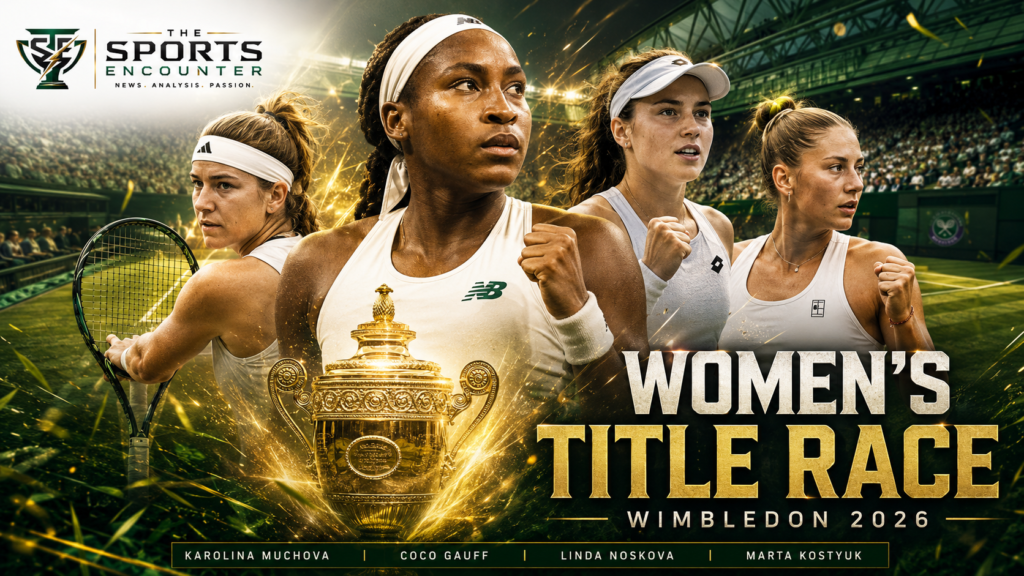
Noskova plays Marta Kostyuk, while Muchova faces Coco Gauff. If both Czech players win, Wimbledon 2026 will have a historic all-Czech women’s final.
Key Facts: Wimbledon 2026 Women’s Semi-Finals
| Player | Quarter-Final Result | Semi-Final Opponent | Main Storyline |
|---|---|---|---|
| Linda Noskova | Beat Elise Mertens 6-3, 7-5 | Marta Kostyuk | First Grand Slam semi-final |
| Karolina Muchova | Beat Naomi Osaka 7-6(4), 6-4 | Coco Gauff | First Wimbledon semi-final |
| Marta Kostyuk | Beat Jasmine Paolini 6-3, 6-2 | Linda Noskova | First Wimbledon semi-final |
| Coco Gauff | Beat Jessica Pegula 4-6, 6-3, 6-3 | Karolina Muchova | First Wimbledon semi-final |
Czech Tennis Has Returned to Wimbledon’s Deepest Stage
Wimbledon has seen Czech women write this kind of story before.
That is why Linda Noskova and Karolina Muchova reaching the 2026 semi-finals feels bigger than two strong individual runs. It feels like another chapter in a national tennis tradition that keeps finding new voices on grass.
Noskova is 21, direct, powerful and now a Grand Slam semi-finalist for the first time. Muchova is 29, elegant, tactically mature and into her first Wimbledon semi-final after years of injury interruptions and near-breakthroughs. They are not the same player. They do not win points in the same rhythm. Their careers have not moved at the same speed.
Yet they now carry the same possibility.
One more win each, and Wimbledon will have an all-Czech women’s singles final.
That is the emotional hook of the women’s draw now. The wider tournament chaos that The Sports Encounter captured in its Wimbledon 2026 curtain raiser has produced something with deeper roots. The women’s field has changed quickly, but Czech tennis has not appeared from nowhere. It has been building, surviving and renewing itself for decades.
Noskova Did Not Need Noise to Announce Herself
Linda Noskova’s 6-3, 7-5 win over Elise Mertens on Court One was not loud in the way some Wimbledon moments are loud.
It was controlled.
Reuters reported that Noskova became the second Czech woman into this year’s Wimbledon semi-finals after beating Mertens with powerful returns, pinpoint groundstrokes and smart variation in the lunchtime heat. The ninth seed also became the youngest Czech women’s Wimbledon semi-finalist since Petra Kvitova.
That detail matters.
Kvitova won Wimbledon in 2011 and 2014. Barbora Krejcikova won the title in 2024. Marketa Vondrousova won it in 2023. Jana Novotna lifted the trophy in 1998. Martina Navratilova, born in what was then Czechoslovakia before representing the United States, won nine Wimbledon singles titles between 1978 and 1990.
Noskova has grown up with that history around her. After beating Mertens, she spoke about how a small country can still do big things when players look up to those who did it before. That was more than a polite tribute. It explained why Czech women’s tennis keeps regenerating.
For more context on how the women’s draw opened up earlier in the tournament, The Sports Encounter’s Wimbledon 2026 Day 6 report showed how quickly major names began falling and how opportunity moved toward the players brave enough to take it.
Noskova took hers.
How Noskova Broke Mertens’ Resistance
Mertens was never going to hand Noskova the match.
The Belgian came in as a six-time Grand Slam doubles champion and had already knocked out former Wimbledon champion Elena Rybakina earlier in the tournament. She knew how to absorb pressure, reset points and force younger players to prove themselves again and again.
Noskova kept asking the same question with her return game.
Mertens saved nine break points, but the Czech pressure eventually became too much. Noskova broke in the eighth game of the first set and again in the 11th game of the second. She then served out the match with a big delivery that Mertens could only send wide.
That was the most important part of the win. Noskova did not drift when the finishing line appeared. She stayed clear.
Her next opponent, Marta Kostyuk, will test that clarity in a different way. Kostyuk beat 2024 Wimbledon runner-up Jasmine Paolini 6-3, 6-2 in just 69 minutes on Centre Court. Reuters reported that Kostyuk did not face a break point, won 90% of her first-serve points and used her forehand to control the match from the start.
That creates a semi-final between two players who have both broken new ground at Wimbledon.
Noskova’s advantage is weight of shot and return pressure. Kostyuk’s advantage is speed, forehand aggression and confidence from a near-perfect quarter-final. If Noskova allows Kostyuk to turn the match into a first-strike sprint, the Ukrainian can take time away. If Noskova gets enough depth on return, she can make Kostyuk play through heavier resistance than Paolini managed.
Muchova’s Win Over Osaka Was a Different Kind of Statement
If Noskova’s breakthrough was built on clean power, Karolina Muchova’s win over Naomi Osaka was built on variation, patience and decision-making.
Muchova beat Osaka 7-6(4), 6-4 to reach her first Wimbledon semi-final. Reuters reported that both players hit 24 winners, but the difference came in control: Muchova made 21 unforced errors compared with Osaka’s 42.
That number tells the story.
Osaka had arrived with momentum after knocking out top seed Aryna Sabalenka. She brought power, confidence and the sense that her Wimbledon run was turning into one of the tournament’s big comeback stories.
Muchova refused to give her one steady rhythm to attack.
She not only used slice but also moved forward and changed pace. She served and volleyed at smart moments. When Osaka tried to hit through her, Muchova made the match more complicated.
That is the beauty of Muchova’s tennis. It can look light, but it is demanding. Her variety forces opponents to keep solving points from different positions. Against a power player like Osaka, that can become mentally expensive.
The win also completed Muchova’s set of Grand Slam semi-finals. She had already reached major semi-finals before, including her run to the French Open final in 2023. Wimbledon had been the missing piece. Now she has solved that too.
The Sports Encounter’s Wimbledon 2026 title preview looked at how the women’s draw could become unpredictable if the biggest names failed to settle. Muchova has turned that uncertainty into a tactical statement.
Muchova vs Gauff May Be the Semi-Final of Fine Margins
Muchova’s semi-final against Coco Gauff is loaded with contrast.
Gauff reached her first Wimbledon semi-final by beating Jessica Pegula 4-6, 6-3, 6-3. Reuters reported that Gauff called her run a “bit of a breakthrough on grass,” an important admission from a player who had already won the US Open in 2023 and French Open in 2025 but had never previously gone beyond the fourth round at Wimbledon.
Gauff is now the only Grand Slam champion left in the women’s singles draw. She also carries a strong head-to-head record against Muchova, leading their tour meetings 6-1. Reuters noted an important detail, though: none of those meetings came on grass.
That gives Muchova a real opening.
Grass rewards her variety and helps her slice stay low. It gives her net play more value besides allowing her to disrupt a rhythm player before longer baseline exchanges become too physical.
Gauff will try to turn the match into a movement and pressure test. Muchova will try to turn it into a thinking test.
That is why this semi-final feels so compelling. Gauff may have the bigger recent major title profile, but Muchova has the surface tools to make this uncomfortable.
The official Wimbledon website lists the last-four route through its ladies’ singles draw, with Muchova facing Gauff and Noskova facing Kostyuk for places in Saturday’s final.
The Czech Legacy Is No Accident
Czech women’s tennis has become one of the most reliable production lines in the sport.
That is not because every player looks the same. It is because the system keeps producing different ways to win.
Navratilova gave Wimbledon its greatest women’s grass-court dynasty. Novotna gave it one of the most emotional title stories. Kvitova brought left-handed force and fearless first-strike tennis. Vondrousova showed how creativity and touch could win on grass. Krejcikova brought structure, doubles intelligence and quiet resilience.
Noskova and Muchova now fit into that history without copying it.
Noskova is the new force. Her game is built on timing, return pressure and clean hitting. Muchova is the problem-solver. She wins by making opponents uncomfortable, then choosing the right moment to accelerate.
That contrast is exactly why a possible all-Czech final would be fascinating.
It would not be a mirror match. It would be a debate inside Czech tennis itself: power against craft, youth against experience, rising force against refined variation.
What an All-Czech Wimbledon Final Would Mean
An all-Czech Wimbledon final would be one of the strongest women’s tennis stories of 2026.
It would confirm Noskova’s arrival at the top table of the sport. It would reward Muchova’s persistence after the injuries and missed chances that have shaped her career. More important than everything else, it would extend a Czech Wimbledon legacy that has already produced champions across multiple eras.
For The Sports Encounter’s growing tennis coverage, this is exactly the kind of tournament story that matters beyond the scoreline. It is about national depth, player identity and how a Grand Slam draw can suddenly reveal which tennis cultures are still producing answers.
There is also a broader women’s tennis angle.
With Sabalenka out, Osaka gone, Paolini beaten and Pegula eliminated, Wimbledon 2026 has created space for a new champion. WTA’s official tournament coverage noted that a new Wimbledon women’s singles champion is guaranteed from this last-four lineup, with Gauff, Muchova, Noskova and Kostyuk all chasing their first title at the All England Club.
That makes the final weekend feel open, but not random.
Each semi-finalist has earned her place with a clear tennis identity.
What Noskova and Muchova Must Do Next
Noskova Must Make Kostyuk Play Under Pressure
Noskova cannot allow Kostyuk to dictate early with the forehand. The Ukrainian’s quarter-final win over Paolini showed how dangerous she becomes when she controls first-strike patterns. Noskova must return deep, protect her second serve and use her heavier ball to push Kostyuk behind the baseline.
If she does that, the semi-final can tilt toward her.
Muchova Must Keep Gauff Out of Rhythm
Muchova cannot let Gauff settle into a physical baseline match. She must vary height, pace and direction. Her slice, net approaches and serve placement will be central. If Gauff starts reading patterns early, Muchova’s head-to-head disadvantage can become relevant again.
If Muchova keeps changing the match, she has a real chance.
Verdict: Czech Tennis Is One Match Away From a Wimbledon Moment That Would Travel Far Beyond Prague
Linda Noskova and Karolina Muchova have already made Wimbledon 2026 a Czech tennis story.
Now they have a chance to make it a Czech tennis final.
Noskova’s run carries the emotion of arrival. She is young, fearless and into her first Grand Slam semi-final. Muchova’s run carries the emotion of persistence. She is experienced, creative and finally into the Wimbledon last four after years of building a game that always looked made for grass.
Neither semi-final will be easy.
Kostyuk is playing fast, clean and with the belief of someone who just dismissed last year’s runner-up in 69 minutes. Gauff is the only major champion left in the draw and has finally found her grass-court breakthrough.
Still, the Czech possibility is real.
If Noskova and Muchova both win, Saturday’s final will become more than a title match. It will become a showcase of how one small country keeps producing women who understand Wimbledon in different ways.
Noskova has the firepower to announce a new era.
Muchova has the craft to complete a long-awaited grass-court story.
Czech tennis has the history to make either ending feel earned.
FAQs
Who are the Wimbledon 2026 women’s semi-finalists?
The Wimbledon 2026 women’s semi-finalists are Linda Noskova, Karolina Muchova, Marta Kostyuk and Coco Gauff.
Are Linda Noskova and Karolina Muchova playing each other in the Wimbledon semi-finals?
No. Linda Noskova will face Marta Kostyuk in one semi-final, while Karolina Muchova will face Coco Gauff in the other. If both Czech players win, they will meet in the Wimbledon final.
Did Linda Noskova reach her first Grand Slam semi-final at Wimbledon 2026?
Yes. Linda Noskova reached her first Grand Slam semi-final by beating Elise Mertens 6-3, 7-5 in the Wimbledon quarter-finals.
How did Karolina Muchova reach the Wimbledon 2026 semi-finals?
Karolina Muchova reached the Wimbledon 2026 semi-finals by beating Naomi Osaka 7-6(4), 6-4. She used variety, net play and better control, finishing with fewer unforced errors than Osaka.
What would an all-Czech Wimbledon final mean?
An all-Czech Wimbledon final would be a major moment for Czech women’s tennis. It would continue a strong Wimbledon tradition that includes Martina Navratilova, Jana Novotna, Petra Kvitova, Marketa Vondrousova and Barbora Krejcikova.
Who will Linda Noskova play next at Wimbledon 2026?
Linda Noskova will play Marta Kostyuk in the Wimbledon 2026 semi-finals. Kostyuk reached the last four by beating Jasmine Paolini 6-3, 6-2.
Who will Karolina Muchova play next at Wimbledon 2026?
Karolina Muchova will play Coco Gauff in the Wimbledon 2026 semi-finals. Gauff reached her first Wimbledon semi-final by beating Jessica Pegula in three sets.
Can Linda Noskova win Wimbledon 2026?
Yes, Linda Noskova can win Wimbledon 2026. She has the power, return game and confidence to beat Marta Kostyuk, but she must handle the pressure of her first Grand Slam semi-final.
Can Karolina Muchova win Wimbledon 2026?
Yes, Karolina Muchova can win Wimbledon 2026. Her variety and grass-court instincts make her dangerous, especially if she can disrupt Coco Gauff’s rhythm in the semi-final.
Is a new Wimbledon women’s champion guaranteed in 2026?
Yes. A new Wimbledon women’s singles champion is guaranteed because none of the four semi-finalists has previously won the Wimbledon singles title.