


Wimbledon has a way of making reputations feel temporary. One afternoon on grass can turn a defending champion into a stunned spectator, a dangerous outsider into a national icon, and a carefully drawn tournament path into a maze.
Day 6 of Wimbledon 2026 did all of that.
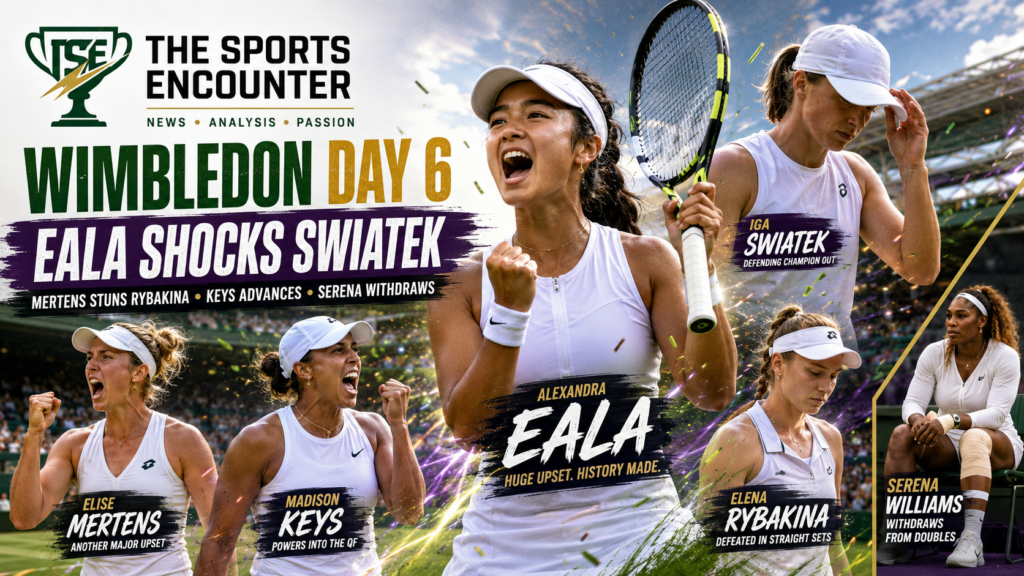
Alexandra Eala, the 29th seed from the Philippines, produced the result of the tournament so far by beating defending champion Iga Swiatek 7-6(9), 6-2 on Centre Court. A few hours earlier, Elise Mertens had already shaken the women’s draw by taking out second seed and Australian Open champion Elena Rybakina 7-6(4), 6-1 on No. 1 Court. By early evening in London, two of the biggest names in the bottom half of the women’s draw were gone, and Wimbledon had a new emotional center.
Eala did not simply defeat Swiatek. She stared down the defending champion in a bruising first-set tiebreak, refused to retreat when the moment grew loud, then ran through the second set with the clarity of a player who understood that Centre Court had given her a lifetime chance. Reuters reported that Eala’s win made her the first player from the Philippines to reach the fourth round of a Grand Slam, while Wimbledon’s official coverage also confirmed the 7-6(9), 6-2 scoreline and her fourth-round breakthrough.
For Swiatek, it was another hard stop in a year that has refused to settle. For Rybakina, it was a missed chance to keep alive her hopes of pushing Aryna Sabalenka for the world No. 1 ranking. For the rest of the field, it was a signal. The second week suddenly looks far less predictable than it did when Saturday began.
For broader tournament context, visit The Sports Encounter’s Tennis hub and our Wimbledon 2026 preview, which highlighted how grass can punish even the most powerful players when movement, serve rhythm, and timing slip.
Day 6 at a Glance
| Match | Result | Why It Matters |
|---|---|---|
| Alexandra Eala vs Iga Swiatek | Eala won 7-6(9), 6-2 | Defending champion out; Eala reaches first Grand Slam fourth round |
| Elise Mertens vs Elena Rybakina | Mertens won 7-6(4), 6-1 | Second seed out; Rybakina’s No. 1 ranking chance ends |
| Madison Keys vs Amanda Anisimova | Keys won 3-6, 6-2, 6-3 | Last year’s runner-up exits in all-American battle |
| Ashlyn Krueger vs Daria Snigur | Krueger won 6-3, 6-2 | Qualifier reaches fourth round |
| Marta Kostyuk vs Emma Navarro | Kostyuk won 6-2, 4-6, 6-1 | Ukrainian seed continues strong major run |
| Jasmine Paolini vs Maria Sakkari | Paolini won 6-1, 6-2 | 2024 finalist sets up Eala fourth-round clash |
| Alexander Zverev vs Marcos Giron | Zverev won 6-2, 7-6(4), 6-4 | Second seed reaches last 16 again |
| Flavio Cobolli vs Karen Khachanov | Cobolli won 0-6, 7-6(4), 6-7(5), 6-2, 6-2 | French Open finalist survives five-set fight |
| Alex de Minaur vs Zachary Svajda | De Minaur won 6-2, 5-7, 6-2, 6-4 | Fifth seed advances after dropping one set |
| Arthur Fery vs Zizou Bergs | Fery won 2-6, 7-5, 2-6, 7-6(3), 7-6(5) | Last British singles player reaches fourth round |
Alexandra Eala Turns Childhood Memory Into Centre Court Shock
Eala’s victory over Swiatek carried the shape of a classic Wimbledon upset: a tight opening set, a champion fighting against discomfort, a rising player refusing to blink, and a second set that suddenly became less about ranking and more about belief.
The first set lasted 84 minutes, according to Reuters, and felt like the emotional hinge of the match. Swiatek fought back from danger and pushed the set into a tiebreak, but Eala found the courage to swing through the biggest points. Swiatek later admitted that Eala had been braver when the tiebreak tightened, saying the Filipino “played a bit faster” when the moment demanded boldness.
That line matters because it explains the match better than the ranking gap does. Swiatek did not lose because Eala was merely inspired. She lost because Eala kept choosing aggression when the obvious temptation was caution.
The second set then became a different kind of test. Upsets often die after the first big swing. The lower-ranked player wins the first set, the champion resets, and the match returns to order. Eala refused to let that happen. Her left-handed baseline game kept Swiatek under pressure, and she earned a double break to move 3-0 ahead before holding off the expected pushback.
When Eala finally closed it out with a forehand winner, the scene became more than a tennis result. It became a personal story in public. She spoke afterward about growing up in the Philippines, going to training after school with her brother and grandfather, wearing ruffled socks, light-up shoes, and carrying the dream of a stage that once felt impossibly far away. Reuters reported that she called the achievement “everything,” while also making clear she was not satisfied yet.
That balance gave the moment its force. Eala was emotional, but not overwhelmed. Grateful, but not finished. Young, but not passive. Wimbledon often searches for stories that reach beyond the scoreboard. On Saturday, Eala gave it one.
Why Eala’s Win Was Bigger Than One Upset
This was Eala’s first appearance in the fourth round of a major, and it came against the defending Wimbledon champion on Centre Court. It also followed a useful recent history between the two players. Eala had beaten Swiatek in Miami last year, Swiatek had answered on clay in Madrid, and Wimbledon became the third act of a rivalry that suddenly has a much bigger meaning.
Grass made the difference feel sharper. Swiatek’s great career has been built on heavy ball-striking, court coverage, return pressure, and relentless scoreboard control. Wimbledon, though, demands shorter reactions. Low bounces and quick exchanges leave less time to reorganize a point. Eala’s flatter hitting and early bravery helped rush Swiatek into mistakes.
Swiatek did not hide from the problem afterward. She said she mis-hit too many returns and described the defeat as a tennis problem rather than the same type of pressure failure she felt during her French Open loss. Reuters reported that Swiatek said she needed to “trust the process” and focus less on results after another uneven stretch in 2026.
That honesty does not soften the result. A defending champion went out in the third round. A six-time Grand Slam champion admitted she was not currently at the level she wanted. A 29th seed from the Philippines walked off Centre Court as one of the tournament’s defining names.
Eala now faces 13th seed Jasmine Paolini, the 2024 Wimbledon runner-up, who overwhelmed Maria Sakkari 6-1, 6-2. Paolini’s win was one of the cleanest performances of the day and gives Eala a very different challenge: a quick, resilient, experienced player who has already lived deep-second-week pressure at Wimbledon. Reuters and Wimbledon’s day-six coverage both confirmed Paolini’s straight-sets win and the Eala-Paolini fourth-round matchup.
Mertens Removes Rybakina and Ends the No. 1 Ranking Chase
Before Eala finished shaking Centre Court, Mertens had already cracked open the women’s draw on No. 1 Court.
The Belgian 25th seed defeated Rybakina 7-6(4), 6-1, ending the Kazakh’s hopes of adding Wimbledon to her Australian Open title this season. Rybakina had needed at least a quarter-final run to keep alive her chance of overtaking Aryna Sabalenka as world No. 1, but she faded badly after losing the first-set tiebreak. Reuters reported that Mertens reached the Wimbledon last 16 for the fourth time and recorded only her second win over Rybakina in nine meetings.
Mertens’ performance was less explosive than Eala’s, but it was tactically just as important. She varied pace, changed shape, absorbed Rybakina’s power, and made the second seed play uncomfortable balls when she wanted clean first-strike tennis. Once the first set slipped away, Rybakina’s resistance faded quickly.
The second set had the feel of a player losing both timing and conviction. Mertens won nine points in a row during one dominant stretch, then closed the match with an ace despite a few nerves while serving it out. Rybakina later said she needed to analyze and change something because her game was “not working,” according to Reuters.
That admission turns the loss into more than a bad afternoon. Rybakina started 2026 with an Australian Open title and a strong run to the Indian Wells final. By Wimbledon’s third round, her season had cooled at the worst possible time. Grass should suit her serve, reach, and clean power. Instead, she looked increasingly short of answers once Mertens took away rhythm.
Mertens next faces Marie Bouzkova. That match now carries serious quarter-final stakes because the section has lost one of its biggest names.
The Women’s Draw Has Changed Shape Overnight
When two major champions leave the same half of a Grand Slam draw on the same day, opportunity spreads fast.
Swiatek’s exit removes the defending champion and one of the sport’s most intimidating problem-solvers. Rybakina’s defeat removes a former Wimbledon champion, a current Australian Open champion, and one of the cleanest grass-court power players in the women’s game. That leaves the second week looking more open for Paolini, Mertens, Bouzkova, Keys, Kostyuk, Krueger, and Eala.
The pressure now changes direction. Eala is no longer only the inspirational upset story. She becomes a player with a visible path, although Paolini will test her movement, patience, and emotional reset. Mertens is no longer only the veteran spoiler. She becomes a legitimate route-blocker in a softened section. Keys, who beat last year’s runner-up Amanda Anisimova, suddenly has a draw that rewards her grass-court weapons if she controls her error count.
Grand Slam draws rarely open gently. They open with noise, then punish anyone who relaxes too soon.
Madison Keys Wins the All-American Fight as Anisimova Falls
Madison Keys added another major result to a dramatic American day by beating sixth seed and last year’s Wimbledon runner-up Amanda Anisimova 3-6, 6-2, 6-3 on Centre Court. Reuters reported that Keys won 76% of points behind her first serve and kept her unforced errors down to 23, while Anisimova finished with 42.
The match started as if Anisimova had control. Her serve had looked dangerous earlier in the tournament, and she took the opening set. But her rhythm dropped in the second set. The toss became less reliable, the breaks came quickly, and Keys grew stronger from the baseline.
Keys’ grass credentials are real. She won the Eastbourne warm-up tournament last month and has twice reached the Wimbledon quarter-finals. On Saturday, she played like someone who understood the value of steadiness on a day full of chaos. While other seeds were being dragged into emotional storms, Keys found a clear route: serve well, reduce mistakes, and punish loose balls.
Her win gives the American women something to celebrate on July 4, even as the day also brought disappointment through the Williams sisters’ withdrawal and Emma Navarro’s defeat.
Krueger Flies the Qualifier Flag, Kostyuk Handles Navarro
Ashlyn Krueger kept another American storyline alive with a 6-3, 6-2 win over Ukraine’s Daria Snigur. Reuters reported that Krueger, ranked 102nd, became the only women’s qualifier to reach the fourth round this year.
That result matters because Wimbledon’s second week is often brutal for qualifiers. The early rounds are physically and emotionally expensive, and the schedule gives little time to recover from the effort of qualifying. Krueger has not only survived the path. She has made it look organized.
Her next opponent is Marta Kostyuk, who beat 23rd seed Emma Navarro 6-2, 4-6, 6-1. Kostyuk’s win was another strong statement from a player who has been building major consistency. After reaching the French Open semi-finals, she now has a chance to extend that form onto grass.
Kostyuk-Krueger should carry a different tension from the blockbuster fourth-round matches. It is a chance for one player to move from good tournament to serious breakthrough.
Serena and Venus Doubles Return Ends Before It Begins
The day’s emotional American setback came away from the singles court. Serena Williams withdrew from her eagerly awaited doubles campaign with Venus because of a knee injury sustained during her opening-round singles defeat to Maya Joint.
Reuters reported that Serena announced the withdrawal on Instagram, saying she was “heartbroken,” and shared that fluid had been drained from her knee after the singles match. The Williams sisters had received a Wimbledon doubles wildcard and were due to play Solana Sierra and Camila Osorio.
For fans, the withdrawal carried a different kind of disappointment. Serena’s return after four years away had already ended in singles defeat, but the doubles with Venus offered one more chapter of family history at a tournament they helped define. Between 2000 and 2016, the sisters won six Wimbledon doubles titles together. Their partnership is part of the tournament’s modern memory.
This time, the body did not allow the story to continue.
Serena’s message still left the door emotionally ajar. Her “stay tuned” line will keep people wondering what comes next. For Wimbledon 2026, though, the Williams sisters’ comeback chapter closed early.
Zverev Reaches the Fourth Round and Wants a Different Wimbledon Ending
On the men’s side, the biggest names mostly avoided the kind of chaos that hit the women’s draw.
Alexander Zverev, the second seed and newly crowned French Open champion, beat Marcos Giron 6-2, 7-6(4), 6-4 to reach the Wimbledon fourth round for the fourth time. Reuters reported that Zverev has never gone beyond the last 16 at the All England Club, but his form and confidence this week suggest he believes this year can be different.

Zverev’s situation is fascinating because grass has never been his natural kingdom. His serve gives him free points, but movement, low balls, and transition instincts have often complicated his Wimbledon runs. This year, dry and firm conditions appear to be helping him. After dropping a set in the opening round, he has moved through the draw with growing authority.
The next test should be tougher. Zverev faces 13th seed Jiri Lehecka, a powerful Czech player with the kind of flat hitting that can rush opponents on grass. If Zverev wins that match, the idea of a deep Wimbledon run will begin to feel less like a surface adjustment and more like a genuine title push.
For more tournament context, The Sports Encounter’s Wimbledon 2026 title preview looked at how the men’s draw could hinge on whether elite hard-court and clay-court players can translate their games onto grass.
Arthur Fery Keeps British Singles Hopes Alive
Arthur Fery gave the home crowd the kind of survival story Wimbledon loves. The British wildcard outlasted Zizou Bergs 2-6, 7-5, 2-6, 7-6(3), 7-6(5), becoming the last British singles player left in the draw. Reuters’ day-six report confirmed the five-set scoreline, while The Guardian described the win as a major home moment on a day when the tournament was already full of drama.
The details made it even more compelling. Fery had to fight through swings in momentum, physical strain, and pressure that grew with every service game. Five-set wins at Wimbledon are never just about tennis. They become negotiations with the crowd, the legs, and the scoreboard.
For Britain, Fery’s run gives the tournament a home thread heading into the second week. It may not carry the expectation that once followed Andy Murray or other established British names, but that may actually help. Fery is playing with house money now, and Wimbledon crowds know how to turn that into noise.
Cobolli Survives a Strange Five-Set Battle
Flavio Cobolli’s win over Karen Khachanov was one of the day’s most dramatic men’s results. The ninth seed and 2026 French Open finalist lost the opening set 6-0, then recovered to win 0-6, 7-6(4), 6-7(5), 6-2, 6-2 in four hours. Reuters confirmed the marathon scoreline and noted that Cobolli’s victory continued a strong Italian push in the men’s draw.
The scoreline tells a story of adjustment. A 6-0 first set can leave a player emotionally exposed on grass because points move quickly and errors can pile up before rhythm arrives. Cobolli did not panic. He dragged the match into longer form, survived two tiebreak sets, then dominated the final two sets as Khachanov’s resistance faded.
His reward is Alex de Minaur, who beat American Zachary Svajda 6-2, 5-7, 6-2, 6-4. De Minaur’s movement and counterpunching make him one of the more awkward grass opponents in the draw. Cobolli will not get many cheap patterns. He will have to earn space.
Italy’s Men Chase a Historic Second Week
Italy’s men have become one of Wimbledon’s major subplots. Reuters reported that Italy could have four men in the last 16 of a Grand Slam for the first time since the 1947 French Open, with Jannik Sinner already through, Cobolli joining him, and Matteo Berrettini and Lorenzo Sonego still involved on Saturday’s schedule.
That possible milestone says something larger about Italian tennis. Sinner has become the standard-bearer, but the depth below him is increasingly visible. Berrettini brings grass-court pedigree. Cobolli brings physical confidence and clay-to-grass momentum after his French Open run. Sonego brings experience and awkward competitiveness.
For a country that once searched for consistent men’s Grand Slam presence, this is a different era. Wimbledon’s second week may now carry a serious Italian accent.
Sunday’s Fourth-Round Stage: Sabalenka vs Osaka Leads the Next Wave
After a wild Saturday, Wimbledon moves straight into a loaded Sunday schedule.
The biggest women’s match is Aryna Sabalenka against Naomi Osaka. Reuters reported that Osaka has lost all three of their meetings this year, at Indian Wells, Madrid, and the French Open, but believes grass gives her a more stable platform. Sabalenka, meanwhile, called Osaka a tricky opponent because of her aggression and focus in their matches.
This match became even more important after Rybakina’s exit. Sabalenka’s hold on the No. 1 ranking is safer, but the draw around her has changed. If she handles Osaka, she will strengthen her position as the player best equipped to impose order on a women’s tournament that suddenly feels open.
On the men’s side, Jannik Sinner faces Japanese qualifier Shintaro Mochizuki, a former junior Wimbledon champion now enjoying the best Grand Slam run of his career. Reuters reported that Sinner praised Mochizuki’s low ball and grass-court danger, while Mochizuki admitted his own run felt strange after arriving with little recent winning form.
Novak Djokovic also opens Centre Court play against Roman Safiullin, while Coco Gauff faces Belinda Bencic on No. 1 Court. Gauff said she is now trying to go bigger on serve rather than simply guide it in, a relevant adjustment as she chases her first Wimbledon quarter-final.
What Day 6 Means for Wimbledon 2026
Day 6 changed Wimbledon 2026 because it removed certainty from the women’s draw.
Swiatek’s loss was the headline. Rybakina’s defeat was the structural shock. Together, they created a tournament opening that players like Paolini, Mertens, Keys, Kostyuk, Krueger, Bouzkova, and Eala will now try to enter before someone else closes it.
The men’s draw, by contrast, still feels more ordered. Zverev advanced. De Minaur advanced. Cobolli survived. Fery gave Britain its emotional storyline, but the main title favorites have not yet suffered the same level of damage as the women’s side.
That split gives Wimbledon its shape heading into the second week. The women’s tournament now feels combustible. The men’s tournament feels like it is building toward collisions.
Still, Saturday’s lesson was simple. Wimbledon does not care much for pre-written scripts. A defending champion can arrive on Centre Court and leave searching for answers. A former champion can lose control after one tiebreak. A qualifier can become a second-week name. A wildcard can carry a nation. A player from the Philippines can turn childhood memory into Centre Court history.
That is what made Day 6 feel bigger than a list of results.
It was the day Wimbledon 2026 stopped warming up and started revealing itself.
FAQs
Who caused the biggest upset on Wimbledon 2026 Day 6?
Alexandra Eala caused the biggest upset by defeating defending champion Iga Swiatek 7-6(9), 6-2 in the third round on Centre Court.
Who will Alexandra Eala play next at Wimbledon?
Eala will face 13th seed Jasmine Paolini in the fourth round. Paolini beat Maria Sakkari 6-1, 6-2 on Day 6.
What happened to Elena Rybakina at Wimbledon?
Elena Rybakina lost 7-6(4), 6-1 to Elise Mertens in the third round. The defeat ended her chance of becoming world No. 1 at Wimbledon.
Did Serena and Venus Williams play doubles at Wimbledon 2026?
No. Serena Williams withdrew from doubles with Venus because of a knee injury sustained during her opening-round singles defeat.
Which British player is still alive in Wimbledon singles?
Arthur Fery is the last British singles player left after beating Zizou Bergs in five sets on Day 6.
Who are the major fourth-round matches to watch on Sunday?
Aryna Sabalenka vs Naomi Osaka leads the women’s schedule, while Jannik Sinner faces Shintaro Mochizuki and Novak Djokovic plays Roman Safiullin on Centre Court.
The Sports Encounter’s tennis coverage focuses on Grand Slam match reports, player analysis, tactical trends, tournament stories, and the biggest talking points from the tennis world.