


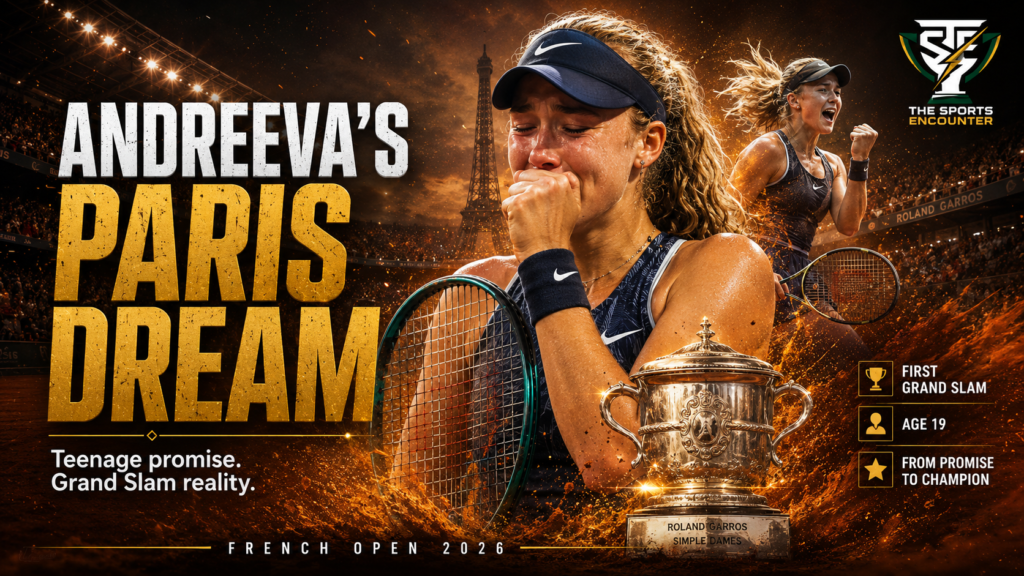
Mirra Andreeva relived the memories of Monica Seles on Super Sunday at Roland Garros to lift her maiden French Open title in front of a packed crowd.
An exclusive story by Jovana Zlatova.
Every few years, tennis gets a teenager who looks different.
Not just talented. Not just fast. Different.
Mirra Andreeva had carried that feeling for some time. She had the timing, the feel, the court sense, and the fearlessness that make people look up from their phones and say, “Watch this one.” But promise can be a tricky thing in tennis. It gets praised early, then questioned quickly. The attention overwhelms experience. It turns every loss into a debate about whether the player is ready.
At the French Open 2026, Andreeva stopped being only the future.
She became a Grand Slam champion.
The 19-year-old defeated Polish qualifier Maja Chwalinska 6-3, 6-2 in the Roland-Garros final to win her first major title. She became the youngest women’s singles champion in Paris since Monica Seles in 1992 and the first Russian woman to win a Grand Slam singles title since Maria Sharapova in 2014.
That is history.
But the real story is more human than the record book.
Mirra Andreeva French Open 2026 triumph was about a teenager learning how to carry pressure without letting it swallow her personality. It was about turning expectation into clarity. It was about proving that youth does not have to mean emotional chaos.
Mirra Andreeva’s French Open 2026 journey showed the full range of a young champion: early composure, one real comeback test, growing confidence, and a fearless finish in her first Grand Slam final.
Mirra Andreeva’s Road to French Open 2026 Glory
| Round | Opponent | Result | Score | Key takeaway |
|---|---|---|---|---|
| Round 1 | Fiona Ferro | Won | 6-3, 6-3 | Calm start in front of the Paris crowd |
| Round 2 | Marina Bassols Ribera | Won | 3-6, 6-1, 6-1 | Lost the first set, then showed serious mental strength |
| Round 3 | Marie Bouzkova | Won | 6-4, 6-2 | Controlled a tricky opponent with clean, disciplined tennis |
| Round 4 | Jil Teichmann | Won | 6-3, 6-2 | Stayed composed and moved closer to the deep rounds |
| Quarterfinal | Sorana Cirstea | Won | 6-0, 6-3 | Produced one of her most dominant performances |
| Semifinal | Marta Kostyuk | Won | 6-1, 6-3 | Played with maturity beyond her age to reach the final |
| Final | Maja Chwalinska | Won | 6-3, 6-2 | Sealed her first Grand Slam title with controlled aggression |
From Talent to Champion: The Road Had Already Started
Andreeva’s rise did not begin with the final.
She had already announced herself as one of tennis’ most exciting young players before Paris 2026. She reached the Australian Open girls’ final in 2023, qualified for her first Grand Slam main draw at Roland-Garros that same year, and later made a breakout run to the French Open semifinals in 2024.
That semifinal run mattered.
It showed that Paris suited her game. Clay rewards players who can think, adjust, build points, defend, and attack at the right time. Andreeva has those layers. She can absorb pressure from the baseline, change direction early, and create openings without forcing every shot.
But promise alone does not win majors.
By 2026, she had added something more important: emotional control.
Teenage tennis can be wild. One moment looks brilliant. The next looks rushed. Andreeva had shown fiery edges in earlier stages of her career, but at Roland-Garros 2026 she looked more settled. Not emotionless. Just more aware of when to breathe, when to reset, and when to let the point go.
That growth made the difference.
Mirra Andreeva French Open 2026 Route to the Title
Andreeva’s path to the title included wins over Fiona Ferro, Marina Bassols Ribera, Marie Bouzkova, Jil Teichmann, Sorana Cirstea, Marta Kostyuk, and Maja Chwalinska.
That route tested different parts of her game.
Early rounds at a Grand Slam can be uncomfortable for a seeded player. The public expects progress. The opponent plays with freedom. Every set carries the risk of a headline. Andreeva managed those rounds with the professionalism of someone older than 19.
The middle rounds asked more of her patience.
Opponents tried to vary height, rhythm, and rally length. Clay-court tennis often turns into a mental negotiation: how much risk is enough, how much defense is too passive, how much aggression can the court accept? Andreeva kept finding the answer.
By the time she reached the final stages, her game had a calm shape.
She dropped only one set across seven matches, according to reports, and moved through the tournament with increasing authority. That is the sign of a champion who is not just surviving the draw but growing through it.
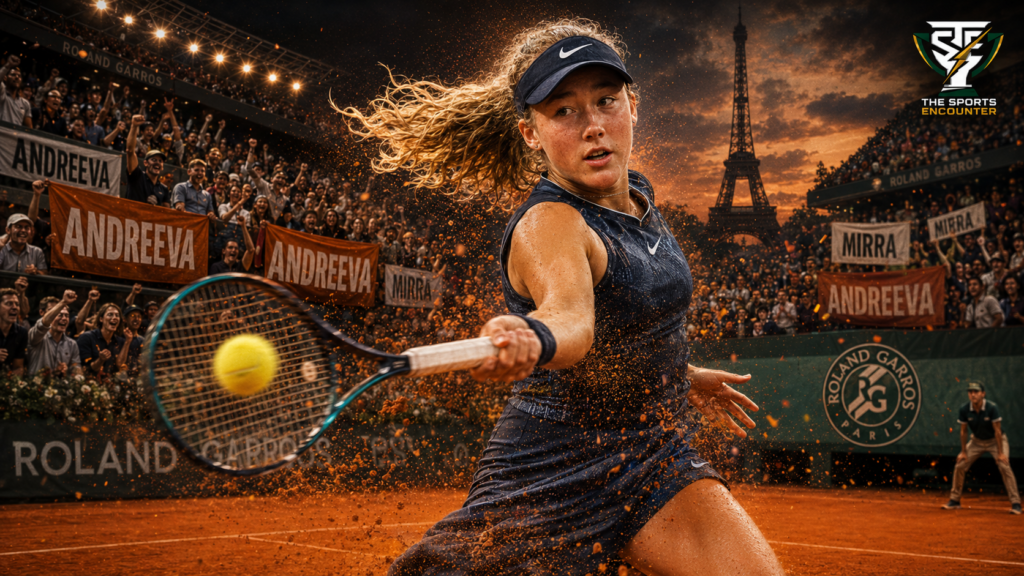
The semifinal win over Marta Kostyuk sharpened the story. Kostyuk had the experience and the power to make Andreeva uncomfortable. Andreeva responded with controlled aggression and strong emotional discipline, giving herself a first Grand Slam final.
Then came Chwalinska, the tournament’s other great story.
The Final Against Maja Chwalinska Was a Test of Nerve
The French Open women’s final had a rare feeling.
Both players were chasing a first Grand Slam title. Andreeva was the higher-ranked player and the favorite. Chwalinska was the qualifier whose run had captured attention across the tournament. She had come through qualifying, won nine matches to reach the final, and built one of the most unexpected Roland-Garros stories in recent memory.
That made the match dangerous for Andreeva.
Favorites in first major finals can tighten up. The mind knows the opportunity is real. The body knows history is close. The opponent has nothing to lose. The crowd senses a story.
Andreeva handled it beautifully.
She won the first set 6-3 and then pushed ahead in the second with the kind of calm that makes a young player look suddenly grown. Chwalinska fought, chased, and tried to stretch the match into something more complicated, but Andreeva kept returning to the basics: clean timing, early ball control, smart movement, and no unnecessary panic.
The 6-3, 6-2 scoreline looked simple.
The moment was not.
Winning a first Grand Slam final requires more than tennis. It requires a player to walk onto the court with a childhood dream in one hand and a global audience in the other, then still swing freely.
Andreeva did that.
Why Mirra Andreeva French Open 2026 Title Feels Inspirational
Andreeva’s title is inspiring because it shows that youth and maturity can meet earlier than expected.
The easy story is that she is a teenage prodigy. That is true, but it is not enough. Many prodigies arrive with talent. Fewer learn how to manage expectation before it damages them.
Andreeva did not win Roland-Garros by playing like someone untouched by pressure. She won by accepting pressure and still choosing the right shots.
That distinction matters.
For young athletes, pressure often feels like proof that something is wrong. In reality, pressure is proof that something meaningful is happening. Andreeva looked like a player who had learned that lesson quickly. She did not run from the size of the occasion. She played inside it.
There is also a lesson in how she handled the attention around her.
Teenage stars can be pushed into becoming brands before they become adults. Andreeva still carries a natural sense of humor and honesty that makes her relatable. Reports around her tournament spoke about simple routines, mental work, and the support of coach Conchita Martinez. Those details matter because they show the human side of elite sport.
A Grand Slam is won by forehands and backhands, but it is also won by the people who steady you when your own thoughts get loud.
Chwalinska’s Run Made Andreeva’s Win Even More Meaningful
It would be wrong to tell Andreeva’s story without respecting Chwalinska’s.
The Polish qualifier produced one of the most remarkable runs of the tournament. She arrived at Roland-Garros far outside the usual title conversation and reached the final after winning through qualifying and the main draw. Her run reminded fans why Grand Slams remain powerful: because the draw still has room for stories nobody predicted.
That made Andreeva’s task harder.
She was not facing only an opponent. She was facing momentum, emotion, and a crowd-ready fairytale. Chwalinska had already beaten expectations many times before the final. Players in that position can be dangerous because they feel free.
Andreeva had to stop the story without getting caught inside it.
She did.
That is championship maturity.
Andreeva Turned the Impossible Into the Inevitable
Mirra Andreeva French Open 2026 triumph will be remembered as a breakthrough, but it may also become the start of something larger.
She did not steal the title. She built it.
Round by round, she looked more comfortable with who she was becoming. Mirra did not need to overpower every opponent. She did not need to perform for drama. She trusted her game, managed her emotions, and stayed present long enough for the dream to become real.
That is the part fans should hold onto.
Impossible tasks rarely become possible in one giant leap. They become possible through small, repeated acts of belief. One hold of serve. One calm response after a bad point. One conversation with a coach. One practice session after a painful loss. One decision to stop being afraid of the stage.
At 19, Andreeva showed that greatness does not always wait for permission.
She walked into Roland-Garros as one of tennis’ brightest young talents. She left as a Grand Slam champion.
For readers, young athletes, and tennis fans, her story carries a simple message: being early does not mean being unready. Sometimes the dream arrives before the world expects it, and the only thing left is to meet it with courage.
In Paris, Mirra Andreeva did exactly that.