


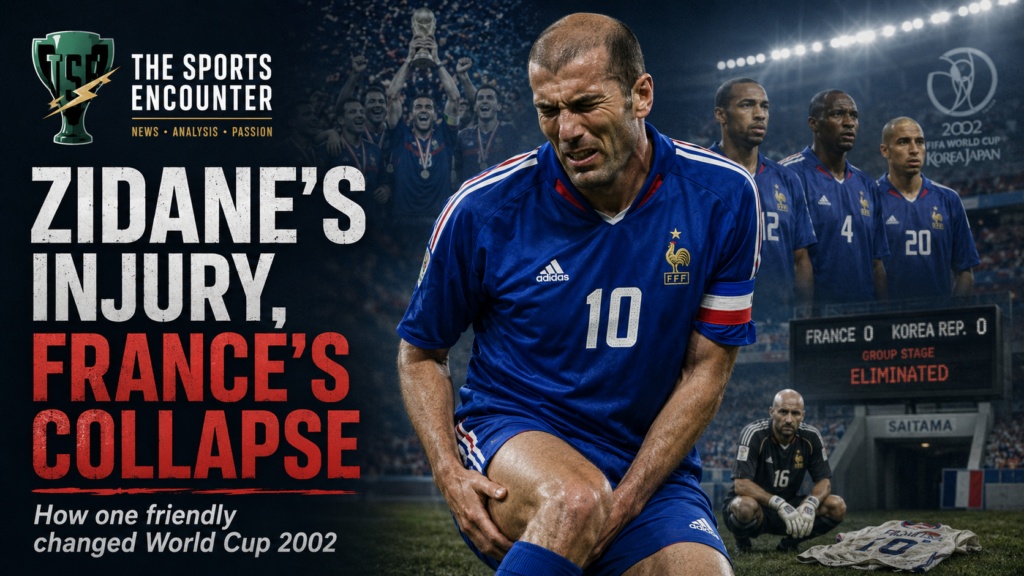
Five days before the 2002 FIFA World Cup began, France played a friendly match that, in hindsight, became one of the most expensive warm-up games in football history.
It was May 26, 2002. France faced South Korea in Suwon. The match meant little on paper. France were already world champions. They were already European champions. They had Zinedine Zidane, Thierry Henry, Patrick Vieira, David Trezeguet, Marcel Desailly, Lilian Thuram, Fabien Barthez and a squad that looked too powerful to collapse.
Then Zidane clutched his left thigh.
The friendly suddenly stopped feeling harmless.
France won that match 3-2, but the victory came with a brutal cost. Zidane left the field in the 38th minute, and medical checks later revealed a small tear in his left thigh muscle. France’s doctor Jean-Marcel Ferret confirmed the injury as a tear in the quadriceps area, leaving Zidane in serious doubt for the World Cup opener against Senegal.
That one injury changed the whole mood around the defending champions.
France entered the 2002 World Cup as the team everyone feared. They had won the 1998 World Cup by beating Brazil 3-0 in Paris, with Zidane scoring twice in the final. They then won Euro 2000, where David Trezeguet scored the golden goal against Italy as France became the first reigning world champions to win the European Championship.
This was not just a strong squad. This was supposed to be a football dynasty.
For more tournament history and modern World Cup coverage, follow The Sports Encounter’s FIFA World Cup 2026 coverage hub.
The Golden Generation That Looked Untouchable
France’s team had almost everything.
Zidane was the brain and rhythm of the side. Henry had become one of Europe’s most dangerous forwards. Trezeguet was a cold finisher. Vieira gave the midfield power and range. Barthez brought experience in goal. Desailly and Thuram gave France authority at the back.
Even the wider squad had serious depth. France arrived with major attacking names and enough tournament-winning experience to scare any opponent.
That is what makes the collapse so shocking. France did not go to Japan and South Korea as an aging underdog trying to survive one last tournament. They arrived as the standard.
But football has a nasty habit of punishing teams that believe status can protect them.
The same truth still runs through the World Cup. The Sports Encounter recently explored that pattern in When Giants Fall: The World Cup Upsets That Still Make Football Feel Dangerous.
Senegal Exposed the Missing Pulse
France opened the tournament against Senegal on May 31, 2002. Zidane was absent. Without him, France still had famous names, but the team’s attacking structure lost its center.
Senegal were making their World Cup debut. France were the holders. On paper, it looked like a routine opening fixture.
On the pitch, Senegal played with belief, speed and no fear.
Papa Bouba Diop scored in the 30th minute. France pushed, searched and panicked, but the goal never came. Senegal won 1-0, creating one of the great World Cup shocks.
For France, the warning light was already flashing.
The team had Henry, Trezeguet and other attacking stars, but without Zidane’s timing and passing, France looked strangely blunt. The ball moved, but the ideas did not.
France and Senegal met again on the World Cup stage in 2026, and the contrast was striking. This time, Kylian Mbappe led France to a 3-1 win, as covered in The Sports Encounter’s report on Mbappe making the difference against Senegal.
Uruguay Made It Worse
The second match against Uruguay was meant to steady France.
Instead, the crisis deepened.
France drew 0-0. Thierry Henry was sent off after 25 minutes, which damaged France’s attacking plan even further. After two games, France had one point and zero goals.
Zidane had missed both crucial matches. Henry was suspended for the final group game. The team that had ruled world football suddenly looked short of imagination, short of calm and short of time.
That is the cruel rhythm of World Cup group-stage football. One bad opener creates pressure. One red card changes a campaign. One injury can pull the whole structure apart. Fans following the current tournament can track that pressure game by game through The Sports Encounter’s FIFA World Cup 2026 schedule.
Zidane Returned, But Too Late
Zidane finally returned for the third group match against Denmark.
By then, France were desperate. They needed a win. They needed goals. They needed their injured No. 10 to perform a rescue act.
But he was not fully right. His thigh was still an issue, and France were asking him to save a tournament that had already slipped out of their hands.
Denmark beat France 2-0 on June 11, 2002. France were eliminated from the group stage with one draw, two defeats and zero goals.
To be precise, France did not lose all three matches. They lost to Senegal and Denmark, and drew with Uruguay. But the emotional truth felt even worse: the defending world and European champions left the tournament without scoring once.
That is the part that still shocks fans.
A team with Zidane, Henry, Vieira, Trezeguet and Barthez finished bottom of Group A without a single goal.
Why That Friendly Still Looks Like a Mistake
Calling the South Korea friendly “useless” may sound harsh, but the timing makes the criticism fair.
France played it only five days before their World Cup opener. Zidane was already one of the most important players in world football. He had just scored that legendary Champions League final volley for Real Madrid earlier in May 2002. France needed him fresh, protected and ready.
Instead, he suffered the injury that removed France’s creative core from the first two group games.
Of course, one injury alone does not explain everything. France also looked tired. Several key players had endured long club seasons. Their confidence may have crossed into complacency. Senegal were excellent and deserved credit. Uruguay made life uncomfortable. Denmark punished France ruthlessly.
Still, Zidane’s injury was the turning point before the tournament had even started.
France built their attacking identity around him. Without him, they had finishers but no conductor. They had runners but no rhythm. They had champions but no control.
The issue also speaks to a wider World Cup truth: preparation can make or break great teams. Modern tournaments are even harder to manage because travel, security, scheduling, player workload and logistics now shape the fan and team experience, as discussed in The Sports Encounter’s feature on the biggest challenges for FIFA World Cup 2026 organizers.
The Lesson From France 2002
The 2002 World Cup remains one of football’s clearest warnings about tournament management.
A golden generation can still be fragile. A squad full of stars can still depend on one player’s balance, timing and imagination. A warm-up match can still carry real risk when the tournament is days away.
France’s collapse became part of the wider “champion’s curse” conversation, later associated with Italy in 2010, Spain in 2014 and Germany in 2018. But France’s version still feels different because of how much talent they had and how little they produced.
The World Cup keeps repeating that lesson. Even in 2026, major teams are discovering how quickly pressure can turn, from Portugal’s frustration against DR Congo to England’s chaotic but important win over Croatia. The Sports Encounter covered that bigger-team pressure in its report on England beating Croatia 4-2.
France 2002 remains one of the sharpest examples.
This was the generation that conquered the world in 1998 and Europe in 2000.
In 2002, one injured thigh helped turn them from untouchable champions into a cautionary tale.
And by the time Zidane came back, France were no longer defending a crown.
They were chasing a tournament that had already left them behind.