


Argentina, Brazil, Germany and England Finish FIFA World Cup 2026 Preparations With Wins
The last dress rehearsal before the FIFA World Cup 2026 is complete, and the message from football’s biggest nations was clear. The traditional powers are not arriving cold.
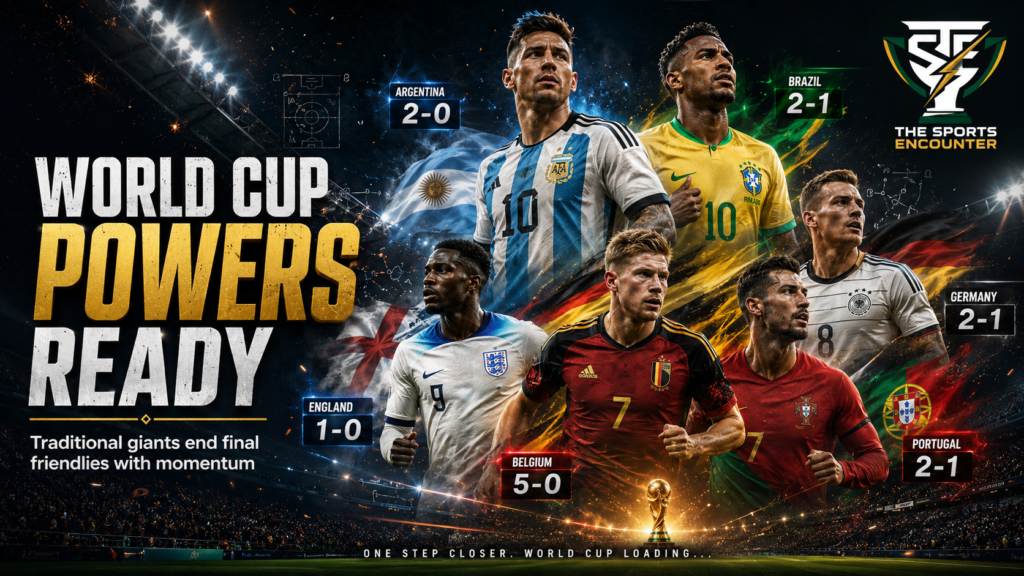
Argentina, Brazil, Germany, England, Belgium, and Portugal all ended their final warm-up phase with victories, giving their coaches exactly what they needed before the tournament pressure takes over: rhythm, confidence, useful minutes, and fewer doubts.
Friendly results do not decide World Cups. Every serious coach knows that. A good warm-up win can disappear from memory after one poor group-stage performance. A dull friendly can still precede a strong tournament. But the final match before a World Cup still carries meaning because it tells us something about mood, selection clarity, team fitness, and how players respond when the real stage is close enough to feel.
On that front, the leading contenders gave themselves something to build on.
Argentina beat Honduras 2-0 without using Lionel Messi. Brazil edged Egypt 2-1. Germany defeated co-host United States 2-1 in Chicago. England beat New Zealand 1-0 through a Harry Kane header. Belgium thrashed Tunisia 5-0. Portugal overcame Chile 2-1 in a physical match that finished with both teams down to ten men.
None of these wins guarantees a deep World Cup run. But together, they created the kind of pre-tournament picture the major teams wanted: organized, competitive, and moving in the right direction.
Argentina Show They Can Win Without Leaning on Messi
Argentina’s 2-0 win over Honduras carried more weight than the scoreline suggested because Lionel Messi stayed on the bench.
For most teams, resting the greatest player in their history would dominate the conversation. For Argentina, it became a useful test of balance. The defending world champions needed to show they could control a match, create chances, and manage the occasion without turning every attacking sequence into a search for Messi.
They did enough.
Lautaro Martinez and Giuliano Simeone gave Argentina the goals, and the team moved through the game with the calmness expected from a side that has already climbed the mountain. That matters before a World Cup. Champions often enter tournaments under a different kind of pressure. They are not chasing belief. They are trying to protect it.
Argentina’s biggest strength remains their emotional structure. They play with the confidence of a team that knows how to survive tournament football. Their 2022 triumph was not built only on Messi’s genius. It was built on collective sacrifice, midfield control, defensive resilience, and the ability to respond after setbacks.
This final friendly suggested that Argentina still carry those habits.
The win over Honduras did not need to be spectacular. It needed to be clean to keep the squad moving. It needed to protect Messi while giving others responsibility. Argentina checked those boxes.
That is exactly what a final friendly should do.
ALSO READ: How Much Lennart Karl Injury Will Cost Germany in FIFA World Cup 2026?
Brazil’s Win Over Egypt Shows Competitive Edge Under Pressure
Brazil’s 2-1 win over Egypt was tighter than some expected, but that may have made it more useful.
A comfortable friendly can build confidence, but a competitive one can teach more. Egypt forced Brazil to work, adjust, and stay sharp. For a team with huge attacking expectation, that kind of test can help more than a simple exhibition win.
Brazil enter every World Cup under a familiar burden. Talent is never the question. The question is whether the talent connects under pressure. Every Brazilian squad must carry the memory of past greatness, the demand for expressive football, and the national expectation that anything short of a serious title challenge feels incomplete.
That is not easy to manage.
Against Egypt, Brazil found a way through a demanding match. That matters because the World Cup will not give them only open games and generous spaces. Many teams will sit deep, compete physically, and try to frustrate their rhythm. Brazil must prove they can win when the match does not flow beautifully.
This result offered a small but useful sign.
The main concern from the match was the injury situation around right back Wesley, which introduced an unwanted question so close to the tournament. Injuries in final friendlies are every coach’s nightmare. The aim is to sharpen the team without losing players. Brazil got the result, but they will hope the physical cost does not become part of the bigger story.
Still, the performance showed competitive edge. Brazil did not need to dominate headlines. They needed to finish preparations with focus and a win. They did that.
Germany Beat the United States and Rebuild Competitive Confidence
Germany’s 2-1 win over the United States may have been one of the most important results of the final friendly round.
Germany do not enter the FIFA World Cup 2026 with the same emotional baggage as Argentina or Brazil. Their burden is different. They are trying to repair a damaged World Cup identity after group-stage exits in 2018 and 2022.
For a four-time world champion, that history hurts.
Julian Nagelsmann’s team needed a performance that looked serious, not experimental for the sake of it. The win over the United States gave Germany a valuable result against a co-host nation playing in front of a charged home crowd. Kai Havertz and Leroy Sane scored, while the United States responded through Antonee Robinson.
That type of match helps Germany because it forces concentration.
A friendly against a motivated host nation can feel closer to tournament tempo than a low-pressure warm-up. The United States had energy, crowd support, and a clear reason to test themselves. Germany had to manage resistance, recover from pressure, and find the winning moment.
For Nagelsmann, that is more useful than a soft win.
Germany’s challenge at this World Cup will not be talent. The squad has technical quality, intelligent midfielders, and attacking options who can hurt opponents in different ways. The real issue is consistency. Can Germany control matches without becoming predictable? Can they defend transitions? Will they handle pressure when the game becomes emotionally messy?
The United States friendly did not answer every question, but it gave Germany positive momentum before their opener.
That matters for a team trying to change the mood around itself.
England Win, But Tuchel Still Has Work to Do in FIFA World Cup 2026
England’s 1-0 victory over New Zealand had a different feel.
The result was positive. Harry Kane scored with a header, adding another reminder of why he remains England’s most reliable tournament weapon. But this was not a performance that will scare every rival on its own.
That may not be a bad thing.
Thomas Tuchel rotated heavily and used the match to examine options, manage workloads, and protect players in difficult conditions. Final friendlies often become less about style and more about information. Managers want to know who is sharp, who can adapt, who handles heat, who follows structure, and who looks ready for responsibility.
England won, but the narrow scoreline suggests there is still room for improvement.
That has become a familiar theme around England. They often have enough talent to win matches, but the debate surrounds rhythm, selection balance, and whether the team can turn possession into sustained attacking pressure. Kane gives England a world-class reference point. The players behind him must now create the conditions for him to matter in the biggest matches.
The New Zealand win should calm England’s preparation rather than inflate it.
They got the victory, and avoided a damaging result. They gave players minutes and moved into the tournament with their captain scoring. Those are useful signs.
But Tuchel will know the FIFA World Cup 2026 will demand sharper execution than a one-goal friendly win.
Belgium Send the Loudest Warning With Five-Goal Display
Belgium’s 5-0 win over Tunisia was the most convincing scoreline of the day, and it should not be ignored.
Belgium have spent years living between expectation and transition. Their golden generation made them one of world football’s most respected teams, but major tournament success never fully arrived. Now, as the squad evolves, every strong performance invites the same question: are Belgium still a serious threat?
A five-goal win before the FIFA World Cup 2026 is not enough to declare them title favorites. But it does show attacking rhythm, confidence, and squad hunger.
The most encouraging part was not only the margin. It was the spread of contribution. When different players score and influence the game, a team becomes harder to read. Opponents cannot build a plan around stopping one source of danger. Belgium’s best World Cup version will need exactly that kind of shared threat.
Romelu Lukaku’s return to action also gives Belgium another layer of interest. Tournament football often rewards proven penalty-box players. Even if they do not dominate every minute, they can decide matches from one cross, one rebound, or one defensive mistake.
Belgium’s win over Tunisia was the kind of friendly result that gives a squad energy. It tells players that the work is connecting. Moreover, it gives the coaching staff confidence in attacking patterns. It reminds rivals that Belgium still have enough firepower to punish weak moments.
Among all the traditional contenders in this final friendly round, Belgium made the loudest statement.
Portugal Show Grit in a Physical Test Against Chile
Portugal’s 2-1 win over Chile was less about comfort and more about resilience ahead of the FIFA World Cup 2026.
A physical match, two red cards, and late-tournament tension gave Portugal a different kind of preparation. Warm-up matches can sometimes feel too controlled. This one gave Portugal friction, and friction can be valuable before a World Cup.
Portugal have enough quality to beat many teams through technique, passing, and individual attacking talent. But World Cup knockout matches often become scrappy. Refereeing decisions, physical duels, emotional flashpoints, and game management can decide outcomes.
The Chile friendly gave Portugal a taste of that edge.
Winning in that kind of environment can strengthen a team’s mentality. It reminds players that not every match will reward clean football. Sometimes a side has to absorb contact, manage frustration, and keep enough structure to win anyway.
Portugal did that.
The danger, of course, is discipline. Playing with emotional heat can help, but losing control can damage a tournament campaign. Portugal will need to carry the competitive edge without allowing it to spill into unnecessary risk.
Still, as final preparations go, this was a useful test. Portugal came through it with a win, and that is what contenders want before the real tournament begins.
Why Momentum Matters Before the FIFA World Cup 2026
Momentum in football is often misunderstood.
It does not mean a team will keep winning simply because it won a friendly. It does not mean a strong warm-up result automatically translates into a strong World Cup. But momentum does affect confidence, media pressure, training mood, and internal belief.
Players feel the difference between entering a tournament after a win and entering after a flat defeat.
Coaches feel it too.
A positive final friendly gives a manager more room to work. It not only reduces external noise but helps players trust the plan. It allows the team to focus on tactical details instead of explaining what went wrong.
That is why this final round mattered.
Argentina protected Messi and still won. Brazil faced resistance and still found a way. Germany handled a strong test against a co-host. England won while rotating heavily. Belgium delivered a statement performance. Portugal survived a physical contest.
Each team got something different from the day.
Together, they showed that the traditional powers understand the assignment. The World Cup does not begin with full answers. It begins with readiness. These teams look ready enough to start the FIFA World Cup 2026.
FIFA World Cup 2026: The Favorites Arrive With Their Engines Warm
The biggest takeaway from the final World Cup friendlies was not the scorelines.
It was the collective mood.
The major nations reached the starting line with their engines warm. Not perfect; not fully proven, not free from concern. But organized, competitive, and carrying positive energy.
That is all a final friendly can truly offer.
Argentina showed maturity without Messi. Brazil showed winning instinct under pressure. Germany showed they can handle a serious test while trying to rebuild their World Cup reputation. England showed they can win even when the performance is more functional than fluid. Belgium showed attacking power. Portugal showed grit.
None of these teams should be judged only by these results. The FIFA World Cup 2026 will ask harder questions. It will test depth, fitness, discipline, tactical clarity, and emotional control. It will expose teams that look good in controlled conditions but struggle when pressure rises.
Still, contenders prefer to enter that storm with a win behind them.
That is what these friendlies delivered.
The final rehearsal is over. The lights are coming on. The real judgment begins now.