


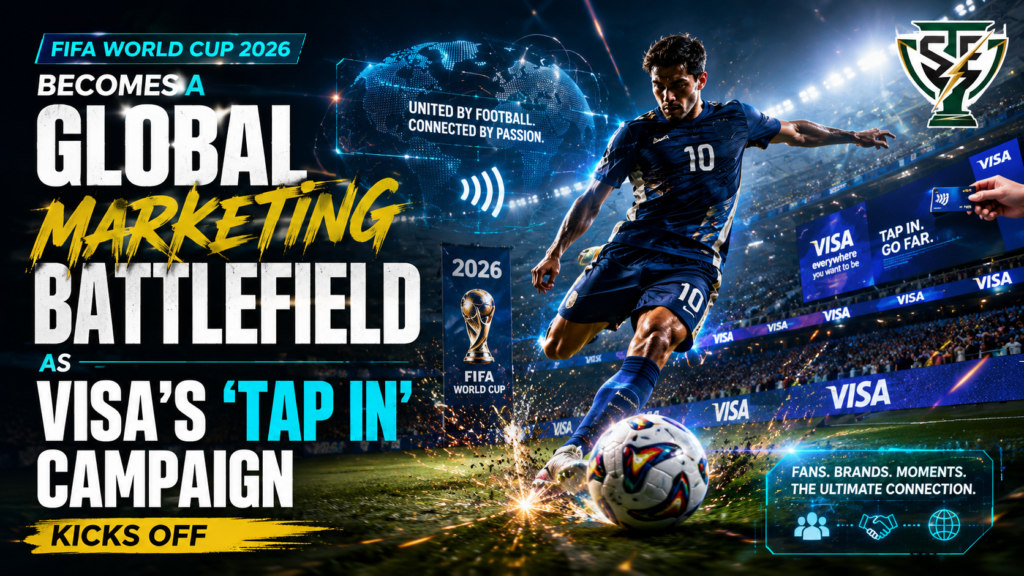
Visa has launched a major global campaign ahead of the FIFA World Cup 2026, using football’s simplest scoring action as the foundation for a wider brand push around payments, fan engagement, prizes, and commercial activation.
The campaign, titled “Tap In,” was announced on May 18 and is built around the idea that some of football’s biggest moments can come from the simplest touch. Visa is applying that same logic to its payment technology, positioning tap-to-pay and digital transactions as a seamless part of the fan experience during the world’s biggest football tournament. The company is the Official Payment Technology Partner of FIFA and has been closely associated with the World Cup ecosystem for years.
The timing is important. FIFA World Cup 2026 will be hosted across the United States, Canada, and Mexico, making it the largest edition of the tournament in history. With 48 teams, more matches, expanded host-city activity, and massive expected fan movement across North America, the event is already attracting serious attention from global advertisers, financial brands, retailers, broadcasters, and technology companies.
Visa’s Tap In Campaign Turns Heads
Visa’s campaign shows how sponsors are no longer treating the World Cup as only a branding platform. They are using it as a full commercial environment where payments, rewards, data, experiences, creator content, and fan participation all connect.
At the center of Visa’s campaign is actor Jason Sudeikis, widely associated with football culture through his role in Ted Lasso. Visa’s campaign follows Sudeikis as he travels through the United States, Canada, and Mexico, using his Visa card during different stages of the World Cup fan journey. The campaign also includes major football figures such as Lamine Yamal, Erling Haaland, Christian Pulisic, Jorge Campos, and legendary commentator Andrés Cantor.
The concept is straightforward: make the fan experience feel easier, faster, and more connected. For Visa, the World Cup is not just a place to display its logo. It is a chance to show how payments can become part of live sport, travel, merchandise, hospitality, ticketing, and everyday fan behavior.
The “Tap In” message also gives Visa a flexible creative platform. It works as a football reference, a payment reference, and a call to action for fans. In football, a tap-in goal may look simple, but it often requires movement, timing, and positioning. Visa is using that metaphor to suggest that the best payment experience should also feel effortless.
Beyond the advertising campaign, Visa is also offering fans the opportunity to win World Cup-related prizes and memorabilia. Through its “Tap In to Score” promotion in the United States and Canada, eligible cardholders can register for chances to win prizes tied to tournament moments. These include FIFA World Cup match tickets, a possible trip to the Final, signed memorabilia, and limited-edition merchandise.
In Mexico, Visa is running a separate promotion called “Pásala Para Ganar,” which gives eligible cardholders a chance to win tickets to a FIFA World Cup 2026 match. The structure reflects a broader trend in sports sponsorship: brands are trying to move beyond passive awareness and create direct fan participation.
Why Tap In Campaign is More Than Commercial?
This is where the campaign becomes more than a commercial. It turns payments into an entry point for fan engagement. Every transaction, registration, or campaign interaction can become part of a larger customer relationship. For a global payments company, that matters.
Visa has also linked the campaign to community impact. The company said it will commit $600,000 through its “Tap In to Impact” initiative, supporting nonprofit partners across the three host countries. The beneficiaries include SCORE in the United States, Pro Mujer in Mexico, and Futurpreneur in Canada.
That social-impact layer is not accidental. Major global sponsors increasingly need to show that their involvement in mega-events goes beyond commercial benefit. With the World Cup expected to bring heavy tourism, local business activity, infrastructure pressure, and significant media attention, corporate partners are under pressure to demonstrate broader value.
The campaign is also arriving as new forecasts point to a major World Cup-driven lift in global advertising spend. WARC Media estimates that FIFA World Cup 2026 will inject $10.5 billion into the global advertising market during the tournament quarter. The forecast suggests the event will reverse the weaker advertising impact seen around Qatar 2022, although it may still fall short of the boost generated by the 2018 World Cup in Russia.
According to reporting based on WARC’s forecast, the $10.5 billion figure represents a 1.1% incremental gain in the global ad market. By comparison, the 2018 World Cup generated an estimated $12.6 billion uplift, or around 2.8%.
The numbers reveal a more complicated advertising story. World Cup 2026 is expected to be enormous in scale, but the way advertisers spend around the tournament is changing. Traditional live-match advertising remains valuable, but brands are now spreading budgets across streaming, social media, retail media, influencer partnerships, podcasts, digital commerce, fan zones, mobile apps, and second-screen experiences.
That shift helps explain why campaigns like Visa’s matter. The commercial battleground is no longer limited to the 90 minutes on the pitch. Brands want to reach fans before the match, during the match, after the match, while they travel, while they shop, while they watch highlights, and while they engage with content online.
In that environment, Visa’s campaign has a clear strategic advantage. Payments sit naturally across the entire fan journey. A fan may use a card to buy flights, hotel rooms, match tickets, food, merchandise, transport, streaming subscriptions, and souvenirs. That gives Visa a broader role than many tournament sponsors. It can connect the emotional energy of football with everyday spending behavior.
The campaign also reflects the commercial value of the 2026 host geography. A World Cup hosted across North America offers strong time-zone advantages for U.S., Canadian, Mexican, and Latin American audiences. It also gives sponsors access to some of the world’s largest consumer, media, and advertising markets. For brands, this makes the tournament not only a sporting event but also a high-value consumer activation window.
FIFA World Cup 2026: The Bigger Picture
The bigger picture is clear. FIFA World Cup 2026 is becoming a testing ground for the next phase of sports marketing. Sponsors are not simply buying visibility. They are building connected ecosystems around live events, digital behavior, loyalty, transactions, and fan identity.
Visa’s “Tap In” campaign captures that shift well. It uses a simple football idea, connects it to payments, adds celebrities and football stars, offers prizes, supports community partners, and positions the brand inside the daily behavior of fans.
The 2026 FIFA World Cup has always been a stage for national teams, players, and supporters. In 2026, it will also be a stage for brands competing to own the fan journey.
Visa has made its move early. The rest of the advertising market is already following.