


Canada brought the noise, the home crowd, and the early pressure.
Morocco brought the knockout patience.
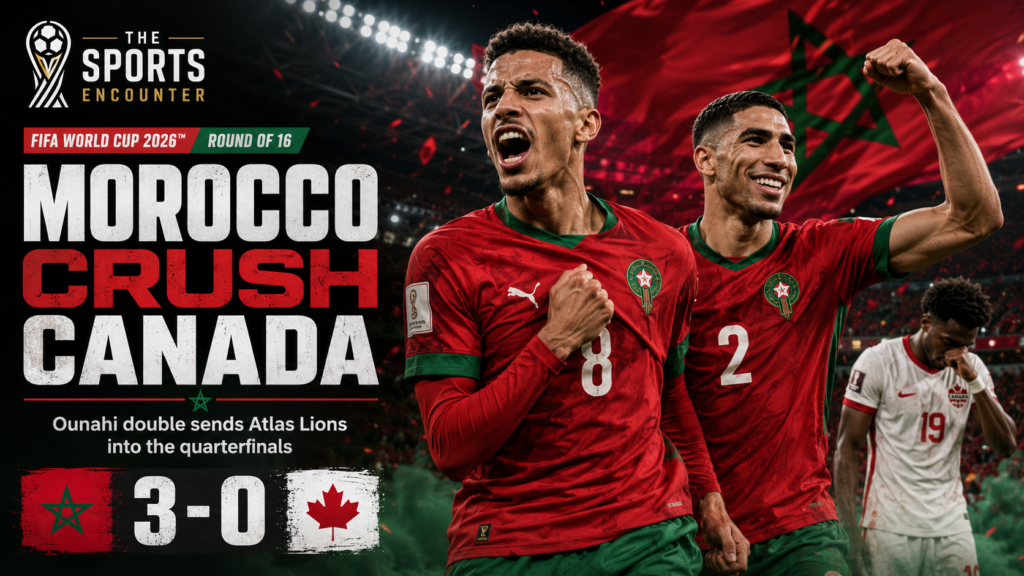
That difference shaped the first Round of 16 match of the FIFA World Cup 2026, as Morocco beat co-host Canada 3-0 in Houston to become the first team to reach the quarterfinals. Azzedine Ounahi scored twice, Soufiane Rahimi added the third in stoppage time, and the Atlas Lions turned a difficult first half into a convincing result that ended Canada’s proud home run.
For Morocco, this was another reminder that their rise on the world stage has moved beyond one magical tournament. After their historic semifinal run in Qatar 2022, they now look like a team that understands knockout football: survive pressure, stay compact, trust the experienced players, and punish the game when it finally opens.
For Canada, the pain will feel sharp. The co-hosts had enough energy, enough crowd support, and enough early control to make Morocco uncomfortable. What they lacked was the final touch that changes a knockout match before the opponent settles.
Readers following the full bracket can track every knockout development through The Sports Encounter’s FIFA World Cup 2026 hub.
Canada Start Fast, but Morocco Refuse to Break
Canada’s first-half approach made sense. Jesse Marsch’s side pressed high, attacked with urgency, and tried to turn the occasion into a test of legs and emotion. The home side pushed Morocco back during the opening spell and created moments that lifted the crowd.
Tani Oluwaseyi carried danger with his movement, Canada competed hard in midfield, and their defensive line tried to squeeze Morocco before the Atlas Lions could move the ball through their creators. For much of the first half, Canada looked like the more aggressive side.
Morocco did not look smooth. They lost some rhythm, took bookings, and suffered a setback when Ismael Saibari went off injured. Saibari had entered the knockout stage as one of Morocco’s important attacking pieces, so his first-half exit could have unsettled the team further.
Instead, Morocco absorbed the disruption.
That became the story of the match. Canada had the better early emotional pulse, but Morocco had the deeper tournament control. They did not panic. They did not chase the match too early. They waited for the moment that would tilt the night.
It arrived five minutes after halftime.
Hakimi and Ounahi Break Canada With One Clever Routine
The opening goal came from intelligence, not chaos.
Achraf Hakimi stood over a free kick on the right side and helped Morocco work the ball low toward the edge of the area. Ounahi arrived with perfect timing and struck a clean first-time finish into the bottom corner. The move looked simple after it worked, but that simplicity came from training-ground clarity.
Canada had spent the first half forcing Morocco into uncomfortable areas. In one set-piece move, Morocco shifted the whole emotional weight of the match.
Hakimi’s role deserves attention. He did not need to dominate the match with constant forward bursts. His influence came through game reading, timing, and execution. On the goal, he gave Morocco the calm technical detail they needed at exactly the right moment. Defensively, he also helped Morocco manage Canada’s wide pressure and gave the back line the assurance it needed when the match became stretched.
Ounahi’s finish changed everything. Canada now had to chase. Morocco could sit into their shape, pick their moments, and use the spaces Canada left behind.
That is a dangerous situation against a team with Brahim Díaz, Hakimi, Rahimi, and Ounahi on the pitch.
Ounahi Shows Why Morocco Trust Their Midfield in Big Games
Ounahi became the face of Morocco’s win because he did more than score twice.
He understood the match.
The midfielder had to operate in a physical game where space came in short bursts. Canada pressed hard, the tempo jumped, and Morocco needed someone who could handle the ball without turning the night into a track meet. Ounahi gave them that control after halftime.
His first goal showed technique and timing. His second showed instinct and confidence.
In the 82nd minute, Morocco broke forward with numbers. Brahim Díaz carried the transition with calm final-third decision-making and found Ounahi, who finished the move to make it 2-0. That goal ended Canada’s realistic hopes of a comeback and confirmed Morocco’s shift from survival mode to command mode.
Ounahi has always had the look of a player who feels comfortable on big international stages. Against Canada, he turned that reputation into a decisive World Cup performance.
The Sports Encounter recently covered Morocco’s earlier knockout survival in Morocco Turn Stoppage-Time Survival Into Penalty Shootout Glory, and this performance felt like the next step in that same story. The Atlas Lions no longer needed penalties or late rescue. They found control, then finished the job.
Canada’s Historic Run Ends With Regret, Not Shame
Canada will replay the first half for a long time.
They had the crowd behind them. They had Morocco under pressure. They had enough attacking presence to make the Atlas Lions work. What they did not have was the goal that would have forced Morocco into a different match.
That miss matters at this level.
Canada’s problem after the opener was not effort. It was game state. Once Morocco led, the match changed shape. Canada had to commit more bodies forward, which created more space for Morocco’s counterattacks. Their early pressing energy also became harder to sustain as the second half stretched.
The co-hosts still leave the tournament with progress. They reached the knockout rounds, gave their supporters a serious World Cup moment, and showed growth on home soil. Their Round of 32 win over South Africa had already given the country a major milestone, and the Morocco match should not erase that.
Still, knockout football has little patience for nearly moments. Canada competed. Morocco converted.
That difference sent one team home and the other into the last eight.
For wider context on how the knockout field developed, readers can revisit The Sports Encounter’s From VAR Drama to Lucky 8 History: World Cup 2026 Round of 16 Preview.
Rahimi Rewards Morocco’s Depth
Rahimi’s late goal gave the scoreline its final authority.
The substitute came on earlier than expected after Saibari’s injury, which could have reduced Morocco’s attacking structure. Instead, Rahimi gave the Atlas Lions movement, fresh legs, and a direct threat in transition.
In stoppage time, Morocco broke again. Díaz slipped the ball through, Rahimi stayed composed, and the forward finished with his left foot to make it 3-0.
That goal mattered beyond the scoreboard. It showed Morocco’s bench strength. It also showed how quickly they can turn defensive control into attacking damage. Canada spent the closing stages chasing pride and hope. Morocco spent them looking for the final cut.
They found it.
Cards and Discipline: A Physical Game Without a Red Card
This was not a gentle knockout match.
The game carried a clear physical edge, especially during Canada’s aggressive first-half spell and Morocco’s attempts to regain control. Available live match reporting listed eight yellow cards in total, with no red card reported.
Ounahi and Bilal El Khannouss were among Morocco’s booked players, while Canada also collected cautions during a match that often tested the referee’s control. The key point for publication is clear: the match stayed eleven vs eleven, but the number of bookings showed how tense the contest became.
Before publishing, the final card list should be checked once more against the Google FIFA timeline or the official FIFA match center to confirm every yellow-card name and minute.
Who Will Morocco Play in the Quarterfinals?
Morocco will face the winner of France vs Paraguay in the quarterfinals.
That gives the Atlas Lions two very different possible tests. France would bring elite attacking quality, tournament history, and one of the strongest squads left in the competition. Paraguay would bring belief, defensive stubbornness, and the emotional lift of a side that already stunned Germany in the Round of 32.
The Sports Encounter has already covered France’s form in Mbappé Leads From the Front as France Crush Sweden and Send a World Cup Warning, while Paraguay’s upset over Germany has made them one of the most dangerous stories in the bracket.
Either opponent will test Morocco more deeply than Canada did after halftime. Yet this result proved something important: Morocco can win without needing a perfect 90 minutes.
They can suffer, adjust, strike, and close.
That is the language of serious tournament teams.
Morocco Are No Longer a Surprise Story
Morocco’s 3-0 win over Canada looked comfortable by the final whistle, but the match did not begin that way. Canada asked real questions. Morocco answered them after halftime with tactical clarity, individual quality, and clinical finishing.
Ounahi gave them the star performance. Hakimi gave them the opening key. Díaz gave them transition class. Rahimi gave them bench impact. Bounou and the defense gave them the platform to survive Canada’s strongest spell.
That balance is why Morocco remain alive.
Canada’s World Cup ends with disappointment, but also with evidence of progress. Morocco’s World Cup moves into a quarterfinal with growing authority.
The Atlas Lions are not playing like tourists in the deep rounds anymore.
They look like they belong there.
The Sports Encounter’s World Cup 2026 coverage focuses on fixtures, team news, match analysis, fan stories, tournament trends, and the biggest talking points from football’s global stage.