


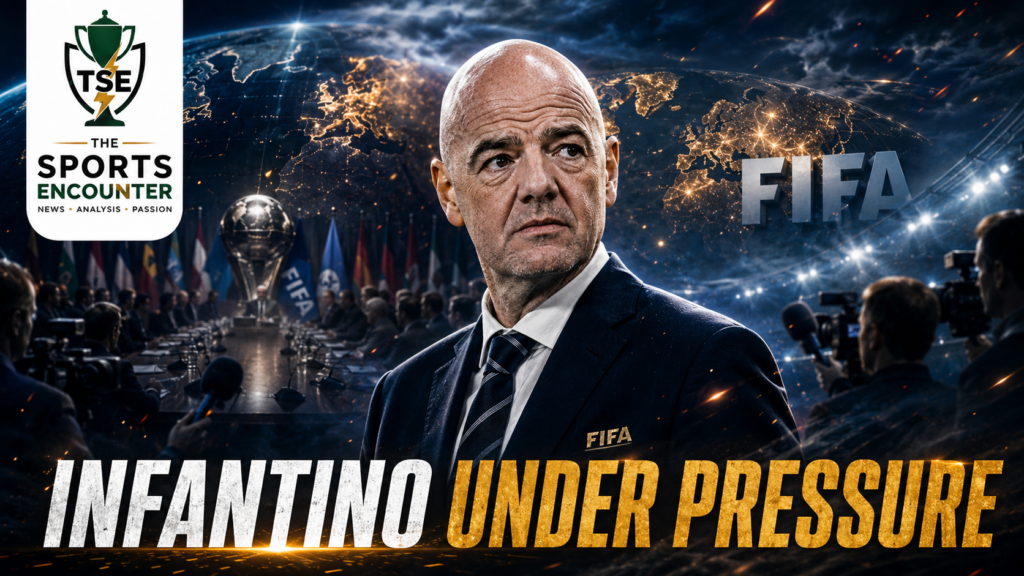
FIFA has escalated its defense of President Gianni Infantino, accusing unnamed opponents of conducting a “concerted and ongoing effort” to undermine his leadership as the political fallout from the abandoned World Cup investment plan deepens across global soccer.
The governing body said challenges to Infantino’s authority must take place through FIFA’s statutes, elections, and established democratic procedures rather than through what it described as allegations, insinuation, or misinformation. The intervention came after another turbulent week in which European associations withdrew support, Norway called for Infantino to resign, and several federations from Africa, South America, and other regions publicly rallied behind him. :contentReference[oaicite:0]{index=0}
The latest statement changes the nature of the crisis.
The dispute began with Infantino’s abandoned proposal to raise approximately $4.2 billion by selling a minority interest in a commercial enterprise linked to FIFA tournaments, including the World Cup. It has since developed into a struggle over who has the legitimacy to decide the FIFA president’s future and whether criticism of his leadership represents ordinary political opposition or an attempt to bypass the governing body’s electoral system. :contentReference[oaicite:1]{index=1}
For The Sports Encounter, this is the next stage of a story that has evolved rapidly since FIFA’s investment plan triggered resistance from UEFA, CONCACAF, senior officials, and national associations. Our earlier coverage examined how the World Cup stake proposal collapsed, how the revolt spread inside FIFA, and why smaller member associations may ultimately decide Infantino’s political future. :contentReference[oaicite:2]{index=2}
FIFA Leadership Crisis: What Changed on Saturday?
| Issue | Latest Position |
|---|---|
| FIFA’s defense of Infantino | FIFA says there is a concerted effort to undermine its president |
| Infantino’s mandate | FIFA says he remains democratically elected by its 211 member associations |
| UEFA position | UEFA has said it no longer has confidence in Infantino |
| Norway position | Norwegian FA President Lise Klaveness has called for Infantino to resign |
| CAF position | The African confederation has unanimously backed Infantino |
| CONMEBOL position | Rejects any attempt to remove Infantino outside a vote involving FIFA members |
| Mexico position | Supports Infantino and rejects leadership processes outside FIFA statutes |
| 2027 FIFA election | Infantino is seeking another term, with no clear challenger yet established |
FIFA Draws a Line Around the Electoral Process
FIFA’s latest message is important because it attempts to define the boundaries of legitimate opposition.
The governing body said anyone seeking to replace or challenge Infantino must do so through the formal mechanisms established by FIFA’s statutes and member associations. It warned against attempts to achieve politically through public allegations what opponents could not achieve through elections. :contentReference[oaicite:3]{index=3}
That argument rests on a powerful institutional fact.
Infantino was elected by FIFA’s member associations, and every one of FIFA’s 211 members holds a vote in presidential elections.
This creates a distinction between influence and authority.
UEFA can generate enormous commercial and political pressure. Major federations such as England, Germany, France, Spain, and the Netherlands carry substantial sporting influence. Players’ unions and sponsors can also shape public legitimacy.
None of them, individually, can remove a FIFA president outside the governing structure.
That is the ground on which FIFA now appears determined to fight.
FIFA Does Not Name the People It Says Are Undermining Infantino
The governing body did not identify the individuals or organizations it believes are behind the alleged effort to weaken Infantino. It also did not specify every report it considered false or misleading. :contentReference[oaicite:4]{index=4}
FIFA said recent reporting had included unsubstantiated and demonstrably false claims concerning both the organization and its president, and said inaccurate coverage would be challenged directly.
The statement followed reports concerning payments made by UEFA to a former employee during Infantino’s time as UEFA general secretary. Infantino has denied wrongdoing, while FIFA has rejected the allegations as unfounded. :contentReference[oaicite:5]{index=5}
The absence of named opponents makes the statement broader than a conventional rebuttal.
It reads as a warning to the wider coalition challenging Infantino’s authority.
The Rabat Meeting Was Supposed to Restore Confidence
FIFA’s leadership met in Rabat, Morocco, earlier in the week as the fallout from the abandoned investment project intensified.
After that meeting, FIFA Secretary General Mattias Grafström and members of the Management Board reaffirmed their full support for Infantino. The organization also acknowledged that the processes, communication, and internal interaction surrounding the withdrawn FIFA Forward Enterprise proposal needed improvement. :contentReference[oaicite:6]{index=6}
FIFA said the meeting was intended to strengthen governance, restore confidence, and improve transparency ahead of future challenges. :contentReference[oaicite:7]{index=7}
That language was conciliatory.
Saturday’s message was considerably more defensive.
The sequence suggests FIFA is trying to pursue two objectives simultaneously: acknowledge procedural mistakes while protecting the president from a political challenge it believes is moving beyond ordinary criticism.
The World Cup Investment Plan Remains the Origin of the Crisis
The current confrontation cannot be separated from the proposal that caused it.
Infantino backed a plan that could have raised approximately $4.2 billion through private investment in a new commercial vehicle connected to FIFA’s competitions.
The project was intended to unlock immediate capital by selling a minority stake in a business containing valuable tournament-related commercial rights.
The reaction was severe.
UEFA objected to the lack of consultation and transparency. CONCACAF also challenged the process. Senior FIFA figures publicly distanced themselves from the plan, while national associations questioned how a project involving one of global football’s most valuable assets could have progressed without broader involvement.
Infantino eventually abandoned the proposal.
FIFA later apologized to member associations for mistakes in the way the plan had been handled, while maintaining that the problem involved process and communication rather than violations of governance rules. :contentReference[oaicite:8]{index=8}
The commercial plan is gone.
The political consequences remain.
Norway Has Moved From Criticism to Calling for Resignation
The strongest personal challenge came from Norwegian Football Federation President Lise Klaveness.
Klaveness said Infantino no longer possessed the institutional trust needed to govern FIFA effectively and called on him to resign. She described international football cooperation as being in serious trouble and argued that the sport needed to move beyond internal power struggles. :contentReference[oaicite:9]{index=9}
Her intervention matters because it moves the debate beyond disagreement over one commercial proposal.
The issue becomes whether Infantino can still command enough institutional confidence to govern effectively even if he retains enough votes to stay in office.
Those are different questions.
A president can survive electorally while losing political cooperation from important stakeholders.
UEFA Is Still Applying Pressure
UEFA has maintained that its concerns were not resolved simply because FIFA withdrew the investment plan.
The European governing body has demanded assurances that similar attempts to restructure the commercial ownership of the game will not be repeated without proper consultation. It has also maintained the possibility of withdrawing from FIFA competitions if those concerns are not addressed. :contentReference[oaicite:10]{index=10}
That threat carries enormous leverage.
Europe controls many of the strongest national teams, biggest television markets, major sponsors, and most commercially valuable players in world football.
At the same time, UEFA cannot unilaterally determine who serves as FIFA president.
This tension explains why the crisis has evolved into a dispute over legitimacy.
Infantino Still Has a Significant Coalition Behind Him
Any assumption that Infantino is politically isolated would be inaccurate.
The Confederation of African Football has unanimously backed his leadership. CONMEBOL has opposed attempts to remove him outside a formal vote of FIFA’s membership. Mexico’s federation has also supported him, despite CONCACAF taking a more critical position. :contentReference[oaicite:11]{index=11}
Argentina has likewise backed FIFA’s work under Infantino, while acknowledging that the abandoned commercial proposal created uncertainty and was handled poorly. Paraguay and Ecuador have also expressed support. :contentReference[oaicite:12]{index=12}
This is why the electoral arithmetic remains complicated.
Infantino’s critics may dominate headlines in some of football’s wealthiest markets, but FIFA presidential elections are decided by associations rather than commercial value.
England gets one vote.
Brazil gets one vote.
Germany gets one vote.
So does every smaller FIFA member.
The Sports Encounter previously examined how that one-country, one-vote structure could protect Infantino if he maintains support across Africa, Asia, Oceania, South America, and smaller national associations. :contentReference[oaicite:13]{index=13}
What FIFA’s New Statement Really Tells Us
The strongest insight from Saturday’s statement is that FIFA is preparing for a political contest, not merely a communications cleanup.
The organization is now framing the president’s mandate as an institutional principle.
That is strategically significant.
If the argument remains focused on the failed investment proposal, critics have substantial ground to attack the process, lack of consultation, and internal resistance.
If the argument shifts toward democratic legitimacy, FIFA can ask a different question:
Who has the right to decide whether Infantino stays?
Under FIFA’s statutes, the answer ultimately rests with the member associations.
That framing may be Infantino’s strongest political defense.
The Crisis Is Becoming a Test of Two Different Types of Power
There are now two power structures operating against each other.
The first is commercial and institutional influence.
UEFA, CONCACAF, major national associations, players, sponsors, and elite leagues can create enormous public and financial pressure.
The second is electoral power.
FIFA’s 211 associations determine the presidency.
Infantino does not necessarily need to regain unanimous support from Europe to survive. He needs enough associations to remain behind him when the votes are counted.
This is why support from CAF, Mexico, Argentina, Paraguay, and other associations is so important.
The crisis may increasingly resemble a contest between football’s largest commercial centers and the wider federation network that gives FIFA its electoral legitimacy.
Could Infantino Still Be Removed?
Yes, but the process would be difficult.
FIFA’s statutes allow member associations to use formal mechanisms to challenge leadership, including congress procedures and presidential elections.
As The Sports Encounter previously reported, an Extraordinary FIFA Congress can be requested by at least 20% of the 211 member associations, which amounts to 43 members. UEFA alone has 55 associations and therefore possesses enough votes to request such a process if its members remained unified. :contentReference[oaicite:14]{index=14}
Requesting a congress and removing a president are not the same thing.
A successful leadership challenge would require a much broader coalition.
That remains the central weakness in the anti-Infantino movement.
Several associations have withdrawn support, but no universally credible challenger has yet emerged.
The 2027 FIFA Election Is Now the Real Battlefield
Infantino is seeking another term at the FIFA Congress in Morocco in March 2027.
Only weeks ago, his re-election appeared largely uncontested.
That assumption has disappeared.
European federations including England and Croatia have withdrawn support, while others are questioning whether the governance crisis has made another Infantino term acceptable. :contentReference[oaicite:15]{index=15}
Yet no clear rival has consolidated the opposition.
This creates a paradox.
Infantino may be more politically vulnerable than at any point during his presidency while still remaining the strongest individual candidate.
TSE Analysis: FIFA’s Crisis Has Reached the Question That Matters Most
The failed World Cup investment plan was the trigger.
The deeper issue is authority.
Critics believe Infantino’s leadership style has become too centralized, insufficiently transparent, and increasingly disconnected from stakeholders who expect major decisions to be developed collectively.
FIFA’s defense is that its president was legitimately elected and cannot be displaced through political pressure, media campaigns, or informal coalitions operating outside the governing body’s constitutional framework.
Both arguments now exist at the same time.
This makes the crisis harder to resolve.
Dropping the investment proposal removed the original policy dispute, but it did not restore trust.
A resignation would satisfy Infantino’s strongest critics, but his supporters see no legitimate reason to surrender a mandate granted by the member associations.
An election could resolve the legal question while leaving the political divisions intact.
That is why FIFA’s latest statement matters.
The governing body is signaling that any attempt to end Infantino’s presidency will have to defeat him inside FIFA’s own system.
From this point forward, the most important question may no longer be how angry UEFA is.
It is whether the opposition can turn that anger into 211-member electoral arithmetic.
What Happens Next?
The immediate focus will remain on whether more national associations formally withdraw their support for Infantino.
UEFA’s next moves will also matter, particularly if the confederation escalates its boycott threat or seeks formal constitutional action.
Attention will then turn toward possible presidential challengers ahead of the 2027 election.
If no credible candidate emerges, Infantino could survive the most damaging crisis of his presidency despite losing the confidence of some of football’s most powerful institutions.
If a challenger can unite Europe with meaningful blocs from Africa, Asia, the Americas, and Oceania, the situation changes completely.
The next phase therefore belongs to federation presidents, not press statements.
Frequently Asked Questions
Why is Gianni Infantino facing a FIFA leadership crisis?
The crisis began after FIFA proposed raising approximately $4.2 billion by selling a minority stake in a commercial company connected to the World Cup and other tournaments. The plan was criticized over transparency, consultation, and governance before being abandoned.
What did FIFA say about attempts to remove Infantino?
FIFA said there was a concerted and ongoing effort to undermine its president and insisted that any challenge to his leadership must follow FIFA’s statutes, elections, and democratic procedures. :contentReference[oaicite:16]{index=16}
Has UEFA withdrawn support for Infantino?
UEFA has said it no longer has confidence in Infantino’s leadership and has maintained pressure on FIFA following the collapse of the investment proposal. :contentReference[oaicite:17]{index=17}
Which organizations still support Infantino?
CAF has unanimously backed Infantino, while CONMEBOL has rejected attempts to remove him outside FIFA’s formal voting structure. Mexico, Argentina, Paraguay, Ecuador, and several other associations have also expressed support. :contentReference[oaicite:18]{index=18}
Has Gianni Infantino resigned?
No. Infantino remains FIFA president and continues to hold the formal mandate granted by FIFA’s member associations.
When is the next FIFA presidential election?
Infantino is seeking another term at the FIFA Congress scheduled for Morocco in March 2027. :contentReference[oaicite:19]{index=19}
Does Infantino currently have a challenger?
No clear challenger has yet emerged who appears capable of uniting enough of FIFA’s 211 member associations to defeat him. :contentReference[oaicite:20]{index=20}
Can UEFA remove the FIFA president?
UEFA cannot remove the FIFA president by itself. It can exert significant political pressure and has enough member associations to request certain formal FIFA procedures, but a successful leadership change would require broader support across FIFA’s global membership.
For official statements and governance updates, readers can follow FIFA’s official platform.
The Sports Encounter will continue following the FIFA leadership crisis as the debate shifts from the collapsed World Cup commercial proposal toward Infantino’s mandate, the 2027 election, and the wider struggle over how world football should be governed.