


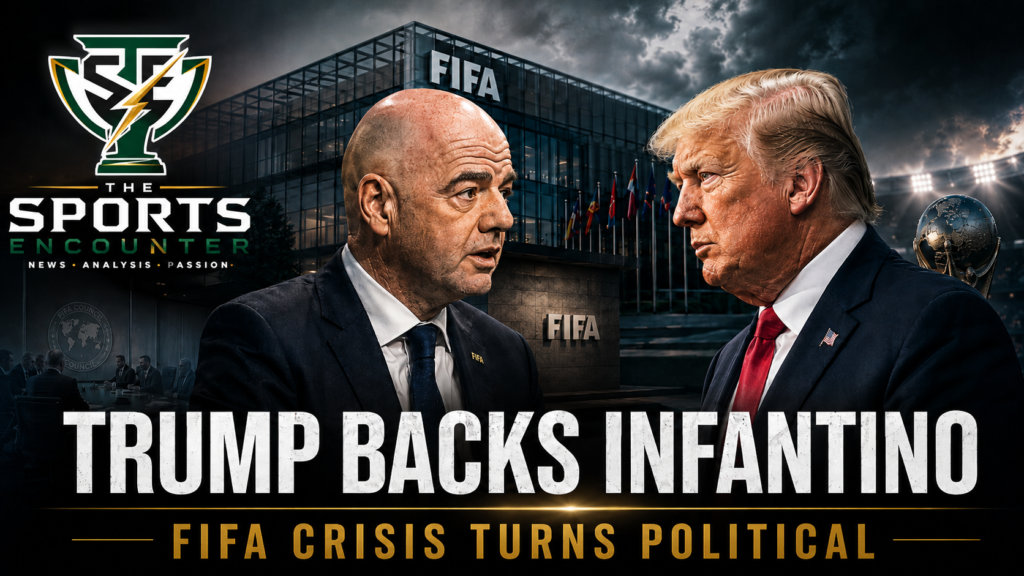
Gianni Infantino entered this week facing the most organized challenge to his authority since he became FIFA president in 2016. UEFA, the Asian Football Confederation and CONCACAF had accused him of breaking trust, demanded an investigation completely independent of FIFA and openly questioned whether his leadership still served world football.
Then Donald Trump stepped in.
The U.S. president warned FIFA that replacing Infantino would be a “terrible mistake,” praised him as “fantastic” and tied his defense directly to what Trump described as the extraordinary commercial success of the 2026 FIFA World Cup.
The intervention gives Infantino something he badly needed after two weeks of institutional revolt: a powerful public ally capable of changing the conversation.
It does not settle the crisis.
UEFA, AFC and CONCACAF collectively represent 136 of FIFA’s 211 voting member associations. U.S. Soccer and Canada Soccer have joined calls for “meaningful” governance reform, while Infantino’s opponents argue that the abandoned World Cup commercial stake proposal exposed a deeper problem involving transparency, consultation and presidential power.
At the same time, Infantino retains considerable support. Almost 70 member associations have publicly indicated they intend to vote for him, CAF has backed him on behalf of its African membership, several Asian associations support his re-election, Mexico remains behind him and important South American federations have also sided with the FIFA president.
The result is a leadership crisis with two competing realities.
Infantino’s authority has been badly tested.
His electoral position may still be strong.
Trump’s intervention now pushes that contradiction into an even more politically sensitive phase.
TL;DR
- Donald Trump says FIFA would make a “terrible mistake” by replacing Gianni Infantino.
- UEFA, AFC and CONCACAF accuse Infantino of breaking trust over the failed World Cup commercial stake proposal.
- The three confederations represent 136 of FIFA’s 211 voting member associations.
- U.S. Soccer and Canada Soccer have backed calls for stronger FIFA governance, transparency and accountability.
- Infantino still has significant support from CAF, parts of Asia, Mexico and several South American associations.
- Almost 70 FIFA associations have publicly backed Infantino ahead of the March 2027 presidential election.
Trump, Infantino and the FIFA Crisis: Key Facts
| Issue | Current Position |
|---|---|
| FIFA President | Gianni Infantino |
| In office since | 2016 |
| Main opposition bloc | UEFA, AFC and CONCACAF |
| Associations represented by opposition bloc | 136 of FIFA’s 211 voting members |
| Trigger for crisis | Failed World Cup commercial rights stake proposal |
| Proposed stake | Approximately 20% |
| Potential capital raised | About $4.2 billion |
| Opposition demand | Fully independent investigation with FIFA having no role |
| Publicly declared Infantino support | Almost 70 associations |
| Trump’s position | Strong public support for Infantino remaining FIFA president |
| Election date | March 18, 2027 |
| Candidate deadline | November 18, 2026 |
Three Confederations Have Turned the Crisis Into an Open Leadership Challenge
Trump’s intervention makes more sense when viewed against what happened immediately before it.
UEFA, AFC and CONCACAF issued a joint open letter to the wider football community attacking Infantino’s conduct during the proposed sale of a minority stake in FIFA’s World Cup commercial business.
The language went far beyond normal institutional disagreement.
The confederations accused Infantino of breaking trust “through deception” and of placing himself above the collective institutions that granted him authority.
The central argument was that football leadership should operate as a responsibility rather than personal possession.
That distinction matters because the dispute has now moved well beyond whether selling a commercial stake was financially attractive.
The Sports Encounter first examined that transformation in our analysis of how FIFA’s $4.2 billion World Cup stake proposal collapsed and damaged Infantino’s authority.
The original plan envisioned selling approximately 20% of a new commercial structure connected to FIFA’s most valuable competitions to private investors.
Potential proceeds of roughly $4.2 billion were presented as a way of creating additional investment and development resources across FIFA’s membership.
The proposal instead triggered resistance from confederations, national associations and senior figures within FIFA itself.
FIFA eventually abandoned it.
The controversy survived.
The Confederations Say Infantino’s Apology Does Not Go Far Enough
Infantino has apologized for mistakes made during the process.
UEFA, AFC and CONCACAF believe that response addresses the wrong problem.
Their criticism is that FIFA has treated the controversy primarily as a failure of procedure when the proposal itself represented, in their view, a fundamental mistake.
The three confederations argue that selling an interest connected to the World Cup should never have reached the stage it did.
That is why they are demanding a review entirely independent of FIFA’s leadership.
The review would examine how the proposal developed, who authorized its progression, how member associations were consulted and why such a transformative commercial decision advanced without broader confidence across world football.
The Sports Encounter explored FIFA’s attempt to repair the damage in our report on Infantino entering survival mode as the revolt spread beyond Europe.
The latest confederation letter suggests that reconciliation remains far away.
The Morocco Meeting Created More Questions
Critics have also focused on FIFA’s emergency leadership meeting in Morocco.
UEFA, AFC and CONCACAF complained that only one elected official was present, reinforcing their argument that the organization’s handling of the crisis remains too concentrated around Infantino and his immediate leadership circle.
FIFA presented the meeting as constructive and supportive of institutional unity.
Infantino emerged with enough internal backing to continue resisting calls for his departure.
His opponents interpreted the same meeting very differently.
For them, the problem has never been whether Infantino can assemble loyal executives around him.
The question is whether FIFA’s elected football institutions still trust the process through which important decisions are made.
U.S. Soccer and Canada Soccer Complicate Trump’s Intervention
This is where Trump’s public support becomes especially interesting.
CONCACAF is one of the three confederations leading the revolt.
U.S. Soccer and Canada Soccer, representing two countries that hosted the 2026 World Cup alongside Mexico, have also supported calls for meaningful changes to FIFA’s governance, transparency and accountability.
Trump therefore finds himself defending Infantino while the soccer federation representing his own country supports the institutional bloc demanding reform.
Canada provides another striking contrast.
Canadian Prime Minister Mark Carney has already said publicly that he does not have confidence in Infantino’s leadership.
That leaves the political leadership of two World Cup co-hosts taking opposite positions on the FIFA president.
The Sports Encounter covered Carney’s intervention as part of the widening governance crisis surrounding Infantino.
Trump Says FIFA Would Make a “Terrible Mistake”
Trump’s response was considerably less cautious.
He argued publicly that FIFA should not even consider replacing Infantino.
Trump tied his endorsement to the 2026 World Cup, describing the tournament as extraordinarily successful and suggesting FIFA would struggle to reproduce that commercial performance without its current president.
That is an important defense because Infantino has consistently built his political case around growth.
Expanded competitions, larger revenues, increased development spending and FIFA’s growing commercial footprint have all become central to his leadership argument.
The 2026 World Cup gave him perhaps the strongest evidence available.
It was the first 48-team men’s World Cup and produced enormous attendance, broadcasting and commercial visibility across North America.
Trump is essentially telling FIFA’s members to judge Infantino by those results.
His opponents want them to judge him by how power was exercised behind the failed commercial proposal.
Trump’s Support May Not Be Entirely Helpful
The endorsement carries obvious value.
Its political usefulness is more complicated.
Trump and Infantino developed a highly visible relationship before and during the World Cup.
Their association already concerned some officials inside the game who believed FIFA’s president had become unusually close to the leader of the tournament’s largest host nation.
The relationship attracted further scrutiny after an investment company run by Joshua Kushner, the brother of Trump’s son-in-law Jared Kushner, emerged as an important participant connected to the proposed commercial transaction.
Trump has said he did not discuss the World Cup stake proposal with Infantino.
There is no verified evidence that his current endorsement resulted from the investment proposal.
Those facts need to remain separate.
The optics are still unavoidable.
Critics already accuse Infantino of concentrating power around personal relationships and limiting collective consultation.
A sitting U.S. president now publicly telling FIFA that removing him would be a mistake may reinforce those concerns among officials who believe political influence has become too visible around the organization.
The Central Contradiction: CONCACAF Opposes Infantino, but Mexico Supports Him
Confederation statements can sometimes create an impression of complete regional unity that does not exist at national-association level.
Mexico is a useful example.
CONCACAF has joined UEFA and AFC in confronting Infantino.
Mexico has nevertheless indicated support for his re-election.
Several AFC nations have also backed him despite the Asian confederation signing the open letter criticizing his conduct.
This distinction could ultimately decide the election.
FIFA presidents are elected by individual member associations.
Confederation leadership can coordinate resistance and apply enormous political pressure, but it cannot automatically deliver every national vote within its region.
The Sports Encounter anticipated this dynamic when we examined why Infantino could increasingly depend on smaller and emerging FIFA nations as opposition hardened among larger football powers.
Africa Has Become Infantino’s Most Important Institutional Shield
CAF’s backing is particularly valuable.
The African confederation has publicly supported Infantino, giving him access to a bloc of 54 member associations at a time when opposition elsewhere has become increasingly organized.
Infantino has spent years cultivating relationships across African football through FIFA development programs, infrastructure spending and greater tournament access.
CAF has emphasized that relationship while continuing to support his leadership.
The mathematical significance is obvious.
If Infantino retains substantial African support and combines it with votes from Asia, South America, Oceania and selected CONCACAF countries, the three-confederation revolt does not automatically translate into electoral defeat.
South America Is Also Far From United Against Him
Important South American associations have publicly supported Infantino.
Argentina, Paraguay, Ecuador and Bolivia are among those siding with him, while CONMEBOL has criticized attempts it considers aimed at destabilizing FIFA’s leadership outside established constitutional procedures.
That gives Infantino another route to electoral survival.
He does not need to win the institutional argument everywhere.
He needs votes.
Almost 70 Associations Have Already Publicly Backed Infantino
Nearly 70 FIFA member associations have publicly indicated support for Infantino’s re-election.
That figure should prevent anyone from assuming the three-confederation revolt has already ended his presidency.
There is still a long road before March.
Potential challengers have until November 18 to enter the race.
A candidate capable of defeating Infantino would need far more than European support.
They would require credibility across Africa, Asia, the Americas and smaller federations whose priorities frequently differ from those of the wealthiest football countries.
The Sports Encounter has already examined the difficulty of converting criticism into an electoral coalition in our continuing soccer and FIFA governance coverage.
136 Associations Oppose His Conduct, but That Does Not Mean 136 Votes Against Him
This may be the most important number in the entire crisis.
UEFA, AFC and CONCACAF together represent 136 of FIFA’s 211 voting associations.
On paper, that is an overwhelming majority.
In practice, it is not an automatic anti-Infantino voting bloc.
Several associations within those confederations have already indicated they intend to back him.
That distinction explains why both sides can currently claim momentum.
The opposition can point to three confederations containing almost two-thirds of FIFA’s membership.
Infantino can point to national associations inside those same regions that remain loyal to him.
The presidential battle therefore depends less on the number of confederations issuing statements and more on what individual associations do when ballots are cast.
FIFA Has Gone on the Offensive
Infantino’s camp has not limited itself to defense.
FIFA recently warned of what it described as a coordinated effort to undermine its president.
The organization argued that challenges to FIFA’s leadership must take place through its statutes and democratic processes rather than through media campaigns or external pressure.
The response followed separate allegations concerning payments made by UEFA during Infantino’s time as the European governing body’s general secretary.
Infantino has denied wrongdoing, and FIFA has rejected the allegations as unfounded.
The organization’s counterattack shows how much the tone has changed.
This is no longer a disagreement over one commercial proposal.
Both sides increasingly speak as though the legitimacy of FIFA’s leadership model itself is under examination.
The Boycott Threat Has Not Completely Disappeared
UEFA, AFC and CONCACAF have also discussed the possibility of refusing participation in FIFA competitions unless they receive assurances that comparable commercialization schemes will not return.
Sources familiar with the dispute have indicated that the confederations have explored organizing competitions among themselves to ensure players would still have elite international football if relations with FIFA deteriorated further.
Whether that possibility ever becomes practical remains uncertain.
The threat itself carries enormous leverage.
World football’s commercial value depends on the participation of its strongest countries and most recognizable teams.
That reality helped kill the original stake-sale proposal.
A World Cup investment structure becomes considerably less attractive if major confederations are threatening to walk away from FIFA competitions.
Infantino’s Authority Has Been Tested Like Never Before
Infantino first became FIFA president in 2016.
For much of the decade since, his political position has appeared remarkably secure.
He expanded competitions, increased FIFA’s revenues and strengthened relationships with smaller associations whose development programs depend significantly on FIFA funding.
The failed World Cup commercial proposal changed that atmosphere.
Senior officials rebelled.
National associations withdrew support.
Confederations coordinated their opposition.
Political leaders became involved.
For the first time in years, the question is not simply how long Infantino wants to remain FIFA president.
It is whether enough of world football still wants him there.
TSE Analysis: Trump Has Given Infantino a Lifeline, Not a Victory
Trump’s intervention matters because leadership contests depend partly on perceptions of strength.
Infantino had spent much of the crisis responding to accusations, apologies, resignations and lost endorsements.
The U.S. president has now changed that rhythm.
One of the world’s most powerful political figures has publicly told football that Infantino should stay.
That sends a message to undecided associations that the FIFA president remains connected to governments, commercial power and the enormous North American market.
It may reassure associations whose primary concern is stability.
It may also harden the opposition.
UEFA, AFC and CONCACAF are arguing that FIFA requires collective leadership, institutional accountability and a presidency less dependent on individual authority.
Trump’s defense cannot answer those concerns.
It could even make them more politically resonant.
That is why calling this a Trump rescue would be premature.
It is a lifeline.
The election remains a football vote.
What Happens Before March 2027?
The November 18 candidate deadline now becomes crucial.
If Infantino remains the only serious candidate, the opposition must decide whether symbolic resistance is enough or whether it can unite around a credible challenger.
If a challenger emerges, the campaign will quickly become a referendum on two competing versions of FIFA.
Infantino will argue that his decade in office delivered unprecedented revenue, expanded competitions, development investment and a commercially enormous World Cup.
His opponents will argue that those achievements cannot justify leadership without sufficient transparency, consultation and institutional restraint.
The official FIFA Congress will ultimately provide the arena where those arguments become votes.
Final Verdict: Trump Changed the Politics, but He Cannot Cast the Ballots
Donald Trump has given Gianni Infantino the strongest external endorsement he could realistically have hoped for.
It arrived when UEFA, AFC and CONCACAF were attempting to frame his presidency as a leadership problem rather than a single commercial mistake.
Trump offers the opposite interpretation.
He sees a FIFA president who presided over an enormously successful World Cup and should be allowed to continue.
World football now has to decide which argument matters more.
The opposition represents 136 member associations through its three confederations.
Infantino has almost 70 associations publicly backing him, plus strong institutional support from Africa and important allies across other regions.
Those two realities can coexist because FIFA’s election is decided association by association.
Trump may influence the atmosphere.
He cannot deliver those votes himself.
That is why the Infantino crisis remains unresolved.
The failed stake-sale proposal began as a debate about who should share in the commercial value of the World Cup.
It has evolved into something larger.
Who should control FIFA?
How much authority should belong to its president?
What happens when political power enters an internal football dispute?
And after ten years under Gianni Infantino, does FIFA believe commercial success outweighs the trust his opponents say has been broken?
Trump has made his choice.
In March, FIFA’s associations will eventually have to make theirs.
Frequently Asked Questions
What did Donald Trump say about Gianni Infantino?
Trump said FIFA would make a “terrible mistake” if it considered replacing Infantino and strongly praised his performance following the 2026 World Cup.
Why are UEFA, AFC and CONCACAF attacking Infantino?
The three confederations say the handling of FIFA’s abandoned World Cup commercial stake proposal damaged institutional trust and exposed serious problems involving consultation, transparency and presidential authority.
How many FIFA associations do UEFA, AFC and CONCACAF represent?
Together, the three confederations represent 136 of FIFA’s 211 voting member associations.
Does that mean 136 associations will vote against Infantino?
No. Several associations within AFC and CONCACAF have already indicated support for Infantino. Confederation opposition does not automatically determine how each national association votes.
How much of the World Cup business did FIFA propose selling?
The abandoned proposal involved approximately a 20% stake in a commercial structure connected to FIFA competitions, with the transaction potentially raising about $4.2 billion.
How much support does Infantino currently have?
Almost 70 FIFA member associations have publicly indicated support for his re-election, while CAF has backed him and additional support has emerged from Asia, CONCACAF and South America.
When is the next FIFA presidential election?
The election will take place at the FIFA Congress in Rabat, Morocco, on March 18, 2027.
When must candidates challenge Infantino?
Potential candidates have until November 18, 2026 to declare their candidacy.
How is the FIFA president elected?
FIFA’s member associations vote individually. A candidate requires a two-thirds majority in the first round or a simple majority in subsequent rounds.
Can Donald Trump determine whether Infantino stays?
No. Trump can provide significant political support, but FIFA’s national member associations control the presidential vote.
How long has Gianni Infantino been FIFA president?
Infantino was first elected in February 2016 and has now led world football’s governing body for more than a decade.