


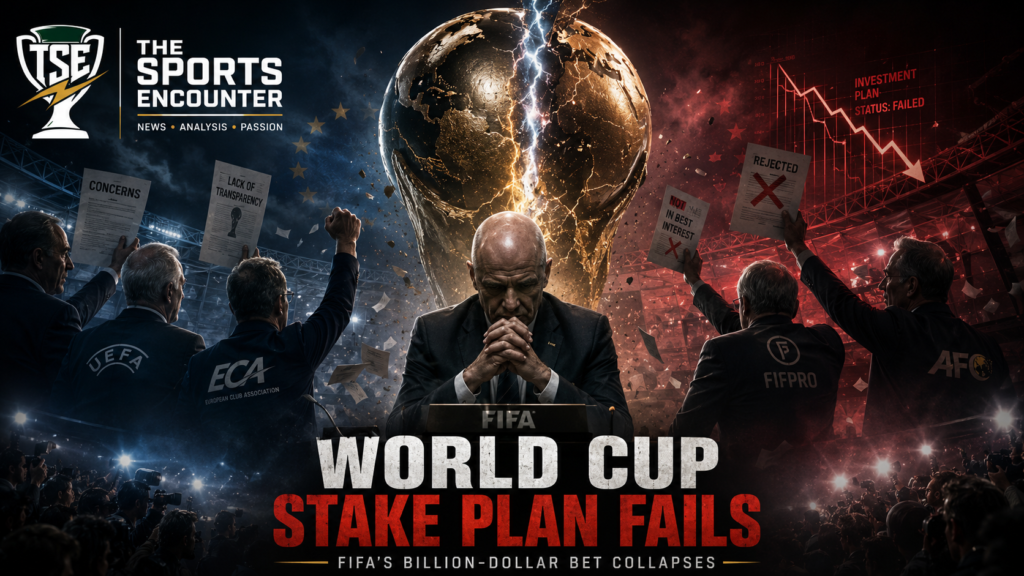
Gianni Infantino entered the final week of July 2026 in the strongest position of his FIFA presidency.
The most commercially successful World Cup in history had concluded less than two weeks earlier. FIFA was forecasting record revenue. Infantino appeared on course to seek another term without meaningful opposition, while the organization he had led since 2016 looked financially stronger than at any previous point.
Three days later, the landscape had changed.
FIFA had withdrawn a proposal to sell approximately 20% of a new commercial company controlling the business and operational delivery of the World Cup and other competitions. UEFA had threatened to boycott FIFA tournaments. Concacaf and the Asian Football Confederation had joined the resistance. A senior adviser had resigned in protest. FIFA’s chief operating officer had accused staff of being deceived.
Wales then became the first national federation to formally withdraw its support for Infantino’s re-election for the 2027-2031 term.
The planned FIFA Forward Enterprise was supposed to unlock as much as $4.2 billion from private investors and turn the World Cup’s enormous commercial power into development funding for FIFA’s 211 member associations.
Instead, it exposed deep distrust inside world soccer.
The proposal failed because FIFA tried to separate commercial ownership from sporting control in a competition where the two can never be fully disconnected. It failed because national associations were presented with a historic governance decision before many felt they had been properly consulted. It failed because UEFA was able to frame the argument in a sentence every supporter could understand: the World Cup is not an investment product.
Above all, it failed because the asset offered to investors loses much of its value if the strongest football regions refuse to participate.
FIFA abandoned the sale, but the argument it created has not disappeared. The crisis now concerns governance, trust, private capital, Infantino’s future, and a more fundamental question about world soccer:
Who actually owns the World Cup?
FIFA World Cup Stake Plan: Key Facts
| Issue | Detail |
|---|---|
| Proposed entity | FIFA Forward Enterprise |
| Proposed valuation | Approximately $20 billion |
| Stake offered | Roughly 20% |
| Potential capital raised | Up to $4.2 billion |
| Assets involved | Commercial rights and tournament operations covering broadcast, sponsorship, ticketing, hospitality, licensing, and new ventures |
| Proposed lead investor | Thrive Eternal, associated with Thrive Capital |
| FIFA member associations | 211 |
| Potential funding offer | Up to $40 million per member association for the 2027-2030 cycle |
| Major opposition | UEFA, Concacaf, AFC, senior FIFA officials, and national federations |
| Outcome | Proposal withdrawn on July 31, 2026 |
What FIFA Was Actually Trying to Sell
The controversy was often reduced to the phrase “selling the World Cup.” Technically, FIFA was not proposing to transfer the tournament itself or hand private investors the authority to select host nations, write competition rules, or control sporting decisions.
The structure was more complicated and, in some ways, more consequential.
FIFA wanted to create a subsidiary called FIFA Forward Enterprise. The new company would consolidate the commercial rights associated with FIFA competitions and combine them with tournament delivery operations.
Those commercial assets included broadcasting, sponsorship, licensing, ticketing, hospitality, and potential new ventures. FIFA would retain control, while outside investors would acquire a minority interest believed to be close to 20%.
At a proposed valuation of around $20 billion, the sale could have raised up to $4.2 billion.
FIFA presented the company as a specialist commercial vehicle capable of capturing value that the existing governing-body structure was leaving behind. Infantino argued that the game had become far more valuable, but too little of that growth was reaching countries without major broadcasting markets, stadium infrastructure, or wealthy domestic leagues.
In an official explanation of the project, the FIFA president described FIFA Forward Enterprise as a golden opportunity to expand investment in pitches, national teams, youth pathways, and women’s football.
Under the proposed funding model, standard FIFA Forward support could have increased from $8 million per member association in the 2023-2026 cycle to $20 million for 2027-2030.
Associations could also have accessed another $20 million through a separate fast-track mechanism, taking the potential total to $40 million each.
The political appeal was obvious.
Many FIFA members do not generate enough domestic revenue to build training centers, fund youth teams, support women’s programs, or maintain international competition schedules. A dramatic increase in distributions could transform football development in those countries.
The proposal therefore combined two powerful arguments.
First, FIFA had a financial asset whose commercial potential might exceed what its traditional structure could unlock.
Second, private investment could supposedly convert that unrealized value into immediate development spending.
The problem was that the company’s value would come from competitions that FIFA does not create alone.
The World Cup exists because national associations supply the teams, clubs employ and develop the players, leagues organize the calendar, supporters create demand, broadcasters pay for access, and governments provide infrastructure and security.
FIFA owns and administers the competition. It does not manufacture the entire ecosystem that gives the tournament its value.
That distinction became the center of the revolt.
The Difference Between Commercialization and Ownership
Soccer has never been protected from commerce.
The World Cup already sells broadcasting packages, global sponsorships, hospitality programs, licensing rights, digital products, merchandise, and tickets. FIFA’s revenue model depends on extracting commercial value from the competition and redistributing part of that income across the global game.
UEFA also operates highly commercial competitions. The Champions League is one of the world’s most valuable annual sporting properties. European federations, leagues, and clubs have spent decades building structures around media rights, sponsorship, and private investment.
The dispute was therefore not a simple battle between commercial FIFA and idealistic UEFA.
It concerned ownership interests and permanent obligations.
A sponsor pays for association with the World Cup. A broadcaster purchases the right to show it. A hospitality operator sells premium access. Those relationships are contractual and limited.
An equity investor owns part of the company.
That ownership creates a different expectation. Investors do not provide billions of dollars because they admire football development. They expect the value of their stake to grow and the company to produce returns.
Once private capital enters the ownership structure, tournament decisions may still formally belong to FIFA. However, commercial pressure becomes continuous.
More matches can mean more broadcasting inventory. More teams can open new national markets. More frequent tournaments can produce additional sponsorship cycles. Dynamic ticket pricing can increase matchday revenue. New digital rights can be packaged and sold.
Every sporting decision acquires an investor dimension.
This was the core argument developed in The Sports Encounter’s earlier analysis of how the $20 billion World Cup proposal threatened to become a global soccer revolt.
The concern was not that private investors would select lineups or appoint referees. It was that the commercial logic of shareholder returns could begin shaping the environment in which sporting decisions are made.
Why UEFA’s Response Was So Powerful
UEFA did not oppose the plan through cautious administrative language.
It turned the proposal into a moral argument.
After an emergency meeting, UEFA and all 55 of its national associations unanimously rejected the sale and threatened to withdraw their teams from FIFA competitions while the project remained active.
The official UEFA statement opposing the FIFA investment plan argued that the World Cup had been built across generations by players, teams, associations, and supporters.
UEFA’s most effective message was simple: the World Cup was being held in trust, not owned like a conventional corporate asset.
That framing moved the debate away from valuation models and development grants.
Instead of asking whether $4.2 billion was a good price, UEFA asked whether FIFA possessed the moral authority to sell any ownership interest at all.
The 55-0 vote also removed the possibility that FIFA could dismiss the objection as a disagreement between a few powerful European countries and the rest of the world.
Every UEFA association stood behind the boycott position.
The Sports Encounter documented the significance of that unified threat in its report on UEFA’s unanimous vote to boycott FIFA competitions.
A World Cup without European teams would not remain the same product.
Europe supplies many of the tournament’s strongest national teams, highest-profile players, largest television markets, and most valuable sponsors. Any investor valuing FIFA Forward Enterprise would have to consider the possibility that UEFA’s absence could destroy a large portion of the company’s projected worth.
The boycott threat therefore worked on two levels.
Politically, it challenged FIFA’s legitimacy.
Commercially, it challenged the valuation of the proposed investment.
The Revolt Became Global When Concacaf Said No
FIFA might have survived opposition from UEFA alone by presenting the dispute as another chapter in the long rivalry between the global governing body and Europe’s wealthy soccer establishment.
That interpretation became much harder when Concacaf rejected the proposal.
The confederation represents 41 associations across North America, Central America, and the Caribbean. Its intervention carried unusual weight because the United States, Canada, and Mexico had just hosted the 2026 World Cup.
Concacaf had benefited directly from FIFA’s largest tournament and its commercial success. It could not easily be characterized as an outside region trying to protect itself from an event it did not support.
The confederation’s unanimous rejection showed that discomfort extended into the territory where the latest World Cup had been staged.
The Sports Encounter analyzed why this mattered in its report on Concacaf’s rejection of the World Cup stake plan.
Concacaf’s 41 votes combined with UEFA’s 55 to create a bloc of 96 associations.
FIFA required majority support among its 211 members. The project had not yet been formally defeated, but the political space around it was narrowing rapidly.
The official Concacaf platform represents associations whose approval would have been essential to any claim that the proposal served the global game rather than one leadership faction.
The AFC’s Intervention Destroyed the Arithmetic
The Asian Football Confederation then aligned itself with UEFA and Concacaf.
The AFC represents 47 associations. When added to UEFA’s 55 and Concacaf’s 41, the opposition reached 143 FIFA members.
That was well beyond half of FIFA’s total membership.
Once the Asian Football Confederation publicly stood with the other regions, the proposal was no longer merely controversial. Its route to democratic approval had effectively disappeared.
The Asian response also attacked the process.
Reports described anger over a lack of consultation and an unacceptable departure from normal institutional protocols. That criticism mattered because FIFA had presented the project as the beginning of a democratic consultation.
For opponents, the process appeared reversed.
They believed investors had been approached, a lead group had been identified, a valuation had been developed, and a new entity had been designed before key football stakeholders had been given a meaningful role.
FIFA insisted nothing had been decided and that member associations would have the final vote.
Its critics argued that consultation should begin before a project reaches that level of preparation.
The $40 Million Offer Created the Wrong Political Impression
Infantino wrote to FIFA’s member associations explaining that each could potentially receive up to $40 million if the proposal was approved.
From FIFA’s perspective, this was the central benefit.
The investment was not being raised to enrich a private owner or remove money from soccer. It was designed to release capital that could be distributed across the global game, especially to countries most dependent on FIFA support.
Yet the timing and structure of the offer created political problems.
Associations were being asked to approve a permanent change in the commercial ownership model of FIFA competitions while being shown an extraordinary financial benefit attached to the decision.
UEFA characterized this as coercive rather than democratic.
That may be a severe interpretation, but the perception became damaging. The argument was no longer simply about whether national associations supported private investment. It became a question of whether financial dependence could influence their judgment.
For smaller federations, $40 million could fund infrastructure and programs for years. Rejecting that sum in defense of an abstract governance principle is much easier for wealthy associations than for countries without modern stadiums, training centers, or secure domestic revenue.
This tension is central to FIFA politics.
Every member has one vote, whether it represents a major global soccer economy or a tiny football nation. FIFA’s redistribution model gives smaller associations influence and resources that regional wealth alone would never provide.
Infantino has built much of his political strength through that structure.
The failure of FIFA Forward Enterprise does not eliminate the financial needs that made the proposal attractive. It merely shows that development funding cannot be used to bypass confidence, consultation, and governance legitimacy.
Thrive Capital and the Kushner Connection Made the Optics Worse
According to the proposal described by FIFA and subsequent reporting, Thrive Eternal was expected to lead the investor group. The fund was connected to Thrive Capital, founded by Joshua Kushner.
Joshua Kushner is the brother of Jared Kushner, the son-in-law of United States President Donald Trump.
There is no evidence that Trump directed the plan, participated in negotiations, or discussed the investment with Infantino. Trump said he had not spoken to the FIFA president about it.
The problem was perception.
Infantino’s relationship with Trump had already attracted scrutiny during and before the 2026 World Cup. FIFA had awarded Trump its inaugural Peace Prize, while the U.S. president publicly said he contacted Infantino about the suspension of American forward Folarin Balogun.
Balogun was later cleared to play after a decision by FIFA’s independent disciplinary structure, but the public intervention intensified debate about political access and institutional independence.
The Sports Encounter examined that controversy in its analysis of how Trump’s intervention transformed a disciplinary issue into a FIFA governance argument.
Against that background, the involvement of an investment firm connected to the Kushner family made the sale harder to defend publicly.
Even without evidence of improper influence, the arrangement allowed opponents to connect private capital, political proximity, and Infantino’s leadership style into one damaging narrative.
A proposal of this sensitivity required impeccable transparency.
Instead, its optics generated suspicion before supporters had successfully explained its structure.
The Crisis Moved Inside FIFA
External opposition damaged the proposal. Internal rebellion damaged Infantino.
Carlos Cordeiro, one of the FIFA president’s senior advisers, resigned with immediate effect and described the plan as a bad deal for football.
FIFA chief operating officer Kevin Lamour then accused the leadership of deceiving staff and reportedly characterized the plan as the project of one person.
Those interventions changed the nature of the crisis.
Confederations can oppose FIFA for strategic reasons. UEFA and FIFA frequently disagree over the international calendar, tournament expansion, club competitions, and control of commercial revenue.
A senior adviser resigning and an operational executive publicly criticizing the process suggest something deeper: parts of FIFA itself did not believe the proposal had passed through a credible institutional process.
The Sports Encounter covered that internal fracture in detail when Cordeiro resigned and Lamour challenged the World Cup selloff from inside FIFA.
The internal criticism reinforced the accusation that Infantino had personalized FIFA’s decision-making.
Since replacing Sepp Blatter in 2016, Infantino has expanded FIFA’s revenues, increased funding to member associations, enlarged competitions, and strengthened the president’s direct relationships across global soccer.
That approach has produced political loyalty and financial growth.
It has also generated frustration among those who believe major decisions are developed around the president rather than through transparent institutional structures.
FIFA Forward Enterprise became the point where that leadership style encountered organized resistance strong enough to stop it.
Why FIFA Withdrew the Proposal So Quickly
The official consultation was supposed to last several weeks.
The proposal survived only days.
On July 31, FIFA issued a statement attributed to Infantino acknowledging that the project had created divisions no longer compatible with its original purpose.
The official FIFA statement withdrawing the proposal said the organization’s purpose was to unite and improve football and confirmed that the plan would not proceed.
The speed of the retreat reflected four realities.
1. FIFA had lost the votes
UEFA, Concacaf, and the AFC represented 143 associations. Even allowing for differences within those confederations, the public position made majority approval politically unrealistic.
2. The investment became commercially unstable
A company built around FIFA competitions cannot be valued normally if major confederations threaten to remove their teams. Investors seek predictable assets. The boycott threat created the opposite.
3. Internal opposition weakened executive authority
Resignations and public criticism from senior figures made it increasingly difficult to present the proposal as a mature institutional strategy.
4. Continuing the fight risked permanent damage
The 2027 Women’s World Cup and other FIFA competitions could have faced participation uncertainty. Legal disputes, document preservation demands, and prolonged governance conflict would have threatened sponsors and broadcasters.
Withdrawing the proposal did not solve those problems, but it prevented them from becoming immediate operational crises.
The World Cup Was Never a Normal Investment Product
The commercial theory behind FIFA Forward Enterprise was not irrational.
Sports properties have attracted major private investment. Funds have purchased stakes in leagues, media companies, commercial rights platforms, clubs, and tournament businesses.
Private capital can provide expertise, technology, international networks, and immediate liquidity.
However, the World Cup differs from a domestic league or privately owned club competition.
Its participants are national teams. Those teams represent associations that also own FIFA politically through the Congress structure. Players are supplied by clubs that receive limited direct control over the event. Governments support host infrastructure. Fans attach national identity to the competition.
The event has commercial value because it carries a public and cultural meaning beyond ordinary entertainment.
That is why equity ownership creates unusual tension.
A private investor might own only part of a commercial subsidiary, yet the underlying cash flows depend on a tournament treated by supporters as a shared sporting inheritance.
UEFA’s argument succeeded because it translated this complexity into a matter of stewardship.
FIFA may own the rights. It does not own the emotional history alone.
Did UEFA Act From Principle or Self-Interest?
UEFA’s position should not be treated as economically neutral.
European soccer has enormous commercial interests of its own.
The international calendar determines when UEFA can stage national-team competitions. Expanded FIFA tournaments affect European leagues and clubs. A financially stronger FIFA could gain greater influence over commercial markets currently dominated by European competitions.
UEFA also understands the value of controlling its own rights and protecting its institutions from external pressure.
Its opposition therefore combined principle with strategy.
That does not invalidate the governance argument.
Institutions often defend principles most strongly when those principles also protect their authority. FIFA’s mistake was creating a proposal that allowed UEFA’s political interests to align with a persuasive public case.
The threat of a European breakaway competition demonstrated how far the conflict could have moved. The Sports Encounter explored that possibility in its report on whether UEFA could create an alternative version of the World Cup.
A genuine rival tournament remained an extreme scenario. FIFA controls global structures, historical legitimacy, and relationships across every confederation.
Nevertheless, the fact that the idea entered serious discussion showed how badly FIFA had misread the scale of resistance.
The Collapse Has Reopened Infantino’s Re-Election
Before the stake proposal, Infantino’s next term looked close to secure.
He had overseen a financially successful World Cup and remained deeply connected to member associations that benefited from FIFA funding. No major rival had established a clear campaign.
The failed sale changed the political calculation.
Infantino is no longer entering the election simply as the president who delivered record revenue. He is also the leader who proposed a fundamental commercial restructuring without building enough support among confederations, officials, and national associations.
Wales became the first federation to formally withdraw its support.
The Football Association of Wales cited failures involving governance, process, leadership, values, stakeholder management, communication, and judgment.
That decision matters beyond one vote.
Political challenges often begin when one association proves that public withdrawal is possible. Other federations can now reconsider their positions without appearing to initiate the rebellion.
UEFA and Concacaf have also indicated that confidence in Infantino’s leadership has been damaged.
Potential challengers will study whether that dissatisfaction can be converted into a viable campaign.
Infantino remains difficult to defeat.
Many associations depend heavily on FIFA funding. His administration has expanded distributions and increased playing opportunities. He maintains relationships across Africa, Asia, Oceania, the Americas, and smaller European federations.
A presidential election is decided by national associations, not journalists, supporters, club owners, or commercial analysts.
He would require a two-thirds majority in the first round or a simple majority in later voting.
The failed plan has made a contest more likely. It has not guaranteed his removal.
The 2018 Warning FIFA Did Not Learn From
This was not Infantino’s first attempt to bring major private investment into FIFA competitions.
In 2018, he supported a proposal involving approximately $25 billion in external capital connected to expanded tournament plans, including the Club World Cup.
That initiative also encountered strong resistance from UEFA and other stakeholders and was eventually abandoned.
The resemblance is important.
Both projects promised significant new revenue. Both were connected to competition restructuring. Both generated concerns over transparency and consultation. Both underestimated UEFA’s willingness to resist.
The 2026 proposal was more politically sophisticated because it directly connected investment proceeds to development funding for all 211 member associations.
Yet the central process problem remained.
Financial scale was treated as a substitute for consensus.
Soccer governance does not work that way. Money can build support, but it cannot erase questions about ownership, legitimacy, and institutional authority.
The World Cup’s Commercial Success Made the Plan Harder to Explain
FIFA introduced the proposal immediately after an exceptionally lucrative World Cup.
That timing weakened the urgency of the investment argument.
If FIFA were facing financial decline, it could have argued that external capital was needed to protect development funding and secure the future of its competitions.
Instead, the organization was forecasting record revenue.
FIFA said its 2027-2030 cycle could generate around $14 billion even before the proposed new structure delivered additional value.
Supporters and associations were therefore entitled to ask why a financially thriving organization needed to sell a permanent minority interest in its commercial engine.
The answer was that FIFA believed future value could grow faster with specialized investors and business expertise.
That may be commercially sound, but it is less emotionally convincing than a rescue plan.
The proposal looked like monetization at the top of the market.
Earlier concerns over World Cup ticket pricing and commercial access had already created tension. The Sports Encounter examined those pressures in its analysis of how ticket prices and changing demand affected the 2026 tournament’s revenue picture.
Against that background, the stake sale appeared to extend the same commercial logic from tickets and hospitality into the ownership structure itself.
What FIFA Was Right About
The proposal failed, but several problems identified by FIFA remain real.
Global soccer revenue is distributed unevenly.
A small group of leagues, clubs, broadcasters, and national markets capture a large proportion of the game’s commercial value. Many associations lack basic facilities, stable youth development, professional women’s structures, and sufficient funding to compete internationally.
FIFA’s argument that more value should reach those countries is difficult to reject.
The organization was also correct that specialized commercial expertise may unlock revenue more effectively than a traditional governing-body administration.
Broadcasting is changing. Digital platforms are creating new packages. Direct-to-consumer products, data services, gaming, licensing, and global sponsorship can be developed beyond established models.
FIFA should explore those opportunities.
The mistake was assuming that private equity ownership was the necessary mechanism.
FIFA could create internal commercial subsidiaries without selling equity. It could hire specialist executives, establish performance incentives, enter limited strategic partnerships, license specific products, or use debt structures that do not transfer ownership.
Development funding can be expanded without permanently attaching shareholder rights to the World Cup’s commercial operations.
What FIFA Must Do Next
Infantino said he intended to bring stakeholders together and continue pursuing growth for countries that need support most.
That process will require more than changing the investor or reducing the stake.
Publish the full governance rationale
Member associations need to understand who developed the proposal, which advisers were involved, how the $20 billion valuation was reached, what investor rights were contemplated, and how sporting independence would have been protected.
Separate development funding from political approval
Future proposals should not create the impression that associations must accept structural change to unlock money they urgently need.
Consult before negotiating
Confederations, associations, leagues, clubs, player representatives, and supporter groups should participate before an investment structure approaches final form.
Create clear limits on private ownership
FIFA may need a formal rule defining whether equity interests can ever be sold in entities connected to its competitions.
Repair internal trust
The resignation of a senior adviser and public criticism from an executive cannot be treated as normal disagreement. FIFA must show that staff and governance bodies are involved in major strategic decisions.
Address election concerns openly
Infantino must decide whether he will defend the process, apologize for it, or argue that the proposal was misunderstood. Avoiding the issue will allow opponents to define it for him.
Could the Plan Return Under Another Name?
UEFA demanded more than the withdrawal of the current proposal.
It sought binding assurances that FIFA would not revive private ownership through a different structure.
That demand reflects an obvious concern.
The commercial logic behind FIFA Forward Enterprise has not disappeared. The World Cup remains extraordinarily valuable. Investors remain interested in global sports assets. FIFA still wants more development revenue.
A future version could reduce the equity percentage, limit investor rights, exclude tournament operations, or focus only on selected commercial categories.
It could also be presented as a partnership rather than a stake sale.
UEFA will scrutinize any such model for the same underlying issue: whether external investors obtain a permanent ownership interest in cash flows created by FIFA competitions.
The Sports Encounter’s previous analysis asking whether the 2030 World Cup was truly no longer for sale remains relevant because withdrawal does not equal philosophical surrender.
FIFA has abandoned this project.
It has not abandoned the search for commercial growth.
What the Failure Means for the 2030 World Cup
The crisis arrived as FIFA was already considering the future shape of its flagship tournament.
The 2030 World Cup will span multiple countries and continents. Proposals have also circulated around further expansion, including a possible 64-team edition.
Those ideas now face a more skeptical political environment.
Competition expansion cannot be separated from commercial incentives. More teams and matches create wider participation, but they also generate additional broadcasting inventory, sponsorship exposure, ticket sales, and market access.
After the stake-plan controversy, every future expansion debate will carry a sharper question:
Is the change being made for sporting inclusion or commercial growth?
The Sports Encounter explored that conflict in its analysis of whether a 64-team World Cup would improve the tournament or stretch it too far.
FIFA will need to provide stronger sporting evidence for major format changes. The days when revenue growth could be presented as an automatic benefit to the global game may be ending.
The Real Winner Was Collective Resistance
UEFA will claim victory, but the plan did not collapse through European power alone.
Concacaf’s rejection removed the argument that the dispute was purely regional. The AFC’s intervention destroyed the voting pathway. Internal dissent weakened Infantino’s authority. National federations began reassessing their political support.
The resistance worked because multiple parts of soccer’s governance system acted together.
That is significant in an era when powerful sports institutions often present major commercial changes as unavoidable.
The FIFA proposal was financially ambitious, backed by the promise of development money, and promoted by one of the most influential leaders in world sport.
It still failed.
The collapse shows that football’s institutional checks remain capable of operating when confederations, associations, executives, and supporters recognize a shared threat.
Final Verdict: The Plan Failed Because FIFA Misunderstood Its Own Product
FIFA believed it was offering investors a minority interest in a commercial company.
Its opponents believed it was offering part of football’s greatest public institution.
That difference was never resolved.
The financial case relied on separating business rights from sporting governance. The political case against the plan relied on showing that the separation was artificial.
Investors would not have owned the trophy, selected the teams, or written the Laws of the Game. They would still have owned part of a company whose returns depended on the World Cup becoming more commercially valuable.
That was enough to trigger resistance.
The project also failed because of process. FIFA announced a consultation after the structure, valuation, investor interest, and development promises had already advanced. Confederations felt they were being asked to approve a direction they had not helped shape.
The $40 million offer to each association strengthened the development argument but weakened confidence in the politics. Internal resignations suggested the lack of consultation extended inside FIFA itself.
Infantino eventually withdrew the proposal because the arithmetic, investment case, and institutional support had collapsed together.
The World Cup stake plan is dead.
The consequences are still developing.
Wales has withdrawn its support for Infantino. Other associations may follow. Rival candidates now have an issue capable of uniting regions that do not usually share the same priorities. UEFA has demonstrated that a boycott threat can force FIFA into retreat.
Infantino may survive the crisis and win another term. His funding network, political relationships, and record of revenue growth remain formidable.
However, he is no longer untouchable.
The most important lesson reaches beyond one president.
FIFA administers the World Cup and controls its commercial rights. Yet the competition draws its legitimacy from teams, players, associations, clubs, supporters, and generations of shared history.
That makes the World Cup immensely valuable.
It also makes it almost impossible to sell.
Frequently Asked Questions
What was FIFA’s World Cup stake plan?
FIFA proposed creating FIFA Forward Enterprise, a new subsidiary that would combine the commercial rights and operational delivery of the World Cup and other FIFA competitions. Approximately 20% of the company could have been sold to private investors.
How much money did FIFA hope to raise?
FIFA hoped to raise up to approximately $4.2 billion through the proposed minority stake sale. The new company was reportedly valued at around $20 billion.
Why did FIFA want private investment?
FIFA argued that specialist investment and commercial expertise could unlock more value from broadcasting, sponsorship, ticketing, hospitality, licensing, and new digital ventures. The additional revenue would then support football development across FIFA’s 211 member associations.
How much funding could each FIFA association have received?
FIFA said member associations could potentially access up to $40 million each during the 2027-2030 cycle through increased FIFA Forward funding and an additional fast-track development program.
Why did UEFA oppose the proposal?
UEFA argued that the World Cup should not become an investment product and that private ownership would create permanent pressure to prioritize shareholder returns. It also criticized FIFA for developing the proposal without sufficient consultation.
Did UEFA threaten to boycott the World Cup?
UEFA and its 55 national associations said European teams would not participate in FIFA competitions while the proposal remained active unless FIFA abandoned it completely and provided assurances against similar private ownership structures.
Which confederations opposed FIFA’s stake plan?
UEFA, Concacaf, and the Asian Football Confederation publicly opposed the proposal. Together, they represent 143 of FIFA’s 211 member associations.
Why was the support of 143 associations decisive?
FIFA said the project would proceed only with majority approval from its member associations and the FIFA Council. Opposition from confederations representing 143 members meant the proposal no longer had a realistic path to majority support.
Who was expected to lead the investor group?
Thrive Eternal, a fund associated with Thrive Capital, was expected to lead the proposed investor group. Thrive Capital was founded by Joshua Kushner.
Did Donald Trump have a role in the FIFA proposal?
No evidence has shown that Donald Trump designed, directed, or negotiated the proposal. Trump said he had not discussed the investment plan with Gianni Infantino.
Why did Carlos Cordeiro resign?
Carlos Cordeiro resigned from his role as a senior adviser to Infantino after calling the proposal a bad deal for football.
What did FIFA chief operating officer Kevin Lamour say?
Kevin Lamour reportedly said FIFA staff had been deceived and described the proposal as the project of one person, intensifying criticism of the internal decision-making process.
When did FIFA withdraw the proposal?
FIFA announced on July 31, 2026, that the FIFA Forward Enterprise proposal would not proceed after Infantino acknowledged that it had created damaging divisions.
Has the Football Association of Wales withdrawn support for Infantino?
Yes. Wales became the first national association to formally withdraw support for Infantino’s re-election for the 2027-2031 FIFA presidential term.
Can Gianni Infantino still win another term?
Yes. Infantino remains politically influential and retains strong relationships with many FIFA member associations. However, the failed proposal has increased the likelihood of rival candidates and made his re-election less certain.
Could FIFA revive the stake plan later?
The current proposal has been withdrawn, but FIFA may continue exploring other ways to increase commercial revenue. Any future structure involving private ownership would likely face intense resistance and demands for stronger consultation.
Does FIFA own the World Cup?
FIFA legally administers the World Cup and controls its commercial rights. Opponents of the stake plan argued that FIFA holds the competition in trust for the wider football community and therefore lacks the moral authority to transfer ownership interests to private investors.