


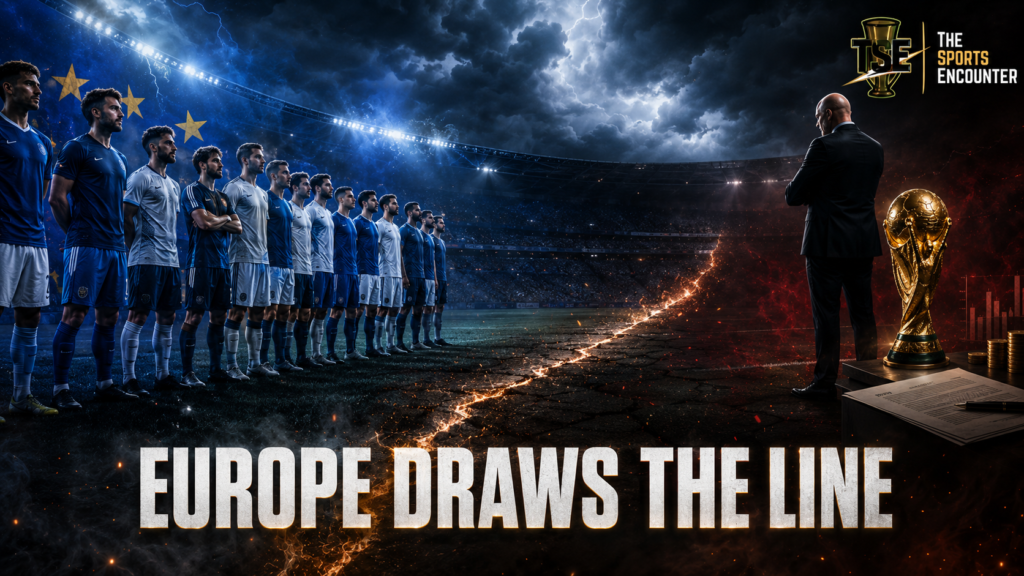
UEFA and its 55 national associations have unanimously agreed to boycott FIFA competitions if Gianni Infantino continues pursuing private investment in a new company built around the World Cup and other FIFA tournaments.
The decision followed an emergency virtual meeting on Thursday, July 30, and transformed a bitter governance dispute into one of the most serious institutional confrontations in modern soccer.
European associations voted 55-0 to reject the proposal. Under the position announced after the meeting, UEFA national teams will refuse to participate in FIFA competitions while the plan remains active.
UEFA also wants FIFA to provide binding assurances that private ownership will never be introduced into its competitions through the proposed structure or a similar future arrangement.
“The World Cup cannot be treated as an investment product,” UEFA said in its official statement issued with its 55 associations. “It is one of football’s greatest sporting legacies.”
The boycott remains conditional. European teams have not withdrawn immediately, and FIFA still has an opportunity to abandon or substantially reconsider the proposal. However, UEFA has made its threshold clear: modification alone may no longer be enough.
UEFA-FIFA Boycott Crisis: Key Facts
| UEFA vote | 55-0 against FIFA’s proposal |
| Proposed company | FIFA Forward Enterprise |
| Initial valuation | $20 billion |
| Target capital raise | Up to $4.2 billion |
| Investor interest | Minority, non-controlling stakes |
| Assets involved | Broadcasting, sponsorship, ticketing, licensing and tournament delivery |
| FIFA members | 211 national associations |
| First major senior tournament at risk | 2027 FIFA Women’s World Cup in Brazil |
What Has UEFA Actually Decided?
UEFA has committed its national associations to withholding their teams from FIFA competitions if the private-investment proposal continues.
Its statement said no European national team would participate “for so long as these proposals remain alive” unless FIFA abandons the plan completely and provides binding guarantees against private ownership of FIFA competitions.
This goes considerably further than an expression of concern or a threat to vote against the proposal. Europe has placed participation in FIFA tournaments directly on the negotiating table.
The immediate calendar could include youth competitions before the dispute reaches a senior World Cup. European teams are scheduled to participate in FIFA age-group tournaments in late 2026, while the next senior global event is the 2027 Women’s World Cup in Brazil.
UEFA’s wording focuses on national teams, making the precise effect on club tournaments less certain. FIFA competitions involving European national sides, from youth level to the senior World Cups, face the clearest danger.
What Is FIFA Forward Enterprise?
Despite the language surrounding a “sale of the World Cup,” FIFA is not proposing to sell the trophy, the tournament’s name or FIFA itself.
The proposal would establish FIFA Forward Enterprise, or FFE, as a FIFA-controlled subsidiary. It would bring together commercial rights and the operational delivery of the governing body’s tournament portfolio.
That portfolio would include some of global soccer’s most valuable assets:
- Broadcasting rights
- Commercial sponsorships
- Ticketing
- Licensing
- Tournament operations
- Commercial rights connected to men’s, women’s and youth competitions
FIFA intends to raise up to $4.2 billion by selling minority, non-controlling interests in the company at an initial equity valuation of $20 billion.
According to FIFA’s official explanation of the proposal, the governing body would retain exclusive authority over soccer governance, competition rules, international calendars and sporting decisions.
Infantino has described the structure as a way to unlock more commercial value and distribute it throughout the global game. FIFA says all net benefits would return to soccer development.
The Sports Encounter previously examined why selling minority interests connected to the World Cup could create long-term commercial pressure, even if investors receive no formal authority over sporting decisions.
Why UEFA Believes the World Cup Is Being Privatized
UEFA’s objection reaches beyond the percentage offered to investors. European officials believe the proposed structure would give outside capital an ownership interest in the commercial engine and operational delivery of FIFA competitions.
Minority investors may lack formal control, but they would still expect financial returns. That expectation could influence the company’s commercial priorities, including broadcasting packages, sponsorship inventory, ticket pricing, hospitality, tournament formats and the frequency with which competitions are staged.
BREAKING: UEFA will boycott FIFA tournaments if Gianni Infantino goes ahead with his proposal to sell off a stake in the World Cup 🚨
— Sky Sports News (@SkySportsNews) July 30, 2026
The decision was taken at an emergency meeting of all UEFA’s 55 member associations this afternoon. pic.twitter.com/HuEXAHiJKF
FIFA maintains that sporting governance would remain protected. UEFA argues that commercial ownership and sporting policy cannot remain completely separate when the company’s value depends on how tournaments are packaged, expanded and sold.
That concern helps explain the force of UEFA’s response:
“No part of it should ever be surrendered to private investors. The World Cup is not for sale.”
The dispute follows earlier criticism of FIFA’s commercial strategy, including ticket pricing and the wider management of the expanded tournament. Infantino recently defended several FIFA World Cup 2026 decisions in an open letter, but the investment proposal has created a much wider governance crisis.
The $20 Million and $40 Million Funding Question
Reports surrounding the proposal have used both $20 million and $40 million figures. The distinction matters.
FIFA’s published plan offers every member association an optional one-time allocation of up to $20 million through the proposed Fast-Forward program. It would also increase regular FIFA Forward funding for the 2027-2030 cycle from the currently budgeted $8 million to $20 million per association.
That creates a possible total of $40 million across the immediate capital allocation and the four-year development cycle. It does not mean every association would receive an unrestricted $40 million payment on the day of approval.
Future cycle funding would rise to $22 million for 2031-2034 and $24 million for 2035-2038 under FIFA’s proposal.
For smaller associations, this is a powerful offer. Many depend heavily on FIFA funding for training facilities, national teams, grassroots development, coaching programs and women’s soccer.
UEFA sees the funding package and decision deadline as pressure placed on associations to accept a permanent structural change in exchange for immediate financial benefits.
AFC and Concacaf Opposition Changes the Vote
Europe represents 55 of FIFA’s 211 members, so UEFA cannot defeat the proposal through its votes alone. The wider reaction is therefore crucial.
The Asian Football Confederation has 47 member associations, while Concacaf represents 41. Together with UEFA, those confederations account for 143 FIFA members.
That does not guarantee 143 opposing votes because every national association holds its own FIFA vote. It does show that concern has spread well beyond Europe.
AFC President Sheikh Salman bin Ebrahim Al Khalifa described FIFA’s lack of consultation as “totally unacceptable” and warned that unilateral decision-making was undermining solidarity, cooperation and transparency within world soccer.
Concacaf said it learned about the proposal through media reporting and FIFA’s subsequent announcement. Its official response expressed deep concern about the lack of due process.
The broader revolt gives added weight to The Sports Encounter’s earlier analysis of whether the FIFA-UEFA dispute could develop into a global soccer rebellion. That possibility has now become far more credible.
Would a World Cup Without Europe Be Commercially Viable?
A FIFA World Cup without UEFA nations would lose many of its most successful teams, largest television audiences and most valuable commercial markets.
Europe supplies countries such as Spain, England, France, Germany, Italy, Portugal and the Netherlands. Spain entered the post-2026 cycle as world champion, while European nations also occupy a central position in global broadcasting and sponsorship markets.
Statement on behalf of UEFA and its 55 National Associations
— UEFA (@UEFA) July 30, 2026
The commercial impact would reach well beyond missing teams. Broadcasters, sponsors and prospective FFE investors would have to reconsider the value of a tournament without Europe’s largest soccer economies.
The record U.S. audience generated by the 2026 World Cup final illustrated the tournament’s enormous media power. Much of that value depends on the presence of elite national teams and globally recognized players.
A boycott could therefore weaken the asset FIFA is attempting to monetize. Private investors are unlikely to value a World Cup commercial company at $20 billion if its flagship tournaments face the loss of an entire confederation.
Why the 2027 Women’s World Cup Faces the Most Immediate Risk
The next senior World Cup is the 2027 women’s tournament in Brazil. Europe holds 11 guaranteed places in the 32-team competition, and its absence would remove several leading contenders.
Spain are the defending champions, while England reached the previous final. Other European teams remain among the strongest and most commercially valuable nations in women’s soccer.
This creates an uncomfortable consequence. UEFA’s action is aimed at FIFA’s governance and commercial model, but the first senior players affected could be women preparing for a career-defining tournament.
European officials may hope the commercial and political threat forces FIFA to retreat before any withdrawal becomes necessary. Allowing the dispute to reach Brazil would damage FIFA, UEFA, players, broadcasters, sponsors and supporters simultaneously.
What Happens Next?
FIFA must decide whether to withdraw the proposal, extend the consultation period, restructure FFE or test whether Infantino can assemble enough support among the 211 associations.
UEFA has left little room for a cosmetic compromise. Its demand covers the complete abandonment of the plan and binding protection against comparable private ownership proposals in the future.
The positions adopted by individual AFC and Concacaf associations will help determine whether FIFA still has a realistic voting path. Responses from the Confederation of African Football, CONMEBOL and the Oceania Football Confederation will also become increasingly important.
Legal scrutiny may follow. Questions are already being raised about whether a simple majority would be sufficient if the structure changes how FIFA’s commercial assets and competitions are held. Competition law, FIFA statutes and the rights of member associations could all enter the dispute.
Fans can follow the wider consequences through The Sports Encounter’s FIFA World Cup coverage hub and its broader soccer news and analysis section.
Final Analysis: UEFA Has Attacked the Proposal’s Economic Foundation
UEFA’s 55-0 decision does more than oppose Infantino politically. It strikes directly at the economic case behind FIFA Forward Enterprise.
The proposed company requires investors to believe that FIFA’s tournament portfolio offers stable, expandable and globally protected revenue. A European boycott introduces uncertainty into every part of that calculation.
FIFA can point to billions in new development funding and promise that sporting control will remain untouched. UEFA sees a permanent transfer of economic influence over competitions built by national teams, players and supporters.
Both institutions now claim they are protecting world soccer’s future. Their definitions of protection could hardly be further apart.
The argument began over how to finance and commercialize FIFA’s competitions. It has reached the point where the World Cup itself could lose many of the national teams that give it global authority.
The Sports Encounter’s World Cup 2026 coverage focuses on fixtures, team news, match analysis, fan stories, tournament trends, and the biggest talking points from football’s global stage.