


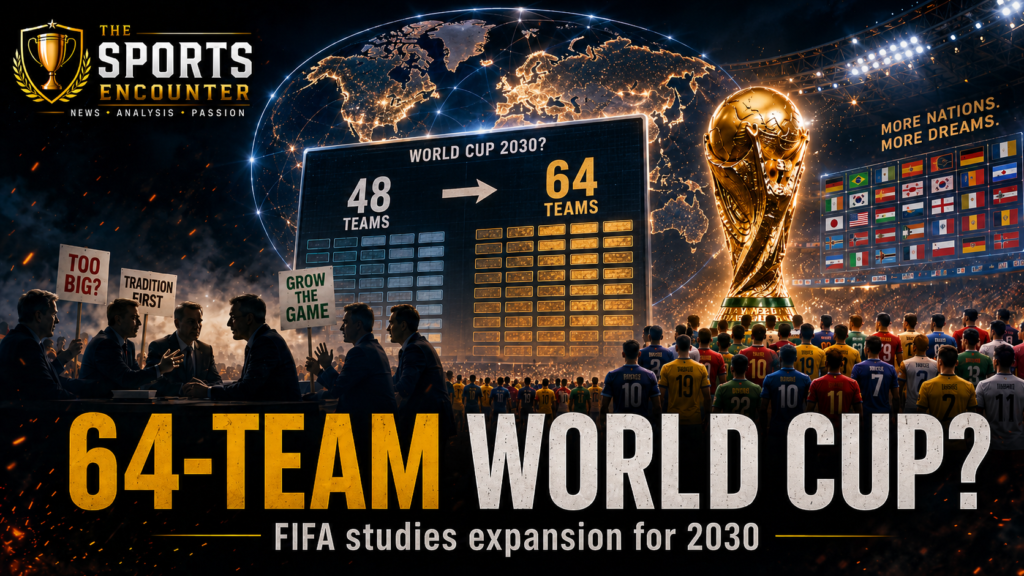
FIFA has commissioned an accelerated study into the viability of expanding the 2030 World Cup from 48 to 64 teams. The proposal promises more nations, matches, revenue, and global representation, but it also raises serious questions about competitive quality, player welfare, scheduling, logistics, and whether football’s biggest tournament is growing faster than the game can support.
The first 48-team FIFA World Cup has barely entered history, yet the governing body is already considering another major expansion.
FIFA wants an independent agency to examine whether the 2030 World Cup should increase from 48 to 64 national teams. Such a move would add another 16 countries to a tournament that expanded from 32 teams only four years earlier.
The study will assess the sporting, financial, operational, and commercial consequences of a 64-team competition. FIFA wants detailed analysis of ticket revenue, sponsorship, media rights, qualification structures, player welfare, competitive balance, tournament duration, and market demand.
The timetable is unusually tight. FIFA plans to select the research agency on August 14, with the final recommendation due by September 11. The chosen firm will therefore have only four weeks to evaluate a structural change capable of reshaping international football.
The proposal originated with CONMEBOL, whose leaders believe a 64-team tournament would allow more nations to participate in the World Cup’s centenary celebration. The 2030 edition will be hosted primarily by Morocco, Portugal, and Spain, while Argentina, Paraguay, and Uruguay will each stage one commemorative match.
Those six hosts are already guaranteed places under the current plan. Expanding the field could reduce the political and competitive pressure created by automatic qualification while giving every confederation additional places.
The central question is not whether FIFA can organize a 64-team World Cup. With enough money, stadiums, broadcasters, and host cities, it almost certainly can.
The real question is whether it should.
FIFA’s 64-Team World Cup Study at a Glance
| Category | Current or Proposed Position |
|---|---|
| Current World Cup size | 48 national teams |
| Proposed 2030 size | 64 national teams |
| Additional teams | 16 |
| Likely match total | Potentially 128 matches if FIFA retains a similar format |
| 2026 match total | 104 matches |
| Main 2030 hosts | Morocco, Portugal, and Spain |
| Centenary match hosts | Argentina, Paraguay, and Uruguay |
| Proposal promoted by | CONMEBOL |
| Research agency selection | August 14, 2026 |
| Study deadline | September 11, 2026 |
| Main opposition | UEFA and AFC leadership |
Why FIFA Is Seriously Considering 64 Teams
The proposal offers an attractive political message.
A 64-team World Cup would allow nearly one-third of FIFA’s 211 member associations to participate. More countries would experience qualification, national celebration, commercial exposure, and the developmental benefits connected with reaching football’s biggest stage.
Regions with limited historical access would receive additional opportunities. Africa, Asia, Concacaf, Oceania, and South America could all gain places without reducing Europe’s representation.
Qualification could become more inclusive for emerging football nations that often reach the final stages of their confederation campaigns but fall short because of limited allocations.
The expanded 2026 tournament already demonstrated how broader representation can generate new narratives. The Sports Encounter’s guide to the 48-team World Cup qualification system showed how the additional places changed the competitive picture before and during the tournament.
More participants also mean more national television audiences, sponsors, traveling supporters, merchandise markets, and digital engagement. Each new qualifier brings millions of potential viewers who might otherwise follow the competition less intensely.
That commercial opportunity will sit near the center of FIFA’s research.
The Revenue Case Could Be Difficult for FIFA to Resist
A 64-team tournament could create 128 matches if FIFA uses 16 groups of four followed by a 32-team knockout stage.
That would mean 24 more matches than the 104-game schedule used in 2026 and twice as many as the 64 matches played under the old 32-team structure.
Each additional fixture creates another television window, ticket inventory, sponsorship activation, hospitality package, betting market, licensing opportunity, and stream of digital content.
The commercial potential becomes even clearer after the 2026 competition proved the scale of global demand. The expanded tournament ran across three countries and generated a five-week calendar of matches, content, and commercial activity.
Its final between Spain and Argentina became a major global event, as reflected in The Sports Encounter’s complete build-up to the 2026 World Cup final.
FIFA will examine whether a larger field can generate sustainable incremental value rather than one cycle of temporary revenue growth.
That distinction matters. More matches do not guarantee stronger demand. The 2026 tournament showed that ticket interest could change sharply when host nations and globally popular teams were eliminated. Our analysis of the World Cup ticket-market decline during the knockout stage demonstrated how dependent commercial value can become on specific teams and star players.
A 64-team World Cup would increase the supply of matches. FIFA must prove that global demand can absorb that supply without reducing the importance and value of individual fixtures.
Did the 48-Team World Cup Work?
FIFA should not decide the future of the tournament without conducting an honest review of 2026.
The 48-team format produced more participating nations, a Round of 32, and a longer period of meaningful football. It also created a complicated system in which eight of the 12 third-placed teams advanced.
That structure kept more countries alive until the final group matches. Goal difference, goals scored, and comparisons between separate groups became central to qualification.
The uncertainty generated drama, but it also weakened the consequences of finishing third. Two-thirds of the teams survived the group stage, meaning only 16 of 48 participants were eliminated before the knockout rounds.
The Sports Encounter’s examination of the Lucky 8 race for the Round of 32 captured the tension created by the new system.
Later results offered a more complicated verdict. Seven of the eight third-place qualifiers were eliminated immediately, while Paraguay became the only Lucky 8 team to survive the Round of 32.
Our follow-up analysis of what happened to the World Cup’s third-place qualifiers raised an important question: did the expanded system create genuine contenders or mainly delay elimination?
FIFA should answer that before increasing the tournament again.
Competitive Dilution Is the Strongest Argument Against Expansion
A World Cup should bring together the strongest national teams from every part of the game.
Expansion improves representation, but every additional qualification place lowers the entry threshold. Some confederations may struggle to provide enough teams capable of competing with established powers.
That could produce more one-sided games, cautious underdog strategies, and group-stage fixtures with limited global appeal.
Smaller nations can surprise stronger opponents. Football’s history is filled with upsets that justify giving emerging teams a chance.
The concern is not that lower-ranked teams do not belong. It is whether adding 16 more countries produces enough competitive value to justify the larger tournament.
A competition becomes diluted when quantity grows faster than quality. FIFA’s agency must examine score margins, expected-goal differences, possession imbalances, shot totals, competitive match time, and the percentage of games carrying meaningful qualification consequences.
The 2026 Round of 32 produced several compelling moments, as explored in The Sports Encounter’s analysis of the first expanded knockout round. FIFA must determine whether those moments justified the added layer or merely increased the journey before elite teams reached one another.
Player Welfare Cannot Become a Footnote
Modern football already carries severe concerns about workload.
Players move between expanded club competitions, domestic leagues, continental tournaments, international qualifiers, Nations League matches, and preseason tours. Adding another week to the World Cup could place more physical strain on athletes who arrive after demanding club seasons.
A larger field does not necessarily require individual teams to play more matches. The champion could still complete an eight-game route, as under the 2026 format.
The wider event would last longer, however, and require more players to remain in tournament camps. Travel, training, recovery, media duties, and emotional pressure all contribute to workload even when a team is not playing.
The six-country 2030 structure already creates unusual logistical demands. Argentina, Paraguay, and Uruguay will each host a centenary match before the main competition continues in Morocco, Portugal, and Spain.
FIFA’s official 2030 World Cup hosting plan includes additional rest and travel periods for teams involved in South America.
Adding 16 teams and potentially 24 matches would increase the strain on training sites, hotels, airports, security systems, medical services, transport networks, and broadcast operations.
A 64-Team Format Would Be Cleaner in One Important Way
The proposal does contain a structural advantage.
Sixty-four teams can be divided neatly into 16 groups of four. The top two in each group could advance into a 32-team knockout stage.
That would eliminate the need to compare third-placed teams across different groups.
Every nation would know that finishing first or second guarantees progression, while third and fourth mean elimination. The bracket could become more predictable and easier for fans to understand.
The format would restore some of the clarity lost in 2026, when teams depended on results from other groups and a complex table of third-place qualifiers.
Such simplicity is valuable, but it comes at a high price: 16 additional teams and another 24 matches.
FIFA must decide whether fixing one structural weakness justifies making the overall tournament considerably larger.
The Four-Week Study Raises Governance Questions
The quality of FIFA’s decision will depend on the quality and independence of its research.
Four weeks is a remarkably short period for evaluating a tournament that could involve six host countries, 64 teams, 128 matches, dozens of stadiums, and billions of dollars in commercial rights.
The research agency must model several formats, confederation allocations, travel schedules, venue requirements, broadcast packages, ticket demand, player workloads, security costs, and long-term market effects.
It must also consult players, coaches, leagues, clubs, confederations, broadcasters, sponsors, supporters, and host authorities.
A compressed study risks becoming a financial forecast rather than a genuine assessment of football’s interests.
The timing will attract further scrutiny because FIFA is already facing a governance crisis over its separate proposal to bring private investors into a commercial company connected with the World Cup.
The Sports Encounter has examined why the proposed World Cup stake sale has alarmed football stakeholders. More matches would create more commercial inventory, making expansion especially sensitive while FIFA debates private investment.
Why UEFA and the AFC Oppose the Proposal
UEFA President Aleksander Čeferin has described the 64-team concept as a poor idea. Asian Football Confederation President Sheikh Salman bin Ebrahim Al-Khalifa has also questioned where continuous expansion will end.
Their concerns involve competitive dilution, calendar congestion, and the loss of qualification value.
Europe may also fear a reduced share of global influence if other confederations receive most of the additional places. That political interest should be acknowledged, but it does not invalidate UEFA’s sporting concerns.
Qualification matters partly because it is difficult. A World Cup place represents years of planning, pressure, and national ambition.
Expanding access can inspire new football cultures. Expanding too far can make qualification feel routine for established countries while weakening the drama of regional campaigns.
Would a 64-Team World Cup Be Worth It?
The answer depends on what FIFA values most.
From a financial perspective, the proposal could become extremely attractive. More matches and participating nations should create additional media, ticketing, sponsorship, and hospitality opportunities.
From a development perspective, more countries would gain exposure, funding, experience, and national engagement.
The sporting case remains less convincing.
FIFA has not yet allowed the 48-team model to establish itself across multiple cycles. The format debuted in 2026 and would disappear after one edition if the 2030 tournament expands again.
Four years is not enough time to measure its effect on qualification, confederation development, competitive balance, fan interest, or commercial sustainability.
Constant expansion also risks turning the World Cup into a permanent experiment.
The tournament’s power comes from rarity, difficulty, and concentration. More access can strengthen its global meaning. Too much access can weaken the value of reaching it.
Final Verdict
A 64-team World Cup is operationally possible and commercially tempting. That does not make it necessary.
The centenary provides an emotional argument for inclusion, particularly when the tournament returns symbolically to Uruguay, where the first World Cup was held in 1930.
Yet football should not make a permanent structural decision because one edition carries ceremonial importance.
FIFA first needs a complete and transparent evaluation of the 48-team tournament. It should publish evidence on match quality, player workload, supporter demand, ticket performance, environmental impact, operational pressure, and the value created for participating nations.
The governing body must also allow enough time for serious consultation. Four weeks may produce financial projections, but it is difficult to believe such a brief process can fully assess the future of the world’s biggest sporting competition.
A 64-team format could create cleaner groups, broader representation, and historic moments for emerging nations. It could also produce 128 matches, another week of football, diluted qualification, heavier logistical demands, and a tournament whose scale overwhelms its meaning.
For now, FIFA should improve the 48-team model rather than immediately replacing it.
The World Cup does not need to become larger after every successful commercial cycle. Its next challenge should be becoming better.
Frequently Asked Questions
Is FIFA expanding the 2030 World Cup to 64 teams?
No final decision has been made. FIFA is commissioning an independent study to assess whether expansion from 48 to 64 teams would be viable and beneficial.
Why is FIFA considering a 64-team World Cup?
Supporters of the proposal believe it would allow more countries to participate in the tournament’s centenary edition while generating additional ticketing, sponsorship, media, and development revenue.
Who proposed the 64-team World Cup?
CONMEBOL formally promoted the proposal as a way to broaden participation in the 2030 centenary celebration.
How many matches would a 64-team World Cup have?
A structure featuring 16 groups of four and a 32-team knockout stage would produce 128 matches.
How many matches were played at the 2026 World Cup?
The 48-team tournament contained 104 matches, up from 64 under the previous 32-team format.
Where will the 2030 World Cup be held?
Morocco, Portugal, and Spain will host the main tournament. Argentina, Paraguay, and Uruguay will each stage one centenary celebration match.
Why do UEFA and the AFC oppose expansion?
Their leaders have raised concerns about competitive dilution, calendar congestion, operational complexity, player welfare, and continuous tournament growth.
Would the 64-team format include third-place qualifiers?
Not necessarily. Sixteen groups of four could send the top two teams directly into a Round of 32, eliminating the third-place qualification system used in 2026.
When will FIFA receive the expansion study?
FIFA expects to appoint the research agency on August 14, with the final analysis scheduled for September 11, 2026.
Is a 64-team World Cup worthy of the centenary?
It could broaden global participation, but FIFA must prove that the sporting and developmental benefits outweigh concerns about quality, workload, logistics, and commercial saturation.