


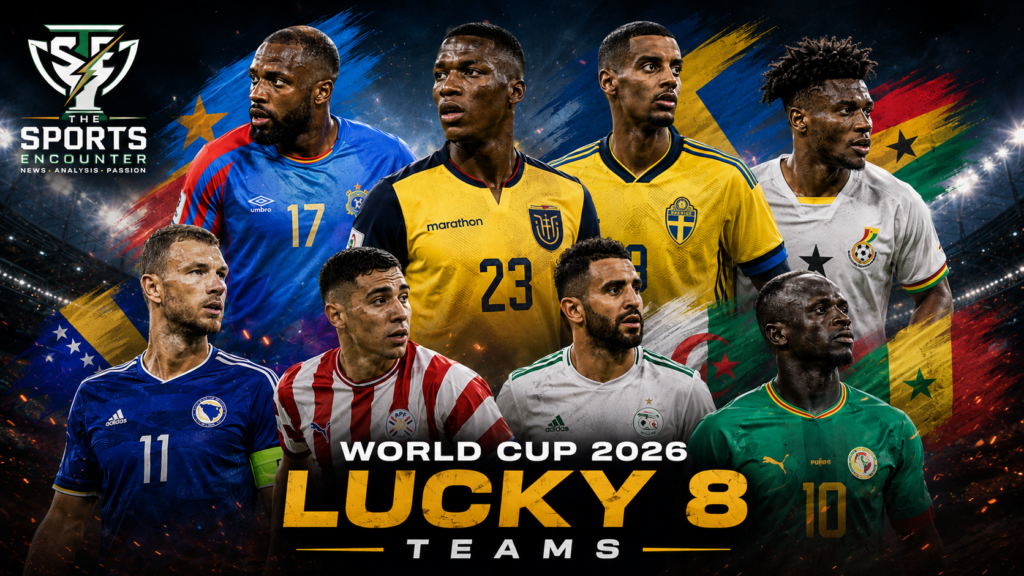
Thirty-two teams entered the first knockout round of the expanded FIFA World Cup. Eight of them arrived through a door that had never existed at a men’s World Cup before.
DR Congo, Ecuador, Sweden, Ghana, Bosnia and Herzegovina, Paraguay, Algeria, and Senegal had all finished third in their groups. Their records were imperfect, but the new 48-team format gave them another chance to show that third place did not have to mean second-rate.
The experiment produced seven immediate eliminations, one historic upset, several painful near-misses, and a clear lesson about the difference between surviving a group and managing a knockout match.
TL;DR
- Paraguay became the only Lucky 8 team to reach the Round of 16.
- Paraguay eliminated Germany on penalties after a 1-1 draw.
- France then ended Paraguay’s run with a narrow 1-0 victory.
- DR Congo led England before losing 2-1.
- Senegal pushed Belgium into a five-goal contest but lost 3-2.
- Ecuador, Sweden, Ghana, Bosnia and Herzegovina, and Algeria all exited without scoring.
- The Lucky 8 won one of their nine combined knockout matches.
- Seven of the eight teams were eliminated in the Round of 32.
- Four African Lucky 8 teams were knocked out, but several left with their reputations enhanced.
- The expanded format created opportunity, though the knockout draw exposed the quality gap between many third-place qualifiers and group winners.
Lucky 8 Knockout Results
| Lucky 8 team | Round of 32 opponent | Result | Final stage reached |
|---|---|---|---|
| DR Congo | England | Lost 2-1 | Round of 32 |
| Ecuador | Mexico | Lost 2-0 | Round of 32 |
| Sweden | France | Lost 3-0 | Round of 32 |
| Ghana | Colombia | Lost 1-0 | Round of 32 |
| Bosnia and Herzegovina | United States | Lost 2-0 | Round of 32 |
| Paraguay | Germany | Drew 1-1, won 4-3 on penalties | Round of 16 |
| Algeria | Switzerland | Lost 2-0 | Round of 32 |
| Senegal | Belgium | Lost 3-2 | Round of 32 |
FIFA’s expanded format sent the top two teams from each of the 12 groups into the knockout stage alongside the eight highest-ranked third-place finishers. The resulting Round of 32 added 16 knockout games and allowed teams with four points, and in Senegal’s case three, to continue their tournaments. The full picture can be followed through FIFA’s official World Cup standings and knockout records.
The Sports Encounter identified the eight teams as the Lucky 8 before the Round of 32 began. Together, they carried a combined group-stage record of eight wins, eight draws, and eight defeats. Seven had collected four points. Senegal advanced with three after scoring eight goals in a chaotic Group I campaign.
What followed showed that all third-place finishes were far from equal.
Paraguay Turned a Lifeline Into a Historic Upset
Paraguay entered the Round of 32 with one win, one draw, one loss, and only two group-stage goals. Their minus-two goal difference offered little reason to expect them to eliminate Germany.
Knockout football gave them a different setting.
Paraguay accepted that Germany would control more of the ball. They protected the middle, defended with patience, and trusted goalkeeper Orlando Gill whenever Germany broke through. A 1-1 draw carried the game into penalties, where Gill and Paraguay held their nerve to win the shootout 4-3.
The result made Paraguay the only Lucky 8 team to cross the first knockout barrier.
That distinction mattered because Paraguay stopped looking like a team that had merely benefited from tournament expansion. They became a legitimate Round of 16 participant by eliminating one of international football’s traditional powers.
Their next assignment exposed the other side of the Lucky 8 route.
France had already crushed Sweden 3-0 and arrived with Kylian Mbappé moving confidently through the tournament. Paraguay again defended deep, reduced space between the lines, and forced France into a slower match than Didier Deschamps would have preferred.
Gill produced another strong performance and kept Paraguay within touching distance. Mbappé eventually broke the resistance from the penalty spot in the 70th minute, giving France a 1-0 victory and closing the Lucky 8 chapter.
The final score carried disappointment, though Paraguay had forced a title contender to work for every opening. Their performance also reinforced the wider argument explored in The Sports Encounter’s original Lucky 8 analysis: a third-place team could still become dangerous if it understood its limitations and managed knockout moments well.
Paraguay’s two knockout games produced a useful measure of their tournament. They conceded twice across 210 minutes, excluding the shootout, while facing Germany and France. Their attack remained limited, but their defensive organization gave them a chance in both matches.
Among the Lucky 8, they were the clearest example of what a second opportunity could become.
DR Congo Came Closest to Joining Paraguay
DR Congo’s 2-1 loss to England carried more emotional weight than the scoreline suggests.
The African side had reached the knockouts from Group K with four points, four goals scored, and three conceded. Their physical strength, direct running, and willingness to challenge opponents made them one of the more uncomfortable third-place qualifiers.
Against England, DR Congo did more than remain competitive. They took the lead and forced one of the tournament favorites into a genuine recovery.
England eventually found two late goals and escaped with a 2-1 victory. The result continued a pattern that followed England deeper into the tournament: falling behind, absorbing pressure, and relying on individual quality to change the match.
For DR Congo, the frustration came from seeing the opportunity so clearly.
They had moved ahead, unsettled England, and brought the game within reach of one of the biggest victories in their football history. Their inability to manage the final phase proved decisive. Legs tired, spaces widened, and England found the moments that strong knockout teams often create when an opponent begins thinking about survival.
The result eliminated DR Congo, yet their performance carried more value than a routine last-32 appearance. They showed that an African third-place qualifier could confront an elite European side with ambition rather than damage limitation.
Of the seven Lucky 8 teams eliminated immediately, DR Congo came closest to changing the wider story.
Senegal Attacked Belgium and Paid for the Open Spaces
Senegal entered the Round of 32 with the strangest Lucky 8 profile.
They had lost twice in the group stage, collected only three points, and still scored eight goals. Their positive goal difference reflected a team that could create chances and produce attacking bursts but could also lose control of matches.
That volatility followed them into their meeting with Belgium.
Senegal scored twice and remained alive in a contest that produced five goals. Their pace, movement, and willingness to commit players forward caused Belgium problems. At several moments, the Lions of Teranga looked capable of turning the match into the Lucky 8’s second great upset.
Belgium’s greater precision ultimately decided the game.
The European side possessed enough creators to punish the spaces Senegal left behind. Belgium won 3-2, ending a Senegal campaign that had supplied plenty of action but little defensive security.
Senegal left the tournament with ten goals scored across four matches. That total reflected attacking talent and ambition. It also came with nine goals conceded, a balance that rarely supports a long knockout run.
Their exit showed that entertainment and tournament control often pull in different directions. Senegal had enough attacking quality to frighten Belgium. They lacked the defensive calm needed to finish the job.
Ecuador’s Strongest Upset Case Faded in Mexico City
Before the Round of 32, Ecuador appeared to have the most credible upset case among the Lucky 8.
They had beaten Germany 2-1 during the group stage. Their overall record of one win, one draw, and one loss came with only two goals conceded. A compact structure and aggressive pressing style looked suitable for a tense knockout match.
The problem was the opponent and the setting.
Mexico entered the game as co-hosts with the crowd, stadium energy, and an unbeaten record behind them. Ecuador needed to control the early emotional surge. Instead, Julián Quiñones and Raúl Jiménez scored before halftime, giving Mexico the kind of game state the hosts wanted.
Ecuador pushed after the break but could not break a Mexican defense that had grown in confidence throughout the tournament.
A stoppage-time red card for Piero Hincapié added frustration to a 2-0 defeat. The sight of one of Ecuador’s most important defenders leaving the field summarized a night when patience disappeared as the possibility of recovery faded.
The match also reinforced a broader World Cup pattern covered throughout The Sports Encounter’s FIFA World Cup 2026 coverage: host nations can turn emotional momentum into a tactical advantage when they score first and force the opponent to chase.
Ecuador’s campaign became difficult to judge.
Their victory over Germany proved they could beat elite opposition. Their inability to score against Mexico suggested that producing one major group-stage result had hidden limitations in their attack.
They entered the knockouts with the strongest Lucky 8 credentials and left without creating the expected upset.
France Made Sweden Look Further Away Than They Were
Sweden’s numbers promised drama.
They scored seven goals and conceded seven in the group stage, finishing third in Group F with four points. Their matches had movement, chances, and vulnerability. France represented the worst possible opponent for that profile.
Kylian Mbappé scored twice, Bradley Barcola added another, and France won 3-0.
Sweden struggled to protect the spaces France attacked most aggressively. Mbappé’s movement stretched the defensive line, while France’s speed turned Swedish turnovers into immediate danger. Once the first goal arrived, Sweden had to chase. That only made the pitch larger for France.
The defeat was the heaviest suffered by any Lucky 8 team in the Round of 32.
Sweden’s exit also exposed the difference between scoring freely in group matches and creating reliable chances against an elite knockout defense. Their seven earlier goals had suggested attacking depth. Against France, they lacked the control needed to bring their forwards into dangerous areas.
The match became another example of how the tournament favorites separated themselves during the knockout stage, a trend that remained central to The Sports Encounter’s ongoing World Cup analysis.
Sweden’s campaign ended with seven goals scored and ten conceded. The numbers told the story of a team that could contribute to exciting matches but could not dictate them.
Ghana Competed With Colombia but Could Not Find the Final Pass
Ghana entered the knockout stage after a group campaign built on narrow margins.
A win over Panama and a draw with England had given the Black Stars enough protection to survive a 2-1 loss to Croatia in their final Group L match. That defeat still sent Ghana through as one of the eight best third-place teams.
Colombia ended that journey with a 1-0 win in Kansas City.
Jhon Arias scored in the 14th minute, allowing Colombia to protect space, defend with aggression, and manage the rhythm of the match. Ghana kept pushing but struggled to turn possession and effort into clear chances.
The Black Stars did enough to keep the contest alive. They could not produce the final pass, run, or finish required to change it.
That distinction matters. Ghana were never overwhelmed. Colombia simply handled the key moments more efficiently.
Knockout matches often punish teams that need several opportunities to settle. Ghana conceded early and spent the rest of the evening trying to repair the damage. Colombia stayed compact and ensured that the equalizer never arrived.
The result fit a wider pattern seen across the Lucky 8’s path into the knockout stage. Several teams were competitive enough to stay close, but very few had the attacking quality to recover once they fell behind.
Ghana finished the tournament with three goals scored across four matches. Their competitive spirit traveled well. Their attacking output did not.
Bosnia and Herzegovina Could Not Silence the Hosts
Bosnia and Herzegovina reached the Round of 32 with four points and five group-stage goals.
Their minus-one goal difference showed both sides of their tournament. They could threaten opponents, though defensive gaps remained. Facing the United States placed those weaknesses under immediate pressure.
The Americans won 2-0 and became one of three host nations to reach the Round of 16.
Bosnia needed to slow the pace, frustrate the crowd, and create uncertainty. The United States instead controlled the major phases and protected its lead with greater energy and depth.
A Round of 32 appearance still carried significance for Bosnia and Herzegovina. Their tournament gave the squad experience in meaningful matches and introduced several players to a global audience. Yet the knockout performance lacked the attacking conviction seen during parts of the group stage.
The expanded field had delivered access. The United States demonstrated the standard required to stay.
For Bosnia, the result became another example of a Lucky 8 side meeting an opponent with more control, greater depth, and home-field momentum.
Algeria’s Hope Disappeared Against Switzerland
Algeria reached the knockout stage after one of the wildest group campaigns among the Lucky 8.
They scored five goals, conceded seven, and finished third in Group J with four points. Their ability to attack made them dangerous. Their defensive record made every match unstable.
Switzerland gave them very little room to turn the Round of 32 into an emotional contest.
A disciplined 2-0 victory sent the Swiss into the Round of 16 and ended Algeria’s run. Riyad Mahrez and Algeria’s other creators struggled to break Switzerland’s shape, while defensive mistakes again carried a heavy cost.
The defeat was especially painful because Algeria had entered the tournament with growing belief that African teams could reshape the expanded World Cup.
Their supporters had seen enough attacking quality to imagine a breakthrough. The knockout match instead highlighted the old problem: promising spells without the consistency required across 90 minutes.
Switzerland later eliminated Colombia on penalties and then pushed Argentina into extra time in the quarterfinal. That later run provided useful context for Algeria’s loss. The Swiss were far more than a convenient Round of 32 opponent. They were one of the tournament’s most difficult teams to break down.
Algeria’s elimination looked disappointing in the moment. Switzerland’s progress made the challenge clearer.
What the Lucky 8 Experiment Really Told Us
Across nine combined knockout matches, including Paraguay’s Round of 16 tie, the Lucky 8 produced one victory, one draw settled by penalties, and eight eliminations.
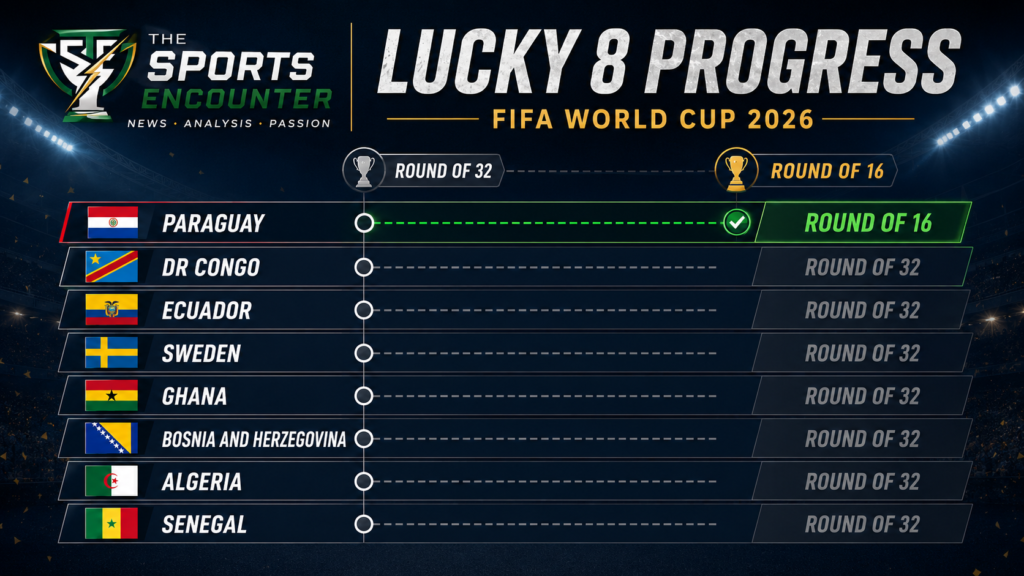
They scored four goals in those nine matches. DR Congo scored once, Senegal twice, and Paraguay once against Germany. Ecuador, Sweden, Ghana, Bosnia and Herzegovina, and Algeria all left the Round of 32 without scoring.
Their opponents scored 16 times.
Those numbers reveal a substantial gap. Third-place qualification created access to the knockout stage, though it did not erase the consequences of finishing behind two teams in a group.
Several Lucky 8 sides drew group winners or major contenders. Sweden met France. DR Congo faced England. Paraguay drew Germany and then France. Senegal met Belgium. The format therefore rewarded survival with another game, while the bracket often delivered an unforgiving opponent.
That does not make the system meaningless.
Paraguay’s elimination of Germany supplied one of the tournament’s defining shocks. DR Congo nearly removed England. Senegal forced Belgium into a dangerous, open contest. Ghana stayed within one goal of Colombia. Those moments justified the presence of a Round of 32 by giving more nations meaningful knockout football.
The problem lies in treating qualification and competitiveness as the same achievement.
Most Lucky 8 teams entered the knockouts with a flaw already visible in their group records. Sweden, Senegal, Algeria, and Bosnia conceded too easily. Ghana and Paraguay lacked goals. Ecuador’s attack had limited output despite the win over Germany. DR Congo struggled to protect a lead when England increased the pressure.
Knockout opponents found those weaknesses quickly.
African Teams Gained Exposure, but the Results Remained Harsh
DR Congo, Ghana, Algeria, and Senegal carried a large share of Africa’s Lucky 8 representation into the knockout stage.
The results were severe. All four were eliminated, and none reached the Round of 16. Their performances, however, added context to a tournament in which African participation expanded significantly.
DR Congo threatened England. Senegal attacked Belgium. Ghana pushed Colombia. Algeria entered the knockout stage after scoring five group goals.
Their exits should lead to practical questions around game management, defensive consistency, and finishing rather than a simple conclusion that expansion lowered the standard.
The 48-team tournament gave more African nations access to matches that reveal exactly what separates a competitive side from a quarterfinal contender. FIFA’s broader vision for the expanded competition can be reviewed through the official FIFA World Cup 2026 tournament portal.
Exposure carries value when federations use the evidence.
Paraguay Gave the Lucky 8 a Legacy
Without Paraguay, the Lucky 8 story would have ended as a warning about expansion.
Seven teams entered the Round of 32 and lost. Several failed to score. France, Mexico, the United States, Switzerland, and Colombia controlled their ties. The established powers appeared to restore order.
Paraguay changed that interpretation.
Their shootout victory over Germany proved that a third-place qualifier could use the new route to create a genuine World Cup upset. They then held France to one goal and forced a semifinal contender into a demanding Round of 16 match.
The Lucky 8 did not transform the tournament. They did create tension, representation, and one unforgettable result.
That may be the fairest verdict on the experiment.
The expanded format gave eight teams another chance. Seven discovered that a lifeline offers no protection once the knockout whistle blows. Paraguay used theirs to remove Germany, challenge France, and turn a third-place finish into one of the World Cup’s most unexpected journeys.
For the other seven, the Round of 32 became the place where hope met the difference between staying alive and knowing how to survive.
The Sports Encounter’s World Cup 2026 coverage focuses on fixtures, team news, match analysis, fan stories, tournament trends, and the biggest talking points from football’s global stage.