


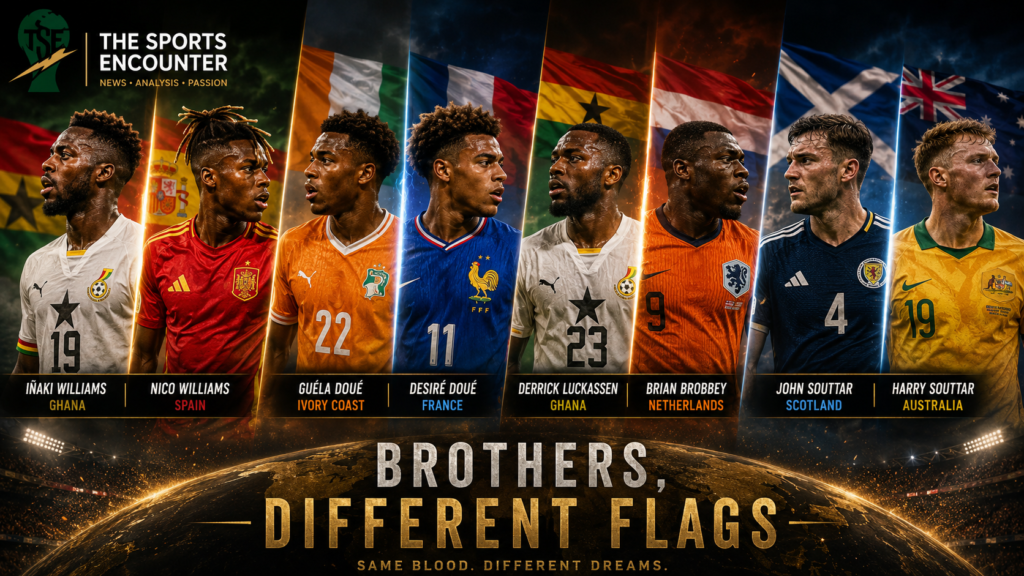
FIFA World Cup 2026 has more than goals, upsets, and tactical battles. It also has one of the most emotional family storylines in tournament history.
Four sibling pairs are playing at this World Cup for different countries.
Iñaki Williams, 32, represents Ghana while his younger brother Nico Williams, 23, plays for Spain. Guéla Doué, 23, represents Ivory Coast while his younger brother Desiré Doué, 21, plays for France. Derrick Luckassen, 30, represents Ghana while his half-brother Brian Brobbey, 24, plays for the Netherlands. John Souttar, 29, represents Scotland while his younger brother Harry Souttar, 27, plays for Australia.
None of these brothers are scheduled to face each other in the group stage. But if the knockout bracket opens the right way, World Cup 2026 could still deliver one of football’s rarest sights: brothers standing on opposite sides of the same match, under different flags, with the same family watching both dreams unfold.
For more tournament coverage, follow The Sports Encounter’s FIFA World Cup 2026 hub.
When the World Cup Turns Family Into Football Drama
The World Cup has always been a tournament of flags.
Players sing anthems. Fans paint their faces. Cities stop moving. Families gather around screens. For one month, football turns national identity into something loud, emotional, and deeply personal.
FIFA World Cup 2026 has added a fascinating twist to that tradition.
This tournament features several brothers who are not only playing on football’s biggest stage, but doing so for different countries. Their stories bring together migration, family roots, dual nationality, youth development, and the difficult personal choices modern footballers face long before a World Cup begins.
ALSO READ: 3 Biggest Challenges for the FIFA World Cup 2026 Organizers
These are not simple cases of divided loyalty.
They are stories of two brothers growing up under the same family name, then taking different routes toward the same global stage. One brother may follow the country of his birth. Another may choose the country of his parents. One may come through a European academy system. Another may answer the call of ancestral heritage.
The result is one of the most human subplots of World Cup 2026.
Fans can follow the results, tables, and match reports across our football coverage, but this story sits in a different emotional lane. It reminds us that behind every shirt number sits a family history.
The Four Split-Flag Sibling Stories at World Cup 2026
| Player | Age | Country | Sibling | Age | Country | Family Link |
|---|---|---|---|---|---|---|
| Iñaki Williams | 32 | Ghana | Nico Williams | 23 | Spain | Brothers |
| Guéla Doué | 23 | Ivory Coast | Desiré Doué | 21 | France | Brothers |
| Derrick Luckassen | 30 | Ghana | Brian Brobbey | 24 | Netherlands | Half-brothers |
| John Souttar | 29 | Scotland | Harry Souttar | 27 | Australia | Brothers |
The ages above are based on the players’ ages during the tournament in June 2026.
What makes these stories special is not just the family connection. It is the reason behind each choice.
Some were born in Europe but had strong African family roots. Some represented one country at youth level before choosing another at senior level. Some grew up in the same football culture but found different international homes through parentage.
This is modern football in one table.
Iñaki Williams and Nico Williams: Ghana, Spain, and a Family Journey Bigger Than Football
Iñaki Williams and Nico Williams may be the most famous split-nationality brothers at World Cup 2026.
Iñaki Williams, 32, plays for Ghana. Nico Williams, 23, plays for Spain.
Both brothers were born in Spain to Ghanaian parents. Both grew up through Athletic Bilbao’s football environment. Both became elite forwards. Yet their international careers took different paths.
Iñaki first represented Spain in a friendly, but later switched allegiance to Ghana. His decision carried emotional weight because it connected him to his parents’ homeland and the sacrifices that shaped his family’s life in Europe.
Nico stayed with Spain, the country where he was born, raised, and developed. His rise with La Roja has made him one of the most exciting wide players in European football.
The brothers now represent two different sides of the same family story.
For Ghana, Iñaki brings experience, work rate, and a connection to the Black Stars’ wider diaspora identity. For Spain, Nico gives direct running, pace, creativity, and the fearless edge of a younger attacking generation.
That contrast makes their World Cup story irresistible.
Imagine Ghana vs Spain later in the tournament. One Williams brother trying to carry the Black Stars forward. The other attacking from the opposite wing in Spanish colors. Their parents would not just be watching a match. They would be watching two versions of the same family dream.
Spain began World Cup 2026 in Group H, while Ghana are placed in Group L. That means the Williams brothers cannot meet in the group stage. A knockout meeting, however, would instantly become one of the tournament’s defining emotional moments.
For more World Cup context, read our report on Spain’s opening draw against Cape Verde.
Guéla Doué and Desiré Doué: France, Ivory Coast, and the Smile That Said Everything
The Doué brothers have already given this World Cup cycle one of its most memorable family images.
Guéla Doué, 23, represents Ivory Coast. Desiré Doué, 21, represents France.
Both brothers were born in France. Their father is Ivorian, while their mother is French. That background gave them two legitimate international paths.
Desiré became part of France’s elite attacking generation. Guéla chose Ivory Coast, where his father’s roots connect him to one of Africa’s proudest football nations.
Their family story came alive before the tournament during a warm-up match between France and Ivory Coast. Guéla scored for Ivory Coast, and cameras caught Desiré smiling from the France side. The moment felt bigger than the scoreline. It showed a brother’s pride breaking through the pressure of national rivalry.
That is the heart of this story.
Guéla was not just scoring against France. He was scoring in front of his younger brother, who had chosen France and was preparing for his own World Cup path. Desiré was not just watching an opponent. He was watching family.
France are one of the tournament favorites, especially with Kylian Mbappé leading their attack. Ivory Coast entered the World Cup with their own belief, built on athleticism, defensive strength, and attacking danger.
A France vs Ivory Coast knockout match would turn the Doué brothers’ story from a warm-up subplot into a World Cup headline.
France already made a strong start in Group I. You can read our full match report on France’s win over Senegal.
Why the Doué Story Hits Differently
The Doué brothers’ story works because both decisions feel authentic.
Desiré chose the country that developed him as one of Europe’s brightest young talents. Guéla chose the country that connects him to his father’s heritage.
There is no betrayal in that.
There is only family, identity, and football’s global reality.
The best World Cup stories rarely fit into one clean box. The Doué brothers prove that national pride and family pride can exist at the same time, even when the shirts are different.
Derrick Luckassen and Brian Brobbey: Ghana and the Netherlands Linked by Blood
Derrick Luckassen and Brian Brobbey bring another powerful variation of the same theme.
Luckassen, 30, represents Ghana. Brobbey, 24, represents the Netherlands.
They are half-brothers. Both were born in the Netherlands. Both are connected to Ghanaian heritage. Yet their senior international journeys now sit on opposite sides of the football map.
Brobbey represents the Dutch pathway. He came through the Netherlands system and became part of a national team built around structure, positional discipline, and attacking rotation.
Luckassen took a different route. After representing the Netherlands at youth levels, he became part of Ghana’s senior setup. His presence gives the Black Stars another European-developed defensive option, with the physical and tactical experience Ghana need in a tough tournament field.
This sibling story speaks directly to one of modern football’s biggest trends: African national teams drawing strength from players born and developed in Europe.
The Ghanaian diaspora has become a major part of Ghana’s football identity. Players like Iñaki Williams and Derrick Luckassen show how the Black Stars can connect talent, heritage, and opportunity across continents.
A Ghana vs Netherlands meeting would carry extra spice because Brobbey and Luckassen could, in theory, affect the same areas of the pitch. One is a forward looking for space. The other is a defender built to close it.
That would be a proper family duel.
John Souttar and Harry Souttar: Aberdeen Brothers, Scotland and Australia Dreams
John Souttar and Harry Souttar tell a slightly different kind of story.
John Souttar, 29, represents Scotland. Harry Souttar, 27, represents Australia.
Both brothers were born in Aberdeen. Both came through Scottish football surroundings. Both built their careers from the same broad football culture. Yet Harry chose Australia through his family eligibility, linked to his mother’s Australian background.
That makes the Souttar story especially interesting.
This is not a case of brothers born in different countries. It is a case of two brothers from the same Scottish roots ending up on different World Cup roads.
John stayed with Scotland, representing the country of his birth. Harry became one of Australia’s most important defenders, bringing height, physical authority, and set-piece danger to the Socceroos.
Harry has already become a major figure for Australia. His aerial strength and defensive presence give the Socceroos a foundation in big tournament matches. John brings Scotland experience, club-level toughness, and familiarity with the demands of British football.
Scotland are competing in Group C. Australia are in Group D.
A Scotland vs Australia match would feel huge for both countries. For the Souttar family, it would feel unforgettable.
Two Aberdeen-born brothers. Two national teams. One family name stretched across two football identities.
That is exactly the kind of story the expanded World Cup was built to create.
For more on Group D action, read The Sports Encounter’s match report on the United States’ dominant win over Paraguay.
Why More Brothers Are Playing for Different Countries Now
Football has become more global because families have become more global.
Many players grow up in countries different from their parents’ birthplace. Some are born in Europe to African, Caribbean, Asian, or South American parents. Others move at a young age. Many qualify for more than one national team through birth, parentage, grandparentage, or residence.
That creates difficult choices.
A player may feel attached to the country where he grew up. Another sibling may feel a stronger pull toward a parent’s homeland. A national team may offer a clearer route to senior football. A coach may make the call at the right time. A family conversation may shape the final decision.
Fans sometimes treat international eligibility as a simple matter.
The World Cup shows it is often far more personal.
The Williams brothers did not follow different flags because they stopped sharing a story. Their story became wider. The same applies to the Doué, Luckassen-Brobbey, and Souttar families.
Each pair reflects the same truth: identity can carry more than one country.
The Boateng Brothers Still Set the Standard
The most famous World Cup example remains Jérôme Boateng and Kevin-Prince Boateng.
Jérôme represented Germany. Kevin-Prince represented Ghana. They faced each other at the 2010 World Cup and again in 2014.
That sibling rivalry became part of World Cup history because it placed family connection directly inside national competition. Fans could understand the drama immediately. Two brothers. Two countries. One pitch.
World Cup 2026 has not delivered that scene yet for the current sibling pairs. None of the four split-flag brother combinations are scheduled to meet in the group stage.
But the possibility remains open.
That possibility makes every group result more interesting. If Ghana, Spain, France, Ivory Coast, the Netherlands, Scotland, or Australia move through the right knockout path, the tournament could suddenly produce a family match with global attention.
A Williams duel would bring Ghana and Spain together through one family. A Doué clash would carry French-Ivorian emotion. A Luckassen-Brobbey meeting would turn a striker-defender battle into a family story. A Souttar clash would bring Scotland and Australia into one of the tournament’s most personal matchups.
What This Story Says About World Cup 2026
The expanded FIFA World Cup 2026 has given more countries, more players, and more families a place on the global stage.
That has changed the tournament’s emotional texture.
More teams means more migration stories. More dual-national players means more layered identities. More family connections means more moments that go beyond tactics and results.
Some fans will remember this World Cup for Messi’s Argentina, Mbappé’s France, Spain’s new generation, Ghana’s fight, Australia’s resilience, or the United States playing on home soil.
Others may remember it for smaller human scenes.
A brother smiling after another brother scores. Parents wearing split colors. A shirt swap after a brutal match. A family trying to celebrate one son without hurting for the other.
That is the World Cup at its best.
It is not just the clean beauty of football. It is the messy, emotional, deeply human reality behind it.
Final Verdict: Different Flags, Same Bloodline
World Cup 2026 has already given fans major results, big performances, and early tournament drama.
The sibling stories add something softer but just as powerful.
Iñaki and Nico Williams show how one family can belong to Ghana and Spain at the same time. Guéla and Desiré Doué show how French and Ivorian identity can live inside the same home. Derrick Luckassen and Brian Brobbey show how the Dutch-Ghanaian football pathway can split into two senior national teams. John and Harry Souttar show how two brothers from Aberdeen can chase World Cup dreams for Scotland and Australia.
Different shirts do not weaken their family stories.
They make them bigger.
The group stage may keep them apart for now, but the knockout rounds still hold a possibility every neutral fan would love to see.
Brother against brother.
Country against country.
Same bloodline, different flags, and a World Cup story waiting for its perfect scene.