


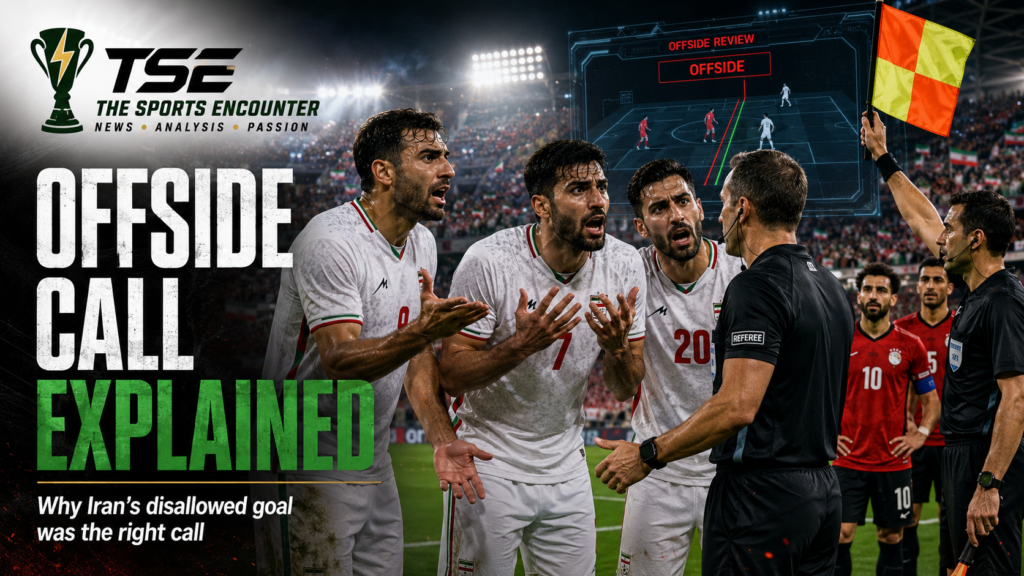
Iran were seconds away from turning a tense 1-1 draw with Egypt into one of the most emotional finishes of the FIFA World Cup 2026 group stage.
The ball went in. Iranian players ran toward the corner. Fans erupted. For a few seconds, it looked as if Iran had pulled off the kind of stoppage-time escape that turns a World Cup campaign into folklore.
Then came the flag.
Then came the delay.
Then came the outrage.
By the time the goal was disallowed for offside, social media had already chosen its villain. The referee was blamed. VAR was blamed. FIFA was accused of protecting bigger markets, bigger stars, and bigger storylines. Clips spread quickly, many of them paused at misleading angles. Screenshots circulated without the defensive line. Some fans insisted the Iranian attacker was behind an Egyptian defender. Others argued that because the goalkeeper was not the last man, the goal should have stood.
That last argument is exactly where the confusion begins.
The decision was not about whether one Egyptian player was ahead of the Iranian scorer. It was about whether two opponents, not one, were between the attacker and the goal line at the moment the ball was played.
That is the part many angry reactions missed.
Match Facts Box
| Match | Egypt vs Iran |
|---|---|
| Competition | FIFA World Cup 2026 |
| Stage | Group G |
| Final score | Egypt 1-1 Iran |
| Main controversy | Iran’s late goal disallowed for offside |
| Key law involved | Law 11: Offside |
| Egypt’s next match | Australia in the Round of 32 |
| Main takeaway | The disallowance was correct if the Iranian attacker was beyond the ball and the second-last Egyptian opponent |
For more World Cup coverage, follow The Sports Encounter’s FIFA World Cup 2026 hub.
What the Offside Law Actually Says
Football fans often simplify offside into one phrase: “Was he behind the last defender?”
That shortcut is useful in normal situations, but it is not the full law.
Under Law 11, an attacker is in an offside position if any playable part of his head, body, or feet is:
- In the opponents’ half, and
- Nearer to the opponents’ goal line than both the ball and the second-last opponent.
The second part is the key.
The law does not say the attacker only needs to be behind one defender. It says he must not be nearer to goal than both the ball and the second-last opponent.
In plain English, an attacker usually needs either:
- The ball ahead of him, or
- Two opponents level with or ahead of him.
Most of the time, one of those two opponents is the goalkeeper. That is why fans casually talk about the “last defender.” In normal defensive shape, the goalkeeper is the last opponent and an outfield defender is the second-last opponent.
But when the goalkeeper comes off his line, gets caught ahead of play, falls behind the phase, or is no longer one of the two deepest opponents, the picture changes.
The law still requires two opponents.
They do not have to include the goalkeeper, but in most real-game situations, one of them does. If only one Egyptian player was between the Iranian attacker and the goal line when the ball was played, the attacker was offside.
That appears to be the core reason the goal was ruled out.
Why the “One Defender Was There” Argument Fails
A large part of the online anger came from fans pointing at one Egyptian player and saying Iran’s striker was not beyond the defender.
But offside is not judged against one opponent.
It is judged against the second-last opponent.
This matters because a goalkeeper can step out, dive, challenge, or get stranded outside the usual last-man position. When that happens, an outfield defender may become the last opponent, not the second-last. If the attacker is beyond the next Egyptian player in the defensive chain, then the attacker is in an offside position.
That is why the decision looked harsh to casual viewers but made sense under the law.
The camera angle also contributed to the anger. Broadcast replays can make the line look different depending on perspective, body lean, and the exact frame used. Offside is judged at the moment the ball is played or touched by a teammate, not when the attacker receives it, not when the crowd reacts, and not when the ball crosses the line.
That is why still images shared after the match were often misleading. A screenshot taken half a second too late can completely change how the incident looks.
Was the Goal Automatically Illegal?
No.
Being in an offside position by itself is not an offence. A player only gets penalized when he becomes involved in active play.
In this case, the Iranian attacker did exactly that. He attacked the ball, finished the move, and directly affected the outcome. Once he scored from that position, the offside position became an offside offence.
That distinction matters.
A player can stand in an offside position and not be punished if he does not interfere with play, interfere with an opponent, or gain an advantage. But when the player in that position scores, the law gives officials no serious room for interpretation.
If the offside line was correct, the goal had to be disallowed.
Why This Felt Bigger Than One Decision
The emotional reaction made sense even if the technical decision did.
Iran were chasing more than a goal. They were chasing survival, pride, and a possible route into the Round of 32. Egypt, meanwhile, were protecting a result that helped them move into the knockout stage, where they now face Australia.
That is why the moment exploded. It was not just a law debate. It was a World Cup campaign turning on a line, a frame, and a rule many fans only half understand.
Iran’s frustration was real. Their players had pushed Egypt into uncomfortable spaces, forced late pressure, and nearly turned a difficult group-stage finale into a defining national moment. To lose that ending to an offside call naturally felt brutal.
But brutal does not mean wrong.
This is where football’s emotional truth and legal truth separate.
Emotion says Iran were robbed of a cinematic winner. Law 11 says the attacker needed two opponents or the ball between him and the goal line. If he had only one opponent ahead of him, the goal could not stand.
For more on Egypt’s World Cup path, read The Sports Encounter’s analysis of Egypt vs Iran and the Round of 32 picture. You can also follow related tournament coverage through our World Cup 2026 match reports.
The Referee Did Not Rewrite the Law in the Iran-Egypt Match
The referee and VAR team did not create a new interpretation in the final minutes. They applied one of football’s oldest principles.
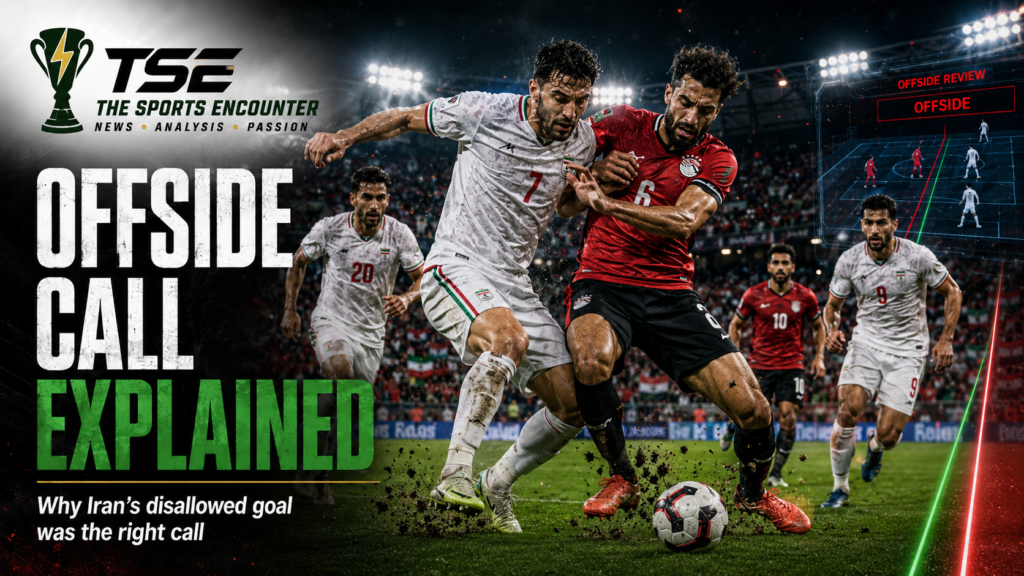
The misunderstanding comes from how offside is discussed by fans, commentators, and even former players. The phrase “last defender” has become popular shorthand, but it can confuse people in goalkeeper-displacement situations.
The correct reference is not the last defender.
The correct reference is the second-last opponent.
That means the goalkeeper is not automatically the offside line. The last outfield defender is not automatically enough either. What matters is the position of the attacker, the ball, and the second-last opponent when the teammate plays the ball.
Once that frame is understood, the Iran-Egypt controversy looks far less mysterious.
What Fans Should Take From the Incident
The bigger lesson is simple: offside is a two-opponent rule, not a one-defender rule.
That one detail explains why the decision caused so much anger and why it still appears to have been correct.
Iran can feel devastated. Their fans can feel crushed. The timing can feel cruel. None of that changes the law.
Football will always produce moments that feel unfair because the emotional rhythm of the match moves faster than the legal process. A late goal feels like destiny. A VAR review feels like interruption. A raised flag feels like theft.
But in this case, the controversy was powered more by misunderstanding than injustice.
Iran did not lose a goal because of a hidden agenda. They lost it because the law demands two opponents between the attacker and the goal line unless the ball is also ahead of him.
That is not a FIFA conspiracy.
That is Law 11.
FAQ
Why was Iran’s late goal against Egypt disallowed?
Iran’s late goal was disallowed because the attacker was judged to be in an offside position when the ball was played by a teammate. If he was nearer to the goal line than both the ball and the second-last Egyptian opponent, the decision was correct.
Does the goalkeeper have to be one of the two players for offside?
No. The law refers to the second-last opponent, not specifically the goalkeeper. However, in most situations, the goalkeeper is naturally one of the last two opponents. When the goalkeeper is out of position, fans often misread the offside line.
Why is one defender not enough to keep an attacker onside?
Because the offside law requires the attacker to be level with or behind the second-last opponent, not just one opponent. If only one defender is between the attacker and the goal line, the attacker can still be offside.
Is standing offside always an offence?
No. A player is only penalized for offside after becoming involved in active play. Scoring from that position clearly counts as involvement.
Did Iran have a right to feel frustrated?
Yes. The timing was painful and the decision shaped Iran’s World Cup fate. But frustration does not make the decision wrong if the offside line was applied correctly.
The Sports Encounter Credibility Line
The Sports Encounter’s World Cup 2026 coverage focuses on fixtures, team news, match analysis, fan stories, tournament trends, and the biggest talking points from football’s global stage.