


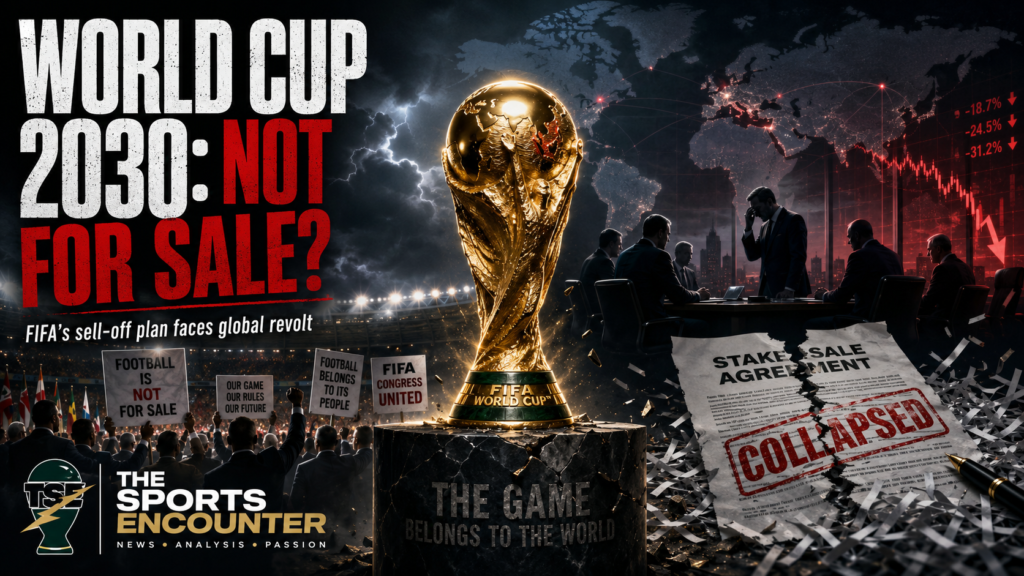
The proposed sale of a stake in FIFA’s most valuable competitions appears to have collapsed under the combined weight of political resistance, internal rebellion and a threat that investors could not ignore: a World Cup without many of its biggest national teams.
For several extraordinary days, the future ownership structure of the World Cup looked as though it could be transformed.
FIFA President Gianni Infantino wanted member associations to consider creating FIFA Forward Enterprise, a new commercial subsidiary reportedly valued at approximately $20 billion. External investors could have acquired a stake of up to 20%, potentially providing FIFA with around $4.2 billion in fresh capital.
The proposal was presented as a way to dramatically increase football development funding. Its critics saw something far more consequential: the partial transfer of football’s most powerful commercial engine into a structure influenced by private capital.
Then the resistance hardened.
UEFA’s 55 national associations unanimously rejected the proposal and threatened to withdraw from FIFA competitions. CONCACAF opposed it. The Asian Football Confederation publicly stood alongside the two confederations. CONMEBOL demanded further information. Carlos Cordeiro, one of Infantino’s senior advisers, resigned and called the idea a bad deal for football. FIFA Chief Operating Officer Kevin Lamour reportedly accused the organization’s president of deceiving staff and described the initiative as the project of one person.
By July 31, the New York Post was reporting that the proposed transaction had been scrapped. Reuters could not independently confirm that report, while FIFA continued to say that it would consult its 211 member associations and would proceed only with majority support.
This leaves world football with an unusual answer to an apparently simple question.
Is the 2030 World Cup no longer for sale?
The proposed transaction appears politically and commercially unviable in its current form. It has not, however, been formally and conclusively buried by FIFA.
That difference matters.
TL;DR
- FIFA proposed placing the commercial operations of the World Cup and other competitions inside a new subsidiary called FIFA Forward Enterprise.
- The company was reportedly valued at around $20 billion, with external investors potentially acquiring a stake of up to 20%.
- The arrangement could have raised approximately $4.2 billion for FIFA.
- UEFA’s 55 member associations unanimously rejected the proposal and backed a conditional boycott of FIFA competitions.
- CONCACAF rejected the plan, while the AFC aligned itself with the opposition.
- Those three confederations represent 143 of FIFA’s 211 member associations, making majority approval extremely difficult.
- Carlos Cordeiro resigned as Infantino’s adviser, while FIFA COO Kevin Lamour publicly condemned the project.
- A report says the transaction has been scrapped, but FIFA has continued to defend the consultation process.
- The current sell-off model may be dead, but the commercial pressure that produced it will continue before the 2030 World Cup.
Key Information: The FIFA World Cup Investment Crisis
| Issue | Key Detail |
|---|---|
| Proposed company | FIFA Forward Enterprise |
| Reported valuation | Approximately $20 billion |
| Potential investor stake | Up to 20% |
| Potential proceeds | Approximately $4.2 billion |
| Reported lead investor | Thrive Eternal, linked to Thrive Capital founder Joshua Kushner |
| FIFA member associations | 211 |
| Associations represented by UEFA, CONCACAF and AFC | 143 |
| FIFA’s reported incentive | Up to $40 million for each association if the proposal was approved |
| Approval deadline initially discussed | September 19, 2026 |
| Current status | Reportedly scrapped, but not formally withdrawn by FIFA |
The Deal Did Not Collapse Because Football Suddenly Rejected Money
Football has lived comfortably alongside commercial expansion for decades.
Broadcasting agreements have turned tournaments into global media products. Sponsors influence schedules, branding, hospitality programs and fan experiences. Wealthy state-linked entities, private investors and financial institutions already have major positions across clubs, leagues, media companies and sporting infrastructure.
The FIFA dispute therefore cannot be reduced to a romantic argument about keeping money out of football.
Money was already inside.
The real conflict concerned ownership, governance and the permanent transfer of future value.
Under the proposed structure, FIFA would have placed commercial assets connected to the World Cup and other events into a new business. A minority investor would not have owned the trophy, written the Laws of the Game or selected national teams. Yet ownership of a significant economic interest could have changed the incentives surrounding FIFA’s competitions.
Private investors usually seek growth, returns and an eventual exit. Those priorities can be rational from a financial perspective. They may also create pressure for more inventory, more premium products, higher prices, new tournament formats, expanded sponsorship categories and greater control over the commercial calendar.
The concerns examined in The Sports Encounter’s earlier analysis of why selling a World Cup stake could be dangerous went beyond symbolism. Once part of the commercial business is transferred, reversing the arrangement can become expensive, legally difficult and politically disruptive.
That is why Cordeiro’s language carried such force.
As a former investment banker and senior football official, he could not easily be dismissed as someone who failed to understand finance. He argued that FIFA risked mortgaging football’s future without a compelling justification, especially when the organization reportedly had substantial revenue, strong reserves and no urgent debt problem requiring emergency capital.
The proposal did not fail because football rejected business.
It failed because many of football’s most powerful institutions believed FIFA was offering investors too much long-term value in exchange for money the governing body had not proved it desperately needed.
UEFA Found the Weak Point in the Financial Model
UEFA’s response changed the entire equation.
Its 55 member associations unanimously declared that they would not participate in FIFA competitions if the proposal moved forward. The official UEFA statement said the associations rejected any transfer of ownership interests in the World Cup and other FIFA competitions to private investors.
The threat had moral language, but its decisive power was commercial.
An investor purchasing a minority stake in FIFA’s tournament business would be paying for future cash flows. Those cash flows depend heavily on the presence of globally followed national teams, elite players, competitive credibility and enormous broadcasting audiences.
A men’s World Cup without England, Spain, France, Germany, Italy, Portugal, the Netherlands and other European nations would lose much of its sporting and commercial value. Women’s and youth tournaments would face similar problems. Sponsors, broadcasters and commercial partners would immediately reassess the value of their agreements.
The boycott threat therefore attacked the investment proposition at its foundation.
Private capital could tolerate supporter criticism, political noise or reputational pressure if the underlying business remained strong. It could not easily ignore the possibility that the product being purchased might lose many of its most valuable participants.
UEFA’s 55-0 boycott decision turned an internal FIFA proposal into an existential commercial risk.
For any potential investor, a new question replaced the optimistic projections in the pitch materials:
What is a stake in the World Cup worth if Europe refuses to play?
The answer was almost certainly far below $20 billion.
The Revolt Became Global Rather Than European
FIFA could initially have framed UEFA’s opposition as another chapter in the long struggle between Europe and the global governing body.
That interpretation became harder to sustain once CONCACAF and the AFC moved against the proposal.
CONCACAF represents North America, Central America and the Caribbean. Its opposition was especially damaging because the United States, Canada and Mexico had just hosted the expanded 2026 World Cup. North America is also central to FIFA’s commercial growth ambitions, sponsorship strategy and access to major financial institutions.
CONCACAF’s rejection of the World Cup stake proposal indicated that this was no longer a predictable Europe-versus-FIFA dispute.
The AFC’s intervention widened the crisis further. Asian football has often been considered an important source of political support for Infantino. Yet the confederation said it stood in solidarity with UEFA and CONCACAF, questioned the proposal’s viability and raised concerns about FIFA’s decision-making process.
UEFA, CONCACAF and the AFC collectively represent 143 of FIFA’s 211 member associations.
A simple majority would require at least 106 votes.
Even allowing for the possibility that confederation statements might not translate into identical votes from every national association, the political path to approval had become extremely narrow.
FIFA insisted that no single confederation could speak for every member and that each association deserved the opportunity to examine the proposal independently. That argument was procedurally defensible. It did little to solve the arithmetic.
The investment plan did not merely face vocal critics. It appeared to have lost the voting coalition needed to exist.
Was the Reported $40 Million Offer Development Funding or Political Leverage?
One of the most controversial elements was Infantino’s reported promise that each member association could receive $40 million if the initiative was approved.
For smaller football nations, that amount could transform infrastructure, coaching, youth development, women’s football, domestic competitions and administrative capacity.
FIFA’s central argument was powerful: the commercial value of elite global tournaments should fund football everywhere, including countries that could never generate comparable revenue independently.
The official FIFA position emphasized that FIFA Forward Enterprise could increase development funding beyond $10 billion. FIFA described the proposal as a route toward unprecedented investment, broader participation in football’s commercial opportunities and greater self-determination for member associations.
Critics saw a governance problem.
Offering large financial distributions to the same associations responsible for approving the structure created an unavoidable perception of influence. Even when the money would ultimately support legitimate development projects, the sequence appeared troubling: approve the plan, unlock the payment.
This placed smaller associations in a difficult position.
Rejecting the proposal could mean turning down infrastructure and development funding their football systems genuinely needed. Supporting it could mean accepting a permanent commercial arrangement whose long-term costs were uncertain.
FIFA presented the payment as the benefit of monetizing football more effectively.
Opponents interpreted it as a mechanism designed to secure votes.
Both views can exist simultaneously. Development funding may have been sincere, while the offer also increased political pressure on associations to support Infantino’s preferred outcome.
That ambiguity should never have been allowed to develop around a decision of this magnitude.
The Internal Rebellion May Have Done More Damage Than UEFA
External opposition can sometimes strengthen a FIFA president.
Infantino could portray criticism from UEFA, European politicians or supporter groups as resistance from established powers that did not want football’s wealth distributed more widely.
The rebellion inside FIFA was harder to explain away.
Cordeiro resigned immediately and said he had not been involved in developing the proposal. His departure suggested that one of Infantino’s senior advisers had been excluded from a project with enormous strategic and governance implications.
Lamour’s criticism went further. According to the Associated Press, FIFA’s chief operating officer accused Infantino of deceiving staff and characterized the proposal as a personal project.
Such accusations strike at institutional legitimacy.
A governing body can survive disagreement over valuation, investor selection or commercial strategy. It faces a deeper crisis when senior officials question whether proper processes existed at all.
The Sports Encounter previously examined how the revolt moved inside Infantino’s own operation. That shift changed the story from a political dispute between confederations into a test of how FIFA itself was being governed.
Questions now extend beyond the fate of FIFA Forward Enterprise:
- Who conceived the proposal?
- Which FIFA officials reviewed it?
- What valuation methodology produced the reported $20 billion figure?
- What rights would the investor have received?
- What exit mechanisms were being considered?
- How would conflicts of interest have been managed?
- Why did senior executives say they lacked meaningful information?
- What role did JPMorgan and the proposed investor group play in developing the structure?
Even if the deal is dead, those questions remain alive.
Is the World Cup 2030 Safe From Private Ownership?
The proposed transaction was linked to FIFA’s tournament business broadly, rather than being a straightforward sale of the 2030 World Cup itself.
That distinction should be kept clear.
No investor was preparing to purchase the sporting authority to stage the World Cup, choose the hosts or control qualification. FIFA would also have retained majority ownership under the reported plan.
Yet the economic rights attached to future competitions, including the 2030 World Cup, would have formed part of the value investors expected to monetize.
For supporters, the practical concern was therefore legitimate. Private ownership of a share in the commercial entity could have influenced how future World Cups were packaged, expanded, priced and sold.
The 2030 tournament is already structurally unprecedented. Morocco, Portugal and Spain will serve as the main hosts, while centenary matches are expected in Argentina, Paraguay and Uruguay. FIFA is also studying the possibility of expanding the competition to 64 teams, a proposal assessed in The Sports Encounter’s analysis of the proposed 64-team World Cup.
More teams would mean more matches, broadcasting inventory, tickets, sponsorship exposure and hospitality opportunities.
That does not prove that expansion is being designed for investors. It demonstrates why the commercial rights attached to 2030 could be exceptionally valuable.
A tournament spanning three continents, potentially involving 64 nations and producing a record number of games would offer an enormous platform for monetization.
The current revolt has probably protected those commercial rights from the specific 20% sale under discussion.
It has not guaranteed that FIFA will never revisit external investment through a different structure.
Why the Current Plan Is Probably Dead
Several forces now make revival extremely difficult.
1. The voting pathway has collapsed
Opposition from confederations representing 143 associations makes majority approval unlikely without a major reversal.
2. The commercial valuation has been damaged
A threatened European boycott introduces a material risk to future tournament revenue. Any investor would demand a lower valuation, stronger protections or both.
3. The proposed structure has become politically toxic
National associations that might have quietly supported the plan would now have to defend it publicly after resignations, boycott threats and accusations of poor governance.
4. Internal confidence has fractured
Senior officials openly challenging the president indicates that implementation would face resistance inside FIFA even after theoretical approval.
5. The investor would inherit reputational risk
Any fund proceeding after the global backlash would be portrayed as attempting to profit from football against the wishes of major confederations, associations and supporter groups.
6. The original timetable has lost credibility
A proposal involving billions of dollars and the future commercial structure of the World Cup required patient consultation. The reported September 19 deadline reinforced concerns that FIFA wanted a rapid decision before opposition could organize.
These factors explain why reports that the plan had been scrapped were immediately plausible.
The deal may still exist in FIFA documents. In commercial terms, however, its foundations have been severely damaged.
Why FIFA Has Not Formally Declared Defeat
FIFA’s refusal to immediately withdraw the plan also makes strategic sense.
A formal retreat would represent one of the most significant defeats of Infantino’s presidency. It would confirm that UEFA’s boycott threat had forced FIFA to reverse course and could encourage further challenges to his authority.
Continuing the consultation process allows FIFA to preserve several options.
The governing body can argue that the media distorted the proposal. It can modify investor rights, reduce the stake, narrow the assets included in the subsidiary or introduce new governance protections. FIFA could also delay the vote while maintaining that no final decision had been made.
Most importantly, consultation gives Infantino an opportunity to test his remaining political support.
FIFA has insisted that it would not establish the subsidiary without majority backing. It also rejected claims that it intended to sell football, arguing that all associations should be free to assess the facts and shape their future democratically.
That language prepares the ground for repositioning.
If the proposal disappears, FIFA can say member associations chose another direction. If a revised model emerges, FIFA can say consultation improved it.
A direct admission that the plan collapsed would give Infantino’s opponents a much cleaner political victory.
The 2030 Question Is Larger Than One Failed Deal
The phrase “football is not for sale” has emotional power.
It does not settle the financial problem FIFA says it is trying to solve.
Global football development costs money. Smaller associations need pitches, academies, coaching programs, women’s competitions, refereeing systems, administration, technology and travel support. FIFA’s revenue is overwhelmingly generated by a limited number of major competitions, particularly the men’s World Cup.
As the governing body promises more development funding, larger tournaments and broader global participation, pressure to produce additional revenue will intensify.
The 2030 World Cup sits at the center of that pressure.
FIFA can abandon the current investor model and still pursue aggressive commercialization through:
- Expanded sponsorship packages
- Higher-value broadcasting agreements
- Dynamic ticket pricing
- More hospitality inventory
- Additional official partners
- Digital subscriptions and direct-to-consumer products
- Licensing agreements
- Expanded tournament formats
- New data, gaming and technology partnerships
The rejection of a minority stake sale does not return the World Cup to a pre-commercial age.
It sets a boundary around who may own part of the commercial machine.
Could UEFA Really Create Its Own World Cup?
The boycott threat raised an even more disruptive possibility.
If UEFA withdrew from FIFA tournaments, it could theoretically organize an alternative international competition and invite teams from other confederations.
The Sports Encounter previously examined whether UEFA could create its own version of the World Cup. The legal, political and logistical barriers would be enormous, but the threat changed FIFA’s calculations.
UEFA controls the strongest concentration of elite national teams, major stadiums, commercial markets, broadcasters and sponsors in world football. A breakaway tournament involving European teams and selected nations from South America, Africa, Asia or North America could compete for global attention.
FIFA would retain the authority, history and worldwide membership associated with the World Cup. UEFA could offer many of the players and teams that give the event its highest commercial value.
Neither side would benefit from a split.
Investors could not ignore its possibility.
The boycott threat succeeded because it showed that FIFA does not own the entire World Cup product by itself. The value is jointly created by national associations, players, clubs, supporters, broadcasters, sponsors, host nations and confederations.
FIFA controls the competition.
It does not independently create everything that makes the competition valuable.
What This Means for Gianni Infantino
The crisis arrives at a dangerous moment for the FIFA president.
Infantino is expected to seek re-election in 2027. Reports have suggested that CONCACAF President Victor Montagliani could emerge as a challenger, although the political field remains fluid.
The failure of the investment proposal would weaken Infantino in three ways.
First, it challenges his reputation as a leader who can unite FIFA’s diverse membership around global development.
Second, it exposes a possible breakdown between the president and senior officials inside the organization.
Third, it gives opposing confederations a shared cause.
UEFA and CONCACAF do not always have identical interests. The AFC has frequently taken a different approach to disputes involving FIFA. A proposal that pushed all three toward the same side created a coalition that could eventually become electoral.
Infantino still possesses important advantages. FIFA presidents build support through development funding, political relationships and the loyalty of associations that believe the existing leadership serves their interests. No challenger can defeat him through European backing alone.
Yet the crisis has punctured the appearance of inevitability surrounding his authority.
The reported collapse of the deal may protect the World Cup from the immediate stake sale. It could also mark the beginning of a broader contest over who leads FIFA after 2027.
What Should Happen Next?
Abandoning the plan quietly would contain the immediate crisis without addressing its causes.
FIFA should publish a detailed account of the proposal, including the commercial logic, valuation methodology, assets under consideration, investor rights, governance protections, advisory fees and consultation timeline.
An independent review should establish how the initiative was developed and why senior officials claimed they were excluded or misled.
Any future attempt to create a commercial subsidiary should require:
- Early consultation with all confederations
- Independent valuation
- Published conflict-of-interest safeguards
- Clear limitations on investor influence
- Protection of tournament format and sporting decisions
- Transparent use of proceeds
- Supporter and player representation
- A supermajority rather than a narrow simple majority
- Long-term exit and buyback provisions
Football’s commercial future cannot be decided through closed negotiations followed by a rapid vote.
The World Cup is FIFA’s primary revenue generator, but its social value extends far beyond FIFA’s balance sheet.
Supporters build its atmosphere. Players create its drama. National associations provide the teams. Clubs develop and employ the talent. Host countries fund infrastructure and security. Broadcasters carry the event across the world.
A governance model that ignores those stakeholders will continue producing conflict, regardless of how attractive the financial projections appear.
Final Verdict: The Sale Is Dead for Now, the Idea Is Not
The FIFA World Cup 2030 appears to be no longer for sale under the proposal that triggered this revolt.
The reported $20 billion structure has lost political support, internal credibility and much of its commercial logic. UEFA’s boycott threat undermined the value investors were being asked to purchase. Opposition from CONCACAF and the AFC destroyed the idea that resistance belonged only to Europe. The resignation of Cordeiro and condemnation from Lamour turned a confederation dispute into a FIFA governance crisis.
FIFA has not issued the final sentence.
Its public position leaves the consultation process open, and no definitive official withdrawal has yet matched reports that the plan has been scrapped. That means the most accurate conclusion remains conditional.
The current sell-off plan is probably dead. The commercial ambition behind it remains very much alive.
FIFA will continue searching for ways to extract more value from the World Cup, particularly as the organization considers further expansion and prepares for an unprecedented 2030 tournament across Europe, Africa and South America.
The revolt has nevertheless established an important boundary.
Football’s governing body may control the World Cup’s legal and commercial structure. It cannot assume that the competition’s future can be reshaped without the consent of the institutions, players and supporters who create its value.
The most important lesson from this crisis concerns power rather than price.
FIFA discovered that a World Cup stake is difficult to sell when the teams that make the World Cup valuable are prepared to walk away.
The Sports Encounter’s World Cup coverage focuses on fixtures, team news, match analysis, fan stories, tournament trends, and the biggest talking points from football’s global stage.