


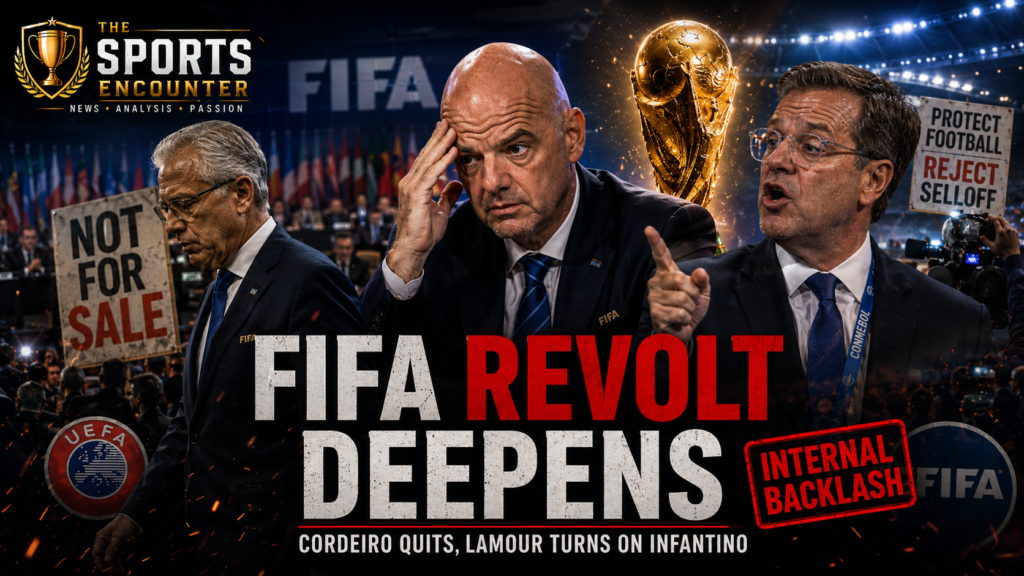
Gianni Infantino’s plan to sell a stake in a commercial company built around the World Cup is facing its most serious threat yet. Senior adviser Carlos Cordeiro has resigned in protest, while FIFA chief operating officer Kevin Lamour says employees were deceived and has described the proposal as the project of one person.
The opposition to FIFA’s controversial World Cup investment plan has moved from regional confederation headquarters into the organization’s own senior leadership structure.
Carlos Cordeiro, a senior adviser appointed by FIFA President Gianni Infantino, resigned with immediate effect after condemning the proposal to sell a minority stake in FIFA Forward Enterprise. Hours later, chief operating officer Kevin Lamour launched an extraordinary public criticism of the process, saying FIFA staff had been deceived and suggesting the proposal reflected the wishes of Infantino rather than a properly developed institutional strategy.
Lamour also indicated that he was prepared to lose his job for speaking out.
The two interventions deepen a crisis already threatening to split international soccer. UEFA’s 55 national associations have voted to boycott FIFA competitions while the plan remains alive. Concacaf has rejected it. The Asian Football Confederation has questioned both the proposal and FIFA’s decision-making process.
Until now, FIFA could present the backlash as a power struggle between competing governing bodies. Cordeiro’s resignation and Lamour’s criticism make that explanation harder to sustain.
One senior figure has left. Another remains inside FIFA while publicly challenging the president’s conduct.
The Sports Encounter has tracked the crisis since FIFA first revealed the proposed structure. Our earlier analysis explained how the World Cup investment plan triggered a global struggle between FIFA and UEFA. The latest events suggest the proposal is also creating a fracture within FIFA itself.
FIFA World Cup Selloff Crisis: Key Developments
| Development | Why It Matters |
|---|---|
| Carlos Cordeiro resigns | A senior Infantino adviser has rejected the plan and left FIFA immediately |
| Kevin Lamour speaks publicly | FIFA’s chief operating officer says staff were deceived and questions the internal process |
| Lamour calls it one person’s project | The allegation places direct responsibility on Infantino rather than FIFA’s wider administration |
| Proposed company value | FIFA Forward Enterprise has been valued at approximately $20 billion |
| Proposed outside stake | Private investors could receive up to 20% |
| Targeted capital raise | FIFA could raise approximately $4.2 billion |
| UEFA response | All 55 associations have backed a boycott while the proposal remains active |
| Concacaf response | The regional body rejected the proposal over governance and consultation concerns |
| AFC response | Asia’s confederation says it was not properly consulted |
| Member-association deadline | FIFA wants associations to decide by September 19, 2026 |
Carlos Cordeiro Refuses to Support a Permanent World Cup Stake Sale
Cordeiro’s departure represents the first major resignation from Infantino’s advisory circle over FIFA Forward Enterprise.
He joined FIFA as a senior adviser in 2021 and was expected to help modernize the organization’s regulatory structure and identify new ways to grow the sport. His background gave him unusual authority to assess the financial logic behind the proposed transaction.
Cordeiro previously worked in global investment banking and served as a vice chairman at Goldman Sachs. He also held senior positions at the United States Soccer Federation and played a leading role in the successful North American bid for the 2026 World Cup.
His objections therefore go beyond emotional claims that the World Cup belongs to supporters.
Cordeiro questioned why FIFA needed to sell part of its most valuable commercial property when the organization holds substantial reserves, carries no debt, and generated approximately $15 billion during the 2022-2026 cycle.
FIFA plans to raise around $4.2 billion by offering outside investors a minority interest in the proposed company. Cordeiro argued that surrendering a permanent stake for that amount made little financial sense when FIFA already possessed the resources to increase development funding.
He also made clear that he had not helped design the proposal.
That detail is damaging because his FIFA role involved advising on strategic initiatives. A plan capable of changing the ownership and commercial incentives surrounding the World Cup would normally fall directly within that area.
Cordeiro’s resignation suggests either that FIFA developed the structure within a very narrow circle or that key advisers were deliberately excluded from the process.
Kevin Lamour’s Intervention May Be Even More Serious
Cordeiro left the organization before criticizing the deal. Lamour spoke while serving as FIFA’s chief operating officer.
That distinction matters.
Lamour is responsible for overseeing a wide section of FIFA’s administration, including finance, legal and compliance, communications, audit and advisory functions, member associations, technology, operations, development, professional football relations, and social responsibility.
He is not a distant consultant or former official commenting from outside the building. His position places him close to FIFA’s operational systems and the departments that would be expected to assess, implement, explain, and govern a transaction of this size.
Lamour said staff had been deceived over the proposal. He also characterized the plan as the project of one person, a clear reference to Infantino.
Those words strike at the heart of FIFA’s defense.
The organization says member associations will decide through a democratic consultation. Lamour’s account raises questions about whether FIFA’s own employees and senior departments had a meaningful role before the proposal reached those associations.
A member vote does not automatically make the process sound. Associations need reliable valuation data, legal analysis, risk assessments, investor terms, governance protections, and independent advice before making an informed decision.
Lamour’s willingness to accept dismissal adds weight to his criticism. Senior executives rarely challenge their president publicly while remaining employed. Such an intervention usually reflects a belief that internal channels have failed or that the issue carries consequences too serious to keep private.
Why the “Project of One Person” Claim Changes the Story
FIFA presents itself as a global democratic institution built around 211 national associations. Major decisions should pass through formal governance structures, including the FIFA Council, committees, compliance systems, confederations, and member consultations.
Lamour’s allegation presents a different picture.
If the enterprise was shaped primarily around Infantino’s personal direction, several questions follow:
- When did the FIFA Council receive the complete proposal?
- Which committees examined the transaction?
- Did FIFA’s finance, legal, compliance, and audit divisions provide written assessments?
- Were alternative funding structures considered?
- How were the proposed investors selected?
- Who established the $20 billion valuation?
- What rights would private investors receive?
- Why were the confederations reportedly surprised by the announcement?
The issue is larger than whether Infantino personally supports the plan. FIFA presidents naturally promote major initiatives.
The concern is whether the institution developed and tested the proposal through its own governance system before asking associations to approve it.
The difference separates leadership from unilateral control.
What FIFA Forward Enterprise Would Control
FIFA Forward Enterprise would become a new commercial organization associated with the World Cup and FIFA’s other competitions.
The proposed company would handle valuable revenue-generating activities such as broadcasting, sponsorship, licensing, ticketing, hospitality, digital services, and other commercial rights.
FIFA would retain a controlling interest, while outside investors could acquire a stake of up to approximately 20%.
Infantino has argued that the transaction would unlock unprecedented development funding for national associations. FIFA says the commercial structure would not transfer control over sporting rules, tournament formats, refereeing, or the governance of football.
Critics believe the distinction between sporting authority and commercial influence is too narrow.
An investor does not need the power to change the Laws of the Game to influence the World Cup’s direction. Financial return requirements can affect the number of fixtures, tournament expansion, broadcast windows, ticket prices, sponsorship categories, hospitality products, host-market priorities, and the creation of new competitions.
The Sports Encounter examined these risks in detail in its report on what private investment could mean for the future of the World Cup.
Infantino’s Funding Argument Faces a Credibility Test
FIFA’s strongest argument concerns development.
Many smaller associations depend heavily on FIFA funding to build pitches, operate national teams, develop women’s soccer, educate coaches, and organize youth competitions. A major increase in distributions could transform the sport in countries with limited commercial revenue.
Infantino has linked approval of the proposal to a broader package that could provide each association with benefits valued at up to $40 million.
Cordeiro’s criticism directly challenges the necessity of selling equity to deliver that money.
FIFA emerged from the 2026 World Cup cycle with strong revenues and significant reserves. If the organization can finance a larger development program through existing resources and future earnings, selling a permanent minority stake becomes harder to justify.
FIFA must therefore answer two different questions:
- Would the proposal generate additional money?
- Does FIFA need to sell ownership to obtain it?
The first answer may be yes. The second remains disputed.
Internal Opposition Reinforces UEFA’s Governance Case
UEFA’s 55 associations unanimously rejected the proposal and threatened to withdraw from every FIFA competition while it remains active.
Europe described the World Cup as a public sporting institution that cannot be converted into an investment product. UEFA also argued that private ownership would create a permanent obligation to generate commercial returns.
The Sports Encounter explained the potential consequences of the UEFA boycott and its threat to FIFA tournaments.
FIFA initially had room to portray Europe’s opposition as part of a familiar battle over control and revenue. UEFA runs immensely profitable club competitions and has its own commercial interests.
Lamour previously served as UEFA’s deputy general secretary, which may allow Infantino’s supporters to question whether his views reflect his former organization. That argument cannot erase his current role or the operational responsibilities FIFA gave him.
Cordeiro’s background further broadens the criticism. He came from U.S. Soccer, investment banking, and Infantino’s own advisory structure rather than UEFA’s current leadership.
Two insiders with different professional histories have now challenged the same proposal.
Concacaf and the AFC Asked Similar Questions
Concacaf rejected FIFA Forward Enterprise after raising concerns about the short deadline, absence of proper review, and lack of approval through the relevant FIFA bodies.
The North American confederation’s stance carries particular weight after the United States, Canada, and Mexico hosted the commercially successful 2026 World Cup.
Our coverage of Concacaf’s rejection of the proposed stake sale showed that the backlash extended beyond Europe.
The Asian Football Confederation also said it had not been consulted before FIFA publicized the plan. AFC President Sheikh Salman bin Ebrahim Al-Khalifa questioned the lack of financial, legal, and governance analysis shared with the confederations.
Lamour’s claims appear to support those external complaints.
If FIFA’s own operational staff were kept outside the process, the absence of confederation consultation may reflect a broader decision-making failure rather than a communication delay.
Can Infantino Still Win the Vote?
FIFA says no new subsidiary will be created without support from a majority of its 211 associations.
UEFA, Concacaf, and the AFC collectively represent 143 members. That number would comfortably block the proposal if every association followed its confederation’s position.
Individual federations may still vote differently.
Smaller associations could view the development package as an opportunity that outweighs long-term concerns about commercial ownership. Some federation presidents may also remain politically loyal to Infantino.
FIFA’s structure gives each national association one vote, regardless of population, sporting success, or revenue contribution. That system has long allowed presidents to build strong support through development programs and direct relationships with smaller members.
The internal revolt could change those calculations.
Associations considering a yes vote must now ask why senior FIFA figures were apparently excluded, why one adviser resigned, and why the chief operating officer believes staff were misled.
A promise of funding may remain attractive. Accepting it without confidence in the underlying process becomes politically riskier.
What Happens to Kevin Lamour Now?
Lamour’s future at FIFA is uncertain.
His comments directly challenge the president’s authority and the integrity of a flagship proposal. In many organizations, such a public break would lead to suspension, resignation, or dismissal.
Removing him would carry its own risks for Infantino.
A dismissal could appear retaliatory and strengthen the impression that FIFA suppresses internal disagreement. Keeping Lamour in office would leave a senior executive overseeing key departments after publicly accusing the leadership of deception.
The situation also creates practical problems. Lamour’s areas of responsibility include many of the departments required to implement FIFA Forward Enterprise. A commercial restructuring cannot proceed smoothly when the executive responsible for operations questions its legitimacy.
FIFA may attempt to separate Lamour from the project or place responsibility under another executive. Such a move would deepen questions about concentration of power.
The Crisis Is Becoming a Test of Infantino’s Presidency
Infantino is expected to seek reelection in 2027. The stake-sale controversy is now likely to shape that campaign.
His supporters can point to expanded tournaments, greater distributions, commercial growth, and the global reach of the 2026 World Cup.
Opponents will focus on consultation, governance, private investment, institutional independence, and the concentration of decision-making around the president.
Concacaf President Victor Montagliani has been discussed as a possible challenger. A contested election would give associations a direct opportunity to judge Infantino’s approach.
The Sports Encounter has also examined whether the dispute could eventually encourage UEFA to develop a rival international competition.
That remains an extreme scenario. The fact that it has entered serious discussion shows how quickly the crisis has escalated.
What FIFA Must Publish Before Any Vote
FIFA can no longer rely on broad promises about development and democratic participation.
Member associations need access to the following information before voting:
- The complete valuation report for FIFA Forward Enterprise
- The proposed shareholder agreement
- Investor voting and approval rights
- Board composition and appointment rules
- Revenue projections and risk scenarios
- Independent legal and compliance assessments
- Alternative financing options
- Details of investor selection and adviser fees
- Protections for tournament formats, ticketing, and sporting priorities
- A clear process for reversing or ending the arrangement
FIFA should also explain which internal departments reviewed the proposal and why Lamour believes staff were deceived.
Without those disclosures, the September 19 deadline lacks the foundation required for an informed decision.
Final Verdict
Carlos Cordeiro’s resignation and Kevin Lamour’s public rebellion have changed the World Cup stake dispute.
The crisis no longer centers only on opposition from UEFA, Concacaf, the AFC, players’ groups, and supporters. It now involves senior figures selected by FIFA and entrusted with shaping or operating the organization.
Cordeiro believes selling a permanent interest in FIFA’s most valuable commercial property makes little financial sense. Lamour says staff were deceived and portrays the proposal as the initiative of one person.
Together, their claims create a serious governance challenge for Infantino.
FIFA may still argue that every member association will receive a vote. The legitimacy of that vote depends on the quality of the information, the independence of the analysis, and the integrity of the process that produced the proposal.
The World Cup carries extraordinary commercial value because players, national teams, and supporters built its history over generations. FIFA administers that value on behalf of the global game.
Any decision to introduce permanent private ownership requires more than a financial promise and a deadline.
Infantino now faces resistance outside FIFA and open dissent within it. His next response will show whether the organization treats internal criticism as a warning to improve the process or as a challenge to presidential authority.
Frequently Asked Questions
Why did Carlos Cordeiro resign from FIFA?
Cordeiro resigned because he opposed FIFA’s proposal to sell a minority stake in FIFA Forward Enterprise. He argued that the transaction would surrender part of FIFA’s most valuable commercial asset without a convincing financial need.
What did Kevin Lamour say about the proposal?
Lamour said FIFA employees had been deceived and described the stake-sale plan as the project of one person. He also indicated that he was prepared to lose his job for speaking publicly.
Who is Kevin Lamour?
Lamour is FIFA’s chief operating officer. He oversees divisions covering finance, legal and compliance, communications, audit, member associations, operations, technology, development, and other major administrative functions.
What is FIFA Forward Enterprise?
FIFA Forward Enterprise is a proposed commercial company that would manage opportunities connected with the World Cup and other FIFA competitions.
How much of the company could FIFA sell?
Private investors could receive a minority stake of up to approximately 20% in a company valued at around $20 billion.
How much money does FIFA hope to raise?
The proposed transaction could raise approximately $4.2 billion.
Why do critics oppose the plan?
Critics question the need to sell a permanent stake, the lack of consultation, the proposed investor rights, the short decision period, and the possibility that commercial returns could influence tournament priorities.
Which confederations have opposed the proposal?
UEFA and Concacaf have formally rejected it. The AFC has criticized the process and expressed solidarity with their concerns.
Can FIFA proceed without member support?
FIFA says it will not create the subsidiary without approval from a majority of its 211 national associations.
Could Kevin Lamour lose his job?
His position is uncertain after openly criticizing Infantino and the proposal. FIFA had not announced his dismissal or resignation at the time of publication.
What happens next?
FIFA plans to continue consulting member associations before the September 19 deadline. Pressure is growing for the organization to release complete legal, financial, valuation, and governance documents before any vote.