


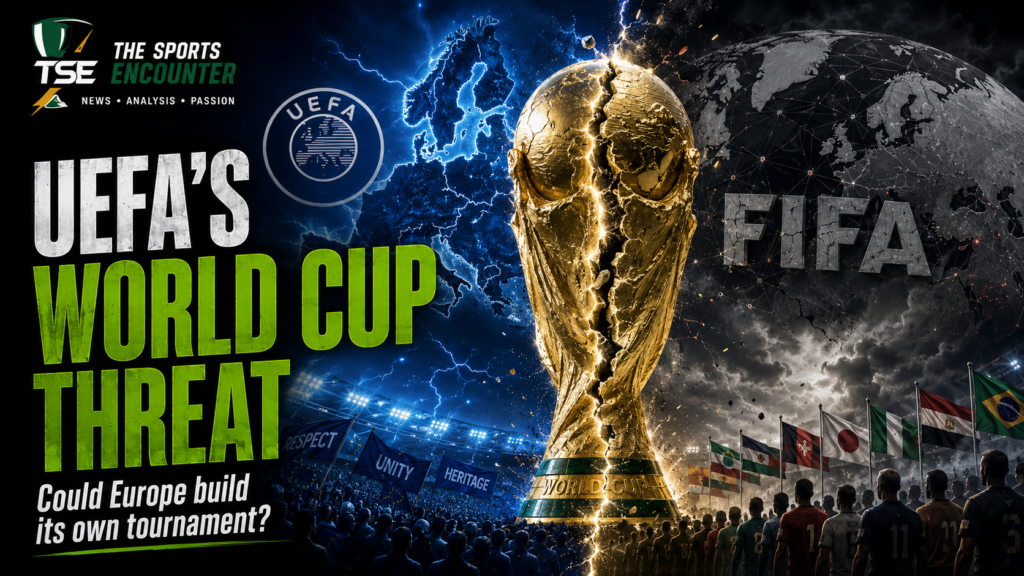
UEFA’s threat to boycott FIFA competitions has already shaken world soccer. Kaveh Solhekol’s latest warning points to an even bigger possibility: Europe could try to build its own version of the World Cup if the dispute with FIFA turns into a full institutional split.
The Sky Sports reporter said UEFA could set up its own World Cup-style tournament if Gianni Infantino pushes ahead with plans to bring private investors into a new FIFA commercial structure linked to the World Cup and other FIFA competitions.
That does not mean a breakaway tournament is about to be launched tomorrow. It does mean the pressure has moved beyond normal football politics. UEFA is no longer only arguing over governance language, consultation, or commercial structure. Europe is now testing the foundation of FIFA’s most valuable asset: participation.
The latest escalation follows UEFA’s emergency meeting with all 55 member associations. European national associations unanimously backed a conditional boycott of FIFA tournaments unless the private-investment proposal is abandoned and FIFA gives binding assurances against similar future plans.
The Sports Encounter previously covered UEFA’s 55-0 boycott decision over Infantino’s World Cup stake plan. This follow-up looks at the next question fans are now asking: if Europe refuses to play in FIFA competitions, what could replace them?
UEFA Rival World Cup Scenario: Key Facts
| Trigger | FIFA’s proposed private investment structure linked to World Cup commercial rights |
| UEFA position | European teams will boycott FIFA competitions if the proposal remains active |
| UEFA members | 55 national associations |
| FIFA members | 211 national associations |
| Possible UEFA move | A European-led international tournament outside FIFA’s control |
| Biggest obstacle | Legal, calendar, player-release, broadcast, and global-recognition issues |
| Biggest leverage point | Europe’s teams, players, broadcasters, sponsors, and global club ecosystem |
What Did Kaveh Solhekol Say?
Solhekol’s point was simple but explosive. If UEFA follows through on its threat to boycott FIFA competitions, Europe would still need a major international stage for its national teams, players, broadcasters, sponsors, and fans.
That could lead to a UEFA-run tournament that functions like a World Cup alternative, especially if FIFA refuses to abandon the proposed private-investment plan.
Sky Sports has reported extensively on the dispute, including FIFA’s attempt to attract outside investment into a new commercial structure and UEFA’s furious response. Fans can follow the developing story through Sky Sports’ coverage of the FIFA-UEFA World Cup investment row.
Solhekol’s warning matters because it gives shape to the boycott threat. A boycott alone creates absence. A rival tournament creates an alternative.
Could UEFA Actually Build Its Own World Cup?
In pure sporting terms, UEFA has enough elite national teams to create a tournament with global appeal.
Europe includes Spain, England, France, Germany, Italy, Portugal, the Netherlands, Belgium, Croatia, Denmark, Switzerland, and several other countries with major football audiences. European teams have won a large share of World Cup titles and regularly dominate the latter stages of the tournament.
A UEFA-led competition would instantly carry star power because many of the world’s most recognized players represent European national teams or play in European club football.
Commercially, the idea is also credible. UEFA already runs the Champions League, Europa League, Conference League, European Championship, Nations League, and major women’s and youth competitions. It has broadcast relationships, sponsorship machinery, tournament-delivery experience, and political weight across the sport.
That gives UEFA a rare combination: sporting depth, operational capacity, commercial infrastructure, and fan demand.
The problem is legitimacy.
🗣️ "UEFA could set up their own version of the World Cup."
— Sky Sports News (@SkySportsNews) July 30, 2026
Kaveh Solhekol on what UEFA's threat to boycott FIFA competitions could mean for the future of the World Cup. pic.twitter.com/4OAnYbfyJt
The FIFA World Cup is not valuable only because of Europe. It is valuable because it is the global tournament where every confederation has a pathway. A UEFA-run version would need to answer a difficult question from day one: is it a true world competition, or a powerful European substitute?
Why This Would Be Different From the European Super League
The comparison with the European Super League is unavoidable, but the situations are not identical.
The Super League was a club project led by a small group of elite teams. It looked like a closed commercial model designed to protect the power of a narrow group.
A UEFA-led international tournament would come from national associations rather than clubs. It would likely be framed as a defense of football’s public sporting heritage against private ownership of FIFA competitions.
That distinction matters. UEFA would argue that it is resisting privatization, not building a closed shop for profit. FIFA would almost certainly argue the opposite: that UEFA is using the World Cup crisis to protect European power over the global game.
Both arguments would find an audience.
What Would a UEFA World Cup Look Like?
If UEFA ever tried to create a rival tournament, it would probably avoid calling it the World Cup. FIFA owns the brand power and legal identity of that competition.
More realistic formats could include:
- A strengthened UEFA European Championship with invited non-European teams
- A “global nations championship” organized by UEFA and allied confederations
- A Europe-versus-world tournament involving selected national teams
- A joint tournament with South American teams if CONMEBOL aligned with UEFA
- An expanded Nations League finals model with invited elite countries
The most powerful version would involve UEFA and CONMEBOL together. A tournament featuring Europe’s strongest sides and South America’s biggest football nations would carry enormous historical weight. Brazil, Argentina, Uruguay, Spain, France, England, Germany, Italy, Portugal, and the Netherlands in one competition would be commercially serious from the first whistle.
Still, a tournament without Africa, Asia, North America, Oceania, and many emerging football nations would struggle to claim the full emotional authority of a World Cup.
Why FIFA Should Take the Threat Seriously
FIFA can survive criticism. It cannot easily survive a World Cup without Europe.
European teams bring major broadcast markets, elite players, historic brands, and commercial pull. Sponsors do not buy World Cup inventory only for the name on the trophy. They buy global attention, star presence, and the guarantee that football’s most watched nations will be there.
If UEFA withdraws, FIFA loses more than teams. It loses part of the product investors are being asked to value.
That is why Solhekol’s warning cuts straight into the economics of the dispute. A rival UEFA tournament would not need to become bigger than the World Cup immediately. It would only need to weaken FIFA’s claim that its tournament portfolio remains stable, unified, and commercially protected.
The Sports Encounter’s earlier analysis of the FIFA versus UEFA World Cup investment revolt argued that the dispute could expand beyond Europe. That possibility now looks more serious because AFC and Concacaf have also raised concerns over consultation and governance.
What Would Happen to Players?
Players would be caught in the middle.
National-team football depends on release windows, insurance, calendar coordination, club cooperation, and governing-body recognition. A rival tournament would need to secure all of that before becoming practical.
European clubs would have a major voice because they employ most of the elite players who would make such a competition attractive. If clubs supported UEFA’s position, FIFA’s leverage would weaken. If clubs feared legal risk, calendar congestion, or player fatigue, a rival tournament could become far harder to stage.
Player unions would also matter. Footballers may support the idea of protecting the World Cup from private ownership, but they would also want clarity on workload, travel, insurance, tournament timing, and career risk.
Could Other Confederations Join UEFA?
This is the central question.
UEFA alone can create a major tournament. UEFA with CONMEBOL can create a genuine global spectacle. UEFA with AFC, Concacaf, or selected federations from multiple confederations could create a serious challenge to FIFA’s tournament monopoly.
The Asian Football Confederation and Concacaf have already criticized the way FIFA handled the proposal. Concacaf said it had deep concerns over the lack of due process in FIFA’s approach, while AFC leadership also objected to the lack of consultation.
That does not mean those confederations will join a UEFA-led breakaway. Many national associations rely heavily on FIFA development funding. FIFA’s proposal includes significant financial incentives for member associations, and that money will matter in many parts of the world.
UEFA’s challenge is therefore political as much as commercial. It must convince other football regions that resisting the proposal protects the global game rather than only Europe’s influence.
Why Fans Should Care
This dispute may sound like governance politics, but it could directly affect fans.
If the crisis escalates, supporters could face cancelled fixtures, reshaped tournaments, new competitions, legal disputes, ticketing uncertainty, and divided broadcast packages. The 2027 Women’s World Cup, youth tournaments, and future men’s World Cup cycles could all be affected if the standoff continues.
Fans also have a deeper stake in the argument. The World Cup is one of the few sporting events that still feels bigger than a commercial product. It belongs to memory, identity, country, family, and history.
That is why UEFA’s language has been so forceful. The dispute is not only about who collects revenue. It is about whether private investors should hold an economic stake in the machinery behind football’s most important competitions.
FIFA’s position is that the new structure would generate more money for development while keeping sporting control under FIFA authority. UEFA’s fear is that once private capital enters the tournament structure, future decisions will naturally bend toward investor value.
Final Analysis: A Rival World Cup Is Still Unlikely, but No Longer Absurd
A UEFA-run alternative to the World Cup remains a drastic scenario. It would face legal barriers, calendar conflicts, political resistance, branding limitations, and questions over global legitimacy.
Yet the idea can no longer be dismissed as fantasy.
UEFA has the teams. It has the competitions experience. It has the broadcasters. It has the commercial network. Most importantly, it has a unified public position from all 55 member associations.
That is why Kaveh Solhekol’s warning matters. The real threat to FIFA may not be a single boycott. It may be the possibility that Europe decides FIFA no longer has exclusive control over the biggest international football stage it can offer its players and fans.
FIFA still has room to step back, consult properly, and protect the World Cup from a historic split. If it does not, the next football war may not be fought over clubs, leagues, or calendars.
It may be fought over who gets to define the World Cup itself.
The Sports Encounter’s World Cup 2026 coverage focuses on fixtures, team news, match analysis, fan stories, tournament trends, and the biggest talking points from football’s global stage.