


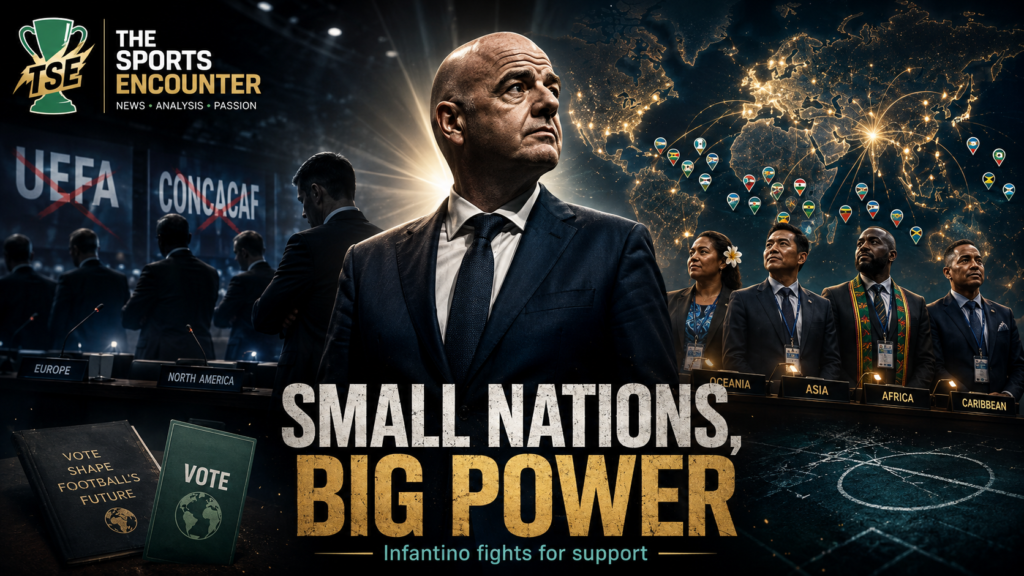
Gianni Infantino’s political future at FIFA may now depend on the smallest associations in world football.
UEFA and CONCACAF have publicly lost confidence in his leadership. Wales has withdrawn its support for his re-election, while England is reportedly preparing to follow. FIFA’s abandoned attempt to sell a stake in a commercial company connected to the World Cup has also triggered internal resignations, legal warnings, and unprecedented questions about Infantino’s authority.
Yet the FIFA president is far from finished.
The governing structure that once allowed Infantino to consolidate power could now provide his strongest protection. Every FIFA member association receives one vote, whether it represents a global football power such as England, France, or Spain, or a developing football nation such as Bhutan or Vanuatu.
That equality gives smaller associations enormous political influence. Many also depend heavily on FIFA funding for stadiums, training facilities, youth programs, administration, and international participation.
Infantino may struggle to regain the trust of Europe’s traditional powers. He may not need to.
TL;DR
- UEFA and CONCACAF have declared that they have lost confidence in Gianni Infantino following the collapse of FIFA’s World Cup investment proposal.
- Wales has formally withdrawn support for Infantino’s 2027 re-election campaign, while England is reportedly preparing to do the same.
- An Extraordinary FIFA Congress can be requested by at least 20% of FIFA’s 211 member associations, meaning 43 written requests would be sufficient.
- UEFA’s 55 associations could trigger that process without support from another confederation if they acted together.
- Removing Infantino would still require a much broader coalition because every FIFA association has an equal vote.
- Smaller nations across Oceania, Africa, Asia, and the Caribbean may become decisive because many have received essential FIFA development funding under Infantino.
Infantino’s Political Crisis at a Glance
| Issue | Current Position |
|---|---|
| World Cup investment plan | Abandoned after international opposition |
| Proposed outside investment | Approximately 20% of a new FIFA commercial entity |
| Potential capital raised | Up to approximately $4.2 billion |
| UEFA position | Lost confidence in Infantino’s leadership |
| CONCACAF position | Called for a comprehensive reckoning |
| Wales position | Formally withdrew support for Infantino’s re-election |
| England position | Reportedly preparing to withdraw support |
| FIFA members | 211 associations with one vote each |
| Extraordinary Congress threshold | At least 20% of members, equivalent to 43 associations |
| Infantino’s intended term | 2027 to 2031 |
The World Cup Stake Plan Has Collapsed, but the Political Damage Remains
Infantino’s crisis began with FIFA’s proposal to create a major commercial enterprise connected to its competitions, including the World Cup.
The structure reportedly involved selling a minority stake of roughly 20% to private investors. FIFA hoped to unlock up to $4.2 billion in immediate capital from a company valued at approximately $20 billion.
Infantino presented the project as a way to expand football development across FIFA’s 211 member associations. Opponents saw a long-term transfer of value from the world’s most important football competitions to private investors.
The Sports Encounter previously examined how the FIFA and UEFA confrontation developed into a global soccer revolt. The disagreement quickly moved beyond commercial policy and became a test of who controlled the future of international football.
UEFA’s 55 associations then voted unanimously to threaten a boycott of FIFA competitions if the proposal continued. CONCACAF’s 41 associations also rejected the plan, while opposition emerged within FIFA itself.
Senior adviser Carlos Cordeiro resigned in protest. FIFA chief operating officer Kevin Lamour accused the organization’s leadership of misleading staff and characterized the proposal as a project driven by one person.
Those internal developments were explored in The Sports Encounter’s report on the revolt inside Infantino’s own administration.
FIFA eventually abandoned the investment plan. The retreat ended the immediate threat to the World Cup’s commercial structure, but it did not repair the political damage created by the process.
UEFA and CONCACAF Have Moved Beyond Policy Opposition
The language used by UEFA and CONCACAF matters because both confederations have moved beyond rejecting a proposal.
UEFA said it had lost confidence in Infantino’s leadership. CONCACAF called for a comprehensive reckoning over how the plan was developed and presented.
Together, the two confederations represent 96 national associations. They also cover several of FIFA’s most commercially valuable markets, including the major European football nations, the United States, Mexico, and Canada.
That gives the opposition financial, sporting, and public influence. It does not automatically give it control of FIFA Congress.
The earlier 55-0 UEFA boycott vote showed that Europe could act as a unified political bloc when members believed FIFA had crossed an institutional boundary.
CONCACAF’s unanimous rejection further widened the crisis. The confederation’s opposition was particularly damaging because the United States, Canada, and Mexico had just hosted the 2026 World Cup and remain central to FIFA’s commercial plans.
However, FIFA elections are decided through association votes, not television value, sponsorship revenue, league strength, or World Cup performance.
Wales Becomes the First Association to Withdraw Support
The Football Association of Wales became the first national federation to formally withdraw its support for Infantino’s candidacy for the 2027 to 2031 term.
The Welsh association cited failures involving governance, process, leadership, values, stakeholder management, communications, and judgment. Its statement argued that FIFA had failed to put football’s interests first.
The decision carried symbolic weight because it converted confederation-level criticism into direct electoral action.
A general statement of lost confidence can leave room for negotiation. Withdrawing support from a presidential candidacy creates a clear voting position.
England’s Football Association is reportedly preparing to take the same step. At the time of the report, that decision had not yet been formally announced, so England’s position should still be treated as an expected action rather than a completed withdrawal.
If other European associations begin issuing individual statements, Infantino could lose any remaining hope of presenting UEFA’s opposition as an institutional disagreement led only by senior officials.
How an Extraordinary FIFA Congress Could Be Triggered
Infantino announced in April that he intended to seek another term as FIFA president. His re-election once appeared likely to be a formality, particularly after he had twice been returned unopposed.
The current crisis has introduced another possible route: an Extraordinary FIFA Congress.
Under FIFA’s governance framework, at least one-fifth of its member associations can request an Extraordinary Congress in writing. With 211 members, the practical threshold is 43 associations.
UEFA contains 55 national associations. A coordinated European request would therefore be sufficient to trigger the process without requiring support from CONCACAF, CONMEBOL, the AFC, CAF, or the OFC.
Once properly requested, the Extraordinary Congress would need to be held within three months. That period could give opponents time to organize a leadership challenge and identify an alternative candidate capable of attracting support outside Europe.
FIFA identifies Congress as its highest legislative body, with all member associations represented and entitled to vote. Readers can review the governing structure through FIFA’s official Congress information.
Calling a Congress may be easier than winning one.
Why UEFA Cannot Remove Infantino Alone
UEFA may have enough votes to demand an Extraordinary Congress, but Europe represents only 55 of FIFA’s 211 associations.
CONCACAF adds another 41. Even if both confederations remained fully united, their combined total would reach 96 votes, leaving them short of a simple majority of the full membership.
The coalition would therefore need support from associations in Africa, Asia, South America, or Oceania.
This is where Infantino’s decade-long relationship with emerging football nations becomes critical.
FIFA does not weight votes according to population, football history, World Cup appearances, revenue generation, or competitive strength. England and Vanuatu each hold one vote. Brazil and Bhutan possess the same formal voting power. Germany’s professional football economy does not entitle it to greater electoral influence than a Pacific island association.
The principle protects smaller nations from domination by wealthy football powers. It also allows an incumbent president to build a broad coalition through development programs, political access, and direct relationships with association leaders.
FIFA Forward Funding Gives Smaller Nations a Powerful Incentive
Member associations have been eligible to claim up to $3 million for football development projects during the 2023-2026 World Cup cycle. That is $1 million more than the maximum available during the previous cycle.
For wealthy European associations, that amount represents a limited part of a much larger football economy.
For small or developing nations, it can determine whether an association builds a training pitch, creates a women’s competition, maintains youth programs, employs coaches, renovates administrative facilities, or sends teams to international tournaments.
FIFA development money has helped finance stadiums, gyms, technical centers, and football programs across Africa, Asia, the Caribbean, and the Pacific.
That funding creates a genuine football benefit. Players and associations in countries with limited commercial revenue often have few realistic alternatives.
It also creates a political question.
Critics argue that FIFA’s development model can make smaller associations reluctant to challenge the president responsible for expanding or approving financial support. The concern is not necessarily that every grant represents a direct exchange for a vote. The broader issue is structural dependency.
Association leaders know that their domestic programs rely on FIFA. They also know that a breakdown in relations with the governing body could introduce uncertainty around future projects, access, and influence.
Vanuatu Shows Why Infantino Still Has a Strong Case
Vanuatu offers a useful example of the political and developmental relationship at the center of this crisis.
The Pacific island nation is ranked well outside football’s traditional elite and has never qualified for a men’s World Cup. Its population is approximately 340,000, while its domestic football economy cannot produce revenue comparable to established European or South American nations.
Despite that limited commercial power, Vanuatu Football Federation president Lambert Maltock holds one of FIFA’s eight vice-presidential positions and sits on the FIFA Council.
FIFA also awarded Vanuatu a development grant of approximately $4.15 million to help build a 6,500-seat stadium in Port Vila. The facility was completed in 2022.
Vanuatu international Brian Kaltak, the country’s first professional footballer, said Infantino had expanded opportunities for Vanuatu and other developing nations.
His view reflects an important reality that Infantino’s critics cannot dismiss.
European associations may see the World Cup investment plan as a governance failure. Smaller associations may judge Infantino through new facilities, expanded competitions, travel support, and access to FIFA’s decision-making structures.
Both perspectives can exist at the same time.
Development or Patronage?
The battle over Infantino’s future will revolve partly around how associations interpret FIFA’s financial model.
Supporters see redistribution as one of FIFA’s central responsibilities. The World Cup generates extraordinary revenue because football is global, so a portion of that income should support nations that cannot independently finance professional development systems.
Under this argument, Infantino has delivered on FIFA’s mission by directing more money toward associations outside the richest football markets.
Critics see another pattern. They argue that the same funding system strengthens presidential power by creating hundreds of direct financial relationships between FIFA and national association executives.
Neither side can reduce the issue to a simple moral choice.
Withholding development money from poorer countries would deepen inequality in world football. Allowing the distribution of funds to become politically associated with one leader also weakens institutional independence.
The real governance challenge is ensuring that development funding follows transparent criteria and remains protected regardless of which candidate an association supports.
Infantino May Campaign Against Europe’s Dominance
Infantino’s most effective political response may be to portray the conflict as a struggle between football’s established powers and the rest of the world.
He can argue that UEFA’s wealthiest associations already control the strongest leagues, the largest clubs, much of the sport’s broadcast revenue, and many of its leading players.
From that position, FIFA development programs provide one of the few mechanisms through which smaller countries can improve infrastructure and compete internationally.
The abandoned World Cup investment plan was originally presented to associations in similar terms. FIFA argued that fresh capital would generate billions for football development and give members outside the traditional elite greater opportunities.
Opponents argued that raising money by selling part of FIFA’s long-term commercial value was unnecessary, poorly governed, and potentially irreversible.
The collapse of the proposal was examined in The Sports Encounter’s analysis of why the World Cup stake sale died under global pressure.
Infantino may now return to the original redistribution argument while presenting himself as the defender of associations that believe European interests receive too much attention.
UEFA Needs More Than Outrage to Win
If UEFA wants to remove Infantino or prevent his re-election, it must develop a campaign that speaks directly to smaller associations.
Condemning governance failures will resonate strongly in Europe. It may carry less weight in countries where FIFA money has recently funded a national stadium, technical center, or women’s football program.
A successful opposition campaign would need to answer several practical questions:
- Would development funding continue at the same or a higher level under a new president?
- How would FIFA protect smaller associations from financial uncertainty?
- Would emerging nations retain access to leadership positions and expanded competitions?
- Could a challenger offer reform without returning FIFA to European dominance?
- Would funding decisions become more transparent and independent of presidential politics?
Without credible answers, UEFA risks creating a coalition that is powerful enough to call a Congress but too narrow to control its outcome.
CONMEBOL, CAF, AFC, and OFC Could Decide the Contest
The remaining confederations now occupy strategically important positions.
CONMEBOL has only 10 associations, but South America carries enormous football authority. Support from countries such as Brazil, Argentina, and Uruguay could help an anti-Infantino coalition appear global rather than European-led.
CAF has 54 members, making Africa one of the most important voting blocs. The AFC has 47 associations, while the OFC represents 11.
No serious leadership challenge can succeed without substantial support from these regions.
Many associations within those confederations have benefited from FIFA development programs, expanded tournament access, and Infantino’s policy of directing more financial resources outside Europe.
Their votes cannot be assumed.
Confederation leaders may issue statements, but national associations retain their individual voting rights at Congress. Internal divisions could emerge even if regional executives adopt a common position.
England’s Withdrawal Would Increase Pressure, Not Settle the Outcome
England withdrawing support would carry substantial symbolic importance.
The Football Association is one of the sport’s oldest and most influential governing bodies. England also operates the Premier League, whose clubs, audiences, and commercial reach shape the global football economy.
Its opposition would reinforce the message that Infantino has lost the confidence of major football institutions.
Electorally, however, England still contributes only one vote.
That contrast captures the unusual nature of FIFA politics. A federation may possess enormous commercial and historical influence while holding no more formal voting power than one of the smallest associations in Oceania.
England and Wales can help create momentum. They cannot decide the election by themselves.
Infantino’s Fourth-Term Question
Infantino first became FIFA president in February 2016 following the crisis that ended Sepp Blatter’s leadership. He subsequently secured re-election without opposition.
His intended 2027 candidacy would seek another term running through 2031.
Before the World Cup stake controversy, another uncontested victory appeared possible. The speed of the political reversal has changed that calculation.
Infantino now faces three connected risks.
First, more national associations could withdraw their endorsements. Second, UEFA could formally trigger an Extraordinary Congress. Third, a credible rival could emerge with enough time to build support across multiple confederations.
His strengths remain substantial. Incumbency provides relationships, visibility, and organizational access. Development funding has built goodwill across regions that often feel ignored by European football’s major institutions.
FIFA’s one-association, one-vote system also means Infantino does not need to win the argument in London, Madrid, or Paris if he can retain support in Africa, Asia, the Caribbean, and the Pacific.
What Happens Next?
The next major development may come from UEFA.
The European governing body has reportedly sent a document preservation notice linked to possible legal action. Such a notice seeks to prevent the deletion or destruction of emails, files, and other materials that could become relevant to an investigation or legal process.
UEFA must also decide whether its political response will stop at public condemnation or move toward a formal Extraordinary Congress request.
Individual national associations will face their own decisions. Wales has acted. England may follow. Others will need to determine whether losing confidence in Infantino should translate into withdrawing electoral support.
Potential challengers will also assess whether a realistic path exists. A candidate identified too closely with UEFA may struggle to attract associations that fear the return of European dominance.
The strongest rival would likely need to combine governance reform with firm commitments to development funding, equal representation, and expanded opportunity.
Final Verdict
Gianni Infantino has suffered the most serious political setback of his FIFA presidency.
The World Cup stake plan has collapsed. UEFA and CONCACAF have lost confidence in his leadership. Wales has withdrawn its electoral support, England is expected to follow, senior officials have broken ranks, and possible legal action now hangs over the process.
Those developments would end many political careers.
FIFA’s structure gives Infantino another route.
Smaller and emerging nations do not produce the governing body’s largest commercial revenues, but they control most of its votes. Many have also seen tangible improvements through FIFA-funded stadiums, facilities, and development programs during Infantino’s presidency.
UEFA can trigger an Extraordinary Congress. Removing Infantino would require a coalition extending far beyond Europe.
The coming contest will therefore be decided in places that rarely dominate global football headlines. Associations in Africa, Asia, the Caribbean, and the Pacific may hold the votes that determine whether Infantino survives, faces a serious challenger, or loses control of FIFA altogether.
World football’s traditional powers have delivered their snub.
Infantino’s response will be to remind smaller nations how much power they possess.
Frequently Asked Questions
Why are UEFA and CONCACAF opposing Gianni Infantino?
Both confederations criticized Infantino’s leadership following FIFA’s failed proposal to sell a minority stake in a new commercial entity connected to the World Cup and other competitions.
Has England withdrawn support for Infantino?
Reports on August 3, 2026, indicated that England’s Football Association was preparing to withdraw its support. Wales had already issued a formal withdrawal. England’s action had not yet been officially confirmed at the time of those reports.
How can an Extraordinary FIFA Congress be called?
At least 20% of FIFA’s 211 member associations must submit a written request. That means 43 associations could trigger an Extraordinary Congress.
Can UEFA trigger an Extraordinary FIFA Congress by itself?
Yes. UEFA has 55 member associations, which is more than the 43 required, provided enough of them formally support the request.
Why are smaller FIFA nations important to Infantino?
Every FIFA association receives one Congress vote regardless of its size or footballing strength. Many smaller nations have also benefited from FIFA development grants and infrastructure programs during Infantino’s presidency.
How much FIFA development funding can associations receive?
Member associations have been eligible to claim up to $3 million for football development projects during the 2023-2026 cycle.
Is Gianni Infantino running for another term?
Infantino announced his intention to seek the FIFA presidency for the 2027 to 2031 term.
Could Infantino still win despite UEFA’s opposition?
Yes. UEFA represents 55 of FIFA’s 211 associations. Infantino could survive or win another election by retaining sufficient support across Africa, Asia, South America, the Caribbean, and Oceania.