Connect with us
Marcos Wetherfield | The Sports Encounter

Published

on

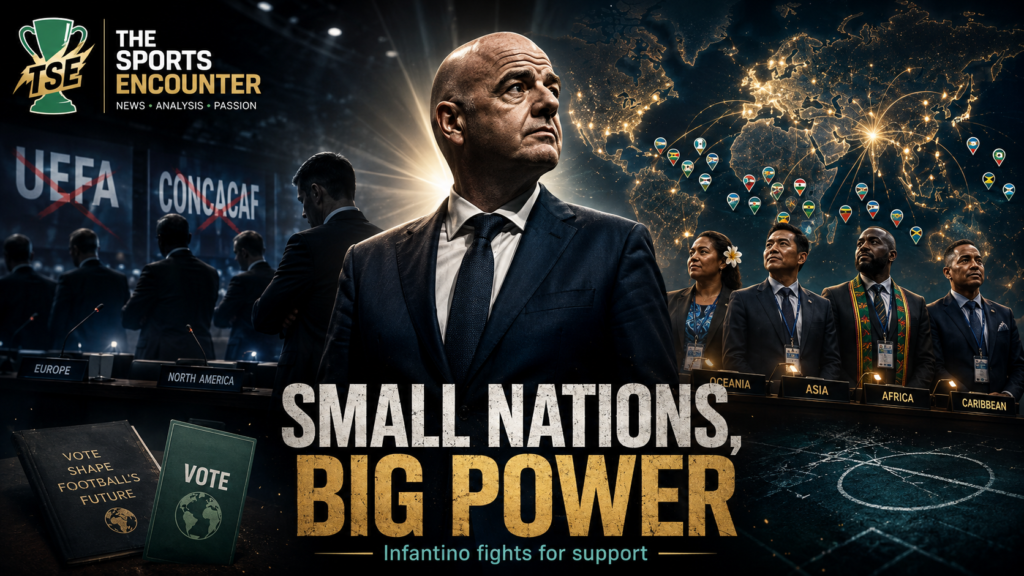
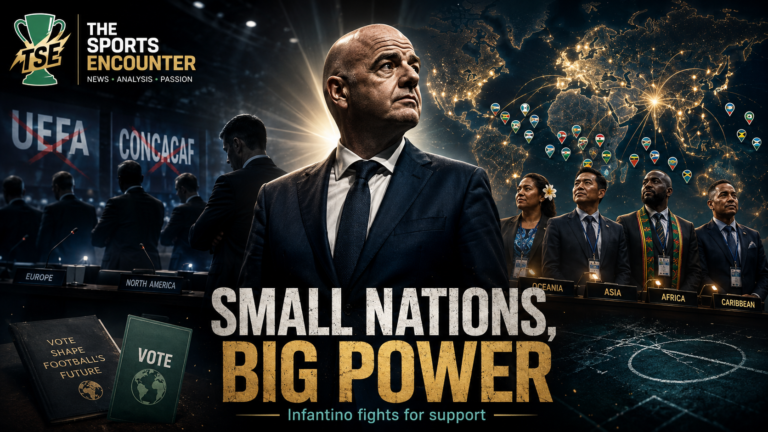
Gianni Infantino’s political future at FIFA may now depend on the smallest associations in world football.

UEFA and CONCACAF have publicly lost confidence in his leadership. Wales has withdrawn its support for his re-election, while England is reportedly preparing to follow. FIFA’s abandoned attempt to sell a stake in a commercial company connected to the World Cup has also triggered internal resignations, legal warnings, and unprecedented questions about Infantino’s authority.

Yet the FIFA president is far from finished.

The governing structure that once allowed Infantino to consolidate power could now provide his strongest protection. Every FIFA member association receives one vote, whether it represents a global football power such as England, France, or Spain, or a developing football nation such as Bhutan or Vanuatu.

That equality gives smaller associations enormous political influence. Many also depend heavily on FIFA funding for stadiums, training facilities, youth programs, administration, and international participation.

Infantino may struggle to regain the trust of Europe’s traditional powers. He may not need to.

TL;DR

  • UEFA and CONCACAF have declared that they have lost confidence in Gianni Infantino following the collapse of FIFA’s World Cup investment proposal.
  • Wales has formally withdrawn support for Infantino’s 2027 re-election campaign, while England is reportedly preparing to do the same.
  • An Extraordinary FIFA Congress can be requested by at least 20% of FIFA’s 211 member associations, meaning 43 written requests would be sufficient.
  • UEFA’s 55 associations could trigger that process without support from another confederation if they acted together.
  • Removing Infantino would still require a much broader coalition because every FIFA association has an equal vote.
  • Smaller nations across Oceania, Africa, Asia, and the Caribbean may become decisive because many have received essential FIFA development funding under Infantino.

Infantino’s Political Crisis at a Glance

Issue Current Position
World Cup investment plan Abandoned after international opposition
Proposed outside investment Approximately 20% of a new FIFA commercial entity
Potential capital raised Up to approximately $4.2 billion
UEFA position Lost confidence in Infantino’s leadership
CONCACAF position Called for a comprehensive reckoning
Wales position Formally withdrew support for Infantino’s re-election
England position Reportedly preparing to withdraw support
FIFA members 211 associations with one vote each
Extraordinary Congress threshold At least 20% of members, equivalent to 43 associations
Infantino’s intended term 2027 to 2031

The World Cup Stake Plan Has Collapsed, but the Political Damage Remains

Infantino’s crisis began with FIFA’s proposal to create a major commercial enterprise connected to its competitions, including the World Cup.

The structure reportedly involved selling a minority stake of roughly 20% to private investors. FIFA hoped to unlock up to $4.2 billion in immediate capital from a company valued at approximately $20 billion.

Infantino presented the project as a way to expand football development across FIFA’s 211 member associations. Opponents saw a long-term transfer of value from the world’s most important football competitions to private investors.

The Sports Encounter previously examined how the FIFA and UEFA confrontation developed into a global soccer revolt. The disagreement quickly moved beyond commercial policy and became a test of who controlled the future of international football.

UEFA’s 55 associations then voted unanimously to threaten a boycott of FIFA competitions if the proposal continued. CONCACAF’s 41 associations also rejected the plan, while opposition emerged within FIFA itself.

Senior adviser Carlos Cordeiro resigned in protest. FIFA chief operating officer Kevin Lamour accused the organization’s leadership of misleading staff and characterized the proposal as a project driven by one person.

Those internal developments were explored in The Sports Encounter’s report on the revolt inside Infantino’s own administration.

FIFA eventually abandoned the investment plan. The retreat ended the immediate threat to the World Cup’s commercial structure, but it did not repair the political damage created by the process.

UEFA and CONCACAF Have Moved Beyond Policy Opposition

The language used by UEFA and CONCACAF matters because both confederations have moved beyond rejecting a proposal.

UEFA said it had lost confidence in Infantino’s leadership. CONCACAF called for a comprehensive reckoning over how the plan was developed and presented.

Together, the two confederations represent 96 national associations. They also cover several of FIFA’s most commercially valuable markets, including the major European football nations, the United States, Mexico, and Canada.

That gives the opposition financial, sporting, and public influence. It does not automatically give it control of FIFA Congress.

The earlier 55-0 UEFA boycott vote showed that Europe could act as a unified political bloc when members believed FIFA had crossed an institutional boundary.

CONCACAF’s unanimous rejection further widened the crisis. The confederation’s opposition was particularly damaging because the United States, Canada, and Mexico had just hosted the 2026 World Cup and remain central to FIFA’s commercial plans.

However, FIFA elections are decided through association votes, not television value, sponsorship revenue, league strength, or World Cup performance.

Wales Becomes the First Association to Withdraw Support

The Football Association of Wales became the first national federation to formally withdraw its support for Infantino’s candidacy for the 2027 to 2031 term.

The Welsh association cited failures involving governance, process, leadership, values, stakeholder management, communications, and judgment. Its statement argued that FIFA had failed to put football’s interests first.

The decision carried symbolic weight because it converted confederation-level criticism into direct electoral action.

A general statement of lost confidence can leave room for negotiation. Withdrawing support from a presidential candidacy creates a clear voting position.

England’s Football Association is reportedly preparing to take the same step. At the time of the report, that decision had not yet been formally announced, so England’s position should still be treated as an expected action rather than a completed withdrawal.

If other European associations begin issuing individual statements, Infantino could lose any remaining hope of presenting UEFA’s opposition as an institutional disagreement led only by senior officials.

How an Extraordinary FIFA Congress Could Be Triggered

Infantino announced in April that he intended to seek another term as FIFA president. His re-election once appeared likely to be a formality, particularly after he had twice been returned unopposed.

The current crisis has introduced another possible route: an Extraordinary FIFA Congress.

Under FIFA’s governance framework, at least one-fifth of its member associations can request an Extraordinary Congress in writing. With 211 members, the practical threshold is 43 associations.

UEFA contains 55 national associations. A coordinated European request would therefore be sufficient to trigger the process without requiring support from CONCACAF, CONMEBOL, the AFC, CAF, or the OFC.

Once properly requested, the Extraordinary Congress would need to be held within three months. That period could give opponents time to organize a leadership challenge and identify an alternative candidate capable of attracting support outside Europe.

FIFA identifies Congress as its highest legislative body, with all member associations represented and entitled to vote. Readers can review the governing structure through FIFA’s official Congress information.

Calling a Congress may be easier than winning one.

Why UEFA Cannot Remove Infantino Alone

UEFA may have enough votes to demand an Extraordinary Congress, but Europe represents only 55 of FIFA’s 211 associations.

CONCACAF adds another 41. Even if both confederations remained fully united, their combined total would reach 96 votes, leaving them short of a simple majority of the full membership.

The coalition would therefore need support from associations in Africa, Asia, South America, or Oceania.

This is where Infantino’s decade-long relationship with emerging football nations becomes critical.

FIFA does not weight votes according to population, football history, World Cup appearances, revenue generation, or competitive strength. England and Vanuatu each hold one vote. Brazil and Bhutan possess the same formal voting power. Germany’s professional football economy does not entitle it to greater electoral influence than a Pacific island association.

The principle protects smaller nations from domination by wealthy football powers. It also allows an incumbent president to build a broad coalition through development programs, political access, and direct relationships with association leaders.

FIFA Forward Funding Gives Smaller Nations a Powerful Incentive

Member associations have been eligible to claim up to $3 million for football development projects during the 2023-2026 World Cup cycle. That is $1 million more than the maximum available during the previous cycle.

For wealthy European associations, that amount represents a limited part of a much larger football economy.

For small or developing nations, it can determine whether an association builds a training pitch, creates a women’s competition, maintains youth programs, employs coaches, renovates administrative facilities, or sends teams to international tournaments.

FIFA development money has helped finance stadiums, gyms, technical centers, and football programs across Africa, Asia, the Caribbean, and the Pacific.

That funding creates a genuine football benefit. Players and associations in countries with limited commercial revenue often have few realistic alternatives.

It also creates a political question.

Critics argue that FIFA’s development model can make smaller associations reluctant to challenge the president responsible for expanding or approving financial support. The concern is not necessarily that every grant represents a direct exchange for a vote. The broader issue is structural dependency.

Association leaders know that their domestic programs rely on FIFA. They also know that a breakdown in relations with the governing body could introduce uncertainty around future projects, access, and influence.

Vanuatu Shows Why Infantino Still Has a Strong Case

Vanuatu offers a useful example of the political and developmental relationship at the center of this crisis.

The Pacific island nation is ranked well outside football’s traditional elite and has never qualified for a men’s World Cup. Its population is approximately 340,000, while its domestic football economy cannot produce revenue comparable to established European or South American nations.

Despite that limited commercial power, Vanuatu Football Federation president Lambert Maltock holds one of FIFA’s eight vice-presidential positions and sits on the FIFA Council.

FIFA also awarded Vanuatu a development grant of approximately $4.15 million to help build a 6,500-seat stadium in Port Vila. The facility was completed in 2022.

Vanuatu international Brian Kaltak, the country’s first professional footballer, said Infantino had expanded opportunities for Vanuatu and other developing nations.

His view reflects an important reality that Infantino’s critics cannot dismiss.

European associations may see the World Cup investment plan as a governance failure. Smaller associations may judge Infantino through new facilities, expanded competitions, travel support, and access to FIFA’s decision-making structures.

Both perspectives can exist at the same time.

Development or Patronage?

The battle over Infantino’s future will revolve partly around how associations interpret FIFA’s financial model.

Supporters see redistribution as one of FIFA’s central responsibilities. The World Cup generates extraordinary revenue because football is global, so a portion of that income should support nations that cannot independently finance professional development systems.

Under this argument, Infantino has delivered on FIFA’s mission by directing more money toward associations outside the richest football markets.

Critics see another pattern. They argue that the same funding system strengthens presidential power by creating hundreds of direct financial relationships between FIFA and national association executives.

Neither side can reduce the issue to a simple moral choice.

Withholding development money from poorer countries would deepen inequality in world football. Allowing the distribution of funds to become politically associated with one leader also weakens institutional independence.

The real governance challenge is ensuring that development funding follows transparent criteria and remains protected regardless of which candidate an association supports.

Infantino May Campaign Against Europe’s Dominance

Infantino’s most effective political response may be to portray the conflict as a struggle between football’s established powers and the rest of the world.

He can argue that UEFA’s wealthiest associations already control the strongest leagues, the largest clubs, much of the sport’s broadcast revenue, and many of its leading players.

From that position, FIFA development programs provide one of the few mechanisms through which smaller countries can improve infrastructure and compete internationally.

The abandoned World Cup investment plan was originally presented to associations in similar terms. FIFA argued that fresh capital would generate billions for football development and give members outside the traditional elite greater opportunities.

Opponents argued that raising money by selling part of FIFA’s long-term commercial value was unnecessary, poorly governed, and potentially irreversible.

The collapse of the proposal was examined in The Sports Encounter’s analysis of why the World Cup stake sale died under global pressure.

Infantino may now return to the original redistribution argument while presenting himself as the defender of associations that believe European interests receive too much attention.

UEFA Needs More Than Outrage to Win

If UEFA wants to remove Infantino or prevent his re-election, it must develop a campaign that speaks directly to smaller associations.

Condemning governance failures will resonate strongly in Europe. It may carry less weight in countries where FIFA money has recently funded a national stadium, technical center, or women’s football program.

A successful opposition campaign would need to answer several practical questions:

  • Would development funding continue at the same or a higher level under a new president?
  • How would FIFA protect smaller associations from financial uncertainty?
  • Would emerging nations retain access to leadership positions and expanded competitions?
  • Could a challenger offer reform without returning FIFA to European dominance?
  • Would funding decisions become more transparent and independent of presidential politics?

Without credible answers, UEFA risks creating a coalition that is powerful enough to call a Congress but too narrow to control its outcome.

CONMEBOL, CAF, AFC, and OFC Could Decide the Contest

The remaining confederations now occupy strategically important positions.

CONMEBOL has only 10 associations, but South America carries enormous football authority. Support from countries such as Brazil, Argentina, and Uruguay could help an anti-Infantino coalition appear global rather than European-led.

CAF has 54 members, making Africa one of the most important voting blocs. The AFC has 47 associations, while the OFC represents 11.

No serious leadership challenge can succeed without substantial support from these regions.

Many associations within those confederations have benefited from FIFA development programs, expanded tournament access, and Infantino’s policy of directing more financial resources outside Europe.

Their votes cannot be assumed.

Confederation leaders may issue statements, but national associations retain their individual voting rights at Congress. Internal divisions could emerge even if regional executives adopt a common position.

England’s Withdrawal Would Increase Pressure, Not Settle the Outcome

England withdrawing support would carry substantial symbolic importance.

The Football Association is one of the sport’s oldest and most influential governing bodies. England also operates the Premier League, whose clubs, audiences, and commercial reach shape the global football economy.

Its opposition would reinforce the message that Infantino has lost the confidence of major football institutions.

Electorally, however, England still contributes only one vote.

That contrast captures the unusual nature of FIFA politics. A federation may possess enormous commercial and historical influence while holding no more formal voting power than one of the smallest associations in Oceania.

England and Wales can help create momentum. They cannot decide the election by themselves.

Infantino’s Fourth-Term Question

Infantino first became FIFA president in February 2016 following the crisis that ended Sepp Blatter’s leadership. He subsequently secured re-election without opposition.

His intended 2027 candidacy would seek another term running through 2031.

Before the World Cup stake controversy, another uncontested victory appeared possible. The speed of the political reversal has changed that calculation.

Infantino now faces three connected risks.

First, more national associations could withdraw their endorsements. Second, UEFA could formally trigger an Extraordinary Congress. Third, a credible rival could emerge with enough time to build support across multiple confederations.

His strengths remain substantial. Incumbency provides relationships, visibility, and organizational access. Development funding has built goodwill across regions that often feel ignored by European football’s major institutions.

FIFA’s one-association, one-vote system also means Infantino does not need to win the argument in London, Madrid, or Paris if he can retain support in Africa, Asia, the Caribbean, and the Pacific.

What Happens Next?

The next major development may come from UEFA.

The European governing body has reportedly sent a document preservation notice linked to possible legal action. Such a notice seeks to prevent the deletion or destruction of emails, files, and other materials that could become relevant to an investigation or legal process.

UEFA must also decide whether its political response will stop at public condemnation or move toward a formal Extraordinary Congress request.

Individual national associations will face their own decisions. Wales has acted. England may follow. Others will need to determine whether losing confidence in Infantino should translate into withdrawing electoral support.

Potential challengers will also assess whether a realistic path exists. A candidate identified too closely with UEFA may struggle to attract associations that fear the return of European dominance.

The strongest rival would likely need to combine governance reform with firm commitments to development funding, equal representation, and expanded opportunity.

Final Verdict

Gianni Infantino has suffered the most serious political setback of his FIFA presidency.

The World Cup stake plan has collapsed. UEFA and CONCACAF have lost confidence in his leadership. Wales has withdrawn its electoral support, England is expected to follow, senior officials have broken ranks, and possible legal action now hangs over the process.

Those developments would end many political careers.

FIFA’s structure gives Infantino another route.

Smaller and emerging nations do not produce the governing body’s largest commercial revenues, but they control most of its votes. Many have also seen tangible improvements through FIFA-funded stadiums, facilities, and development programs during Infantino’s presidency.

UEFA can trigger an Extraordinary Congress. Removing Infantino would require a coalition extending far beyond Europe.

The coming contest will therefore be decided in places that rarely dominate global football headlines. Associations in Africa, Asia, the Caribbean, and the Pacific may hold the votes that determine whether Infantino survives, faces a serious challenger, or loses control of FIFA altogether.

World football’s traditional powers have delivered their snub.

Infantino’s response will be to remind smaller nations how much power they possess.

Frequently Asked Questions

Why are UEFA and CONCACAF opposing Gianni Infantino?

Both confederations criticized Infantino’s leadership following FIFA’s failed proposal to sell a minority stake in a new commercial entity connected to the World Cup and other competitions.

Has England withdrawn support for Infantino?

Reports on August 3, 2026, indicated that England’s Football Association was preparing to withdraw its support. Wales had already issued a formal withdrawal. England’s action had not yet been officially confirmed at the time of those reports.

How can an Extraordinary FIFA Congress be called?

At least 20% of FIFA’s 211 member associations must submit a written request. That means 43 associations could trigger an Extraordinary Congress.

Can UEFA trigger an Extraordinary FIFA Congress by itself?

Yes. UEFA has 55 member associations, which is more than the 43 required, provided enough of them formally support the request.

Why are smaller FIFA nations important to Infantino?

Every FIFA association receives one Congress vote regardless of its size or footballing strength. Many smaller nations have also benefited from FIFA development grants and infrastructure programs during Infantino’s presidency.

How much FIFA development funding can associations receive?

Member associations have been eligible to claim up to $3 million for football development projects during the 2023-2026 cycle.

Is Gianni Infantino running for another term?

Infantino announced his intention to seek the FIFA presidency for the 2027 to 2031 term.

Could Infantino still win despite UEFA’s opposition?

Yes. UEFA represents 55 of FIFA’s 211 associations. Infantino could survive or win another election by retaining sufficient support across Africa, Asia, South America, the Caribbean, and Oceania.

Marcos Wetherfield is a Boca Raton-based fitness expert covering WWE, soccer, baseball, NHL, NBA, and major American sports for The Sports Encounter. His work focuses on athletic conditioning, strength, mobility, recovery, injury prevention, performance habits, and the physical demands behind elite competition. Coverage areas: fitness, sports performance, WWE, soccer, baseball, NHL, NBA, athlete conditioning, recovery, and American sports culture.

Breaking News

Harper and Asalanka Punish Colombo’s Chaos as Galle Reach LPL Final

Sam Harper’s commanding 77 and Charith Asalanka’s composed 59 carried Galle Gallants past Colombo Kaps and into the LPL 2026 final against Jaffna Kings.

Published

on

Galle Gallants, Colombo Kaps, Lanka Premier League 2026, Sam Harper, Charith Asalanka

Colombo Kaps scored quickly enough to threaten Galle Gallants, but they never batted long enough to control the match.

That difference decided Qualifier 2.

Colombo lost five wickets inside seven overs, recovered through Rubin Hermann and Ravindu Fernando, and then surrendered its remaining batting resources before completing 20 overs. Galle responded with a far calmer chase, riding Sam Harper’s masterful 77 and Charith Asalanka’s 59 to reach 177 for four in 18.4 overs.

The six-wicket victory at the R. Premadasa Stadium sends Galle into Saturday’s Lanka Premier League 2026 final against Jaffna Kings. Colombo’s promising playoff run ends one victory short of the title match.

TL;DR

  • Galle Gallants chased 177 in 18.4 overs to win Qualifier 2 by six wickets.
  • Sam Harper led the chase with 77 from 51 balls, including four fours and four sixes.
  • Charith Asalanka scored 59 from 42 and shared a match-defining 126-run partnership with Harper.
  • Colombo recovered from 52 for five to reach 176, but was bowled out in 18.5 overs.
  • Dasun Shanaka’s constant bowling changes prevented Colombo from controlling the innings.
  • Galle will face Jaffna Kings in the LPL 2026 final on August 8.

Galle Gallants vs Colombo Kaps Scorecard

DetailInformation
CompetitionLanka Premier League 2026, Qualifier 2
VenueR. Premadasa Stadium, Colombo
DateAugust 7, 2026
TossColombo Kaps elected to bat
Colombo Kaps176 all out in 18.5 overs
Galle Gallants177/4 in 18.4 overs
ResultGalle Gallants won by six wickets
Top Galle batterSam Harper, 77 from 51 balls
Galle supportCharith Asalanka, 59 from 42 balls
Top Colombo battersRavindu Fernando 48; Rubin Hermann 45
Best Galle bowlingSachindu Colombage 2/34; Charith Asalanka 2/34
Turning pointHarper and Asalanka added 126 after Galle slipped to 21/1
What comes nextGalle face Jaffna Kings in the August 8 final

Colombo’s Run Rate Hid a Deeper Batting Failure

A total of 176 from 18.5 overs suggests aggression. The scorecard tells a harsher story.

Colombo fell to 20 for three before the third over had ended. Sadeera Samarawickrama made five, Thanuka Dabare scored 11, and captain Kamindu Mendis managed one. Janith Liyanage briefly counterattacked with 23 from nine balls, but his dismissal left the Kaps at 47 for four.

James Neesham then fell for one, reducing Colombo to 52 for five in 6.1 overs.

The Kaps kept swinging when the situation called for one decisive partnership. That approach produced boundaries, but it repeatedly exposed new batters before they had understood the surface or match situation.

Hermann supplied some resistance with 45 from 33 balls. Ravindu Fernando changed the innings’ pace with five sixes in a 27-ball 48, while Malsha Tharupathi contributed a valuable 28 from 17. Their hitting dragged Colombo toward a defendable total, yet the team lost its seventh wicket at 158 in the 17th over and was dismissed with seven balls unused.

Those missing deliveries mattered. Even at a modest late-innings rate, Colombo could have added another 10 to 15 runs. Against a Galle batting lineup that eventually needed eight runs from the final eight balls, that extra cushion could have changed the pressure entirely.

Colombo had shown much better knockout control while eliminating Kandy, as detailed in The Sports Encounter’s report on McDermott, Neesham and Wanuja Sahan ending the Royals’ campaign. Qualifier 2 exposed the opposite version of their batting.

Shanaka Kept Searching Until Galle Found Control

Dasun Shanaka’s captaincy deserves as much credit as the wickets.

Colombo’s batters attacked nearly every bowling matchup, which could easily have forced a captain into defensive thinking. Shanaka continued rotating his options instead. Six bowlers entered the attack, preventing any Colombo batter from settling against one repeated pace or angle.

Charith Asalanka conceded 34 from three overs but removed Dabare and Kamindu. Mohammad Nawaz delivered the evening’s most economical spell, taking one for 12 from two overs. Akif Javed and Tharindu Ratnayake collected one wicket each, while Sachindu Colombage returned two for 34.

The changes did not stop every boundary. They kept producing questions, and Colombo’s reckless shot selection eventually supplied the answers.

Galle had already beaten the Kaps twice during the league stage, including a 13-run victory that secured a top-two finish. Shanaka again showed why his team has handled changing match situations better across the tournament.

Harper and Asalanka Remove the Panic From the Chase

Galle lost Thomas Rogers for 13 at 21 for one, giving Colombo the early opening it needed. Harper and Asalanka closed it with patience, strike rotation and controlled aggression.

Their 126-run partnership lasted 84 balls. Harper struck four fours and four sixes during his 77 from 51, while Asalanka contributed three fours and four sixes in a 42-ball 59.

Both batters understood that the required rate demanded intent without desperation. They targeted weaker deliveries, kept the scoreboard moving between boundaries and denied Colombo the clusters of wickets that had damaged the first innings.

Harper has repeatedly shaped Galle’s successful chases. His earlier 65 against the same opponent helped produce another victory, covered in The Sports Encounter’s report on Galle’s five-wicket win over Colombo.

Asalanka again provided the calm middle-overs influence that defined his 65 in Galle’s opening victory over Jaffna.

Colombo dismissed Asalanka, Harper and Chamika Karunaratne late, but the damage had already been done. Shanaka completed the chase with a six, finishing unbeaten on eight from three balls.

The Final Brings Galle Back to Jaffna

Galle’s reward is an immediate rematch with Jaffna Kings, who defeated them by 14 runs in Qualifier 1 after Kamil Mishara’s unbeaten century.

Jaffna will enter the final rested and confident after posting 242 for two in that meeting. Galle arrives with momentum, a proven chasing structure and fresh evidence that Harper and Asalanka can manage knockout pressure.

The official Lanka Premier League schedule confirms that the final will take place at the R. Premadasa Stadium on August 8. Readers can follow the buildup through The Sports Encounter’s Lanka Premier League coverage hub and wider cricket reporting and analysis.

Colombo leaves with clear evidence of its attacking ability, but also with the question that ended its season: why keep swinging when the match was asking someone to stay?

Galle found the balance Colombo could not. One more victory will make them champions.

Continue Reading

Breaking News

Ilhan Fandi Delivers the Point That Sends Singapore Through

Ilhan Fandi rescued Singapore with a decisive second-half equalizer against Indonesia, earning the Lions the point they needed to reach the ASEAN Championship semifinals.

Published

on

Ilhan Fandi Delivers the Point That Sends Singapore Through

Singapore spent 19 tense second-half minutes watching its place in the ASEAN Championship semifinals slip toward Indonesia. Then Ilhan Fandi reacted first to one moment of defensive confusion and changed the direction of two campaigns.

His 66th-minute equalizer earned Singapore a 1-1 draw at Jalan Besar Stadium on Friday, August 7, giving the Lions the point they needed to finish second in Group A. Indonesia, which had to win, finished one point behind Singapore and exited the tournament despite leading through Ragnar Oratmangoen.

For Singapore, the final whistle brought relief, celebration and another place in the last four. For Indonesia, it confirmed a painful elimination after a group campaign that began with two convincing victories.

TL;DR

  • Singapore drew 1-1 with Indonesia and qualified for the semifinals.
  • Ragnar Oratmangoen put Indonesia ahead in the 47th minute.
  • Ilhan Fandi equalized in the 66th minute after confusion inside Indonesia’s penalty area.
  • Jacob Mahler earned the official Hyundai Player of the Match award.
  • Song Ui-young briefly received a second yellow card, but the referee overturned it after an on-field review.
  • Vietnam won Group A with 10 points, followed by Singapore with eight and Indonesia with seven.

Singapore vs Indonesia Match Information

DetailInformation
MatchSingapore vs Indonesia
CompetitionASEAN Hyundai Cup 2026, Group A
Final scoreSingapore 1-1 Indonesia
GoalscorersRagnar Oratmangoen 47’; Ilhan Fandi 66’
VenueJalan Besar Stadium, Singapore
DateFriday, August 7, 2026
Top performerJacob Mahler, Hyundai Player of the Match
Turning pointIlhan punished confusion between Rizky Ridho and Cahya Supriadi
CardsSeven confirmed yellow cards; Song Ui-young’s second yellow was overturned
Group impactSingapore qualified in second place; Indonesia was eliminated
Next matchSingapore hosts the Group B winner on August 15

Indonesia Struck First but Could Not Find Control

Indonesia approached the match with no room for calculation. John Herdman’s side needed all three points, while Singapore could advance with a draw.

That urgency nearly produced a goal after only two minutes. Mitch Baker found space with goalkeeper Izwan Mahbud exposed, but Shah Shahiran recovered with a perfectly timed sliding block. The intervention set the tone for a Singapore performance built on defensive concentration and collective recovery.

Indonesia carried the greater attacking obligation, yet Singapore gradually slowed the contest in midfield. Jacob Mahler helped protect the central areas, while Shah and Hariss Syahin limited the clean passing lanes Indonesia needed to dictate the tempo.

The hosts also created chances. Song Ui-young forced Cahya Supriadi into a save after meeting Lionel Tan’s low cross, while Ilhan tested the goalkeeper with an improvised effort. At the opposite end, Izwan stretched to keep out Baker’s header.

The score remained level until two minutes after halftime. Thom Haye delayed his pass just long enough to release Dony Pamungkas on the left. Dony cut the ball back, and Oratmangoen scored at the second attempt.

Indonesia had earned the lead it needed. The challenge was keeping it.

A Reversed Decision Kept Singapore Alive

The match appeared to turn decisively against Singapore in the 58th minute when Song received what initially looked like his second yellow card for a challenge on Ivar Jenner.

Referee Mohammed Khalfan Salim Al Mani reviewed the incident at the pitch-side monitor and rescinded the booking. The decision meant Singapore remained at full strength rather than facing the closing half-hour with 10 men.

Eight minutes later, the Lions equalized.

A lofted delivery created hesitation between defender Rizky Ridho and goalkeeper Cahya. Neither completed the clearance, allowing Ilhan to reach the loose ball and guide a first-time finish into an empty net.

It was a poacher’s goal shaped by anticipation rather than elaborate buildup. Ilhan understood the danger before Indonesia’s defenders resolved it. His third important goal of the tournament completed a group stage in which he repeatedly supplied Singapore’s decisive attacking moments.

Readers who followed his earlier contributions will recognize the pattern. Ilhan also delivered the dramatic winner in the tournament opener before scoring against Timor-Leste, a performance covered in The Sports Encounter’s report on Singapore’s controlled victory over Timor-Leste.

Mahler Gave Singapore Its Defensive Foundation

Ilhan scored the qualification goal, but Mahler earned the official Player of the Match award for holding Singapore together under pressure.

His positioning helped close central spaces, and his willingness to contest second balls prevented Indonesia from building sustained attacks after taking the lead. Indonesia pushed forward late, with Rizky Pratama hitting the side netting, but Singapore protected the penalty area and avoided the decisive mistake.

The defensive resilience echoed the disciplined performance that earned the Lions a goalless draw against Vietnam in Hanoi. Across those two defining matches, Singapore conceded only once and collected the two points that separated it from Indonesia.

More regional tournament reporting is available through The Sports Encounter’s soccer coverage and its ASEAN Championship 2026 coverage.

Indonesia’s Strong Start Ended in Frustration

Indonesia leaves the tournament with seven points and a positive goal difference, but its inability to recover from the 3-0 defeat against Vietnam proved costly.

Herdman’s team had looked dangerous earlier in the campaign. Baker scored a hat trick in the 5-1 victory over Cambodia, and Indonesia later defeated Timor-Leste 3-0. Those results created momentum but could not guarantee qualification.

Against Singapore, Indonesia produced several threatening moments and deserved its lead. The team’s problems arrived after Oratmangoen scored. Rather than controlling possession and forcing Singapore to chase recklessly, Indonesia allowed the hosts to remain within one incident of qualification.

That incident came in the 66th minute.

Yellow and Red Cards

MinutePlayerTeamCard
43’Song Ui-youngSingaporeYellow
58’Ivar JennerIndonesiaYellow
76’Mitch BakerIndonesiaYellow
77’Lionel TanSingaporeYellow
82’Marc KlokIndonesiaYellow
86’Timo GeypensIndonesiaYellow
90+7’Jacob MahlerSingaporeYellow

No player finished the match with a red card. Song’s second caution was canceled following the referee’s monitor review.

Final Group A Points Table

Pos.TeamPWDLGFGAGDPts
1Vietnam4310131+1210
2Singapore422052+38
3Indonesia421195+47
4Cambodia4103610-43
5Timor-Leste4004015-150

Vietnam’s 3-1 win over Cambodia secured first place. Singapore qualified as the runner-up, while Indonesia, Cambodia and Timor-Leste were eliminated.

What Comes Next for Singapore?

Singapore will host the Group B winner in the first leg of its semifinal on August 15. The Lions remain two stages away from a fifth regional title, but their group campaign has shown why they can trouble stronger opponents.

They can defend compactly, absorb pressure and find decisive contributions from Ilhan. Mahler’s influence gives the midfield stability, while Izwan’s experience provides security behind the defensive line.

Singapore did not require a victory on Friday. It needed composure when the match turned against it. The Lions found enough, and Ilhan found the goal that carried them into the semifinals.

Continue Reading

Breaking News

Nguyễn Đình Bắc Answers Cambodia’s Challenge as Vietnam Win Group A

Nguyễn Đình Bắc scored twice as Vietnam survived Cambodia’s second-half fightback, won 3-1 in Hanoi and secured first place in ASEAN Championship Group A.

Published

on

Nguyễn Đình Bắc Answers Cambodia’s Challenge as Vietnam Win Group A

Cambodia’s equalizer forced Mỹ Đình National Stadium to confront an uncomfortable possibility. Vietnam had controlled the ball, created the better chances and led for most of the evening, yet one sharp Cambodian attack had suddenly placed top spot in Group A back in jeopardy.

The defending champions responded with the composure expected from a team planning another deep tournament run.

Vakhim Im’s 84th-minute own goal restored Vietnam’s advantage before Nguyễn Đình Bắc completed his two-goal performance five minutes later, sealing a 3-1 victory in Hanoi on Friday, August 7.

Vietnam finished the group stage unbeaten with 10 points and advanced to the ASEAN Hyundai Cup 2026 semifinals as Group A winners. Cambodia ended its campaign in fourth place with three points, but Iago Bento Fernandes’ equalizer and the resistance surrounding it made Vietnam work far harder than the final score suggests.

Fans can follow The Sports Encounter’s continuing regional coverage through our soccer news and analysis hub.

TL;DR

  • Vietnam defeated Cambodia 3-1 at Mỹ Đình National Stadium.
  • Nguyễn Đình Bắc scored in the 18th and 89th minutes.
  • Substitute Iago Bento Fernandes equalized for Cambodia in the 71st minute.
  • Vakhim Im’s 84th-minute own goal became the decisive turning point.
  • Vietnam won Group A with 10 points and qualified for the semifinals.
  • Cambodia received one yellow card. Vietnam received none, and no red cards were shown.

Vietnam vs Cambodia Match Information

DetailInformation
MatchVietnam vs Cambodia
CompetitionASEAN Hyundai Cup 2026, Group A
ResultVietnam 3-1 Cambodia
VenueMỹ Đình National Stadium, Hanoi
DateFriday, August 7, 2026
Vietnam goalsNguyễn Đình Bắc 18’, 89’; Vakhim Im own goal 84’
Cambodia goalIago Bento Fernandes 71’
Top performerNguyễn Đình Bắc, two goals and four shots on target
Turning pointVakhim Im’s own goal restored Vietnam’s lead in the 84th minute
Yellow cardsVietnam 0; Cambodia 1
Red cardsNone
Group impactVietnam won Group A; Cambodia were eliminated

Dình Bắc Gives Vietnam Early Control

Vietnam entered the match knowing a draw would secure qualification, but coach Kim Sang-sik had made his intention clear beforehand. He wanted victory and first place after the frustration of the team’s earlier goalless draw with Singapore.

Dình Bắc delivered the opening goal after 18 minutes. The forward received possession inside the penalty area and produced a forceful finish past Koy Salim, giving Vietnam the reward their territorial control deserved.

The hosts held 75.2 percent possession and attempted 16 shots compared with Cambodia’s six. Their passing repeatedly moved Cambodia’s compact 4-4-2 shape from side to side, while Nguyễn Quang Hải and Nguyễn Hoàng Đức helped control the central spaces.

Dình Bắc remained the most direct threat. All four of his attempts tested the goalkeeper, extending a tournament that began with his hat trick in Vietnam’s 7-0 opening victory over Timor-Leste.

Yet Vietnam failed to turn its control into a second goal before halftime. Salim made timely saves, while Cambodia protected the central route toward goal better than it had during the 5-1 defeat against Indonesia.

Cambodia’s Halftime Change Creates a Real Contest

Cambodia coach Koji Gyotoku introduced Iago Bento Fernandes for Hav Soknet at halftime, sacrificing the scorer of two goals in the 3-0 win over Timor-Leste for a quicker, more mobile attacking option.

The change paid off in the 71st minute.

Iago found the space Cambodia had spent most of the match trying to create and beat Patrik Lê Giang to make it 1-1. Vietnam had conceded for the first time in the tournament, and Cambodia suddenly had a result capable of disrupting the top of Group A.

The equalizer exposed the only serious concern in Vietnam’s performance. Heavy possession can create comfort, and comfort can reduce defensive alertness. Cambodia completed far fewer passes and produced only three shots on target, but one well-timed attack was enough to change the emotional temperature inside Mỹ Đình.

For 13 minutes, Cambodia had belief.

Two Late Goals Separate the Group Winner From the Eliminated Side

Vietnam’s winning goal arrived cruelly for the visitors. With six minutes remaining, pressure around Cambodia’s penalty area ended with Vakhim Im turning the ball into his own net.

The own goal reflected the strain Vietnam had built across the match. Cambodia spent long periods defending close to its goal, making 12 fouls and repeatedly clearing attacks before the hosts could find a clean final shot.

Dình Bắc then removed any remaining uncertainty in the 89th minute. His second goal completed Vietnam’s recovery and moved him further into the tournament’s individual scoring conversation.

The forward’s development has given Kim another reliable match-winner alongside Nguyễn Xuân Son, Đỗ Hoàng Hên and Quang Hải. Vietnam’s depth had already driven its 3-0 victory over Indonesia. Against Cambodia, Dình Bắc supplied both the early finish and the late assurance.

Updated ASEAN Championship Group A Table

Singapore’s draw with Indonesia completed the final Group A standings.

Pos.TeamPWDLGFGAGDPts
1Vietnam4310131+1210
2Singapore422052+38
3Indonesia421195+47
4Cambodia4103610-43
5Timor-Leste4004015-150

Vietnam and Singapore advance to the two-legged semifinals. Indonesia miss out despite collecting seven points, while Cambodia and Timor-Leste leave the competition.

The final standings confirm the possibilities outlined in The Sports Encounter’s final group-stage qualification preview. Vietnam will face the Group B runner-up, whose identity will be decided after the remaining matches.

Official tournament schedules and semifinal updates are available through the ASEAN United FC competition portal.

What Vietnam and Cambodia Take From the Group Stage

Vietnam reached the semifinals through three different types of performance. It overwhelmed Timor-Leste, endured Singapore’s defensive resistance and clinically punished Indonesia before surviving Cambodia’s late challenge.

That range matters in knockout football. Kim’s team has scored 13 goals, conceded only once and shown it can win through sustained possession, pressing and rapid transitions.

Cambodia leave with fewer rewards, but their campaign contained useful signs. Soknet’s two goals against Timor-Leste, Iago’s impact in Hanoi and the team’s willingness to keep attacking stronger opponents offer a base for future development.

Vietnam move forward as Group A’s strongest team. Cambodia head home after proving, for a tense second-half spell in Hanoi, that they could still make the defending champions feel the pressure.https://chatgpt.com/backend-api/sentinel/frame.html?sv=20260423af3c

Continue Reading

FIFA World Cup 2026 Hub

Cinematic FIFA governance graphic showing a somber football executive at a FIFA Congress podium, a glowing FA letter stamped “Support Withdrawn,” the headline “FA Turns Against Infantino,” international flags, a connected globe, and The Sports Encounter logo. Cinematic FIFA governance graphic showing a somber football executive at a FIFA Congress podium, a glowing FA letter stamped “Support Withdrawn,” the headline “FA Turns Against Infantino,” international flags, a connected globe, and The Sports Encounter logo.
Breaking News1 day ago

English FA Turns Its Back on Gianni Infantino, Withdraws Support for Re-Election

The English FA has formally withdrawn its support for Gianni Infantino’s bid for another term as FIFA president, adding major...

A suited FIFA official bows at a crisis meeting beneath a fractured world football graphic, surrounded by delegates, torn $4.2 billion deal papers and the headline “World Cup Not for Sale.” A suited FIFA official bows at a crisis meeting beneath a fractured world football graphic, surrounded by delegates, torn $4.2 billion deal papers and the headline “World Cup Not for Sale.”
Editor's Choice2 days ago

FIFA President Apologizes to Member Nations After FIFA World Cup Selloff Plan Fails to Inspire

FIFA has apologized to its member associations after abandoning a controversial plan to sell a 20% stake in a new...

Gianni Infantino stands under pressure as FIFA officials hold crisis talks in Morocco following the rejected World Cup commercial stake sale proposal. Gianni Infantino stands under pressure as FIFA officials hold crisis talks in Morocco following the rejected World Cup commercial stake sale proposal.
Breaking News2 days ago

Infantino in Survival Mode After World Cup Stake Sale Idea Results in Global Revolt

Gianni Infantino’s abandoned World Cup commercial rights proposal has triggered an internal FIFA revolt, lost European support, and drawn a...

Gianni Infantino stands isolated at a FIFA podium as Arsène Wenger, Mattias Grafstrom, Prince Ali and divided football officials surround him, with fractured blue-and-red VFX imagery, The Sports Encounter logo, and the headline “Allies Break Ranks.” Gianni Infantino stands isolated at a FIFA podium as Arsène Wenger, Mattias Grafstrom, Prince Ali and divided football officials surround him, with fractured blue-and-red VFX imagery, The Sports Encounter logo, and the headline “Allies Break Ranks.”
Editor's Choice3 days ago

Crisis Plagues FIFA as Wenger, Grafstrom and Federations Break Ranks

Gianni Infantino’s grip on FIFA is under growing pressure after senior officials, European federations and former allies distanced themselves from...

Gianni Infantino stands between representatives of smaller football nations and the rejected UEFA and CONCACAF blocs, with a glowing world map, voting imagery, and the headline “Small Nations, Big Power” beneath The Sports Encounter logo. Gianni Infantino stands between representatives of smaller football nations and the rejected UEFA and CONCACAF blocs, with a glowing world map, voting imagery, and the headline “Small Nations, Big Power” beneath The Sports Encounter logo.
Editor's Choice4 days ago

Infantino Looks to Smaller Nations After UEFA, CONCACAF Snub

Gianni Infantino’s FIFA future may depend on smaller and emerging nations after UEFA and CONCACAF lost confidence in his leadership....

Gianni Infantino appears under a fractured World Cup trophy as UEFA, AFC, and other football stakeholders reject FIFA’s failed private investment stake plan. Gianni Infantino appears under a fractured World Cup trophy as UEFA, AFC, and other football stakeholders reject FIFA’s failed private investment stake plan.
Editor's Choice5 days ago

FIFA’s World Cup Stake Plan Failed in Three Days. The Damage to Gianni Infantino May Last Much Longer

FIFA’s attempt to sell a 20% stake in a new World Cup commercial entity collapsed within days after a global...

Cinematic tribute to Cristiano Ronaldo’s World Cup career, showing his rise, record-breaking goals and six-tournament journey on one side, and his emotional final farewell with Portugal on the other, under the headline “Goals. Records. Farewell.” with The Sports Encounter logo. Cinematic tribute to Cristiano Ronaldo’s World Cup career, showing his rise, record-breaking goals and six-tournament journey on one side, and his emotional final farewell with Portugal on the other, under the headline “Goals. Records. Farewell.” with The Sports Encounter logo.
Editor's Choice5 days ago

Cristiano Ronaldo’s World Cup Career: Goals, Records and Final Farewell

Cristiano Ronaldo became the first man to score in six FIFA World Cups, but football’s greatest tournament never gave him...

Cinematic VFX featured image showing fictionalized World Cup legend silhouettes walking toward a glowing stadium tunnel, with farewell confetti, The Sports Encounter logo, and the headline “The Last Dance: World Cup Legends Say Goodbye.” Cinematic VFX featured image showing fictionalized World Cup legend silhouettes walking toward a glowing stadium tunnel, with farewell confetti, The Sports Encounter logo, and the headline “The Last Dance: World Cup Legends Say Goodbye.”
Editor's Choice6 days ago

The Golden Generation Saying Goodbye After the FIFA World Cup 2026

The 2026 World Cup did more than crown a champion. It marked the emotional farewell of a generation that shaped...

Cinematic tribute to Neymar Jr.’s World Cup journey, showing his Brazilian flair and rainbow-flick skill on one side and his pain, injuries and emotional heartbreak on the other, with the headline “Skill. Pain. Legacy.” and The Sports Encounter logo. Cinematic tribute to Neymar Jr.’s World Cup journey, showing his Brazilian flair and rainbow-flick skill on one side and his pain, injuries and emotional heartbreak on the other, with the headline “Skill. Pain. Legacy.” and The Sports Encounter logo.
Editor's Choice7 days ago

Neymar’s World Cup Career: Skill, Pain, and the Rainbow Flick Legacy

Neymar carried Brazil’s World Cup hopes across four tournaments, producing unforgettable goals while enduring injuries, criticism and elimination heartbreak. His...

Cinematic FIFA World Cup 2030 graphic showing the golden trophy at the center of a global football revolt, with protesting delegates, distressed executives, collapsing financial charts, torn investment documents, and the headline “World Cup 2030: Not for Sale?” alongside The Sports Encounter logo. Cinematic FIFA World Cup 2030 graphic showing the golden trophy at the center of a global football revolt, with protesting delegates, distressed executives, collapsing financial charts, torn investment documents, and the headline “World Cup 2030: Not for Sale?” alongside The Sports Encounter logo.
Editor's Choice7 days ago

Is the FIFA World Cup 2030 Not for Sale Anymore?

FIFA’s proposal to sell a minority stake in a $20 billion World Cup commercial company appears to have collapsed after...

A cinematic World Cup 2030 graphic compares a 48-team format with a proposed 64-team expansion, surrounded by national teams, global flags, the trophy, and contrasting calls to grow or protect the tournament. A cinematic World Cup 2030 graphic compares a 48-team format with a proposed 64-team expansion, surrounded by national teams, global flags, the trophy, and contrasting calls to grow or protect the tournament.
Editor's Choice1 week ago

FIFA Explores 64-Nation World Cup for 2030: Is Another Expansion Worth It?

FIFA is examining whether the 2030 World Cup should expand from 48 to 64 teams. The proposal could increase global...

Gianni Infantino faces mounting internal opposition at FIFA as Carlos Cordeiro resigns and Kevin Lamour publicly challenges the proposed World Cup stake sale. Gianni Infantino faces mounting internal opposition at FIFA as Carlos Cordeiro resigns and Kevin Lamour publicly challenges the proposed World Cup stake sale.
Editor's Choice1 week ago

FIFA Revolt Moves Inside Infantino’s Office as Cordeiro Quits and Kevin Lamour Condemns World Cup Selloff

FIFA’s World Cup stake crisis has moved inside the organization. Carlos Cordeiro has resigned in protest, while chief operating officer...

Gianni Infantino faces mounting opposition to FIFA’s proposed World Cup stake sale as UEFA officials threaten a boycott and private investors circle the tournament’s commercial future. Gianni Infantino faces mounting opposition to FIFA’s proposed World Cup stake sale as UEFA officials threaten a boycott and private investors circle the tournament’s commercial future.
Editor's Choice1 week ago

Infantino’s World Cup Selloff Crisis Deepens as Adviser Quits and UEFA Backs FIFA Boycott

Gianni Infantino’s plan to bring private investors into a $20 billion FIFA commercial company has triggered a global soccer revolt....

Cinematic VFX-style featured image showing a cracked FIFA World Cup trophy chained at the center beneath a fractured globe as CONCACAF rejects FIFA’s World Cup stake sale proposal. A CONCACAF flag with a red “Rejected” stamp faces a FIFA flag in a storm-lit stadium, with the headline “CONCACAF Rejects FIFA Stake Plan” and the official The Sports Encounter logo in the top-left. Cinematic VFX-style featured image showing a cracked FIFA World Cup trophy chained at the center beneath a fractured globe as CONCACAF rejects FIFA’s World Cup stake sale proposal. A CONCACAF flag with a red “Rejected” stamp faces a FIFA flag in a storm-lit stadium, with the headline “CONCACAF Rejects FIFA Stake Plan” and the official The Sports Encounter logo in the top-left.
Editor's Choice1 week ago

CONCACAF Rejects FIFA’s World Cup Stake Plan as Infantino Faces a Global Governance Revolt

CONCACAF has unanimously rejected FIFA’s proposal to bring private investors into a new company controlling the commercial business of the...

Cinematic graphic showing a cracked World Cup trophy between UEFA and FIFA, symbolizing Europe’s boycott threat and the possibility of a rival international tournament. Cinematic graphic showing a cracked World Cup trophy between UEFA and FIFA, symbolizing Europe’s boycott threat and the possibility of a rival international tournament.
Breaking News1 week ago

Could UEFA Create Its Own World Cup? Kaveh Solhekol’s Warning Shows How Far the FIFA Crisis Could Go

UEFA’s threat to boycott FIFA competitions has opened a much bigger question for world soccer: if Europe walks away from...

European football representatives confront FIFA’s World Cup investment proposal across a fractured stadium pitch, with the headline “Europe Draws the Line.” European football representatives confront FIFA’s World Cup investment proposal across a fractured stadium pitch, with the headline “Europe Draws the Line.”
Breaking News1 week ago

UEFA Votes 55-0 for FIFA Boycott as Infantino’s World Cup Plan Sparks Open Revolt

UEFA’s 55 member associations have unanimously threatened to withdraw their national teams from FIFA competitions unless Gianni Infantino abandons plans...

Cinematic illustration of a global football trophy caught between passionate fans and private investors, symbolizing FIFA’s proposed $20 billion World Cup commercial stake sale. Cinematic illustration of a global football trophy caught between passionate fans and private investors, symbolizing FIFA’s proposed $20 billion World Cup commercial stake sale.
Editor's Choice1 week ago

Why FIFA Selling Stakes in the World Cup Isn’t a Good Idea

FIFA plans to raise up to $4.2 billion by selling minority stakes in a new commercial company valued at $20...

Cinematic FIFA vs UEFA confrontation with rival soccer executives facing off across a fractured pitch as global federation delegates gather around the World Cup trophy. Cinematic FIFA vs UEFA confrontation with rival soccer executives facing off across a fractured pitch as global federation delegates gather around the World Cup trophy.
Breaking News1 week ago

FIFA and UEFA at Loggerheads: Could the $20 Billion World Cup Plan Trigger a Global Soccer Revolt?

UEFA has opened a direct confrontation with FIFA over its proposed $20 billion World Cup company. The decisive battle will...

VFX cinematic featured image showing Cape Verde’s Sidny Lopes Cabral-inspired footballer celebrating a dramatic long-range goal against Argentina, with The Sports Encounter logo and the headline “Goal of a Nation.” VFX cinematic featured image showing Cape Verde’s Sidny Lopes Cabral-inspired footballer celebrating a dramatic long-range goal against Argentina, with The Sports Encounter logo and the headline “Goal of a Nation.”
Breaking News2 weeks ago

Sidny Lopes Cabral’s World Cup Wonder Goal Gave Cape Verde a Moment No One Can Take Away

Sidny Lopes Cabral’s stunning 25-yard strike against Argentina gave Cape Verde its defining World Cup 2026 moment. The 23-year-old left-back...

Gianni Infantino angrily addresses reporters at a tense press conference as cameras flash, alongside The Sports Encounter logo and the headline “FIFA Fires Back.” Gianni Infantino angrily addresses reporters at a tense press conference as cameras flash, alongside The Sports Encounter logo and the headline “FIFA Fires Back.”
Editor's Choice2 weeks ago

Gianni Infantino Defends FIFA World Cup 2026 Decisions in an Open Letter

Gianni Infantino says critics allowed hate to obscure the joy of FIFA World Cup 2026. Fans, players, officials, and national...

ASEAN Championship 2026

English Premier League 2026

NHL 2026

The Hundred 2026

Wimbledon 2026

French Open 2026

Lanka Premier League 2026

Global Super League 2026

The World of LeBron James

NFL 2026-27

Boxing Gloves On

US Open 2026

Breaking News