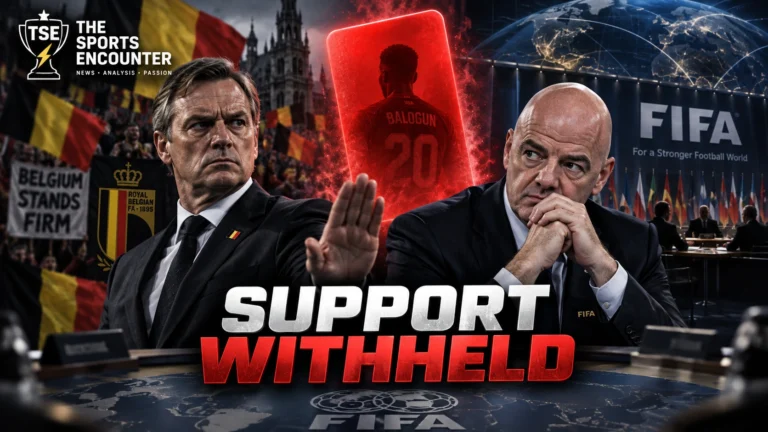
BRUSSELS, Belgium: Folarin Balogun’s controversial World Cup red card disappeared from the match-day conversation two months ago. It has now returned in a place where FIFA President Gianni Infantino may find it considerably harder to ignore.
The Royal Belgian Football Association has announced that it cannot support Infantino’s campaign for another term as FIFA president, arguing that important questions remain unanswered over both FIFA’s handling of Balogun’s suspension during the 2026 World Cup and the governance surrounding the failed FIFA Forward Enterprise project.
Belgium has also formally asked for the Balogun case to be placed on the agenda when the FIFA Council meets on October 15.
That changes the nature of the dispute.
Story at a glance
Belgium’s Position on Infantino: The Key Facts
The Royal Belgian Football Association’s official statement says its position rests on two issues where it believes FIFA has failed to provide sufficient transparency: FIFA Forward Enterprise and the Balogun disciplinary case.
The Red Card Belgium Still Wants FIFA to Explain
The controversy began during the United States’ 2-0 Round of 32 victory over Bosnia and Herzegovina on July 1.
UEFA Called the Balogun Decision a “Red Line”
Belgium was never isolated in questioning the decision.
Belgium Beat the USA 4-1, but Winning Did Not End the Dispute
There is an obvious sporting counterargument.
Two Months Later, Belgium Says Its Questions Remain Unanswered
RBFA President Pascale Van Damme says the Belgian federation communicated with FIFA both during and after the World Cup seeking clarity.
What began as anger over whether an American striker should have been eligible for one World Cup knockout match has developed into a broader argument about how FIFA makes decisions, how transparently those decisions are explained and whether member associations can trust the governing body to apply its rules consistently when political, commercial and sporting interests collide.
Infantino has already confirmed that he intends to seek re-election in 2027. The vote is scheduled to take place at the 77th FIFA Congress in Rabat, Morocco, on March 18.
Belgium therefore is no longer merely asking FIFA to explain what happened in Seattle.
It is attaching its future presidential support to the answer.
Belgium’s Position on Infantino: The Key Facts
| Issue | Belgium’s Position |
|---|---|
| Gianni Infantino’s 2027 re-election bid | RBFA says it cannot support the campaign under the current circumstances |
| Folarin Balogun case | Belgium says important questions about the disciplinary decision remain unanswered |
| FIFA Forward Enterprise | RBFA says important decisions and assessments lacked sufficient justification |
| Transparency | Belgium wants clearer reasoning, consistent processes and safeguards for future cases |
| Next formal step | RBFA has asked for the Balogun case to be placed on the October 15 FIFA Council agenda |
| 2027 FIFA presidential election | Scheduled for March 18, 2027 in Rabat, Morocco |
The Royal Belgian Football Association’s official statement says its position rests on two issues where it believes FIFA has failed to provide sufficient transparency: FIFA Forward Enterprise and the Balogun disciplinary case.
The Red Card Belgium Still Wants FIFA to Explain
The controversy began during the United States’ 2-0 Round of 32 victory over Bosnia and Herzegovina on July 1.
Balogun scored for the USA before being sent off in the 64th minute. Under the normal operation of a red card at the tournament, the dismissal brought an automatic one-match suspension.
That next match was against Belgium.
The Sports Encounter covered the original sequence in our report on how the 10-man United States defeated Bosnia and set up its Round of 16 meeting with Belgium.
The expectation was straightforward: Balogun would miss the knockout game.
FIFA then used Article 27 of its Disciplinary Code to suspend the implementation of that automatic match suspension for a probationary period of one year.
That distinction remains important.
FIFA did not announce that the red card had been erased. It suspended the enforcement of the resulting one-match ban, allowing Balogun to play against Belgium.
FIFA’s official disciplinary update on Balogun stated that the implementation of the automatic suspension had been suspended for a one-year probationary period.
Why the Decision Became So Explosive
The legal mechanism was only one part of the argument.
The timing created the larger problem.
The decision came before a World Cup knockout match involving one of the tournament hosts. U.S. President Donald Trump had personally asked Infantino to review Balogun’s case, creating an unavoidable question about political access and the appearance of influence around a sporting disciplinary process.
The Sports Encounter examined that issue before the Round of 16 match in our original analysis of the Trump, FIFA and Balogun controversy.
The important distinction remains the same today.
A call from a political leader does not by itself prove that FIFA’s disciplinary body changed its decision because of political pressure.
It does, however, create an unusually high burden of transparency.
When a disciplinary ruling benefits the host nation shortly after its president personally raises the matter with FIFA’s president, the governing body needs to explain the process well enough that teams, federations and supporters can understand why the outcome followed the regulations rather than the influence surrounding the case.
Belgium says that explanation still has not arrived.
UEFA Called the Balogun Decision a “Red Line”
Belgium was never isolated in questioning the decision.
UEFA issued an unusually strong response on July 6, saying FIFA’s handling of Balogun’s suspension had “crossed a red line.”
The European governing body argued that an automatic minimum one-match suspension following a red card should not become discretionary during a tournament, particularly when other players had served comparable suspensions.
UEFA also warned that changing the treatment of one case could create a precedent requiring similar treatment later in the competition.
Its official statement on the Balogun decision framed the dispute around rule certainty, competition integrity and public trust.
That matters today because Belgium says it remains in close contact with UEFA while seeking answers from FIFA.
The Balogun case therefore sits inside a much larger institutional confrontation that has developed between FIFA and important parts of European football.
Belgium Beat the USA 4-1, but Winning Did Not End the Dispute
There is an obvious sporting counterargument.
Belgium played the match. Balogun was available. Belgium won 4-1 anyway.
Charles De Ketelaere scored twice as Belgium dismantled the final remaining World Cup host nation and advanced to the quarterfinals.
Our match report on Belgium’s 4-1 elimination of the United States showed how decisively the Belgians settled the sporting argument on the field.
Yet that result does not answer Belgium’s governance question.
A disciplinary process does not become transparent because the protesting team eventually wins.
The principle Belgium is pursuing concerns what would happen next time.
Would another player receiving a direct red card be allowed to have the resulting suspension placed under probation?
What factors would justify that decision?
Would Article 27 be applied consistently?
How would opponents be informed?
What safeguards would prevent political access from creating even the appearance of preferential treatment?
Those are institutional questions, and a 4-1 scoreline cannot resolve them.
Two Months Later, Belgium Says Its Questions Remain Unanswered
RBFA President Pascale Van Damme says the Belgian federation communicated with FIFA both during and after the World Cup seeking clarity.
According to the Belgian federation, those discussions have not produced satisfactory answers.
The RBFA says it wants FIFA to explain both the reasoning behind the Balogun decision and how similar disciplinary cases will be handled in the future.
That second request may be the more consequential one.
Belgium is asking FIFA to turn an exceptional decision into a predictable framework.
If the governing body believes the Balogun ruling was correct, it should be able to identify the circumstances under which another player could receive the same treatment.
If those circumstances cannot be clearly defined, the appearance of inconsistency becomes difficult to remove.
October 15 Is Now an Important Date for FIFA
Belgium has asked for the case to be formally discussed at the next FIFA Council meeting on October 15.
Van Damme herself sits on the FIFA Council.
That moves the dispute from public statements into one of FIFA’s central decision-making institutions.
The Council serves as FIFA’s main decision-making body between Congress meetings, meaning Belgium is trying to place the disciplinary controversy directly into the organization’s governance process.
The meeting may therefore become an important test of whether FIFA addresses the underlying questions or allows the dispute to remain politically unresolved heading toward the 2027 presidential election.
The Second Belgian Complaint Has Nothing to Do With Balogun
The most important detail in Monday’s statement may be that Belgium did not base its position on the red-card controversy alone.
The RBFA identified FIFA Forward Enterprise as the other fundamental issue influencing its refusal to support Infantino.
That links Belgium directly to the governance revolt that has been developing since late July.
FIFA had considered bringing private investment into a new structure connected with the commercial business surrounding the World Cup and other competitions.
The proposal produced fierce resistance.
UEFA and its 55 national associations unanimously opposed the plan. Concacaf also rejected it. Opposition then spread into FIFA’s own senior structure.
The Sports Encounter tracked the confrontation as it developed, including UEFA’s unanimous stand against FIFA’s World Cup investment proposal and Concacaf’s rejection of the same commercial model.
The Proposal Failed, but the Governance Questions Survived
FIFA eventually abandoned the investment plan.
That did not end the political consequences.
Our analysis of how the World Cup stake proposal collapsed and damaged Infantino’s authority argued that the lasting issue would be the decision-making process rather than the failed transaction itself.
Belgium is now making precisely that argument.
The RBFA says important decisions and assessments relating to FIFA Forward Enterprise were not supported by sufficient justification, raising questions about transparency and governance.
That complaint overlaps with concerns that had already emerged inside FIFA.
The revolt deepened when senior figures began distancing themselves from the proposal, a development documented in our report on how the FIFA crisis moved inside Infantino’s own operation.
Belgium Is Joining an Existing Challenge to Infantino’s Authority
One national association withholding support does not decide a FIFA presidential election.
FIFA has 211 member associations, and the president is elected through the Congress.
Belgium’s importance lies in where its decision fits politically.
It is another federation publicly connecting its future support for Infantino to questions about transparency, governance and the concentration of decision-making power.
By early August, TSE had already identified a widening pattern in our analysis of federations and senior football figures breaking ranks with FIFA’s leadership.
The dispute has since become more confrontational.
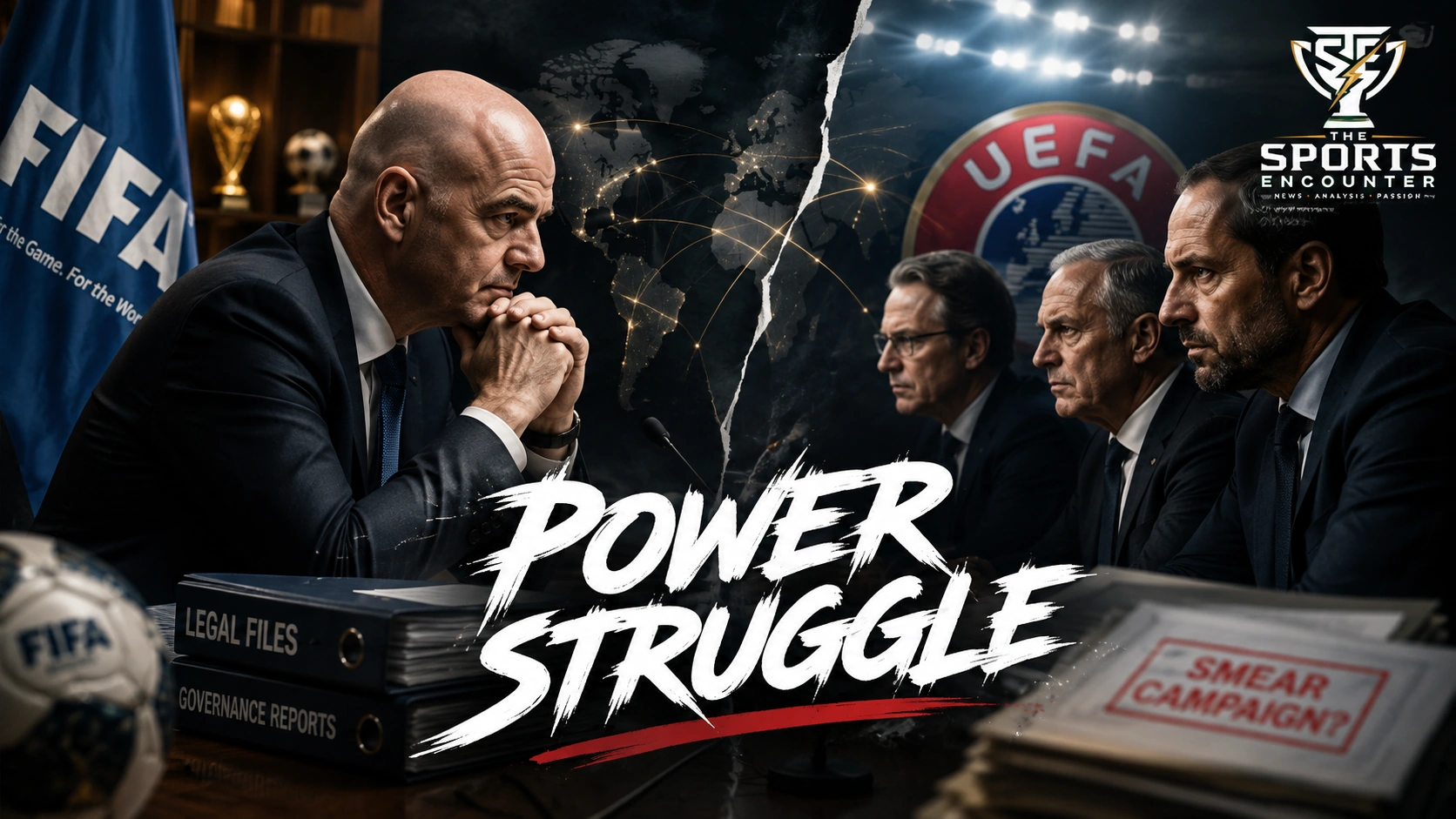
FIFA recently accused UEFA of participating in a “smear campaign” against the organization and its president as legal maneuvering around FIFA Forward Enterprise moved into U.S. courts.
The Sports Encounter covered that escalation in our report on the expanding FIFA-UEFA legal and political fight.
Trump’s Support for Infantino Adds Another Layer
The political dimension cannot be separated entirely from the Balogun controversy because Trump has remained one of Infantino’s strongest public supporters.
That relationship became more significant after the World Cup governance crisis intensified.
Trump publicly defended Infantino while other football institutions were calling for governance changes, creating an unusual situation in which the U.S. president stood strongly behind the FIFA president even as criticism spread across parts of the sport.
We examined that divide in our analysis of Trump’s support for Infantino during the FIFA power struggle.
The Balogun case now makes that relationship relevant again.
Belgium’s concern is not that political leaders are prohibited from speaking with FIFA officials. Governments interact with major sporting bodies constantly, particularly around tournaments of the World Cup’s scale.
The credibility issue appears when access to FIFA leadership and a disciplinary decision affecting that political leader’s national team occur close together without enough public explanation to establish a clear separation between the two.
What FIFA Can Do to Defuse the Balogun Dispute
Belgium’s demands are not impossible to satisfy.
FIFA could publish a detailed explanation of the disciplinary reasoning.
It could clarify how Article 27 interacts with automatic red-card suspensions during major tournaments.
It could identify the circumstances under which a one-match suspension may be placed under probation.
It could explain whether the Balogun case established any precedent.
It could also define procedures protecting disciplinary bodies from external political pressure or the appearance of such pressure.
The underlying principle is relatively simple: exceptional decisions require exceptional clarity.
FIFA has repeatedly emphasized the independence of its judicial bodies. Greater disclosure around a controversial ruling would strengthen that argument more effectively than asking federations to accept the process without understanding its reasoning.
Infantino’s 2027 Election Is Still a Long Way From Being Decided
Infantino announced at the FIFA Congress in Vancouver in May that he intends to seek another term.
The presidential election will take place in Rabat on March 18, 2027.
Belgium represents only one member association, and there is no basis at this stage to suggest its withdrawal of support determines the outcome.
The significance lies elsewhere.
Presidential elections inside major sporting bodies are built through coalitions.
If Belgium’s position remains isolated, Infantino may absorb the criticism without significant electoral damage.
If other associations begin attaching their votes to similar demands for governance reform, transparency and explanations about FIFA Forward Enterprise, the political calculation changes.
That is why the next several months matter.
Belgium has effectively created a test that other federations can now use for themselves: are FIFA’s answers good enough to restore confidence?
TSE Analysis: The Balogun Case Matters Because Belgium Refuses to Let FIFA Treat It as Finished
The easiest response to the Balogun controversy would have been to allow time to bury it.
The World Cup ended. Belgium beat the USA comfortably. Balogun moved back into club football. Attention shifted toward transfers, new competitions and the next international cycle.
The RBFA has prevented that natural disappearance.
Its September 7 statement connects three moments that FIFA would probably prefer to discuss separately.
The first is a controversial disciplinary decision involving the host nation during the World Cup.
The second is the collapse of a commercial proposal that triggered opposition from confederations and national associations.
The third is Infantino’s campaign to remain FIFA president beyond 2027.
Belgium’s argument is that all three ultimately lead to the same question: how transparent is FIFA when it makes decisions carrying major sporting, commercial or political consequences?
That is considerably harder to answer with a press release.
It requires processes that member associations trust before a controversy occurs, reasoning they can understand after a difficult decision and governance structures that do not leave major stakeholders asking for explanations months later.
Infantino still enters the 2027 election process as FIFA’s incumbent president with a powerful global network and years of relationships across its 211 member associations.
Belgium has not ended that advantage.
It has done something more modest and potentially more important.
It has placed a condition on its support and publicly explained why.
October 15 will show whether FIFA chooses to answer.
Continue the FIFA World Cup 2026 Story
 FIFA World Cup 2026Infantino Says Sorry, Critics Demand the Files as FIFA Puts $6.35 Billion on the Table
 FIFA World Cup 2026Infantino Faces FIFA’s Reckoning as Revolt Reaches Zurich, and Now $6 Billion Reserves Enter the Fight
 FIFA World Cup 2026Asia Backs Infantino After FIFA World Cup Rights Revolt, Transforming His 2027 Re-Election Battle
Frequently Asked Questions
Why will Belgium not support Gianni Infantino’s re-election?
The Royal Belgian Football Association says it cannot support Infantino’s re-election campaign because of unresolved transparency and governance concerns involving FIFA Forward Enterprise and FIFA’s handling of Folarin Balogun’s World Cup red-card suspension.
What happened with Folarin Balogun’s red card at the 2026 World Cup?
Balogun was sent off during the United States’ 2-0 Round of 32 win over Bosnia and Herzegovina. FIFA later suspended implementation of his automatic one-match ban for a one-year probationary period, allowing him to play against Belgium in the Round of 16.
Did FIFA cancel Folarin Balogun’s red card?
No. FIFA suspended the implementation of the automatic match suspension associated with the red card. Its official announcement cited Article 27 of the FIFA Disciplinary Code.
Why was Belgium angry about Balogun playing against them?
Belgium wanted an explanation for why an automatic red-card suspension was placed under probation before a World Cup knockout match. The federation also wanted clarity about how similar disciplinary cases would be handled in the future.
Did Belgium still beat the United States?
Yes. Belgium defeated the United States 4-1 in the World Cup Round of 16 and advanced to the quarterfinals.
What has Belgium asked FIFA to do now?
The RBFA has requested that the Balogun case be placed on the agenda for the FIFA Council meeting scheduled for October 15, 2026.
What is FIFA Forward Enterprise?
FIFA Forward Enterprise was connected with FIFA’s proposed new commercial structure involving private investment in the business surrounding the World Cup and other competitions. The proposal faced heavy opposition and was eventually abandoned, but governance questions around the process remain.
When is the next FIFA presidential election?
The FIFA presidential election is scheduled for March 18, 2027 at the 77th FIFA Congress in Rabat, Morocco. Gianni Infantino has announced that he intends to seek re-election.
Does Belgium’s decision mean Infantino will lose the election?
No. Belgium is one of FIFA’s 211 member associations. Its decision is politically significant because it adds to wider governance criticism, but it does not by itself determine the outcome of the 2027 election.