
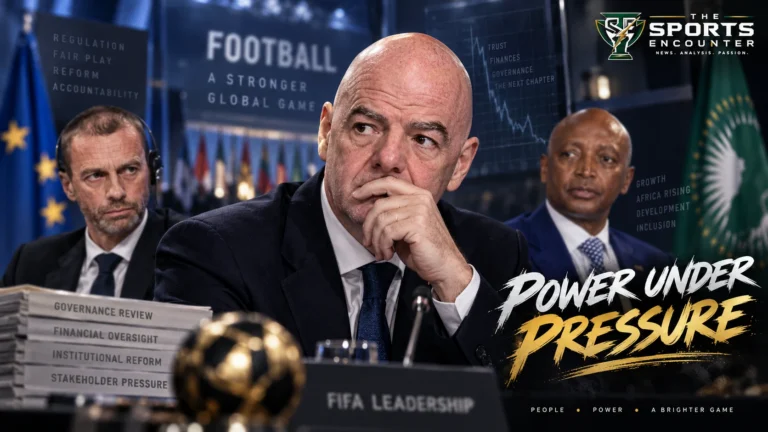
CAIRO, Egypt, September 19, 2026: The pressure around Gianni Infantino is no longer coming from one direction. As UEFA and Concacaf challenge the financial rationale behind FIFA’s abandoned private-investment plan, the FIFA president is preparing to enter a very different room in Cape Verde, where the leaders of Africa’s 54 national associations will gather for a major CAF strategy conference next month.
The two developments arriving together reveal the central contradiction surrounding Infantino’s position seven months before the FIFA presidential election.
His critics are becoming more organized. Their argument has moved beyond opposing one failed commercial proposal and toward questions about FIFA’s reserves, internal decision-making, presidential authority and whether the organization requires a more independent system of scrutiny.
At the same time, Infantino still has access to one of the most important constituencies in world football. CAF has backed him institutionally, several African associations have expressed individual support, and CAF President Patrice Motsepe has remained one of his most prominent allies.
Story at a glance
The $2.1 Billion Proposal Changes the Nature of the Argument
The latest challenge from Čeferin and Montagliani is important because it does not simply repeat the earlier objection to FIFA Forward Enterprise.
The $6 Billion Figure Needs an Important Qualification
The headline number is striking: approximately $6 billion in projected reserves by the end of the current financial cycle.
FIFA Has Its Own Development-Funding Record to Point To
Any analysis of the reserves fight also needs to account for what FIFA already distributes.
That Is Why FIFA Forward Enterprise Still Matters Even Though It Is Dead
FIFA permanently withdrew the project weeks ago.
The Dispute Has Become a Test of Presidential Authority
That distinction explains why withdrawing the proposal did not restore the political position Infantino held before July.
The going has clearly become tougher.
The harder question is what “getting going” now means for Infantino. There is no single move that settles this dispute. His position will ultimately be tested by FIFA’s governance processes, the response to demands for greater financial scrutiny, the willingness of national associations to translate public statements into votes, and whether his opponents can turn dissatisfaction into a formal electoral alternative.
The Sports Encounter has followed the dispute from the moment FIFA’s World Cup stake plan collapsed within days. What began as a commercial controversy has now become a wider examination of who controls the institution and how its enormous financial resources should be governed.
Follow The Sports Encounter’s global soccer coverage for the wider developments shaping international football.
Infantino’s FIFA Crisis: What Changed This Week?
| Issue | Latest Development | Why It Matters |
|---|---|---|
| FIFA financial reserves | UEFA President Aleksander Čeferin and Concacaf President Victor Montagliani have called for an independent review | The debate now tests whether FIFA needed outside investment to expand development funding |
| Proposed distribution | At least $10 million for each of FIFA’s 211 associations during 2027-30 | The proposal totals roughly $2.1 billion in additional development funding |
| Projected FIFA reserves | Approximately $6 billion at the end of the 2023-26 cycle, according to the analysis behind the proposal | Critics argue reserves should be examined before FIFA seeks external capital |
| Africa | CAF is convening its 54 association presidents for a strategy conference in Cape Verde | Africa represents more than a quarter of FIFA’s 211-member electorate |
| Infantino | Invited to attend the CAF gathering | The conference provides direct contact with a major group of member associations |
| 2027 election | Scheduled for March 18 in Rabat | Infantino has confirmed he will seek another term |
| Opposition | European leaders say they want a credible alternative | No consolidated opposition candidate has yet emerged |
The $2.1 Billion Proposal Changes the Nature of the Argument
The latest challenge from Čeferin and Montagliani is important because it does not simply repeat the earlier objection to FIFA Forward Enterprise.
It offers an alternative financial proposition.
The two FIFA vice-presidents have called for an independent examination of FIFA’s financial position and proposed that at least $10 million be made available to every one of the organization’s 211 national associations during the 2027-30 cycle.
That would amount to approximately $2.1 billion.
The proposed money would be additional to FIFA’s existing Forward Programme rather than a replacement for it.
The distinction matters.
The original FIFA Forward Enterprise proposal was presented as a way of generating significantly more capital for football development by bringing outside investors into a commercial entity connected to FIFA competitions, including the World Cup.
Concacaf’s official rejection of FIFA Forward Enterprise had already questioned whether private equity was necessary when FIFA had emerged from the 2026 World Cup with enormous financial strength.
The new reserves proposal sharpens that question.
If FIFA can responsibly release billions from its own balance sheet while maintaining adequate reserves, critics can argue that development funding and private investment never needed to be tied together in the first place.
That is a more difficult argument for FIFA to answer than a simple disagreement over the structure of one transaction.
The $6 Billion Figure Needs an Important Qualification
The headline number is striking: approximately $6 billion in projected reserves by the end of the current financial cycle.
It should not be treated as though FIFA has $6 billion sitting in an unrestricted bank account waiting to be divided among its members.
Financial reserves contain a wider set of accumulated resources, commitments and accounting considerations. The analysis used by Čeferin and Montagliani combines reported figures with estimates for the remainder of the current cycle and assumptions for 2027-30.
That is precisely why their proposal calls for an independent review before a final distribution is recommended.
According to their preliminary analysis, FIFA could release $2.1 billion and still keep reserves above roughly $1.5 billion throughout the following cycle.
Whether those assumptions withstand detailed examination is now one of the substantive questions inside the dispute.
The debate has therefore moved into territory where slogans will not be enough. The underlying financial models, liabilities, tournament commitments, investment requirements and minimum reserve assumptions matter.
FIFA Has Its Own Development-Funding Record to Point To
Any analysis of the reserves fight also needs to account for what FIFA already distributes.
FIFA Forward 3.0 committed $2.25 billion to football development during the 2023-26 cycle. Each member association can access up to $8 million across operational funding and approved development projects, with additional support available in certain circumstances.
FIFA has already announced another increase for the 2027-30 cycle. At the 76th FIFA Congress, Infantino said Forward investment would reach $2.7 billion.
The official FIFA Congress summary also confirms that Infantino intends to contest the March 2027 presidential election.
This gives FIFA a substantive response to any suggestion that development has been ignored. Funding to smaller and less wealthy associations has grown significantly during Infantino’s presidency.
The dispute is increasingly about something narrower and more consequential: who decides how much additional money can be distributed, how that decision is reached, and what level of independent scrutiny should accompany it.
That Is Why FIFA Forward Enterprise Still Matters Even Though It Is Dead
FIFA permanently withdrew the project weeks ago.
The Sports Encounter examined the aftermath when FIFA apologized to its member associations following the collapse of the proposal.
The underlying governance questions did not disappear with the commercial vehicle.
UEFA, the AFC and Concacaf subsequently issued a joint challenge demanding an external examination of how the project was developed and presented. Our earlier analysis of the three-confederation break with Infantino showed how quickly the argument shifted from financial terms to institutional trust.
UEFA’s open letter to the football family argued that FIFA’s own administration should not control the investigation and said relevant records should be preserved for an independent review.
That question remains unresolved.
FIFA has said a review of the abandoned project will be presented through its governance structure. Critics continue to argue that FIFA cannot provide sufficient independence by reviewing itself.
The Dispute Has Become a Test of Presidential Authority
That distinction explains why withdrawing the proposal did not restore the political position Infantino held before July.
If the controversy had been only about price, structure or investor terms, cancellation might have ended it.
Instead, critics focused on how the proposal reached member associations, which governance bodies had been consulted, what documents existed and how much authority had been concentrated around the presidency.
The Sports Encounter documented that progression in our report on senior figures and federations breaking ranks.
FIFA responded by defending Infantino’s democratic mandate and accusing opponents of attempting to undermine him outside established procedures, a position analyzed in our report on the emerging battle over FIFA legitimacy.
Those positions are still fundamentally opposed.
One side argues that proper governance requires external scrutiny when presidential authority itself is under examination.
The other insists that FIFA’s statutes, Council, committees and Congress provide the legitimate framework for accountability and leadership change.
Africa Gives Infantino Something His Critics Cannot Ignore
While pressure grows around FIFA’s finances, the second major development is unfolding in Africa.
CAF will gather the presidents of its 54 member associations in Cape Verde in early October for a strategy conference focused officially on strengthening African football, improving global competitiveness and examining lessons from the 2026 World Cup.
Infantino has been invited.
Former Arsenal manager Arsène Wenger, now FIFA’s Chief of Global Football Development, is also expected to lead a post-World Cup technical review involving African national-team coaches on October 9.
The gathering has obvious football-development value. Africa sent a record number of teams to the expanded World Cup and produced several important performances.
It also takes place in an unmistakable leadership context.
Motsepe has supported Infantino during the current crisis, and CAF’s executive leadership has expressed backing for the FIFA president.
The meeting therefore places Infantino in direct contact with the largest confederation by number of FIFA voters at precisely the moment when European opposition is trying to broaden its own coalition.
But 54 African Votes Are Not a Single Vote
This is where simple electoral arithmetic can become misleading.
CAF has 54 FIFA member associations.
That does not mean a CAF endorsement automatically delivers 54 presidential votes.
Each national association votes individually.
African federations have not always followed continental endorsements uniformly in previous FIFA elections, and individual associations have their own relationships, interests and leadership calculations.
The same principle applies in every confederation.
UEFA can take a strong institutional position against Infantino without automatically controlling every European ballot. The AFC can criticize FIFA leadership while individual Asian associations take different positions, a tension The Sports Encounter explored when the Infantino dispute exposed a public AFC-Qatar rift.
That is why the election cannot be reduced to a simple UEFA-versus-CAF map.
FIFA’s One-Country, One-Vote System Remains the Central Fact
FIFA’s Congress gives each eligible member association one presidential vote regardless of commercial size, television market or competitive strength.
Germany has one vote.
England has one.
Brazil has one.
Cape Verde has one.
Maldives has one.
That structure has always made global development relationships politically significant inside FIFA because smaller associations possess the same formal electoral power as football’s richest nations.
Infantino has spent a decade expanding development funding and maintaining direct engagement with national federations across Africa, Asia, the Caribbean, Oceania and other regions.
Those relationships are now part of the institutional context surrounding the 2027 election.
At the same time, some European federations have already withdrawn their support. Ireland’s decision was examined in The Sports Encounter’s report on how the anti-Infantino movement spread beyond Europe’s biggest associations.
The Opposition Has Pressure. It Still Needs an Electoral Structure
UEFA’s challenge has become increasingly explicit.
Its national-association leaders have called for new FIFA leadership, and UEFA Vice-President Laura McAllister said this week that work continues on identifying a credible challenger capable of building support beyond Europe.
The Sports Encounter’s latest analysis found that the movement to replace Infantino is spreading while the candidate question remains unresolved.
That remains the defining limitation of the opposition as of September 19.
Criticism is not a candidature.
A governance coalition is not automatically an electoral coalition.
FIFA statutes require a presidential candidate to be formally proposed by a member association and supported by at least five associations. Candidatures must be submitted at least four months before the Congress.
With the election scheduled for March 18, 2027 in Rabat, the effective nomination deadline falls in November.
The window for converting institutional opposition into an actual presidential contest is therefore narrowing.
The Reserves Proposal Could Be More Important Than Another Call for Resignation
The $2.1 billion proposal deserves attention because of who would receive the money.
Every FIFA member association.
The same 211 organizations that ultimately determine the presidency.
That does not mean the proposal should be interpreted simply as an electoral maneuver. The authors have framed it as a football-development and governance initiative, and its underlying financial assumptions still require independent testing.
Its political relevance nevertheless comes from the fact that it addresses one of Infantino’s strongest institutional arguments: that FIFA’s modern commercial growth has allowed it to return unprecedented levels of money to the global game.
The alternative argument from his critics is no longer merely “do not sell part of FIFA’s commercial business.”
It is now: examine whether FIFA can distribute even more money without doing so.
That directly contests the financial premise that surrounded FIFA Forward Enterprise.
FIFA’s Critics Are Also Expanding the Battlefield Beyond the Boardroom
The dispute has already entered legal territory.
UEFA has sought evidence in the United States connected to the abandoned investment project, while FIFA has accused its European counterpart of using legal processes as part of a wider campaign against Infantino.
The Sports Encounter examined that escalation when the FIFA-UEFA dispute moved into U.S. court proceedings.
No criminal finding against Infantino should be inferred from those proceedings. They concern efforts to obtain information that could potentially be used in a separate process.
The distinction is important.
The governance argument, legal argument and election argument overlap politically, but they remain separate processes with different standards.
Even a No-Confidence Debate Would Not Automatically Remove Infantino
Earlier in the crisis, officials across several confederations discussed whether a no-confidence mechanism could be pursued.
Our analysis of the possible no-confidence route showed why such a move would be institutionally complicated.
FIFA’s statutes establish procedures around Congresses, leadership and elections. UEFA cannot remove the FIFA president by itself, nor can any single confederation.
That leaves the March Congress as the clearest established mechanism for deciding who leads FIFA for the next term unless an extraordinary process develops beforehand.
What the Cape Verde Meeting Can Tell Us, and What It Cannot
The CAF conference will be closely watched because of its timing.
If African associations speak publicly, those comments may provide a clearer picture of where individual federations stand.
If they do not, the absence of public declarations should not automatically be interpreted as support or opposition.
Much of FIFA’s presidential politics historically occurs through direct relationships and private federation-level discussions rather than public campaigning months in advance.
The conference itself also has a legitimate technical agenda.
Africa’s performance at the 2026 World Cup, the development of domestic competitions, infrastructure, coaching standards and preparations for 2030 are substantial football issues independent of the presidential contest.
Reducing the entire meeting to election politics would therefore miss much of its stated purpose.
Ignoring the electoral context would be equally unrealistic.
Infantino Still Has a Development Record His Supporters Can Defend
It is easy for a leadership crisis to flatten a decade of administration into a single controversy.
FIFA Forward is one reason that does not happen neatly.
Under Infantino, the amount of money available to associations for development and operations has increased substantially.
Continue the FIFA World Cup 2026 Story
 FIFA World Cup 2026UEFA’s Push to Replace Infantino Spreads, but the Hardest Part Starts Now
 FIFA World Cup 2026Can FIFA Oust Gianni Infantino? Regional Powerhouses Now Weigh Historic No-Confidence Vote
 FIFA World Cup 2026Belgium Turns Balogun Red-Card Row Into Direct Challenge to Infantino’s FIFA Re-Election
Infrastructure projects, training centers, women’s football, national teams, youth development and administrative capacity have all received funding through the program.
For wealthy European federations, some of those distributions represent a relatively small part of overall football income.
For smaller associations, FIFA funding can influence whether pitches are built, national youth teams travel, coaches are trained or domestic administration functions properly.
That difference helps explain why perceptions of FIFA leadership can vary sharply by region.
The Sports Encounter previously examined that divide when confederations opposing the commercial plan confronted associations that remained supportive of Infantino’s development model.
His Critics Are Arguing That Development and Accountability Are Not Opposites
That is the significance of the reserves letter.
Čeferin and Montagliani are effectively contesting the idea that national associations must choose between receiving more money and demanding stronger scrutiny.
Their proposal says both can happen at once: preserve FIFA Forward, investigate the balance sheet independently and determine whether additional reserves can be distributed through the institution.
Whether their financial assumptions prove correct remains to be established.
The governance argument is easier to identify.
Development funding, in their view, should operate through transparent institutional mechanisms rather than depend on the discretion of any individual FIFA president.
That is a fundamentally different challenge from asking Infantino simply to resign.
So, Will the Tough Get Going for Infantino?
There is no factual basis yet for predicting the outcome of the March election.
What can be identified are the tests that now sit between September and Rabat.
| Test | What Is Known |
|---|---|
| Independent financial review | UEFA and Concacaf want FIFA’s reserves examined before recommendations on additional distributions are made |
| FFE review | Critics continue to seek an investigation independent of FIFA’s administration |
| CAF position | CAF leadership supports Infantino, but individual African associations control their own FIFA votes |
| Opposition candidate | European officials say they are working toward a credible alternative, but no consolidated challenger has been announced |
| Election timetable | The vote takes place in Rabat on March 18, 2027 |
| Development debate | FIFA points to record Forward investment; critics argue reserves may permit substantially more without external investors |
This is why the latest phase is more difficult for Infantino than the initial collapse of FIFA Forward Enterprise.
The original project could be withdrawn.
A dispute over trust, money, governance and presidential authority cannot be cancelled by withdrawing a document.
It has to move through institutions.
The Next Few Weeks Could Clarify the Shape of the Crisis
The calendar now matters.
CAF’s Cape Verde meetings arrive in early October, bringing Infantino into the same environment as 54 African federation presidents.
The debate over FIFA’s finances will continue as Čeferin and Montagliani seek support from other confederation leaders for an independent review and possible reserve distribution.
FIFA’s own review of the abandoned investment proposal is also expected to move through the Council process.
Then comes November, when any serious presidential challenger must move from discussion to the formal FIFA nomination process.
After months of statements, letters, withdrawals of support, counter-statements and legal maneuvering, that deadline will provide something the current debate often lacks: clarity.
Until then, two realities can exist at once.
Infantino is facing the most sustained institutional challenge of his presidency.
He also retains relationships and support across parts of the global federation system that his critics cannot simply dismiss.
That tension is now the story.
Gianni Infantino and the FIFA Leadership Crisis FAQs
Why is Gianni Infantino under pressure?
The immediate crisis began with the abandoned FIFA Forward Enterprise proposal, which would have introduced outside investors into a commercial structure connected to FIFA competitions. Critics then broadened their concerns to governance, transparency and presidential authority.
What are UEFA and Concacaf proposing?
Aleksander Čeferin and Victor Montagliani have called for an independent review of FIFA’s financial reserves and proposed that at least $10 million be made available to each of FIFA’s 211 member associations during 2027-30.
How much would the proposed FIFA distribution cost?
Approximately $2.1 billion if each of the 211 associations received at least $10 million.
Does FIFA definitely have $6 billion available to distribute?
No. The approximately $6 billion figure is a projection of financial reserves used in the preliminary analysis behind the proposal. An independent review has been requested to determine the real amount that could responsibly be released.
Why is Africa important to Infantino?
CAF has 54 FIFA member associations, more than one quarter of FIFA’s 211 voters. CAF leadership has backed Infantino, although each national association controls its own presidential vote.
When is the CAF strategy conference?
CAF is bringing African football leaders together in Cape Verde in early October 2026, with Infantino invited to attend and a post-World Cup technical review also scheduled.
Is Gianni Infantino running again?
Yes. Infantino has confirmed that he will seek another term as FIFA president.
When is the next FIFA presidential election?
The presidential election will be held at the 77th FIFA Congress in Rabat, Morocco, on March 18, 2027.
Does UEFA have a candidate to challenge Infantino?
UEFA officials say they are working toward a credible alternative, but no consolidated opposition candidate has been publicly established as of September 19, 2026.
Can CAF guarantee Infantino 54 votes?
No. CAF may take an institutional position, but FIFA member associations cast their presidential votes individually.
The Sports Encounter’s continuing coverage has tracked the crisis from the collapse of the commercial proposal through federation defections, confederation divisions and the emerging 2027 election challenge.
FIFA
- The Going Gets Tough for Infantino as FIFA’s $6B Reserves Fight Meets His African Power Base
- UEFA’s Push to Replace Infantino Spreads, but the Hardest Part Starts Now
- FIFA ASEAN Cup 2026: Vietnam Bring the Crown Into a New Regional Race
- Belgium Turns Balogun Red-Card Row Into Direct Challenge to Infantino’s FIFA Re-Election
- Gianni Infantino Will Run Again in 2027: How FIFA’s Failed World Cup Deal Turned Re-Election Into a Global Power Fight