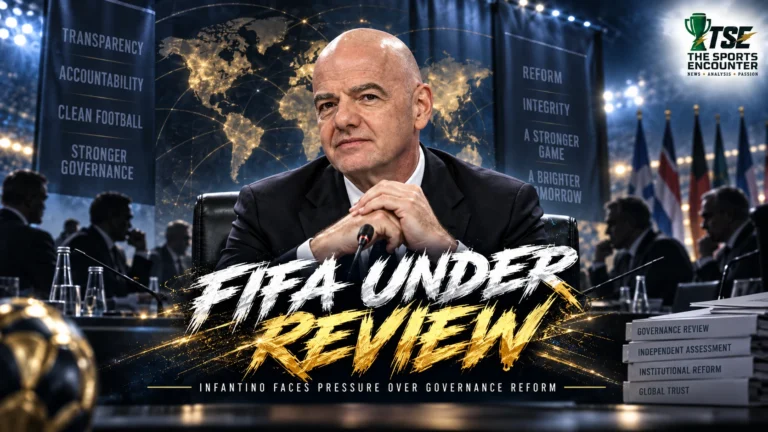
ZURICH, Switzerland, September 22, 2026: Gianni Infantino has responded to the biggest governance challenge of his FIFA presidency by proposing something his critics have demanded for weeks: independent external scrutiny of how world soccer’s governing body makes major decisions.
In a letter sent to the FIFA Council and all 211 member associations, the FIFA president outlined two proposals ahead of the Council’s October 15 meeting in Zurich.
The first is an independent external review of FIFA’s decision-making structures around major initiatives.
The second is a more formal consultation process involving member associations, confederations and other stakeholders before major strategic decisions advance through the organization.
Story at a glance
What Has Gianni Infantino Proposed?
According to the letter circulated to FIFA’s governing bodies, Infantino wants the October 15 Council meeting to consider two connected reforms.
Why FIFA Forward Enterprise Triggered the Crisis
FIFA Forward Enterprise was presented as a commercial vehicle designed to generate significantly more revenue from FIFA competitions and distribute more money into global football development.
CONCACAF’s Rejection Changed the Nature of the Dispute
UEFA opposition could initially be interpreted as another institutional clash between European soccer and FIFA.
UEFA Escalated the Pressure
UEFA’s 55 associations mounted the most organized resistance.
The Crisis Also Spread Inside FIFA
The most damaging criticism did not come exclusively from outside the organization.
The proposals arrive after the collapse of FIFA Forward Enterprise, or FFE, the controversial plan to create a new commercial subsidiary built around FIFA’s tournament rights and potentially sell a minority stake to outside investors.
Infantino maintains that the project never reached final approval and would not have transferred control over sporting decisions. Critics have focused less on the eventual withdrawal and more on how such a consequential proposal reached an advanced stage before major parts of the football system said they had been properly consulted.
That distinction has turned FFE from a failed commercial project into a wider argument about presidential authority, institutional checks and who should have a voice before FIFA reshapes the economics of the World Cup.
The Sports Encounter has tracked that dispute from its beginning, including our original analysis of the proposed FIFA commercial-rights structure and the institutional revolt that followed.
What Has Gianni Infantino Proposed?
According to the letter circulated to FIFA’s governing bodies, Infantino wants the October 15 Council meeting to consider two connected reforms.
1. An Independent External Governance Review
The review would examine how FIFA handles major strategic initiatives and whether the current balance of authority between the president, senior leadership, Council and Congress provides sufficient transparency and oversight.
The word “independent” is important.
Several of FIFA’s critics have argued that an internal examination would be insufficient because the central issue involves the organization’s own leadership structure.
The proposed review therefore raises questions that go beyond FFE itself:
- How early should the FIFA Council become involved in major commercial projects?
- When should confederations and member associations be consulted?
- What authority should sit with the president before formal Council approval?
- Which major initiatives should require independent due diligence?
- How should potential investors and commercial partners be evaluated?
- What information should be disclosed before commitments become difficult to reverse?
Infantino has not yet published the review’s terms of reference, who would conduct it or whether its findings would automatically become public.
Those details may determine how much confidence critics ultimately place in the process.
2. A Structured Consultation Process
The second proposal addresses one of the complaints that followed FFE from the moment it became public.
Major stakeholders said they learned too much too late.
Infantino is now proposing a more structured framework through which FIFA would consult confederations, national associations and other football stakeholders before advancing major initiatives.
The model has not yet been finalized.
The principle is significant because FIFA’s own structure is built around 211 voting member associations, six continental confederations, a 37-member Council and a Congress that serves as the organization’s supreme legislative body.
The question raised by FFE was whether those bodies were being involved early enough to exercise meaningful oversight rather than simply responding once a project had already been developed.
Why FIFA Forward Enterprise Triggered the Crisis
FIFA Forward Enterprise was presented as a commercial vehicle designed to generate significantly more revenue from FIFA competitions and distribute more money into global football development.
The proposed company would have combined major commercial functions connected with FIFA competitions, including:
- broadcast rights;
- sponsorship;
- licensing;
- ticketing and hospitality;
- and elements of tournament commercial operations.
FIFA discussed selling up to a 20 percent minority interest in the proposed company to private investors.
Its argument was that outside capital and commercial expertise could increase the value of FIFA’s assets while the governing body retained sporting authority.
Infantino publicly described the proposal as an opportunity to direct substantially more money toward football development, particularly smaller and less wealthy member associations.
The Sports Encounter examined those claims in our first detailed breakdown of FIFA Forward Enterprise.
The controversy quickly moved away from valuation.
It became about process.
CONCACAF’s Rejection Changed the Nature of the Dispute
UEFA opposition could initially be interpreted as another institutional clash between European soccer and FIFA.
CONCACAF changed that.
The confederation representing North America, Central America and the Caribbean said it had first learned about important elements of the proposal through media reports and later criticized what it described as a lack of due process.
Its 41 associations subsequently rejected the project.
The official CONCACAF statement said major decisions affecting football’s long-term assets should pass through proper governance structures and meaningful consultation.
The Sports Encounter examined why that intervention mattered in our report on CONCACAF’s rejection of the FIFA World Cup stake proposal.
Once opposition spread beyond Europe, the argument became harder to characterize as a regional power struggle.
UEFA Escalated the Pressure
UEFA’s 55 associations mounted the most organized resistance.
The dispute escalated to the point that European federations discussed withholding participation from FIFA competitions if the project continued without governance safeguards.
TSE documented that extraordinary confrontation when UEFA associations backed a potential FIFA boycott.
The threat eventually receded after FIFA abandoned FFE, but the governance dispute did not disappear with the commercial proposal.
European officials continued asking how the project had been developed, what authority had been exercised and why relevant governing bodies had not been engaged earlier.
The later decision to step back from the boycott threat therefore did not amount to institutional reconciliation.
The Crisis Also Spread Inside FIFA
The most damaging criticism did not come exclusively from outside the organization.
Former senior adviser Carlos Cordeiro resigned during the controversy.
Then-chief operating officer Kevin Lamour publicly challenged the handling of the project and raised questions about how much senior FIFA staff had known about its development.
TSE covered the moment when the FFE dispute moved into FIFA’s own leadership structure.
Lamour later left the organization, adding another layer to the governance debate.
Our subsequent report on his departure from FIFA examined why the episode mattered beyond one executive exit.
Criticism from insiders strengthened the argument that the problem was not simply how FIFA had communicated the proposal publicly.
It raised questions about how the proposal had been developed internally.
FIFA Says the Project Was Never a Final Decision
FIFA has consistently pushed back against the suggestion that it had already committed the World Cup’s commercial future to private investors.
Its position is that FFE remained a proposal subject to consultation and eventual approval.
In the official July 31 withdrawal statement, Infantino said the project would only have proceeded with majority support from FIFA’s member associations and following consultation with the Council, confederations and wider stakeholders.
He withdrew it after concluding that the division surrounding the proposal had become inconsistent with its stated purpose.
That distinction is essential to a fair assessment of the dispute.
FIFA says no commercial stake was ultimately sold and no sporting authority was transferred.
Critics respond that their concern is precisely that such a significant structure had developed as far as it did before the wider football community became fully engaged.
The Proposed Review Is Broader Than FIFA Forward Enterprise
This is where Infantino’s new proposal becomes potentially more consequential than the abandoned project itself.
The review would not necessarily be limited to whether FFE was handled correctly.
It could examine the institutional architecture through which FIFA handles large decisions.
That includes the relationship between several centers of authority.
The FIFA President
The president provides political and strategic leadership and chairs both Congress and Council.
The Bureau of the Council
The Bureau can deal with urgent matters between full Council meetings.
The FIFA Council
FIFA formally describes the Council as the organization’s main decision-making body between Congress meetings.
Its membership includes the president, eight vice presidents and 28 additional members representing FIFA’s confederations.
The FIFA Congress
Congress remains the supreme legislative body and contains all 211 member associations, each with one vote.
If an independent review concludes that the balance of authority between those bodies needs changing, some reforms could require amendments to FIFA’s governing rules.
That is why Infantino has acknowledged that major structural changes could ultimately require Congress approval.
October 15 Becomes the First Institutional Test
The FIFA Council is scheduled to consider the proposals on October 15.
The meeting will not automatically rewrite FIFA’s governance structure.
It can determine what happens next.
Council members could discuss:
- the scope of an independent review;
- who would conduct it;
- the timetable for completion;
- whether findings would be published;
- how member associations would contribute;
- what consultation mechanism FIFA should create;
- and which potential reforms may later require Congress approval.
Infantino has invited member associations to submit their own ideas ahead of the meeting.
That creates an important distinction between consultation as a promise and consultation as a measurable process.
If associations can shape the review’s mandate before it begins, critics may regard the exercise differently than if its structure is determined entirely by FIFA’s central administration.
What Critics Still Want to Know
An independent governance review does not automatically answer the questions created by FFE.
Several remain unresolved in the public debate.
- Who originally initiated the FFE proposal?
- How early were potential outside investors contacted?
- Which FIFA bodies reviewed the proposed valuation and structure?
- When did Council members receive complete information?
- Why did several confederations say they had not been properly consulted?
- What due diligence had been completed before the proposal became public?
- Would the external review examine the FFE episode itself or only future governance procedures?
That final question may become particularly important.
A review designed only to improve future processes would address one part of the crisis.
Critics seeking accountability for how FFE developed may want an examination of the past as well.
FIFPRO Has Already Said Process Reform Alone Is Not Enough
The international players’ union has taken one of the strongest positions.
FIFPRO welcomed the withdrawal of FFE but argued that removing the project did not resolve the governance issues exposed by it.
Its public statement called for stronger institutional safeguards and independent scrutiny.
The criticism matters because players are among the stakeholders whose competitions, labor and commercial image underpin FIFA tournaments but who do not possess votes at FIFA Congress.
This broadens the governance question beyond national associations and confederations.
If FIFA creates a structured consultation model, it will eventually have to decide how formal a role players, clubs, leagues, sponsors and other stakeholders receive.
Infantino’s Critics Have Already Shifted From the Project to His Leadership
Once FFE was withdrawn, the dispute changed shape.
The commercial proposal no longer existed.
The leadership debate continued.
TSE described that transition in our analysis of how the failed World Cup stake plan became a wider challenge to Infantino’s authority.
The confrontation intensified as UEFA, the AFC and CONCACAF demanded stronger guarantees around transparency and independent oversight.
Our later report on the three-confederation challenge documented how far the dispute had moved beyond Europe.
The debate has since become intertwined with the FIFA presidential election scheduled for March 2027.
That electoral context makes the October governance discussion more sensitive.
Any reform proposal will be judged on its institutional merits while also being interpreted through a leadership contest already taking shape around FIFA.
The Legal Fight Has Made Transparency More Important
The dispute has also entered the legal arena.
UEFA has sought documents and information connected to FFE, while FIFA has accused its opponents of using legal processes to damage Infantino politically.
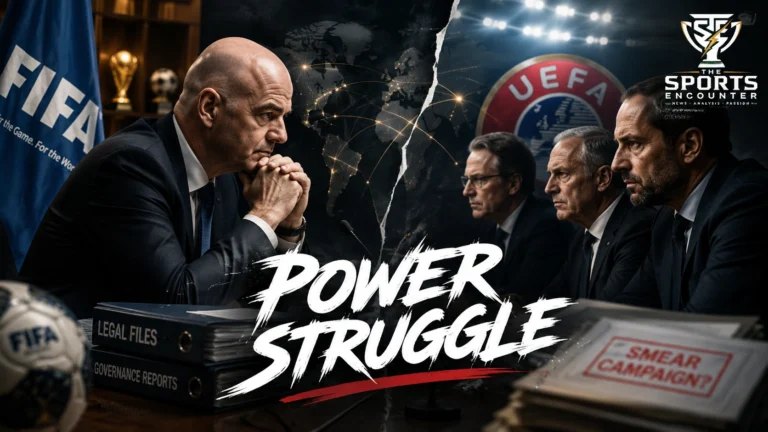
TSE examined that escalation in our report on FIFA’s accusation of a UEFA “smear campaign”.
That legal conflict makes the design of any independent review especially important.
A credible review would need to distinguish between three different questions:
- Was the FFE proposal commercially sound?
- Was the proposal developed through appropriate governance procedures?
- Does FIFA’s current structure provide sufficient safeguards for future major initiatives?
Those questions overlap.
They are not identical.
Why This Review Could Matter Beyond Gianni Infantino
The governance debate is often framed around the current FIFA president.
The institutional issue is larger.
Any rule that concentrates or limits presidential power will apply to future FIFA presidents as well.
Any requirement for earlier Council scrutiny will change how future commercial projects are developed.
Any formal consultation mechanism could alter the relationship between Zurich, the confederations and national associations for years.
That is why the proposed review should not be measured exclusively by whether it strengthens or weakens Infantino personally.
The more important question is whether it produces rules capable of functioning regardless of who occupies the presidency.
FIFA’s Financial Success Makes the Governance Question More Important
The controversy emerged after an enormously successful commercial period for FIFA.
The expanded 2026 World Cup generated unprecedented global attention and reinforced the value of FIFA’s competition portfolio.
That success created the economic logic behind FFE.
It also intensified the governance argument.
The more valuable the World Cup becomes, the greater the consequences of decisions involving its commercial future.
Minority private ownership does not automatically mean sporting control.
Long-term commercial structures can still influence incentives, investment priorities and future decision-making.
That was one of the central concerns identified in TSE’s original FFE analysis.
The debate therefore sits at the intersection of two legitimate objectives.
FIFA wants to maximize the commercial value of global football and distribute more money to its members.
Its critics want major decisions involving those assets to pass through stronger consultation and oversight.
The March 2027 Election Adds Another Layer
Infantino is expected to seek another term when FIFA’s member associations vote at the March 2027 Congress.
Opposition groups have increasingly linked the FFE dispute to the question of FIFA leadership.
TSE recently examined that developing landscape in our report on the effort to identify an alternative candidate.
The governance review should nevertheless be assessed separately from electoral strategy.
A stronger system of institutional checks could matter regardless of who wins the next election.
Likewise, an external review that lacks independence, transparency or a meaningful mandate could fail to satisfy critics regardless of its timing.
What Would Make the Independent Review Credible?
The October 15 meeting will likely be judged against several practical standards.
| Issue | What Stakeholders Will Watch |
|---|---|
| Independence | Who selects the reviewer and whether investigators are institutionally separate from FIFA leadership |
| Scope | Whether the review examines the FFE episode itself or only future procedures |
| Access | Whether reviewers can obtain documents, communications and relevant testimony |
| Transparency | Whether the findings and recommendations will be published |
| Consultation | Whether confederations, associations, players and other stakeholders can contribute meaningfully |
| Implementation | Who will decide which recommendations become binding reforms |
| Congress role | Whether structural changes requiring statutory approval will be submitted to all 211 associations |
Why Infantino’s Proposal Matters
The most important development is not that FIFA has admitted the FFE proposal was commercially wrong.
It has not.
Infantino continues to defend the original objective of generating more money for football development and maintains that sporting control would have remained with FIFA.
The change lies elsewhere.
He is now acknowledging that the way major FIFA initiatives move through the institution deserves external examination.
That is a meaningful shift after weeks in which the organization defended the proposal as part of a consultation process disrupted by premature public reporting.
The latest account of Infantino’s letter confirms that the president has opened the door to an independent review and asked FIFA’s members to contribute ideas before October 15.
The next question is what walks through that door.
October 15 Will Decide the Shape of the Response, Not the Final Reform
The Council meeting should be understood as the beginning of the next phase rather than the end of the crisis.
FIFA’s governance structure cannot be fundamentally rewritten in one meeting.
The Council can commission work, define scope, create processes and recommend changes.
The FIFA Congress remains the ultimate legislative authority for major statutory reforms.
That means the real sequence could extend for months:
- October 15 Council discussion;
- appointment of an external reviewer;
- consultation with stakeholders;
- publication or consideration of recommendations;
- Council decisions on operational reforms;
- and possible Congress votes on statutory changes.
The timetable may therefore run directly into the 2027 presidential election cycle.
The Governance Question FIFA Can No Longer Avoid
FIFA Forward Enterprise is gone.
The argument that destroyed it remains.
How much authority should a FIFA president exercise before the organization’s collective governing bodies become meaningfully involved?
That is the question underneath the investor controversy, the confederation revolt, the resignations, the legal battle and now the proposed external review.
Infantino’s latest intervention recognizes that FIFA cannot settle the issue simply by reminding critics that FFE never reached final approval.
The process that produced the dispute has become the subject.
If the October 15 Council creates a genuinely independent examination with access, transparency and clear implementation mechanisms, the episode could produce institutional reforms extending well beyond one abandoned commercial project.
If the review is narrow or opaque, the same questions that followed FFE out of July will remain waiting for FIFA in October.
Continue the FIH Hockey World Cup 2026 Story
 SoccerInfantino Proposes Independent FIFA Governance Review After World Cup Rights Backlash
 SoccerGianni Infantino Will Run Again in 2027: How FIFA’s Failed World Cup Deal Turned Re-Election Into a Global Power Fight
 FIFA World Cup 2026FIFA Accuses UEFA of “Smear Campaign” as Infantino Fight Enters US Courts
Frequently Asked Questions
What has Gianni Infantino proposed?
Infantino has proposed an independent external review of FIFA’s governance and decision-making processes for major initiatives, alongside a more structured consultation system involving member associations and other stakeholders.
Why is FIFA considering a governance review?
The proposal follows criticism over FIFA Forward Enterprise, a withdrawn project that could have allowed outside investors to acquire a minority stake in a commercial subsidiary connected to FIFA’s competition rights.
What was FIFA Forward Enterprise?
FFE was a proposed FIFA-controlled company intended to consolidate commercial and operational activities around FIFA competitions. FIFA discussed selling a minority interest to outside investors while retaining sporting and governance control.
Did FIFA sell part of the World Cup?
No. The proposal was withdrawn before a transaction was completed. FIFA maintains that sporting control would have remained exclusively with the governing body.
Why did UEFA and CONCACAF oppose the proposal?
Their principal concerns centered on consultation, due process, transparency and the governance framework through which the proposal had been developed.
When will the FIFA Council discuss the review?
The FIFA Council is scheduled to consider the proposals at its October 15, 2026 meeting.
How many FIFA member associations are involved?
FIFA has 211 member associations. Infantino sent his letter to all of them as well as members of the FIFA Council.
Can the FIFA Council change the organization’s statutes by itself?
Major statutory reforms ultimately require the FIFA Congress, which is FIFA’s supreme legislative body and gives each member association one vote.
Will the independent review examine FIFA Forward Enterprise itself?
The precise mandate has not yet been published. That is one of the key issues likely to be debated before and during the October 15 Council meeting.
Why does this matter for the 2027 FIFA presidential election?
The governance dispute has become part of the broader debate around FIFA leadership ahead of the March 2027 election, although any structural reforms adopted would extend beyond the tenure of the current president.
FIFA
- Infantino Proposes Independent FIFA Governance Review After World Cup Rights Backlash
- Infantino Proposes Independent FIFA Governance Review After World Cup Rights Backlash
- The Going Gets Tough for Infantino as FIFA’s $6B Reserves Fight Meets His African Power Base
- UEFA’s Push to Replace Infantino Spreads, but the Hardest Part Starts Now
- FIFA ASEAN Cup 2026: Vietnam Bring the Crown Into a New Regional Race