


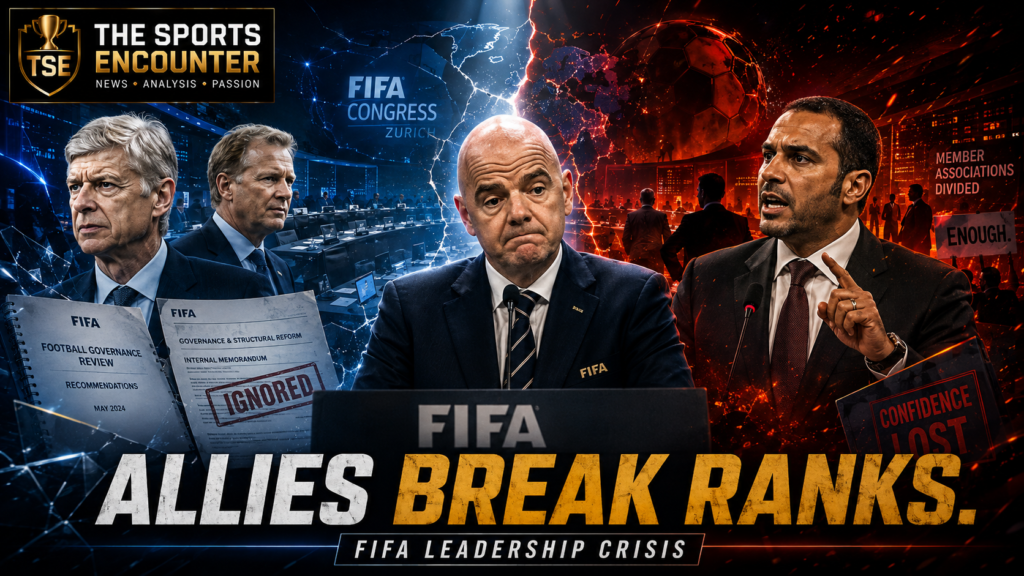
ZURICH, Switzerland, August 5, 2026: Gianni Infantino survived the collapse of his World Cup investment proposal, but the political damage is now spreading through FIFA itself.
Senior officials who might once have been expected to close ranks around the president are creating distance. FIFA Secretary General Mattias Grafstrom has urged employees to remain loyal to the institution rather than individual figures. Arsène Wenger says he had no involvement in the project and supported its withdrawal. Former senior adviser Carlos Cordeiro has already resigned in opposition.
Outside FIFA headquarters, the resistance is becoming more organized. Five European associations have withdrawn support for Infantino’s re-election, Jordan Football Association President Prince Ali bin Al Hussein has accused FIFA of using pressure to secure endorsements, and UEFA is preserving documents as it considers possible legal action.
Infantino still has allies across Africa, Asia and the Middle East. Yet the question is no longer whether his proposed commercial structure will survive. FIFA has permanently abandoned it.
The real contest is now over whether Infantino can retain enough authority to govern FIFA, prevent an Extraordinary Congress and win another presidential term in March 2027.
FIFA Leadership Crisis: Key Facts
| Issue | Latest Development |
|---|---|
| World Cup investment proposal | Infantino withdrew the plan after opposition from major confederations and national associations |
| Capital FIFA sought to raise | Approximately $4.2 billion through a new commercial rights company |
| Proposed investor stake | Roughly 20% of a commercial enterprise reportedly valued near $20 billion |
| Internal FIFA response | Secretary General Mattias Grafstrom sent staff a message acknowledging institutional turmoil |
| Arsène Wenger’s position | He denied involvement and said withdrawal of the proposal was necessary |
| European political response | Five national associations have withdrawn support for Infantino’s re-election |
| Extraordinary Congress threshold | At least 43 of FIFA’s 211 member associations must submit written requests |
| Next presidential election | Scheduled for the FIFA Congress in Morocco in March 2027 |
| Candidate nomination deadline | November 18, 2026 |
The Project Is Dead, but the Crisis Has Changed Form
Infantino withdrew the proposal late on Friday after several days of open conflict across world soccer.
The plan would have created a new commercial company connected to FIFA’s competitions, including the World Cup. Private investors could have acquired a minority stake, giving FIFA an immediate capital injection that reports placed at approximately $4.2 billion.
Opponents feared that the structure would surrender long-term influence over soccer’s most valuable competition, weaken existing governance safeguards and allow private capital to gain a permanent position inside the World Cup’s commercial system.
The Sports Encounter first examined those risks when FIFA and UEFA moved toward direct confrontation over the proposed $20 billion company. What began as an argument about commercial structure soon became a wider dispute over consultation, authority and the limits of presidential power.
UEFA’s response then escalated rapidly. Its 55 national associations unanimously backed a conditional boycott of FIFA competitions unless the proposal was abandoned and safeguards were provided against a similar project returning under another name.
That revolt was followed by criticism from CONCACAF and the Asian Football Confederation. The proposal’s withdrawal ended the immediate threat of a boycott, but it could not restore the relationships damaged during the dispute.
Our previous analysis of why the World Cup stake plan failed identified consultation as the central weakness. Major confederations, senior FIFA officials and other stakeholders said they had been excluded from the process or learned crucial details too late.
That failure now sits at the heart of the leadership crisis. Infantino can argue that the controversial project has been removed. His opponents can respond that the process exposed how FIFA was being governed.
Grafstrom’s Message Draws a Line Between FIFA and Its President
Mattias Grafstrom’s internal communication to FIFA employees may become one of the most consequential developments in the dispute.
As secretary general, Grafstrom is FIFA’s senior administrative executive. His office is responsible for the daily functioning of the organization, implementation of Council decisions and management of the institution’s professional operations.
According to Reuters, Grafstrom described the events leading to the project’s abandonment as sad and reproachable. He encouraged staff to remain focused on serving soccer, FIFA’s 211 member associations and the regulations governing the organization.
Infantino was not named in the message.
That omission does not make the memo neutral. Grafstrom’s emphasis on institutional continuity created a visible separation between FIFA as an organization and the individuals temporarily leading it.
His message effectively reminded employees that presidents, political disputes and unstable periods eventually pass. FIFA’s statutory responsibilities remain.
Such language matters because Infantino has spent a decade building a highly centralized presidency. Public criticism from confederations can be dismissed as political competition. A warning from the secretary general reaches much closer to the center of FIFA’s operating structure.
Grafstrom did not call for Infantino’s resignation or directly accuse him of misconduct. His intervention was more controlled. Staff were urged to protect their professionalism and continue serving the institution despite the turmoil around them.
That is precisely why the memo will attract attention. It suggests FIFA’s administrative leadership is already thinking about how to protect the organization from the consequences of a presidential crisis.
Wenger Says He Learned About the Proposal Through the Media
Arsène Wenger has also moved to protect his position.
FIFA’s Chief of Global Football Development said he had no involvement in the proposed commercial company and learned about it through media reporting. He described the decision to withdraw the project as “absolutely necessary.”
Wenger’s statement carries weight because he is one of FIFA’s most recognizable executives. His role includes technical development, youth programs, coaching policy, competition analysis and advisory work with soccer’s rule-making structures.
His denial raises another governance question. If one of FIFA’s most senior and publicly trusted soccer figures was not consulted on a project capable of changing the World Cup’s commercial ownership structure, how narrow was the decision-making circle?
Wenger’s statement also places him outside that circle. He has aligned himself with the principles of independence, transparency and institutional integrity rather than defending the abandoned proposal.
The former Arsenal manager did not attack Infantino personally. Still, his position reinforces the growing impression that senior FIFA figures are refusing to share responsibility for the project.
Carlos Cordeiro went further. The former United States Soccer Federation president resigned as Infantino’s senior adviser after opposing the plan. The Sports Encounter covered how Cordeiro’s departure and internal criticism turned the commercial dispute into a FIFA revolt.
When senior officials begin documenting their lack of involvement, the political objective is clear. They want the public record to show that the project belonged to a limited group rather than FIFA’s broader leadership.
Jordan’s Prince Ali Accuses FIFA of Pressure and “Blackmail”
The most serious public allegation has come from Prince Ali bin Al Hussein, president of the Jordan Football Association and a former FIFA presidential candidate.
Prince Ali claimed FIFA offered assistance with problems facing Jordanian soccer in exchange for supporting Infantino. He described the alleged approach as blackmail and said Jordan would not endorse the FIFA president.
Reuters reported that FIFA had been contacted for a response to the allegation. No evidence supporting the claim was presented in the report, and it should therefore be treated as an accusation rather than an established fact.
Even with that necessary distinction, the allegation creates another layer of risk for Infantino.
FIFA distributes development funding across 211 member associations. Many smaller federations rely heavily on those funds for training facilities, youth development, women’s soccer, administration, competitions and national-team infrastructure.
That relationship gives the FIFA presidency considerable influence. Funding programs can be presented as mechanisms for global equality, but critics have long argued that they also help presidents build political loyalty among associations with limited independent revenue.
The World Cup commercial proposal reportedly included projected dividends of between $20 million and $40 million for each national association supporting the structure. For wealthier federations, such an offer could be evaluated as one component of a wider commercial debate. For smaller associations, that amount could transform an entire national soccer system.
This is why Prince Ali’s allegation strikes at the most sensitive part of Infantino’s power model. It suggests that financial assistance and political endorsement may have been presented as connected considerations.
FIFA will need to address that claim clearly. A general denial may not be enough if more associations describe similar conversations.
European Federations Start Withdrawing Their Votes
Infantino’s electoral position remains difficult to measure because only a small number of FIFA’s 211 voters have declared firm public positions.
The political direction in Europe, however, is becoming unmistakable.
Five European associations, including England’s Football Association, have formally withdrawn support for Infantino’s re-election. Germany has said it is not endorsing him, while the Netherlands has stated that it will not vote for him. Denmark said it had not planned to support him in the first place.
Those declarations do not yet threaten Infantino’s presidency mathematically. UEFA has 55 member associations, while the election is decided across all six continental confederations.
Their importance lies in momentum. Public withdrawals can make it safer for undecided federations to follow. They also help UEFA demonstrate that its opposition is moving beyond executive statements and becoming a voting campaign.
The Sports Encounter previously reported how UEFA’s boycott position and Cordeiro’s resignation fractured Infantino’s coalition. The latest withdrawals show that abandoning the project did not bring those votes back.
Some federations appear to have concluded that the dispute revealed a leadership problem that cannot be repaired by canceling one proposal.
The German Football Association has called for greater transparency and a different decision-making culture. The Netherlands has moved directly to an electoral position. England’s withdrawal adds another commercially influential association to the opposition.
Infantino now faces the possibility that European resistance will produce a rival candidate rather than another symbolic protest.
UEFA, CONCACAF and the AFC Created a Rare Global Front
UEFA’s challenge became far more dangerous when other confederations joined the criticism.
CONCACAF, which governs soccer in North America, Central America and the Caribbean, issued a strongly worded rejection of the proposed commercial structure. That opposition was especially significant because the confederation had worked closely with FIFA during the 2026 World Cup across the United States, Canada and Mexico.
The Sports Encounter’s report on CONCACAF’s rejection of the World Cup stake plan explained why its intervention changed the balance of the dispute. Infantino could no longer describe the resistance as another familiar struggle between FIFA and Europe.
The AFC stopped short of declaring that it had lost confidence in Infantino, but called the lack of consultation totally unacceptable and demanded institutional reform.
That language was damaging because Asia has been an important component of Infantino’s electoral coalition. Several Asian associations continue to support him, yet the continental leadership has made clear that the proposal crossed a governance line.
Reports have suggested UEFA, CONCACAF and the AFC could paralyze FIFA’s operations or explore alternative competitions if Infantino refuses to leave. Those possibilities remain unconfirmed, and none of the three confederations has publicly announced a coordinated breakaway structure.
Still, The Sports Encounter has already examined what an independent UEFA competition could mean for FIFA’s World Cup authority. The scenario remains difficult, expensive and politically risky, but the fact that it is being discussed shows how far trust has deteriorated.
UEFA has also sent FIFA a document-preservation notice covering materials related to the commercial plan. That step protects emails, presentations, communications and other records that could become relevant if legal proceedings follow.
Preserving documents does not mean a lawsuit is certain. It means UEFA wants to ensure the evidentiary record survives while it considers its options.
Infantino Still Has a Global Coalition
The FIFA president is under serious pressure, but he is not isolated.
Qatar, Kuwait, Lebanon, Sri Lanka, Morocco and Indonesia have publicly supported him. Leading figures within African soccer have also sent messages of backing, although the Confederation of African Football has not adopted a formal collective position.
Morocco’s support carries particular importance. The country will host the March 2027 FIFA Congress and co-host the 2030 World Cup with Spain and Portugal.
Infantino has amplified supportive federation statements through his social media channels, presenting them as evidence that his global coalition remains intact.
That strategy reflects the structure of FIFA elections. Europe may possess the largest clubs, richest domestic leagues and deepest commercial markets, but each FIFA member receives one Congress vote. England and Germany have the same individual voting weight as a small island federation.
Infantino’s power has been built through associations outside Europe, particularly federations that view FIFA development money as essential to their survival and growth.
Our earlier report on Infantino’s efforts to reinforce support among smaller nations showed why the electoral picture remains different from the public-relations picture. Losing UEFA’s confidence is politically damaging, but it does not automatically produce defeat at Congress.
João Havelange and Sepp Blatter also built long-lasting FIFA presidencies by cultivating associations beyond Europe. Infantino has followed a similar model, combining development funding, expanded competitions and direct relationships with federation presidents.
His opponents will therefore need more than criticism. They must offer smaller and less wealthy associations a credible financial and developmental alternative.
The Extraordinary Congress Threshold Is the First Test
Infantino’s immediate objective will be preventing an Extraordinary FIFA Congress.
Under FIFA’s statutes, one-fifth of the member associations can submit a written request for an Extraordinary Congress. With 211 members, the practical threshold is 43 associations.
The request must specify the agenda, and the Congress would need to be held within the period established by FIFA’s governing rules.
Readers can review the organization’s current regulations through FIFA’s official legal documents and statutes portal.
Forty-three is a reachable number if UEFA acts collectively. Europe alone contains 55 voting associations. The harder question is whether all or most of them are prepared to trigger a direct constitutional confrontation.
An Extraordinary Congress would not automatically remove Infantino. Its importance would come from forcing the crisis into FIFA’s formal decision-making system and creating an official forum for motions, accountability demands or leadership challenges.
Infantino will try to prevent that stage from being reached. Meetings with senior staff and federation leaders will likely focus on rebuilding support, limiting further defections and presenting the withdrawal of the proposal as a completed correction.
His opponents will argue that the commercial project was a symptom rather than the whole problem.
The Search for a Credible Challenger Has Become Urgent
Opposition to an incumbent FIFA president means little without an alternative candidate capable of winning votes across multiple continents.
The nomination deadline is November 18, giving Infantino’s opponents little more than three months to identify, vet and unite behind a challenger.
A successful candidate would need to satisfy competing constituencies.
European associations want stronger consultation, transparent governance and protection of the World Cup from private control. Smaller federations will demand guarantees that development funding continues. Africa, Asia, CONCACAF, South America and Oceania will expect meaningful representation rather than a return to European dominance.
The challenger must also answer the practical question that often decides FIFA elections: what will each member association gain?
Criticizing the abandoned investment proposal will not be enough. Any rival must explain how FIFA can increase revenue, fund global development, protect competition ownership and distribute money without creating private influence over the World Cup.
CONCACAF President Victor Montagliani is likely to feature in political speculation because of his administrative experience and his confederation’s role in opposing the proposal. Prince Ali has challenged for the presidency before. Other figures could emerge from UEFA or from a broader reform coalition.
No consensus candidate has been formally announced.
Until one appears, Infantino retains the advantage of incumbency, access, relationships and an established global campaign network.
Why Withdrawing the Plan Did Not End the Revolt
The abandoned proposal is often described as a failed commercial project. That description is now too narrow.
The dispute exposed four deeper problems.
1. Major Stakeholders Were Blindsided
UEFA, CONCACAF, the AFC and senior FIFA figures said they were not properly consulted. A proposal affecting the commercial future of the World Cup required a level of consensus that never existed.
2. Responsibility Became Unclear
Wenger denied involvement. Cordeiro resigned in opposition. Other executives said they had been excluded or misled. As more senior figures step away, the project appears increasingly concentrated around Infantino and a limited group of advisers.
3. Financial Incentives Became Politically Explosive
Reported promises of major dividends to member associations made the proposal attractive to smaller federations. They also created suspicion that financial dependency was being used to secure political support.
4. The Crisis Raised Questions About FIFA’s Institutional Independence
Soccer’s governing body controls competitions that belong to a worldwide sporting ecosystem. Any plan to place private investors inside that structure must meet exceptionally high standards of transparency, consultation and accountability.
The Sports Encounter’s analysis of whether the World Cup was still effectively for sale concluded that even a withdrawn project could leave a lasting governance legacy. The latest developments support that assessment.
What Happens Next?
- Infantino must stop further endorsements from disappearing: Every federation that publicly withdraws support makes additional defections easier.
- FIFA must answer the Jordan allegation: Prince Ali’s accusation requires a clear and factual response.
- UEFA will decide whether to pursue legal action: Its document-preservation notice suggests the legal dimension remains active.
- Opponents must find a presidential candidate: The November 18 nomination deadline is approaching quickly.
- The Extraordinary Congress count will matter: Reaching 43 formal requests would move the crisis into FIFA’s constitutional machinery.
- Africa and Asia could decide the presidency: European opposition alone may not be sufficient to defeat Infantino.
- FIFA staff will watch Grafstrom closely: The secretary general’s handling of the institution could become critical if the leadership crisis deepens.
The Sports Encounter View
Infantino’s greatest problem is no longer the loss of a commercial project. It is the disappearance of collective responsibility around him.
Wenger says he was not involved. Cordeiro resigned because he opposed the plan. Grafstrom has reminded FIFA employees that the institution must outlast individuals and political turmoil. European federations are withdrawing their votes, while three major confederations have challenged the process that produced the proposal.
That pattern leaves Infantino increasingly exposed as the central owner of the failed idea.
His global support network remains strong enough to prevent assumptions about his removal. FIFA elections are decided by 211 associations, many of which have different priorities from UEFA’s wealthiest members. Development funding, access and representation will shape their decisions as much as governance language.
Infantino can still survive this crisis. To do so, he must convince member associations that he has understood why the proposal caused such resistance and that FIFA will operate differently.
A campaign based only on loyalty and financial promises may preserve part of his coalition, but it will also reinforce the criticism now surrounding his presidency.
The World Cup investment plan has disappeared. The struggle it created is moving deeper into FIFA, where executive authority, institutional independence and the future leadership of world soccer are now being contested.
Follow The Sports Encounter’s soccer news and analysis for further developments surrounding the FIFA presidency, confederation politics and the governance of the global game.
FIFA Leadership Crisis FAQs
Why are FIFA officials distancing themselves from Gianni Infantino?
Senior figures have said they were not involved in the abandoned World Cup investment proposal. Their statements suggest the project was developed without broad consultation inside FIFA.
What did Arsène Wenger say about the proposal?
Wenger said he learned about it through media reports, had no role in developing it and supported the decision to withdraw it.
What has Mattias Grafstrom told FIFA staff?
The secretary general urged employees to remain professional, focus on FIFA’s institutional responsibilities and continue serving its 211 member associations despite the political turmoil.
What did Jordan FA President Prince Ali allege?
He accused FIFA of offering assistance in exchange for endorsing Infantino and characterized the alleged approach as blackmail. The allegation has not been independently established.
How many associations are needed to call an Extraordinary FIFA Congress?
A written request from one-fifth of FIFA’s members is required. With 211 associations, at least 43 would need to support the request.
When is the next FIFA presidential election?
The election is scheduled to take place at the FIFA Congress in Morocco in March 2027.
Can UEFA remove Infantino on its own?
No. FIFA’s president is elected by all 211 member associations, with each receiving one vote. UEFA can organize opposition, but a successful challenge requires support across several confederations.
Does Infantino still have international support?
Yes. Federations including Qatar, Kuwait, Lebanon, Sri Lanka, Morocco and Indonesia have publicly backed him, while support has also come from influential African soccer officials.