


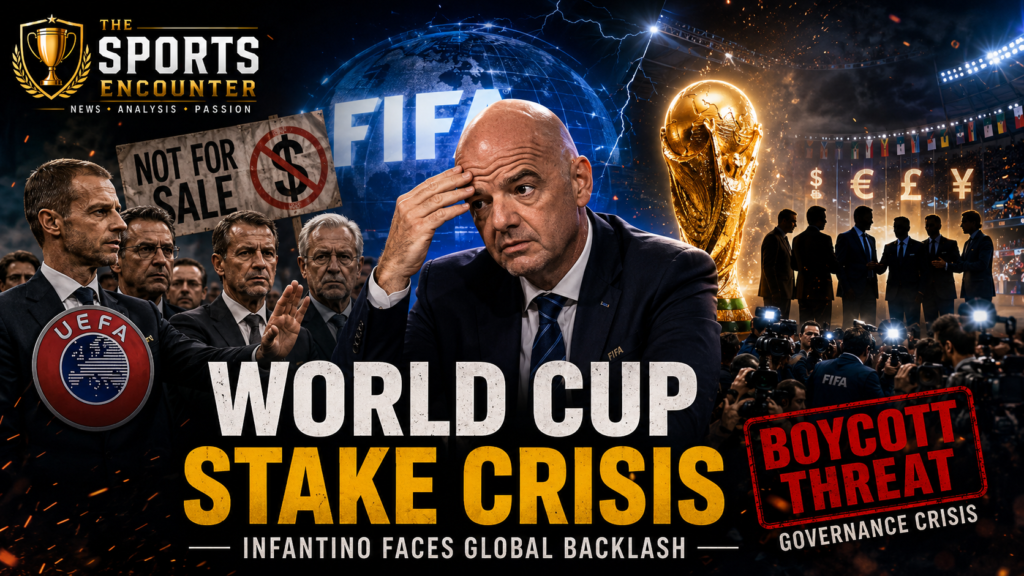
Gianni Infantino’s proposal to bring private investors into a new company built around the World Cup has entered a far more dangerous phase. A senior FIFA adviser has resigned, UEFA’s 55 associations have backed a boycott, and opposition now stretches across Europe, Asia and Concacaf.
The struggle over FIFA’s proposed World Cup investment company is no longer a disagreement about financial structure. It has developed into a direct challenge to Gianni Infantino’s leadership, FIFA’s consultation process and the future ownership model of international soccer.
Carlos Cordeiro, a senior adviser to the FIFA president, resigned with immediate effect after condemning the proposal as harmful to the game. His departure came as UEFA and all 55 of its national associations unanimously agreed that their teams would withdraw from FIFA competitions while the private-investment plan remained alive.
Concacaf has also rejected the proposal. The Asian Football Confederation has expressed solidarity with the opposition and questioned why the confederations were not properly consulted before FIFA presented the model publicly.
The combined resistance matters because UEFA, Concacaf and the AFC represent 143 of FIFA’s 211 member associations. That total is comfortably above the simple majority FIFA says would be required before the proposed company could proceed.
Individual associations could still break from their confederations. Some may also be attracted by the development funding FIFA has linked to the plan. Yet the political landscape has changed rapidly. What began as a commercial proposal now threatens tournaments, alliances, sponsorships, FIFA’s presidential election and the working relationship between the global governing body and its most powerful regional organizations.
The Sports Encounter has followed the controversy from its earliest stage, including the original analysis of the FIFA and UEFA conflict over the $20 billion World Cup investment plan. The latest developments show that the feared global revolt is no longer theoretical.
Key Facts in the FIFA World Cup Stake Crisis
| Issue | Latest Position |
|---|---|
| Proposed company | FIFA Forward Enterprise, a commercial business linked to the World Cup and other FIFA competitions |
| Implied valuation | Approximately $20 billion |
| Planned capital raise | Up to $4.2 billion |
| Potential private stake | Up to approximately 20% |
| Potential lead investor | Thrive Eternal, a fund connected with Thrive Capital |
| FIFA membership | 211 national associations |
| UEFA position | All 55 associations voted to boycott FIFA competitions while the proposal remains active |
| Concacaf position | Proposal rejected by the confederation and its 41 associations |
| AFC position | Opposes the process and stands with UEFA and Concacaf |
| Associations represented by UEFA, Concacaf and AFC | 143 |
| Key resignation | Carlos Cordeiro resigned as senior adviser to Gianni Infantino |
| FIFA’s response | Consultation will continue and no subsidiary will be created without majority support |
| Decision deadline linked to enhanced funding | September 19, 2026 |
Carlos Cordeiro’s Resignation Changes the Nature of the Crisis
External criticism of FIFA is common. Internal protest from someone appointed to help shape the organization’s future carries a different kind of weight.
Carlos Cordeiro joined Infantino’s advisory structure in 2021. He previously worked in banking and served in senior leadership roles within the United States Soccer Federation. His professional background makes his objection especially relevant because the dispute centers on valuation, investment, control and long-term commercial obligations.
Cordeiro said he had no role in developing the proposal and opposed it unequivocally. He described the transaction as a bad deal for FIFA’s member associations, for soccer and for the game’s long-term future. His most damaging criticism was that FIFA appeared ready to mortgage the future of the sport without presenting a compelling justification.
The resignation weakens FIFA’s effort to frame opposition as a reaction driven mainly by European institutional rivalry. UEFA and FIFA have fought over calendars, club competitions, political control and commercial influence for years. Critics of UEFA can therefore argue that its objections contain an element of self-interest.
Cordeiro’s decision is harder to dismiss in those terms. He worked close to Infantino, understood FIFA’s internal direction and had professional experience in the financial world. His departure suggests that concerns also exist within FIFA’s broader leadership circle.
The exact internal approval path remains one of the central unanswered questions. Confederations have asked whether the FIFA Council, relevant committees and other governance bodies received sufficient time, documentation and authority to evaluate the proposal before it entered public discussion.
FIFA says inaccurate reporting interrupted the consultation process it had planned. That explanation may account for some confusion around the proposal, but it does not fully answer why several confederations say they were surprised by a project of such scale.
What FIFA Forward Enterprise Would Actually Do
FIFA has proposed forming a new commercial enterprise that would manage opportunities connected with the World Cup and other FIFA tournaments.
The official FIFA Forward Enterprise information page presents the project as a way to unlock new capital, expand development funding and allow FIFA’s members to participate more directly in soccer’s global commercial growth.
The proposed business has been discussed at an implied valuation of approximately $20 billion. FIFA could raise up to $4.2 billion in initial capital, with outside investors receiving a minority ownership interest.
FIFA argues that the money would strengthen development programs and widen access to the commercial success created by its tournaments. The organization insists that private investors would not control FIFA, sporting rules, tournament formats, match decisions or the governance of the World Cup.
Under FIFA’s presentation, investors would acquire an interest in a commercial vehicle rather than ownership of soccer itself. The governing body also says that net benefits generated by the enterprise would return to the game.
That distinction sits at the center of FIFA’s defense.
Opponents believe the separation looks much cleaner on paper than it would in practice. A private investor does not need formal control over sporting rules to influence priorities. The requirement to generate returns can shape scheduling, broadcasting, sponsorship, hospitality, ticketing, tournament expansion and the number of commercially valuable matches.
The Sports Encounter previously examined those risks in its analysis of why selling a stake connected with the World Cup could damage the competition.
UEFA’s 55-0 Vote Gives the Opposition Real Power
UEFA’s emergency vote transformed the controversy from a governance dispute into a potential sporting rupture.
All 55 European associations backed the position that their national teams would not participate in FIFA competitions while the proposal remained active. UEFA also demanded binding assurances that FIFA would not reopen its competitions to private ownership through a similar structure later.
The official UEFA statement on the FIFA investment proposal argues that the World Cup cannot be treated as an ordinary investment product. Europe’s governing body believes that private ownership would create a permanent commercial obligation capable of reshaping the priorities behind international competitions.
The Sports Encounter reported the full significance of the UEFA 55-0 vote to boycott FIFA tournaments when the decision emerged.
A boycott involving Europe would have immediate consequences because European teams dominate both the men’s and women’s international game. Spain won the 2026 men’s World Cup, while six of the top 10 teams in both the men’s and women’s rankings were European when the dispute erupted.
UEFA’s position could affect the 2027 Women’s World Cup in Brazil, youth tournaments, futsal competitions, beach soccer and qualification structures connected with future senior World Cups.
The next immediate test is the Women’s Under-20 World Cup scheduled for September. Host nation Poland said it had not received formal information indicating that teams would withdraw. That gives FIFA and UEFA a limited window to find a temporary arrangement before the institutional dispute reaches the field.
Could Europe Really Walk Away From the World Cup?
A boycott threat carries enormous force, but carrying it out would create legal, financial and sporting complications for both sides.
European associations have commercial contracts, sponsor obligations, broadcasting arrangements and commitments to players and supporters. Their national teams also depend on FIFA tournaments for prestige and revenue.
FIFA would lose much of the competitive and commercial value of its events without Europe. A World Cup without Spain, England, France, Germany, Portugal, Italy, the Netherlands and other major European teams would struggle to retain the same global stature.
Both institutions would suffer. That reality creates room for negotiation, but it does not make UEFA’s threat empty.
The unanimity of the vote matters. FIFA cannot easily isolate one federation, apply individual pressure or portray the rebellion as the project of a small political faction. Europe’s associations have publicly tied their participation to the complete withdrawal of the proposal.
The dispute has also encouraged discussion about whether UEFA could eventually create a rival global competition. The Sports Encounter explored that scenario in its report asking whether UEFA could organize its own version of the World Cup.
A breakaway tournament would be exceptionally difficult to build. It would require broadcast agreements, sponsors, venues, player release rules and participation from countries outside Europe. The fact that serious observers are discussing such an outcome shows how badly relations have deteriorated.
Concacaf’s Rejection Removes FIFA’s Easiest Defense
Concacaf’s opposition carries unusual significance because the United States, Canada and Mexico had just hosted the expanded 2026 World Cup.
The tournament delivered FIFA a major commercial platform and brought the governing body closer to North American investors, sponsors, broadcasters and political figures. A rejection from the region therefore cannot be explained as European resistance to growing American influence.
Concacaf and its 41 associations cited concerns about due process, governance, the short timetable and the absence of sufficient review by FIFA’s established decision-making bodies.
The official confederation statement said the proposal had been rejected and instructed Concacaf representatives on the FIFA Council to examine whether FIFA’s existing reserves could support increased development funding without introducing private ownership.
The Sports Encounter has covered the full regional response in its analysis of Concacaf’s rejection of the World Cup stake plan.
That alternative funding question may become increasingly important. FIFA has presented outside investment as a route toward unprecedented development support. Opponents want to know whether the organization could deliver more money through current reserves, future tournament revenue or a revised distribution system.
Mexico’s federation has indicated that it wants to review the documents before fixing its final position. This shows that a confederation-level statement may not guarantee identical voting behavior from every association.
The AFC Response Shows the Backlash Has Gone Global
The Asian Football Confederation has traditionally maintained a less confrontational public relationship with FIFA than UEFA. Its criticism therefore represents another significant warning for Infantino.
AFC President Sheikh Salman bin Ebrahim Al-Khalifa said the confederation had not been consulted at any stage before the public announcement. He also criticized the absence of detailed legal, financial and governance analysis.
The AFC stopped short of announcing a boycott, but it expressed solidarity with UEFA and Concacaf and questioned whether any plan could succeed without the backing of all six regional confederations.
Asia’s 47 associations include some of FIFA’s most important development constituencies and several commercially powerful soccer markets. Their votes could determine whether Infantino retains enough support to continue the project.
Africa, South America and Oceania now occupy pivotal positions. The Confederation of African Football planned to evaluate the proposal, while CONMEBOL had yet to establish a public collective position. Oceania’s smaller bloc also planned to discuss the matter.
FIFA may focus its lobbying on those regions, where the promise of development money could carry greater immediate weight than UEFA’s broader arguments about ownership and institutional principle.
The $40 Million Question Facing Member Associations
One of the most controversial elements of the proposal involves the amount of money potentially available to FIFA members.
Infantino reportedly informed associations that each could receive a total package worth up to $40 million if the proposal gained approval by September 19. That figure appears to combine increased FIFA Forward funding with an opportunity to access one-off capital through the new structure.
FIFA’s official announcement describes an increase in available development funding and an opportunity for each association to participate in a program connected with the proposed enterprise.
The financial attraction is obvious. For a smaller national association, tens of millions of dollars could fund training centers, women’s soccer, youth academies, coaching programs, domestic competitions and national-team travel for years.
Critics believe the offer creates an unhealthy incentive. Associations are being asked to evaluate a permanent structural change while considering a major short-term financial benefit. The September deadline also gives them limited time to conduct independent legal and financial analysis.
FIFA rejects the idea that the process is coercive. Participation would be voluntary, and each association would receive an opportunity to review and vote on the proposal.
The tension lies between legal freedom and practical pressure. An association can technically vote no, but its leaders must then explain why they declined funding that could transform domestic soccer.
Why Private Minority Ownership Still Creates Influence
FIFA has repeatedly emphasized that external investors would hold only a minority interest and would not gain control over the sport.
Minority ownership, however, does not mean absence of influence.
Major investors typically negotiate information rights, board representation, financial protections, approval rights over important transactions and agreed expectations for growth. Even without controlling FIFA’s laws, they could have a meaningful interest in decisions affecting revenue.
Commercial pressure could emerge in several areas:
- Expanding tournaments to create more matches and inventory
- Moving fixtures into high-value television windows
- Increasing premium hospitality and ticket prices
- Adding sponsorship categories and commercial breaks
- Changing tournament frequency
- Prioritizing host markets with greater commercial returns
- Creating new digital products and subscription services
- Packaging historical footage, data and licensing rights
None of these decisions would automatically destroy the World Cup. Many forms of commercial expansion have helped globalize the game and finance development.
The concern involves accountability. FIFA is governed through national associations and exists as the custodian of international soccer. An investor answers to financial stakeholders. Those duties can coexist for a time, but they can also move in different directions.
The 2026 World Cup Made FIFA’s Commercial Asset More Valuable
The timing of the proposal is important.
FIFA introduced the plan shortly after the expanded 2026 World Cup in the United States, Canada and Mexico. Spain defeated Argentina in the final after a tournament that delivered enormous attention, television demand and sponsorship opportunities.
The Sports Encounter’s report on Spain’s World Cup final victory over Argentina captured the sporting climax of the competition.
Commercial evidence soon followed. The final attracted a reported U.S. audience of nearly 63 million across English-language and Spanish-language coverage. That record audience reinforced the World Cup’s ability to expand in one of the most valuable sports media markets.
More details are available in The Sports Encounter’s analysis of how the 2026 World Cup final confirmed soccer’s growth in the United States.
From an investment perspective, FIFA was presenting a stake in a commercial asset immediately after demonstrating its global reach and North American growth potential.
Opponents see the same moment differently. They believe FIFA is attempting to monetize a public sporting institution at the point of maximum valuation.
Thrive Eternal and the Political Optics Around the Plan
FIFA identified Thrive Eternal as the expected leader of the proposed investor group. The fund is operated by Thrive Capital, founded by Joshua Kushner.
Joshua Kushner is the brother of Jared Kushner, the son-in-law of U.S. President Donald Trump. That connection has intensified scrutiny around the proposal, even though family and political links do not establish misconduct.
The World Cup has always intersected with politics, state power and major business interests. Host selection, stadium construction, sponsorship and diplomatic access all involve governments and wealthy organizations.
FIFA nevertheless needs to explain how investors were identified, what bidding or valuation process occurred, which advisers participated and how conflicts of interest would be managed.
A transparent competitive process could answer some concerns. A structure developed through limited internal discussion would deepen them.
FIFA Says It Is Not Selling Football
FIFA has responded firmly to the backlash.
The organization says nobody is selling soccer and that private investors would not control FIFA’s competitions or governance. It has accused some reports of creating confusion before member associations could evaluate the facts.
FIFA also argues that no confederation can claim to speak for all 211 associations. Under its democratic structure, every national federation should have the right to review the model and decide independently.
That position is constitutionally important. FIFA is a federation of national associations rather than a federation of six confederations. UEFA, Concacaf and the AFC can establish regional policy, but the ultimate FIFA vote belongs to individual members.
FIFA has also promised that the enterprise will not be established without majority support.
The organization’s defense therefore rests on four claims:
- The project would unlock historic development funding.
- Private investors would not control soccer or FIFA’s sporting decisions.
- Every national association would receive a vote.
- The plan would proceed only with majority approval.
Those arguments deserve serious examination. Development funding has helped many smaller associations build infrastructure and create opportunities that domestic revenue could never support.
The unresolved issue is whether the financial benefits require the proposed ownership structure and whether members received enough information to assess the long-term cost.
Infantino’s Leadership Is Now Part of the Story
Cordeiro’s resignation and the confederation backlash have turned the proposal into a judgment on Infantino’s presidency.
British political figures have openly questioned whether he should continue leading FIFA. Infantino is expected to seek reelection, while Concacaf President Victor Montagliani has been mentioned as a possible challenger.
A contested FIFA election would give the investment crisis an immediate political channel. Associations could use the vote to express their opinion about governance, consultation and FIFA’s commercial direction.
Infantino has built much of his support by increasing distributions to member associations and expanding global participation. A private-capital plan offering additional funds fits that broader strategy.
His opponents will argue that the same model has concentrated too much power around the presidency and encouraged associations to evaluate governance decisions through the amount of money available.
The result could depend on whether members view Infantino as the leader who expanded soccer’s resources or the executive who pushed commercialization beyond an acceptable boundary.
What Happens If UEFA Activates the Boycott?
| Area | Possible Impact |
|---|---|
| Youth World Cups | European teams could withdraw first because these tournaments arrive before the next senior World Cup cycle |
| 2027 Women’s World Cup | The tournament could lose leading teams, including major European contenders |
| 2030 Men’s World Cup | Spain and Portugal are co-hosts, creating an extraordinary conflict between FIFA and host associations |
| Sponsors | Brands could demand clarity over reduced participation and audience value |
| Broadcasters | Rights agreements could face disputes if elite European teams are absent |
| Players | Leading athletes could lose access to major international tournaments through no decision of their own |
| Domestic leagues | Calendars could change if FIFA windows and qualification events collapse |
| FIFA election | The crisis could strengthen calls for a challenger to Infantino |
Five Possible Outcomes From the World Cup Ownership Crisis
1. FIFA Withdraws the Proposal
The simplest path would involve FIFA suspending or abandoning the enterprise. UEFA would then need to decide whether FIFA’s assurances met its demand for permanent protection against private ownership.
2. FIFA Revises the Structure
A modified plan could remove equity ownership and replace it with debt financing, commercial partnerships, revenue-sharing agreements or bonds. That approach might generate capital without giving investors an ownership interest.
3. Member Associations Reject the Plan
FIFA could proceed with consultation and allow the proposal to fail through a formal vote. This would preserve the democratic process but expose the depth of opposition to Infantino.
4. Associations Break From Their Confederations
Some national federations may support the proposal despite regional opposition. The result could divide UEFA, Concacaf or the AFC internally, although UEFA’s unanimous boycott vote currently suggests strong European discipline.
5. The Dispute Produces a Lasting Split
The most damaging scenario would involve UEFA carrying out its boycott while FIFA continues pursuing private investment. Rival tournaments, legal action and competing international calendars could follow.
Why Fans and Players Have a Stake in This Decision
The debate may appear technical because it involves corporate valuation, minority ownership, governance procedures and development funding.
Its consequences would reach the field.
Players could face more matches if investors seek additional inventory. Supporters could encounter higher ticket prices and more premium products. Broadcasters may receive greater influence over kickoff times. Host selection could become increasingly tied to commercial potential.
FIFPRO has warned that changing the ownership incentives behind FIFA competitions could reshape the tournaments in which players build their careers.
Supporters’ groups have also argued that soccer’s value comes from players, fans, clubs and communities rather than from FIFA alone. Under that view, FIFA administers the World Cup but does not possess an unrestricted moral right to monetize its future commercial value.
The governance question therefore reaches beyond legal ownership. It asks who has the authority to make irreversible decisions about a competition built over nearly a century.
The Central Problem Is Trust
FIFA may have legitimate commercial reasons for exploring outside capital. A major investment could accelerate infrastructure, digital innovation and development across countries with limited resources.
The opposition has grown because stakeholders do not trust the process.
Confederations say they were not consulted. A senior adviser says he had no involvement. Member associations reportedly face a short deadline linked to a major financial benefit. Governance and legal documents have not yet satisfied influential regional bodies.
Those concerns create the impression that FIFA developed the destination before building collective agreement around the journey.
Trust cannot be restored through slogans about democratization or claims that critics misunderstand the proposal. FIFA needs to publish the valuation methodology, investor rights, governance protections, risk analysis, decision process and long-term financial projections.
UEFA must also explain how it would protect players and fans if its boycott became real. Defending the soul of the game carries less meaning if national teams and supporters become collateral damage in an institutional power struggle.
Final Verdict
Carlos Cordeiro’s resignation has made Gianni Infantino’s World Cup investment proposal much harder to defend as a misunderstood financial initiative.
UEFA has backed its opposition with a unanimous boycott vote. Concacaf has rejected the plan despite its close connection to the commercially successful 2026 World Cup. The AFC has criticized the lack of consultation and joined the broader resistance.
Together, those confederations represent enough associations to defeat the proposal if their members maintain a common position.
FIFA still has a case to make. More development funding could transform soccer in countries that lack facilities, coaching resources and sustainable competitions. Minority investment does not automatically mean investors would control the World Cup.
The burden of proof now rests with FIFA.
Infantino must show why outside equity is necessary, how investors would be prevented from shaping sporting priorities and why confederations learned about the project without the level of consultation they expected.
The World Cup derives its value from generations of players, supporters and national teams. Any decision involving its long-term commercial ownership requires more than a majority assembled through financial incentives and a compressed deadline.
FIFA says it is not selling soccer. Its opponents believe the proposed structure would place part of the game’s future under a permanent obligation to private capital.
That disagreement now threatens to remove Europe from FIFA competitions, divide the global governing system and define the next FIFA presidential election.
Infantino’s World Cup selloff plan has reached the point where compromise may still be possible, but delay carries growing risk. The next decision will determine whether FIFA remains the unquestioned center of international soccer or becomes one side of a global institutional split.
Frequently Asked Questions
What is FIFA Forward Enterprise?
FIFA Forward Enterprise is a proposed commercial company connected with the World Cup and other FIFA competitions. FIFA says the business would raise capital, expand development funding and create new commercial opportunities for its 211 member associations.
Is FIFA selling the World Cup?
FIFA says it is not selling the World Cup or giving investors control over soccer. Opponents argue that selling an ownership interest in a commercial company built around FIFA competitions would still create lasting investor influence and financial obligations.
How much is the proposed FIFA company worth?
The proposed enterprise carries an implied valuation of approximately $20 billion. FIFA has discussed raising up to $4.2 billion through an initial capital transaction.
How large a stake could private investors receive?
Reports indicate that outside investors could receive a minority interest of up to approximately 20%, depending on the final amount raised and agreed valuation.
Why did Carlos Cordeiro resign?
Cordeiro resigned as a senior adviser to Gianni Infantino because he opposed the proposed transaction. He called it a bad deal for FIFA’s members and the long-term future of soccer and said he had not participated in developing it.
Why has UEFA threatened to boycott FIFA tournaments?
UEFA believes FIFA competitions should never carry private ownership interests. Its 55 associations unanimously agreed that their teams would stay out of FIFA tournaments while the proposal remained active and until FIFA provided binding assurances against similar future plans.
Would the UEFA boycott include the World Cup?
UEFA’s statement refers to FIFA competitions generally, which would include senior and youth World Cups if the dispute remained unresolved. The timing and implementation of any withdrawal would still require practical and legal decisions.
Which confederations oppose FIFA’s proposal?
UEFA and Concacaf have formally rejected the proposal. The AFC has expressed solidarity with their opposition and criticized FIFA’s consultation process. Africa, South America and Oceania remain important to the final balance of support.
Can UEFA, Concacaf and the AFC block the plan?
The three confederations contain 143 of FIFA’s 211 associations. They could defeat the proposal if their individual members voted together. National associations retain their own FIFA votes, however, and some could depart from their regional position.
How much money could FIFA member associations receive?
The wider funding proposal has been described as offering each association access to a package worth up to $40 million through increased development funding and potential one-off capital. The exact structure and eligibility conditions require careful review.
Who is expected to invest in FIFA Forward Enterprise?
Thrive Eternal, a fund operated by Thrive Capital, has been identified as the expected leader of the proposed investor group. The final investor lineup has not been publicly completed.
Will private investors control FIFA?
FIFA says they will not control the organization, tournament rules or sporting decisions. Critics want stronger information about voting rights, board representation, approval powers and the commercial influence investors could exercise.
What happens next?
FIFA plans to continue consulting its 211 member associations. Confederations will hold further meetings, national federations will study the documents, and pressure will grow ahead of the September 19 deadline connected with the proposed funding package.